
Kirjahaku
Etsi kirjoja tekijän nimen, kirjan nimen tai ISBN:n perusteella.
1000 tulosta hakusanalla Julia K Duncan

Doris Force at Locked Gates Or Saving a Mysterious Fortune
Julia K Duncan
ALPHA EDITION
2021
pokkari
Doris Force at Locked Gates Or Saving a Mysterious Fortune, is many of the old classic books which have been considered important throughout the human history. They are now extremely scarce and very expensive antique. So that this work is never forgotten we republish these books in high quality, using the original text and artwork so that they can be preserved for the present and future generations. This whole book has been reformatted, retyped and designed. These books are not made of scanned copies of their original work and hence the text is clear and readable.

Doris Force at Locked Gates: Or Saving a aMysterious Fortune
Julia K. Duncan
Createspace Independent Publishing Platform
2014
nidottu
Concise Guide to Child and Adolescent Psychiatry
Mina K. Dulcan; Rachel R. Ballard; Poonam Jha; Julie Sadhu
American Psychiatric Association Publishing
2017
nidottu
Much like the patients on which it focuses, the field of pediatric mental health continues to grow and develop. Among other advances, the body of clinical research and the number of empirically supported treatments have grown, evaluation practices have been refined, and awareness of emotional and behavioral problems in youth has increased. Stay up-to-date on significant DSM-5 changes to psychiatric nomenclature and criteria—and the developments that have spurred them—with the Concise Guide to Child and Adolescent Psychiatry.,br>This fifth edition prunes older content while distilling and incorporating clinically relevant findings, and features:Reorganized diagnostic chapters that reflect updates to DSM-5Tables of selected diagnostic criteria from DSM-5 for quick referenceRelevant treatment methods for each section on a specific disorder or clinical situationAn informative chapter dedicated to pharmacological treatments—from stimulant medications and antidepressants to antipsychotics and anticonvulsantsSuggested additional readings for those interested in learning more about particular topicsRecommended published and on-line information resources for parentsAn indispensable primer on child and adolescent psychiatry for medical and mental health students and clinical trainees, this guide also serves as an ideal, quick-reference update for practicing physicians, nurses, and advanced practice nurses.Complex theoretical notions, new research, and areas of controversy have been simplified in the interest of brevity and ease of reference, making this a useful resource for professionals in special education, child welfare, and juvenile justice, as well as parents.

Studienarbeit aus dem Jahr 2007 im Fachbereich Ethik, Note: 2,0, Albert-Ludwigs-Universit t Freiburg, Sprache: Deutsch, Abstract: Inhaltsverzeichnis: 1. Einleitung 1.1 Zum Begriff der Eugenik und seiner begrifflichen Systematik 2. Pr implantationsdiagnostik (PID) und Pr nataldiagnostik (PND) 2.1 Problemfelder der PND 2.2 Problemfelder der PID 2.2.1 Positionen in der bioethischen Debatte um den Status des Embryos 2.2.2 Unterschiede zwischen einer Legalisierung der PID und der des Schwangerschaftsabbruchs 2.2.3 Die Debatte um die Legalisierung der PID 2.2.4 Ist die PID der Weg zu einer neuen Art der Eugenik? 2.2.5 Die ethische Einschr nkung der Person in Folge der PID oder der Keimbahntherapie 3. Keimbahnmanipulation - eine neue Vision zur Umprogrammierung des Lebens? 4. Fazit

During the Soviet Union's Great Patriotic War, from 1941 to 1945, as many as 24 million of its citizens died. 14 million were children ages fourteen or younger. And for those who survived, the suffering was far from over. The prewar Stalinist vision of a ""happy childhood"" nurtured by a paternal, loving state had given way, out of necessity. What replaced it--the dictate that children be prepared to sacrifice everything, including childhood itself--created a generation all too familiar with deprivation, violence, and death. The experience of these children, and the role of the state in shaping their narrative, are the subject of this book, which fills in a critical but neglected chapter in the Soviet story and in the history of World War II. In Sacrificing Childhood, Julie deGraffenried chronicles the lives of the Soviet wartime children and the uses to which they were put--not just as combatants or workers in factories and collective farms, but also as fodder for propaganda, their plight a proof of the enemy's depredations. Not all Soviet children lived through the war in the same way; but in the circumstances of a child in occupied Belarus or in the Leningrad blockade, a young deportee in Siberia or evacuee in Uzbekistan, deGraffenried finds common threads that distinguish the child's experience of war from the adult's. The state's expectations, however, were the same for all children, as we see here in children's mass media and literature and the communications of party organizations and institutions, most notably the Young Pioneers, whose relentless wartime activities made them ideal for the purposes of propaganda. The first in-depth study of where Soviet children fit into the history of the war, Sacrificing Childhood also offers an unprecedented view of the state's changing expectations for its children, and how this figured in the nature and direction of post-war Soviet society.

Law, Religion, and Public Policy provides a timely examination of the impact of First Amendment jurisprudence about religion on American public policy. It offers historical and analytical insight into two centuries of judicial thinking on the meaning of the First Amendment and explores the prevailing religious freedom theories used by the judiciary to interpret the Constitution's religious clauses. Through studies of education and welfare policy, Julia Stronks reveals the continuing struggle to separate belief systems and government decision-making. This work is a superb addition to the discussion of the legal profession's understanding of religious beliefs and the ever shifting balance between faith and politics in a liberal democracy.

The struggles and achievements of forty-six notable women artists of the early modern period, as documented by their contemporaries, are uniquely brought together in this anthology. The life stories presented here are foundational texts for the history of art, but since most are found only in rare volumes and few have been translated into English, until now they have been generally inaccessible to many scholars. Originally published in biographical compendia such as Vasari's Lives of the Artists, the writings included here document not only the lives of relatively well known women artists such as Artemisia Gentileschi and Sofonisba Anguissola, but also those who have languished in obscurity, like Anna Waser and Li Yin. Each life story is preceded by a brief introduction to the artist as well as to her biographer, and the texts themselves are annotated to provide necessary clarification. Beyond their documentary value, these stories provide fascinating insight as to how men commonly characterized women artists as exceptions to their sex, and attempted to explain their presence in the male-dominated realm of art. The introductory chapter to the book explores this intriguing gender dynamic and elucidates some of the strategies and historical context that factored into the composition of these lives. The volume includes an appended index to women artists' life stories in biographical compendia of the period

Child Training in the Light of Theosophy, 1927
Julia K. (EDT) Sommer; R. K. (EDT) Kulkarni
Kessinger Pub
2003
pokkari

Christian Teachers in Public Schools – A Guide for Teachers, Administrators, and Parents
Julia K. Stronks; Gloria Goris Stronks
Baker Books, a division of Baker Publishing Group
1999
nidottu
If Christian teachers in public schools are often unsure how to relate their faith to their work. How can I teach Christian values without Christianity as a foundation? How can my faith influence my teaching? What can I say in the classroom? Or after class? Christian Teachers in Public Schools provides an invaluable resource for Christian teachers faced with such questions. offers: * a discussion of how to plan curriculum in ways that stay true to one's faith * an overview of the legal aspects of religion and the public schools * ways to teach Christian values in a multicultural community * practical guidance for applying the law to the classroom * testimony and advice from numerous Christian teachers in state-sponsored schools Teachers, administrators, prospective teachers, and parents who wish to learn more about public schooling and the Christian faith will find this a thought-provoking book.
Something other than a memoir of a life well lived, Body Story conveys Julia K. De Pree’s troubling journey from adolescence to adulthood and from anorexia to health. For De Pree, between being a girl and being a woman, there was starvation. Body Story is her intimate account of girlhood, virginity, anorexia, and motherhood. De Pree’s prose is spare and unguarded, revealing in vivid flashbacks and poignant vignettes the sources of her inner pain. In high school, the five-foot-ten De Pree weighed as little as 114 pounds. She was too weak to raise her arms above her head. “In a paradoxical way, I starved my body in order to understand my life,” she writes. “I had to place my body in suspension before I could move physically into sexuality. Starving allowed me to create an interim space between innocence and experience.” De Pree renders the starkness of anorexia along with the process of recovery, relapse, and, ultimately, redemption. She also tells the story of the physical landscape, from her origins in the Midwest to the American South, Paris, and the vast New Mexican desert, as well as the psychic landscape of her body as it encounters the joys and challenges of maturation, childbirth, and motherhood. De Pree offers readers a new way of understanding women’s bodily experience, as she writes about the mystery and the meaning of her illness. As many as eight million Americans suffer from eating disorders. Body Story, unlike clinical reports or news accounts, illuminates the complexity of anorexia as the narrative moves toward a subjective and deeply personal truth. This evocative and often radiant vision is a unique window into womanhood and selfhood in middle-class, contemporary America.

Something other than a memoir of a life well lived, Body Story conveys Julia K. De Pree's troubling journey from adolescence to adulthood and from anorexia to health. For De Pree, between being a girl and being a woman, there was starvation. Body Story is her intimate account of girlhood, virginity, anorexia, and motherhood. De Pree's prose is spare and unguarded, revealing in vivid flashbacks and poignant vignettes the sources of her inner pain. In high school, the five-foot-ten De Pree weighed as little as 114 pounds. She was too weak to raise her arms above her head. "In a paradoxical way, I starved my body in order to understand my life," she writes. "I had to place my body in suspension before I could move physically into sexuality. Starving allowed me to create an interim space between innocence and experience." De Pree renders the starkness of anorexia along with the process of recovery, relapse, and, ultimately, redemption. She also tells the story of the physical landscape, from her origins in the Midwest to the American South, Paris, and the vast New Mexican desert, as well as the psychic landscape of her body as it encounters the joys and challenges of maturation, childbirth, and motherhood. De Pree offers readers a new way of understanding women's bodily experience, as she writes about the mystery and the meaning of her illness. As many as eight million Americans suffer from eating disorders. Body Story, unlike clinical reports or news accounts, illuminates the complexity of anorexia as the narrative moves toward a subjective and deeply personal truth. This evocative and often radiant vision is a unique window into womanhood and selfhood in middle-class, contemporary America.

This personal and provocative look at poverty in America is shaped around the author's own engaging stories, song lyrics, and poems, including the well-known "Call Me Child of God ...Not Those People". The story of her growing up in a large Irish Catholic working-class family in Minneapolis, Minnesota, draws together the experiences of living in poverty, the role of the church and music in her life, and the many remarkable people who populated her life and the lives of her family.
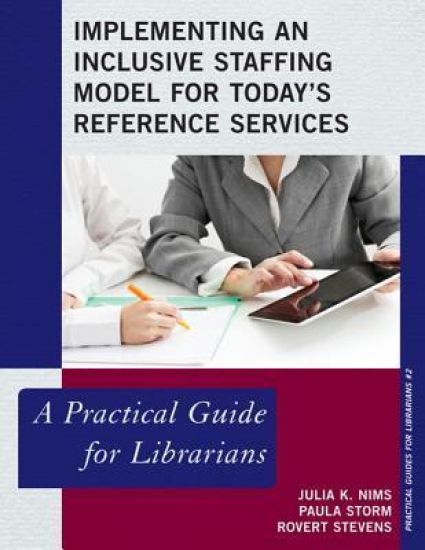
Implementing an Inclusive Staffing Model for Today's Reference Services
Julia K. Nims; Paula Storm; Robert Stevens
Rowman Littlefield Publishers
2013
nidottu
Reference service remains a core function of modern libraries. However, how and where we provide assistance has evolved with changing technologies and the shifting habits and preferences of our users. One way libraries can provide the on-demand, in-person assistance while managing and developing new services and resources that will benefit current and future users is to reconsider how their reference points and services are staffed and adopt a staff-based reference model. The authors, staff members at Eastern Michigan University, chose to address this by implementing an inclusive reference model in which staff and student assistants are trained to answer certain levels of reference questions while working at the reference desk and at other service points. The result was that librarians became more available to work with students who needed in-depth assistance and users were able to get simple questions answered throughout the library. Similar training for all staff and student assistants who work in the library results in better service, more accurate answers, and improved interdepartmental communication. In Implementing an Inclusive Staffing Model for Today's Reference Services, they describe step-by-step how to transition from the traditional librarian-staffed reference desk to an inclusive reference model where non-MLS personnel are equipped and empowered to answer reference questions wherever these questions might be asked. Users ask questions of staff at all service points, not just at the Reference Desk. It is vitally important that those who work at circulation, periodicals, maps, archives and other public service points be trained in how to answer certain reference questions. When this is accomplished, users who have simple questions will not have to make useless treks to the Reference Desk. Topics covered include: ·Recognizing that nearly all staff answer reference questions, but few are trained to do so ·documenting the necessity for a change in reference model ·gaining buy-in from all interested parties—librarians, non-MLS staff, and administrators ·determining the optimal staffing level ·creating training materials and schedules ·monitoring the quality of reference service ·supervising staff ·evaluating the new model using multiple methods Additionally, each chapter contains practical resources such as checklists, forms, and sample materials, and other usable features to support readers as they implement the inclusive reference model. The book describes in detail the process of transforming traditional reference into a model that transcends departmental and job title boundaries, is focused on the user, and allows librarians to better utilize their time and talents, and include non-professional staff in their reference services.

Mirror of Morality takes an interdisciplinary look at an important form of pictorial art produced during two millennia of Chinese imperial rule. Ideas about individual morality and state ideology were based on the ancient teachings of Confucius with modifications by later interpreters and government institutions. Throughout the imperial period, members of the elite made, sponsored, and inscribed or used illustrations of themes taken from history, literature, and recent events to promote desired conduct among various social groups. This dimension of Chinese art history has never before been broadly covered or investigated in historical context. The first half of the study examines the nature of narrative illustration in China and traces the evolution of its functions, conventions, and rhetorical strategies from the second century BCE through the eleventh century. Under the stimulus of Buddhism, sophisticated techniques developed for representing stories in visual form. While tracing changes in the social functions and cultural positions of narrative illustration, the second half of the book argues that narrative illustration continued to play a vital role in elite visual culture.

Solarpunk is a type of optimistic science fiction that imagines a future founded on renewable energies. The seventeen stories in this volume are not dull utopias--they grapple with real issues such as the future and ethics of our food sources, the connection between technology and nature, and the interpersonal conflicts that arise no matter how peaceful the world is. In these pages you'll find a guerilla art installation in Milan, a murder mystery set in a weather manipulation facility, and a world where you are judged by the glow of your solar nanite implants. From an opal mine in Australia to the seed vault at Svalbard, from a wheat farm in Kansas to a crocodile ranch in Malaysia, these are stories of adaptation, ingenuity, and optimism for the future of our world and others. For readers who are tired of dystopias and apocalypses, these visions of a brighter future will be a breath of fresh air.

When Were You Born or the Prenatal Correction of a Horoscope: A Short Cut Method
Julia K. Sommer
Literary Licensing, LLC
2013
nidottu

The Aura of Confucius is a ground-breaking study that reconstructs the remarkable history of Kongzhai, a shrine founded on the belief that Confucius' descendants buried the sage's robe and cap a millennium after his death and far from his home in Qufu, Shandong. Improbably located on the outskirts of modern Shanghai, Kongzhai featured architecture, visual images, and physical artifacts that created a 'Little Queli,' a surrogate for the temple, cemetery, and Kong descendants' mansion in Qufu. Centered on the Tomb of the Robe and Cap, with a Sage Hall noteworthy for displaying sculptural icons and not just inscribed tablets, Kongzhai attracted scholarly pilgrims who came to experience Confucius's beneficent aura. Although Kongzhai gained recognition from the Kangxi emperor, its fortunes declined with modernization, and it was finally destroyed during the Cultural Revolution. Unlike other sites, Kongzhai has not been rebuilt and its history is officially forgotten, despite the Confucian revival in contemporary China.
When Were You Born or the Prenatal Correction of a Horoscope
Julia K. Sommer
KESSINGER PUBLISHING CO
2004
pokkari