Kirjojen hintavertailu. Mukana 11 699 587 kirjaa ja 12 kauppaa.

Kirjahaku

Etsi kirjoja tekijän nimen, kirjan nimen tai ISBN:n perusteella.

1000 tulosta hakusanalla Justin Thomas McDaniel

Gathering Leaves and Lifting Words

Gathering Leaves and Lifting Words

Justin Thomas McDaniel

University of Washington Press
2008
sidottu
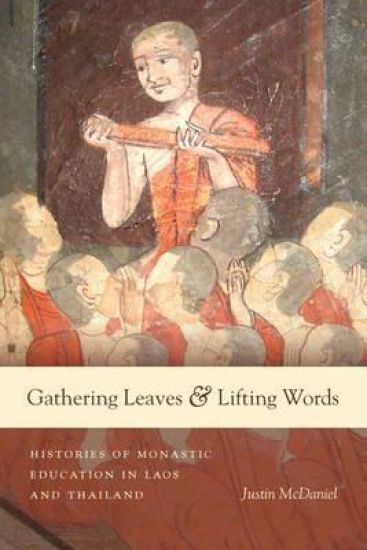
Winner of the Henry J. Benda Prize sponsored by the Association for Asian StudiesGathering Leaves and Lifting Words examines modern and premodern Buddhist monastic education traditions in Laos and Thailand. Through five centuries of adaptation and reinterpretation of sacred texts and commentaries, Justin McDaniel traces curricular variations in Buddhist oral and written education that reflect a wide array of community goals and values. He depicts Buddhism as a series of overlapping processes, bringing fresh attention to the continuities of Theravada monastic communities that have endured despite regional and linguistic variations. Incorporating both primary and secondary sources from Thailand and Laos, he examines premodern inscriptional, codicological, anthropological, art historical, ecclesiastical, royal, and French colonial records. By looking at modern sermons, and even television programs and websites, he traces how pedagogical techniques found in premodern palm-leaf manuscripts are pervasive in modern education.As the first comprehensive study of monastic education in Thailand and Laos, Gathering Leaves and Lifting Words will appeal to a wide audience of scholars and students interested in religious studies, anthropology, social and intellectual history, and pedagogy.
Gathering Leaves and Lifting Words

Gathering Leaves and Lifting Words

Justin Thomas McDaniel

University of Washington Press
2008
pokkari
Winner of the Henry J. Benda Prize sponsored by the Association for Asian StudiesGathering Leaves and Lifting Words examines modern and premodern Buddhist monastic education traditions in Laos and Thailand. Through five centuries of adaptation and reinterpretation of sacred texts and commentaries, Justin McDaniel traces curricular variations in Buddhist oral and written education that reflect a wide array of community goals and values. He depicts Buddhism as a series of overlapping processes, bringing fresh attention to the continuities of Theravada monastic communities that have endured despite regional and linguistic variations. Incorporating both primary and secondary sources from Thailand and Laos, he examines premodern inscriptional, codicological, anthropological, art historical, ecclesiastical, royal, and French colonial records. By looking at modern sermons, and even television programs and websites, he traces how pedagogical techniques found in premodern palm-leaf manuscripts are pervasive in modern education.As the first comprehensive study of monastic education in Thailand and Laos, Gathering Leaves and Lifting Words will appeal to a wide audience of scholars and students interested in religious studies, anthropology, social and intellectual history, and pedagogy.
Architects of Buddhist Leisure

Architects of Buddhist Leisure

Justin Thomas McDaniel

University of Hawai'i Press
2016
sidottu
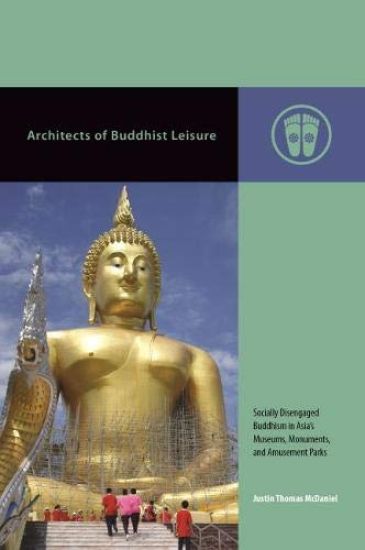
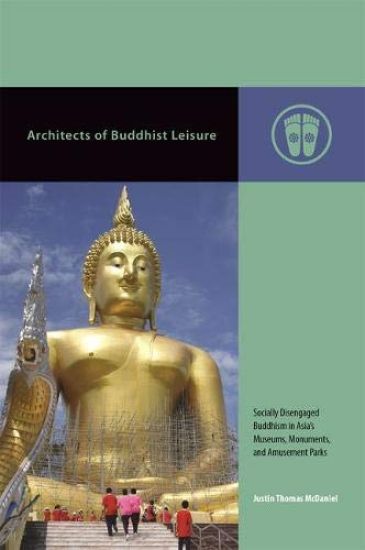
Buddhism, often described as an austere religion that condemns desire, promotes denial, and idealizes the contemplative life, actually has a thriving leisure culture in Asia. Creative religious improvisations designed by Buddhists have been produced both within and outside of monasteries across the region—in Nepal, Japan, Korea, Macau, Hong Kong, Singapore, Laos, Thailand, and Vietnam. Justin McDaniel looks at the growth of Asia’s culture of Buddhist leisure—what he calls “socially disengaged Buddhism”—through a study of architects responsible for monuments, museums, amusement parks, and other sites. In conversation with noted theorists of material and visual culture and anthropologists of art, McDaniel argues that such sites highlight the importance of public, leisure, and spectacle culture from a Buddhist perspective and illustrate how “secular” and “religious,” “public” and “private,” are in many ways false binaries. Moreover, places like Lek Wiriyaphan’s Sanctuary of Truth in Thailand, Su?i Tiên Amusement Park in Saigon, and Shi Fa Zhao’s multilevel museum/ritual space/tea house in Singapore reflect a growing Buddhist ecumenism built through repetitive affective encounters instead of didactic sermons and sectarian developments. They present different Buddhist traditions, images,and aesthetic expressions as united but not uniform, collected but not concise: together they form a gathering, not a movement.Despite the ingenuity of lay and ordained visionaries like Wiriyaphan and Zhao and their colleagues Kenzo Tange, Chan-soo Park, Tadao Ando, and others discussed in this book, creators of Buddhist leisure sites often face problems along the way. Parks and museums are complex adaptive systems that are changed and influenced by budgets, available materials, local and global economic conditions, and visitors. Architects must often compromise and settle at local optima, and no matter what they intend, their buildings will develop lives of their own. Provocative and theoretically innovative, Architects of Buddhist Leisure asks readers to question the very category of “religious” architecture. It challenges current methodological approaches in religious studies and speaks to a broad audience interested in modern art, architecture, religion, anthropology, and material culture.
Architects of Buddhist Leisure

Architects of Buddhist Leisure

Justin Thomas McDaniel

University of Hawai'i Press
2018
nidottu
Buddhism, often described as an austere religion that condemns desire, promotes denial, and idealizes the contemplative life, actually has a thriving leisure culture in Asia. Creative religious improvisations designed by Buddhists have been produced both within and outside of monasteries across the region—in Nepal, Japan, Korea, Macau, Hong Kong, Singapore, Laos, Thailand, and Vietnam. Justin McDaniel looks at the growth of Asia’s culture of Buddhist leisure—what he calls “socially disengaged Buddhism”—through a study of architects responsible for monuments, museums, amusement parks, and other sites. In conversation with noted theorists of material and visual culture and anthropologists of art, McDaniel argues that such sites highlight the importance of public, leisure, and spectacle culture from a Buddhist perspective and illustrate how “secular” and “religious,” “public” and “private,” are in many ways false binaries. Moreover, places like Lek Wiriyaphan’s Sanctuary of Truth in Thailand, Su?i Tiên Amusement Park in Saigon, and Shi Fa Zhao’s multilevel museum/ritual space/tea house in Singapore reflect a growing Buddhist ecumenism built through repetitive affective encounters instead of didactic sermons and sectarian developments. They present different Buddhist traditions, images, and aesthetic expressions as united but not uniform, collected but not concise: Together they form a gathering, not a movement.Despite the ingenuity of lay and ordained visionaries like Wiriyaphan and Zhao and their colleagues Kenzo Tange, Chan-soo Park, Tadao Ando, and others discussed in this book, creators of Buddhist leisure sites often face problems along the way. Parks and museums are complex adaptive systems that are changed and influenced by budgets, available materials, local and global economic conditions, and visitors. Architects must often compromise and settle at local optima, and no matter what they intend, their buildings will develop lives of their own. Provocative and theoretically innovative, Architects of Buddhist Leisure asks readers to question the very category of “religious” architecture. It challenges current methodological approaches in religious studies and speaks to a broad audience interested in modern art, architecture, religion, anthropology, and material culture.
Wayward Distractions

Wayward Distractions

Justin Thomas McDaniel

Ridge Books
2021
nidottu
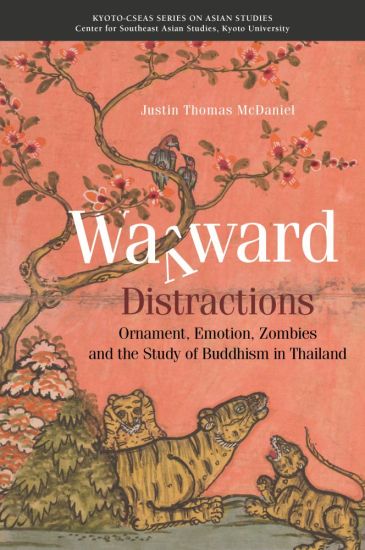
A collection of essays engaging with Buddhism in Thailand and the virtues of distraction and variety within the materialist turn in studies of religion.In Thailand, Buddhism is deeply integrated into national institutions and ideologies, making it tempting to think of Buddhism in Thailand as a textual, institutional, cultural, and conceptual whole. At the same time, religious expression in the country reflects anything but a single order. Often gaudy, cacophonous, variegated, and jumbled, diversity and apparent contradiction abound. A more open engagement with Buddhism in Thailand requires a willingness to be distracted, to step away from received hierarchies and follow the intriguing detail in the ornate design, the odd textual reference, and to prefer "thin description" over a search for meaning. Justin McDaniel's well-known book-length writings in Buddhist and Theravada studies cannot be fully understood without taking into account his shorter writings, what he calls his wayward distractions. Collected together for the first time, these essays cover subjects ranging from ornamental art to marriage and emotion, the role of Hinduism, neglected gender and ethnic diversity, Buddhist inflections in contemporary art practice, and the boundaries between the living, dead, and undead. These writings will be of importance to students of Theravada and Thailand, of religion in Southeast Asia and more generally, of the materialist turn in studies of religion.
Become a Provider

Become a Provider

Justin Thomas

Justin Thomas Coaching
2022
pokkari
Has your life hit a plateau? Discover how to unlock your real strength and leave a positive legacy. Struggling to make headway with personal growth? Frustrated with damaging behaviors? Can't seem to recover after a tragic loss or major setback? National Board-Certified Health and Wellness Coach, successful entrepreneur, and faith-based non-profit co-founder Justin Thomas has dedicated his life to helping people thrive. Now he's here to share a surprising family story that inspired his unique model for turning your mindset around, blessing others, and discovering your own inner strength. Become a Provider: Overcome Tragedy, Become Stronger, and Serve Others Without Getting Burned Out is an inspiring approach to reinventing and redefining how you engage with the world. Using a powerful chapter-by-chapter framework and an ingenious accompanying eight-week program, Thomas guides you through thought-provoking principles and challenging action items that will spur you to level up your worldview. And by investing in yourself as you guide and nurture others, you'll open your days to an abundance of goodness while leaving a long-lasting legacy. In Become a Provider, you'll discover: - What it means to step up and give back, so everyone benefits- Eight intentional habits to dramatically improve your lifestyle- How to escape self-destructive passiveness and concentrate on growth- Practical strategies and examples to get you started climbing the ladder- Developmental exercises, moving stories, an exclusive two-month challenge, and much, much more Become a Provider is the perfect antidote for anyone seeking to truly lead. If you like collaborative thinking, inspirational methodologies, and the power of devotion, then you'll appreciate Justin Thomas's essential-living resource. Buy Become a Provider to assert your influence today
Fable Avenue Book III

Fable Avenue Book III

Justin Thomas

Twin Griffin Books
2022
pokkari
With parallel stories playing out in both contemporary and historical times, the third installment of THE FABLE AVENUE SAGA is an epic tale continuing author Justin Thomas' Black Speculative Fiction conjure series.ON FABLE AVENUE the search for the conjure children abducted by Stanley Fallows' needlemen and night doctors continues, as he and his wife siphon power and essence from the young ones, configured into flowers, drained from their colorful petals.Lillian Eledas-Ghedemere, called Voodoo Lily, takes her rightful place as the newly crowned Crossroads Queen. Spearheading a reconquest of WATER BUG HOLLOW with her consort, Armand Gideon, as they search for the buried and hexed bones of a murdered political to disperse the cursed fog that keeps the area locked in poverty and gang violence.Gordon Goodspeed works overtime, operating alongside his brother's crew, The Gypsy Moon Misfits, in search of the kidnapped children and fighting off Stanley Fallows' new rogues' gallery of formidable Blood Cursers. Using his conjure-tech device named Spook, he also dreams of history in an attempt to locate Lady Arachne's missing Lovers card to complete her ancient tarot deck. His dreaming unravels a fairy-tale-like epic that begins in a time considered myth among conjure folk and continues into the 17th century to the stars above AFRICA, where two tricksters clash in ideologies amid the terrible, African slave trade.Pinpointing the whereabouts of The Lovers card gives Gordon belief that its use in ritual will bring back his sweetheart, Fey Forrester, and her cosmic, cobalt-blue flame spirit. As he observes players in history positioned around the ancient, powerful tarot card, he gathers clues from each viewing on how and where The Lovers make their journey to now...
South Amesbury's Red Earthenware & Stoneware

South Amesbury's Red Earthenware & Stoneware

Justin Thomas

Beverly Historical Society
2021
pokkari
Red earthenware production in South Amesbury (Merrimacport), Massachusetts dates to the eighteenth century, supplying households in the small corner of northeastern Massachusetts, southern New Hampshire and probably other spots in New England, with everyday utilitarian wares. This multi-generational family business lasted for more than 100 years, making it one of the longest standing potteries in New England. The most famous of those employed in South Amesbury was William Pecker, who operated a pottery during the circa 1791-1820 period. Although, it is not widely known that Pecker was one of New England earliest potters to produce red earthenware and stoneware, perhaps only the second business to accomplish this feat in New England behind the Parker Pottery in Charlestown, Mass. in the 1740s. This book is the first of its kind to explore South Amesbury's pottery production, the aesthetic appeal of these wares, archaeology and closely examine the stoneware manufactured by William Pecker.
A Celebrated Industry

A Celebrated Industry

Justin Thomas

Beverly Historical Society
2022
pokkari
The aesthetics of utilitarian domestic red earthenware are what collectors and museums have been drawn to for more than a century now, although, it was likely an important factor in the marketplace even when red earthenware was originally produced in the eighteenth and nineteenth century. In New England, the wares manufactured in southeastern Massachusetts, Bristol County and Cape Cod were unquestionably at the forefront of the visual appeal of the region's red earthenware production. The wares produced in this part of Massachusetts have it all: form, glaze, skill and refinement, transforming many of these objects into works of art that can be displayed at any art museum in America. This book is the first of its kind to explore this region's red earthenware production through archaeology, a historical context, as well as the artistry and creativity behind this industry's production.
A City on the River

A City on the River

Justin Thomas

Beverly Historical Society
2023
pokkari
The stoneware manufactured in Hartford, Connecticut in the nineteenth century is a well-known subject today, which served a larger area than just the local marketplace, utilizing the Connecticut River for transportation. In fact, some of the stoneware was inspired by the industry in New York City. Although, it was red earthenware that was actually the original type of household pottery produced in the area, dating as early as the 1700s, where some of the early wares may have been influenced by production in Massachusetts. In some years, thousands of pieces of red earthenware were produced, utilizing the local clays, resulting in a wide range of accomplished wares, some of which were embellished with dramatic styles of hand-applied slip decoration. The most famous of the potters were the Seymours, the Goodwins and Hervey Brooks, but there were other potters as well. This book is the first of its kind to take an in-depth look at the various types of wares manufactured in the Hartford area, as well as the variety of domestic red earthenware artifacts recovered along the Connecticut River within eighteenth and nineteenth century archaeological contexts.
From One Town Came Many

From One Town Came Many

Justin Thomas

Beverly Historical Society
2023
pokkari
The red earthenware industry in North Yarmouth, Maine was established in the 1790s, and for the next century, it flourished through a group of multigenerational family potteries. Many were located at Yarmouth Corner, which included production from at least five family businesses: Brooks, Cleaves, Corliss, Foster and Thomas. Much of this history had been forgotten due to 20th century development and a lack of published documentation. But thanks to historic preservation, archaeologists, museums and family records, the history of this industry has been reidentified. The industry in North Yarmouth was likely the largest red earthenware manufacturing center in the state, and connected to many well-known potters and red earthenware industries located elsewhere in New England. This book is the first of its kind to take an in-depth look at the various types of wares manufactured in North Yarmouth.