

Kirjahaku
Etsi kirjoja tekijän nimen, kirjan nimen tai ISBN:n perusteella.
1000 tulosta hakusanalla K Merton Claar






The author is an old man, like Fred. He doesn't tweet or twitter or even quack. He spent most of his adult life as an electronic engineer for the FAA and for the Navy. The last 12 years of his career was spent working in his wife's Christian bookstore. He considers those the best years of his life. Fred and Mabel have moved to an assisted living facility. Because of the company's loss of a large sum of money, the facility may be forced to close, and all the folks seek new places to live. Fred is eager to find the lost money, but has no accounting knowledge, so Mabel must step in. Almost all of the folks from the previous books help and in the end there are some romances and a twist in the adventure.

Phoenix residents Bill and Bev Johnstone inherited a small sawmill in western Washington. Even before they took it over, they were warned to close it down. As they ignored the threat and moved to Littlerock, Washington, the threats worsened, and people lost their lives. The Johnstones and their kids learned a lot about logging and more about how to protect themselves from a large and evil organization that was out to stop all the gyppo loggers. With God's guidance and the help of their family they were able to finally find peace. I have a host of relatives in the logging business in the northwest. I grew up where trees were plentiful. I am now older and those places and things are only memories, but they live in my book.


Synopsis coming soon.......

Robert K. Merton
Columbia University Press
2010
sidottu
Robert K. Merton (1910-2003) was one of the most influential sociologists of the twentieth century, producing clear theories and innovative research that continue to shape multiple disciplines. Merton's reach can be felt in the study of social structure, social psychology, deviance, professions, organizations, culture, and science. Yet for all his fame, Merton is only partially understood. He is treated by scholars as a functional analyst, when in truth his contributions transcend paradigm. Gathering together twelve major sociologists, Craig Calhoun launches a thorough reconsideration of Merton's achievements and inspires a renewed engagement with sociological theory. Merton's work addressed the challenges of integrating research and theory. It connected different fields of empirical research and spoke to the importance of overcoming divisions between allegedly pure and applied sociology. Merton also sought to integrate sociology with the institutional analysis of science, each informing the other. By bringing together different aspects of his work in one volume, Calhoun illuminates the interdisciplinary--and unifying--dimensions of Merton's approach, while also advancing the intellectual agenda of an increasingly vital area of study. Contributors: Aaron L. Panofsky, University of California; Alan Sica, Pennsylvania State University; Alejandro Portes, Princeton University; Charles Camic, Northwestern University; Charles Tilly, Columbia University; Craig Calhoun, Social Science Research Council and New York University; Cynthia Fuchs Epstein, City University of New York; Harriet Zuckerman, Mellon Foundation; Peter Simonson, University of Colorado; Ragnvald Kalleberg, University of Oslo; Robert J. Sampson, Harvard University; Thomas F. Gieryn, Indiana University; Viviana A. Zelizer, Princeton University

Robert K. Merton
Columbia University Press
2017
pokkari
Robert K. Merton (1910-2003) was one of the most influential sociologists of the twentieth century, producing clear theories and innovative research that continue to shape multiple disciplines. Merton's reach can be felt in the study of social structure, social psychology, deviance, professions, organizations, culture, and science. Yet for all his fame, Merton is only partially understood. He is treated by scholars as a functional analyst, when in truth his contributions transcend paradigm. Gathering together twelve major sociologists, Craig Calhoun launches a thorough reconsideration of Merton's achievements and inspires a renewed engagement with sociological theory. Merton's work addressed the challenges of integrating research and theory. It connected different fields of empirical research and spoke to the importance of overcoming divisions between allegedly pure and applied sociology. Merton also sought to integrate sociology with the institutional analysis of science, each informing the other. By bringing together different aspects of his work in one volume, Calhoun illuminates the interdisciplinary--and unifying--dimensions of Merton's approach, while also advancing the intellectual agenda of an increasingly vital area of study. Contributors: Aaron L. Panofsky, University of California; Alan Sica, Pennsylvania State University; Alejandro Portes, Princeton University; Charles Camic, Northwestern University; Charles Tilly, Columbia University; Craig Calhoun, Social Science Research Council and New York University; Cynthia Fuchs Epstein, City University of New York; Harriet Zuckerman, Mellon Foundation; Peter Simonson, University of Colorado; Ragnvald Kalleberg, University of Oslo; Robert J. Sampson, Harvard University; Thomas F. Gieryn, Indiana University; Viviana A. Zelizer, Princeton University

This volume offers scholars of sociology and allied areas the fruits of an international conference on the contributions of the eminent Robert K. Merton. The assessment, as good in content as well as in participants, took place in Amalfi, Italy, with the participation of Merton himself and under the auspices of the Italian Sociology Association. Carlo Mongardini aptly summarizes the unique impact of Merton on the social theory of our century. "His strength as a classic writer lies in his balance, unveiling complexity, and in his humanism which looks beyond the apparent simplicity and coherence of social reality."A special treat is the final chapter by Merton reviewing "Unanticipated Conse-quences and Kindred Sociological Ideas." In it, he ranges from the historical an-tecedents of the concept to his own evolution in the use and expansion of the idea. Merton approaches the development of his thought as installments rather than sim-ple evolution, and in so doing gives us unique insight into how he built upon his originating notions in the context of social science as it existed in the United States. Tensions between integrating scholarship and reaching the general public provide a special insight into Merton that might prove new even to those who know his work well.Contributors to this original volume include: Volker Meja, Nico Stehr, Paolo Ammassari, Gianni Statera, Birgitta Nedelmann, Harriet Zuckerman, Piotr Sztompka, Peter Gerlich, Charles Crothers, Elena Besozzi, and Arnold Zongerle, among others. The chapters address the full range of Merlon's work, with special emphasis on such areas as anomie, structural analysis, the relationship of theory to research, patterns of latent and manifest influence, and even the application of Mertonian concepts to the analysis of Merton as a scholar. This unusual compendium, translated from the Italian, will interest social researchers across the academic spectrum.
This volume offers scholars of sociology and allied areas the fruits of an international conference on the contributions of the eminent Robert K. Merton. The assessment, as good in content as well as in participants, took place in Amalfi, Italy, with the participation of Merton himself and under the auspices of the Italian Sociology Association. Carlo Mongardini aptly summarizes the unique impact of Merton on the social theory of our century. "His strength as a classic writer lies in his balance, unveiling complexity, and in his humanism which looks beyond the apparent simplicity and coherence of social reality."A special treat is the final chapter by Merton reviewing "Unanticipated Conse-quences and Kindred Sociological Ideas." In it, he ranges from the historical an-tecedents of the concept to his own evolution in the use and expansion of the idea. Merton approaches the development of his thought as installments rather than sim-ple evolution, and in so doing gives us unique insight into how he built upon his originating notions in the context of social science as it existed in the United States. Tensions between integrating scholarship and reaching the general public provide a special insight into Merton that might prove new even to those who know his work well.Contributors to this original volume include: Volker Meja, Nico Stehr, Paolo Ammassari, Gianni Statera, Birgitta Nedelmann, Harriet Zuckerman, Piotr Sztompka, Peter Gerlich, Charles Crothers, Elena Besozzi, and Arnold Zongerle, among others. The chapters address the full range of Merlon's work, with special emphasis on such areas as anomie, structural analysis, the relationship of theory to research, patterns of latent and manifest influence, and even the application of Mertonian concepts to the analysis of Merton as a scholar. This unusual compendium, translated from the Italian, will interest social researchers across the academic spectrum.
Studienarbeit aus dem Jahr 2002 im Fachbereich Soziologie - Klassiker und Theorierichtungen, Note: 2,0, Johannes Gutenberg-Universitat Mainz (Soziologie), Sprache: Deutsch, Abstract: Der Begriff der Rolle" wird seit uber einem Jahrhundert von vielen Soziologen diskutiert, darunter Georg Simmel, Talcott Parsons und insbesondere Ralf Dahrendorf. Ein weiterer Soziologe der sich mit den Thema auseinandersetzte ist der Amerikaner Robert King Merton. Sein Hauptanliegen war die Entwicklung von Theorien mittlerer Reichweite, also begrenzter Abstraktheit. Im Bezug zur Rollentheorie entwickelte er das Rollen-Set, von dem diese Hausarbeit handelt. Was ist also das Rollen-Set mit allen seinen Merkmalen und wie lasst es sich auf Akteure anwenden

This book reintroduces the work of Robert K. Merton as a bridge between classical sociology and modern sociology. Founded in the sociological classics but developing a modern approach to the advancement of theory and research methodology, Merton’s thought helped to construct modern sociology in its coverage of many of the social institutional areas of contemporary society. Recovering and analysing the system of ‘structural analysis’, which Merton progressively developed – a system largely overlooked due to the tendency among commentators to stereotype him as a ‘functionalist’ – the author considers the applications of this approach to various substantive fields, particularly science and criminal justice, and examines the effect of Merton’s later ‘sociological semantics’ on his overall schema. A clear and accessible presentation of the array of concepts introduced by Merton to sociology, Reintroducing Robert K. Merton will appeal to scholars and students with interests in sociological theory, social research, the history of sociology and the various substantive areas covered in the work of Merton – deviance, science, and communications.
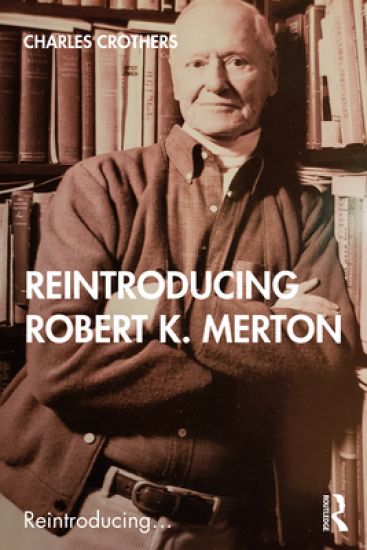
This book reintroduces the work of Robert K. Merton as a bridge between classical sociology and modern sociology. Founded in the sociological classics but developing a modern approach to the advancement of theory and research methodology, Merton’s thought helped to construct modern sociology in its coverage of many of the social institutional areas of contemporary society. Recovering and analysing the system of ‘structural analysis’, which Merton progressively developed – a system largely overlooked due to the tendency among commentators to stereotype him as a ‘functionalist’ – the author considers the applications of this approach to various substantive fields, particularly science and criminal justice, and examines the effect of Merton’s later ‘sociological semantics’ on his overall schema. A clear and accessible presentation of the array of concepts introduced by Merton to sociology, Reintroducing Robert K. Merton will appeal to scholars and students with interests in sociological theory, social research, the history of sociology and the various substantive areas covered in the work of Merton – deviance, science, and communications.
Robert King Merton (1910 – 2003) gilt heute längst als Klassiker der Soziologie. Er kann als der bedeutendste Soziologe der zweiten Hälfte des 20. Jahrhunderts und als Wegbereiter einer modernen Soziologie bezeichnet werden, die das konstitutive Verhältnis von soziologischer Theorie und empirischer Forschung ins Zentrum des Interesses gerückt hat. Aufgrund seiner Beiträge zur Sozialtheorie, zur Begriffsbildung in der Soziologie und seiner vielfältigen inhaltlichen und empirischen Arbeiten spielt Merton bis heute eine bedeutende Rolle in der Soziologie als wissenschaftlicher Disziplin.