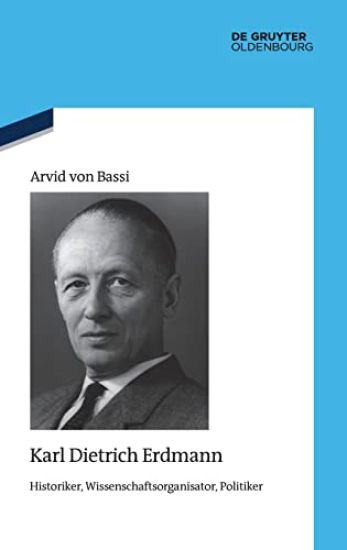
Das Buch widmet sich der Lebensgeschichte eines der einflussreichsten Repr sentanten der sogenannten "Gr ndergeneration" der westdeutschen Geschichtswissenschaft. Auf Grundlage seines umfangreichen Nachlasses wird Karl Dietrich Erdmanns Denken und Verhalten im Nationalsozialismus, vor allem aber sein au ergew hnlicher Werdegang nach 1945 untersucht, der ihn bis in die h chsten Gremien nationaler Bildungspolitik und an die Spitze internationaler Wissenschaftsdiplomatie f hren sollte. Im Zentrum der Arbeit stehen zum einen Kontinuit ten und Br che in Erdmanns intellektueller Biographie, zum anderen seine Position als Stichwortgeber und Multiplikator im Kontext der liberal-konservativen Modernisierung der alten Bundesrepublik.
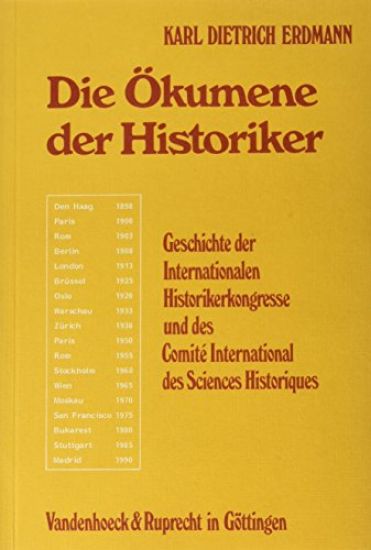
Zur Glaubwürdigkeit der Geschichtswissenschaft. Karl Dietrich Erdmann (1910-1990) war einer der bedeutendsten deutschen Historiker nach 1945. Lange Zeit galt er in seiner Generation als Ausnahmeerscheinung: als ein Wissenschaftler, der sich, ohne Nationalsozialist gewesen zu sein, mutig und kompromißlos durch die NS-Zeit gebracht hat. Diese Deutung seiner Biographie ist revisionsbedürftig. Karl Dietrich Erdmann hat - das steht außer Zweifel - nach 1945 einen erheblichen und wichtigen Beitrag zum demokratischen Neuaufbau der Bundesrepublik geleistet. Er war Sekretär der deutschen UNESCO-Sektion, Vorsitzender des deutschen Bildungsrats, Vorsitzender des Verbands deutscher Historiker und Vorsitzender des Comité International des Sciences Historiques. Die Autoren dieses Buches zeigen, daß Erdmann sich nicht nur auf Kompromisse mit dem NS-Regime eingelassen hat, sondern daß er, bei mancher Einzelkritik am Nationalsozialismus, wichtige Grundsätze dieser Ideologie akzeptiert und sie historisch legitimiert hat.
This work has been selected by scholars as being culturally important, and is part of the knowledge base of civilization as we know it. This work was reproduced from the original artifact, and remains as true to the original work as possible. Therefore, you will see the original copyright references, library stamps (as most of these works have been housed in our most important libraries around the world), and other notations in the work.This work is in the public domain in the United States of America, and possibly other nations. Within the United States, you may freely copy and distribute this work, as no entity (individual or corporate) has a copyright on the body of the work.As a reproduction of a historical artifact, this work may contain missing or blurred pages, poor pictures, errant marks, etc. Scholars believe, and we concur, that this work is important enough to be preserved, reproduced, and made generally available to the public. We appreciate your support of the preservation process, and thank you for being an important part of keeping this knowledge alive and relevant.
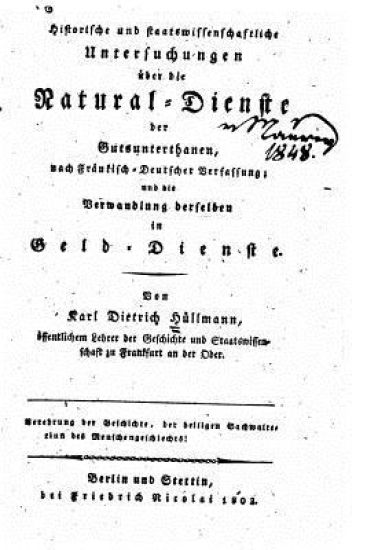
Historische und staatswissenschaftliche Untersuchungen by Karl Dietrich H llmann. This book is a reproduction of the original book published in 1803 and may have some imperfections such as marks or hand-written notes.
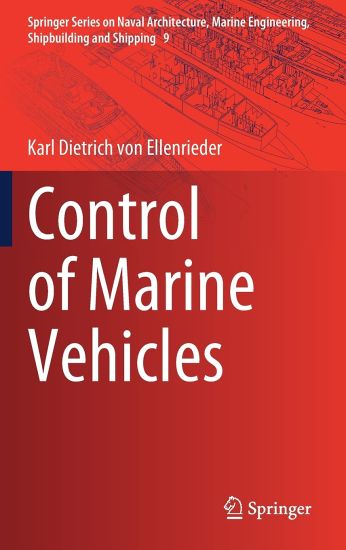
This textbook offers a comprehensive introduction to the control of marine vehicles, from fundamental to advanced concepts, including robust control techniques for handling model uncertainty, environmental disturbances, and actuator limitations. Starting with an introductory chapter that extensively reviews automatic control and dynamic modeling techniques for ocean vehicles, the first part of the book presents in-depth information on the analysis and control of linear time invariant systems. The concepts discussed are developed progressively, providing a basis for understanding more complex techniques and stimulating readers’ intuition. In addition, selected examples illustrating the main concepts, the corresponding MATLAB® code, and problems are included in each chapter. In turn, the second part of the book offers comprehensive coverage on the stability and control of nonlinear systems. Following the same intuitive approach, it guides readers from the fundamentals to more advanced techniques, which culminate in integrator backstepping, adaptive and sliding mode control. Leveraging the author’s considerable teaching and research experience, the book offers a good balance of theory and stimulating questions. Not only does it provide a valuable resource for undergraduate and graduate students; it will also benefit practitioners who want to review the foundational concepts underpinning some of the latest advanced marine vehicle control techniques, for use in their own applications.
This textbook offers a comprehensive introduction to the control of marine vehicles, from fundamental to advanced concepts, including robust control techniques for handling model uncertainty, environmental disturbances, and actuator limitations. Starting with an introductory chapter that extensively reviews automatic control and dynamic modeling techniques for ocean vehicles, the first part of the book presents in-depth information on the analysis and control of linear time invariant systems. The concepts discussed are developed progressively, providing a basis for understanding more complex techniques and stimulating readers’ intuition. In addition, selected examples illustrating the main concepts, the corresponding MATLAB® code, and problems are included in each chapter. In turn, the second part of the book offers comprehensive coverage on the stability and control of nonlinear systems. Following the same intuitive approach, it guides readers from the fundamentals to more advanced techniques, which culminate in integrator backstepping, adaptive and sliding mode control. Leveraging the author’s considerable teaching and research experience, the book offers a good balance of theory and stimulating questions. Not only does it provide a valuable resource for undergraduate and graduate students; it will also benefit practitioners who want to review the foundational concepts underpinning some of the latest advanced marine vehicle control techniques, for use in their own applications.