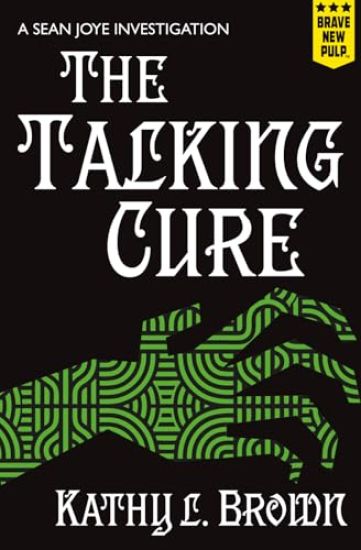
All hell breaks loose when a jailhouse preacher aims for heavenly escape. Sean Joye is a fae-touched young veteran of 1923's Irish Civil War. He wants nothing more than to start a clean, new life in America, free of supernatural misadventures and shoot-on-sight orders. He takes what he thinks is an easy job as bodyguard for a St. Louis judge, driving him to Missouri's infamous state penitentiary to witness an execution. The appointed day is clear and fine. A perfect day for a hanging. Yet as soon as they arrive at the prison, Sean realizes his back is up over something. Maybe it's just the summer heat or Sean's memories of his own time as a prisoner of war, but psychic premonitions of trouble are more likely. He soon finds himself a pawn in a jailhouse preacher's mountain-magic-fueled escape attempt. Sean must rise to the occasion, evading rioting convicts, trigger-happy guards, and a preternatural cyclone to rescue both the judge and an unjustly condemned prisoner from the resurrectionist.
Did faeries spirit away the young moonshiner? Sean Joye can't help but wonder, yet he hopes for a more reasonable explanation. Fleeing to America in 1923 as soon as he'd mustered out of the army, Sean aims to put Ireland's civil war, his assassin past, and faerie attention behind him. But his one-time lover, Caleb, is missing. As Sean treks through a November ice storm in search of his friend, the forest itself bristles with fae ill intent, and a strange old mountain woman would just as soon shoot Sean as feed him squirrel stew. Calamity reigns unless he cracks the secret of Otter Springs and its water of life. "Caleb's whiskey is the best. Better than legit brands like Canadian Club, even," I said. "At home we call whiskey 'uisce beatha'- the water of life." Praise for Water of Life- "Delightfully peculiar." M. R. Sellars, Author of The Rowan Gant Investigations
This provocative work provides a radical reassessment of the emergence and nature of Christian sexual morality, the dominant moral paradigm in Western society since late antiquity. While many scholars, including Michel Foucault, have found the basis of early Christian sexual restrictions in Greek ethics and political philosophy, Kathy L. Gaca demonstrates on compelling new grounds that it is misguided to regard Greek ethics and political theory--with their proposed reforms of eroticism, the family, and civic order--as the foundation of Christian sexual austerity. Rather, in this thoroughly informed and wide-ranging study, Gaca shows that early Christian goals to eradicate fornication were derived from the sexual rules and poetic norms of the Septuagint, or Greek Bible, and that early Christian writers adapted these rules and norms in ways that reveal fascinating insights into the distinctive and largely non-philosophical character of Christian sexual morality. Writing with an authoritative command of both Greek philosophy and early Christian writings, Gaca investigates Plato, the Stoics, the Pythagoreans, Philo of Alexandria, the apostle Paul, and the patristic Christians Clement of Alexandria, Tatian, and Epiphanes, freshly elucidating their ideas on sexual reform with precision, depth, and originality. Early Christian writers, she demonstrates, transformed all that they borrowed from Greek ethics and political philosophy to launch innovative programs against fornication that were inimical to Greek cultural mores, popular and philosophical alike. The Septuagint's mandate to worship the Lord alone among all gods led to a Christian program to revolutionize Gentile sexual practices, only for early Christians to find this virtually impossible to carry out without going to extremes of sexual renunciation. Knowledgeable and wide-ranging, this work of intellectual history and ethics cogently demonstrates why early Christian sexual restrictions took such repressive ascetic forms, and casts sobering light on what Christian sexual morality has meant for religious pluralism in Western culture, especially among women as its bearers.
This provocative work provides a radical reassessment of the emergence and nature of Christian sexual morality, the dominant moral paradigm in Western society since late antiquity. While many scholars, including Michel Foucault, have found the basis of early Christian sexual restrictions in Greek ethics and political philosophy, Kathy L. Gaca demonstrates on compelling new grounds that it is misguided to regard Greek ethics and political theory--with their proposed reforms of eroticism, the family, and civic order--as the foundation of Christian sexual austerity. Rather, in this thoroughly informed and wide-ranging study, Gaca shows that early Christian goals to eradicate fornication were derived from the sexual rules and poetic norms of the Septuagint, or Greek Bible, and that early Christian writers adapted these rules and norms in ways that reveal fascinating insights into the distinctive and largely non-philosophical character of Christian sexual morality. Writing with an authoritative command of both Greek philosophy and early Christian writings, Gaca investigates Plato, the Stoics, the Pythagoreans, Philo of Alexandria, the apostle Paul, and the patristic Christians Clement of Alexandria, Tatian, and Epiphanes, freshly elucidating their ideas on sexual reform with precision, depth, and originality. Early Christian writers, she demonstrates, transformed all that they borrowed from Greek ethics and political philosophy to launch innovative programs against fornication that were inimical to Greek cultural mores, popular and philosophical alike. The Septuagint's mandate to worship the Lord alone among all gods led to a Christian program to revolutionize Gentile sexual practices, only for early Christians to find this virtually impossible to carry out without going to extremes of sexual renunciation. Knowledgeable and wide-ranging, this work of intellectual history and ethics cogently demonstrates why early Christian sexual restrictions took such repressive ascetic forms, and casts sobering light on what Christian sexual morality has meant for religious pluralism in Western culture, especially among women as its bearers.
When Kathy L. Patrick lost her job as a publisher's rep, she took that lemon and made margaritas. She opened Beauty and the Book, the world's only combination beauty salon/bookstore. Soon after that whirlwind success, Kathy founded the Pulpwood Queens of East Texas, a book club that became a nationwide phenomenon almost overnight. She set out to change the world, one reader at a time.
This collection of conference papers and notes begins an important dialogue across the divides that exist nationally and internationally. Topics include the Voluntary Sector Initiative, regulatory and legislative reform, charity commissions, nongovernmental organizations abroad, civil society and volunteerism, privacy and language issues in the sector, and challenges facing governments and voluntary organizations as they learn to work together. Improving Connections between Governments, Nonprofit and Voluntary Organizations resulted from the Queen's Public Policy and Third Sector conference that brought together prominent Canadian representatives from the third sector, federal and provincial governments, and the academic community. Special contributions are included from Chief Charity Commissioner for England and Wales John Stoker, General Secretary for CARE International Guy Tousignant, and BC Minister of Community Development, Cooperatives and Volunteers Jenny Kwan. Contributors include Susan Fletcher (PCO), Susan Carter (Voluntary Sector Secretariat), Patrick Monahan (Osgoode Hall), Arthur Drache (QC), Monica Patton (Community Foundations of Canada), Al Hatton (National Voluntary Organisations), Rainer Knopff (Calgary), Terry Goertzen (Manitoba), Hal Gerein (BC), Deena White (Universite de Montreal), Michael Hall (Canadian Centre for Philanthropy), Paddy Bowen (Volunteer Canada), Miyo Yamashita (Mt. Sinai Hospital), David Cameron (University of Toronto), Penelope Rowe (Community Services Council), Vivian Randell (Newfoundland), Katherine Graham (Carleton), Tim Simboli (Ottawa Carleton Family Service Centre), Peter Levesque (CURA).
At the dawn of a new century, the third sector has become increasingly embedded in the business of government in Canada. What is the nature of this relationship? What does it forecast for Canadian public policy? This collection of essays, the second in the Public Policy and the Third Sector series, analyses the role of the nonprofit sector and its links with both the state and society in Canada. The Nonprofit Sector and Government in a New Century captures the complexities and contradictions in the relationship between the nonprofit sector and government, and highlights the struggles of nonprofit organizations to respond to an environment defined by increased expectations and constrained resources. Contributors include Keith Banting, Kathy Brock, Jack Quarter (OISE), Caroline Andrew (University of Ottawa), James Rice (McMaster University), Darcy Mitchell (Mitchell Consulting), Joesph Tindale (University of Guelph), and Luc Theriault (University of Regina).
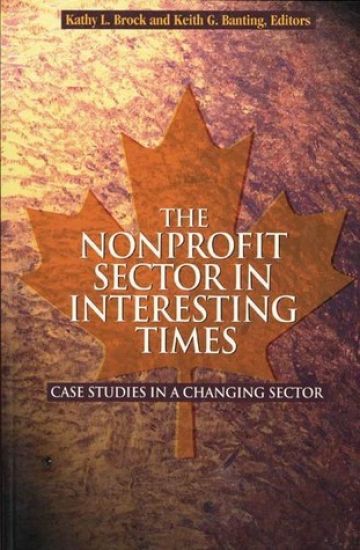
The cases explored here include internet regulation and privacy legislation, conservation efforts and biodiversity, the savings behaviour of NPOs, the breast cancer policy community, and voluntary sector-government compacts. Contributors include Kathy Brock, Philippe Barla (Universite Laval), Malcolm Grieve (Acadia), Femida Handy (York University), Alison Li (York University), Agnes Meinhard and Mary Foster (Ryerson University), and Susan Phillips (Carleton University).
The cases explored here include internet regulation and privacy legislation, conservation efforts and biodiversity, the savings behaviour of NPOs, the breast cancer policy community, and voluntary sector-government compacts. Contributors include Kathy Brock, Philippe Barla (Universite Laval), Malcolm Grieve (Acadia), Femida Handy (York University), Alison Li (York University), Agnes Meinhard and Mary Foster (Ryerson University), and Susan Phillips (Carleton University).
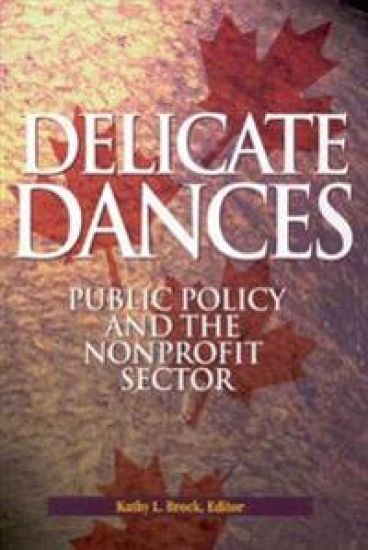
The authors look at the relationships in different provincial settings, focusing on Ontario, Quebec, and Saskatchewan, examining the defining influence of government welfare programs on the lives of two local religious orders in Atlantic Canada. The authors argue that both the public and the nonprofit sectors are changing. In the public sector, the traditional dominance of central governments has given way to a governance system that interweaves action at the global, national, regional and local levels. In the nonprofit sector, groups are assuming new organizational forms and engaging in public policy more centrally, both as advocates and service providers. Not surprisingly, relations between these two sectors involve a complex series of delicate dances, in which missteps by either partner can produce tangled confusion. It includes contributors such as: Donald Abelson (University of Western Ontario), Kathy Brock (Queens University), Ian Brodie (University of Western Ontario), Ann Capling (Melbourne University), Miriam Lapp (University of Western Ontario), Georges leBel (UQAM), Heidi Macdonald (University of Lethbridge), David Malloy (University of Regina), Kim Nossal (Queens University), Susan Phillips (Carleton University), Ken Rasmussen (University of Regina), Paul Pross (Dalhousie University), Peter Smith (Athabaska University), Elizabeth Smythe (Concordia University College of Alberta), Kernaghan Webb (Carleton University), and Mary Wiktorowicz (York University).
Mimi Adam lives in a shabby London apartment with an old sewing machine and unpaid bills, learning that working as a modern day seamstress is not what she imagined as a child. Leo lives as a smuggler without a proper home; she wouldn't call herself a criminal, but she doesn't shy away from crime. When Leo is ordered to kidnap Mimi and take her out of the country, the situation quickly gets out of hand. Leo isn't good at the job, and Mimi is bratty, demanding and difficult. A story about cautious friendship and aggressive attraction while on journey across Europe.
Lissa stared open-mouthed at the GIF that played over and over on the screen in front of her. Heat flushed to her face, igniting her skin. Her heart started pounding in her chest. Stupid internet, it should really come with a warning label. She swallowed once. Twice. Just scroll past it. Of course she was going to scroll past it. She wasn't going to sit there and stare at... Star. Lissa is a twenty-something party-planner. She's never been interested in relationships or sex and as the years have gone by she has retreated more and more into her work. Everything changes when she meets Star, a porn actress with a heart of gold and a troubled childhood. They say that opposites attract, but how much of that is true? What chance do they have when one of them is a virgin and the other one star in pornography?
"By "granting the other specificity," authors Domenici and Littlejohn successfully uphold the important values of human dignity, honor, and respect as anchoring points in which the story of the book evolves."—Stella Ting-Toomey, California State University at Fullerton"The book is written in user-friendly language, well planned, well executed, and packed with useful ideas on building positive facework in diverse contexts."—Stella Ting-Toomey, California State University at Fullerton"The advantage of this text is its consistent, strong, and thoroughly researched focus on Communication. The benefits for readers come from this focus, as well as from the accessible language, vivid examples, and engaging suggestions." —Liliana Castañeda Rossmann, California State University, San Marcos "Written in an accessible and engaging style, there is much to recommend this text as an excellent illustration of practical theory." —William R. Cupach, Illinois State University Written in a clear, engaging style Facework: Bridging Theory and Practice introduces a new paradigm that identifies facework as the key to communication within the management of difference. Authors Kathy Domenici and Stephen W. Littlejohn illustrate how facework is a central process in the social construction of both identity and community. Key Features: Goes beyond traditional understandings of face to enrich the concept of facework: This book formulates a new practical theory of facework and provides principles of practice derived from the theory. Skills and methods appropriate for a face-centered practice of communication in the management of difference are addressed. Offers a wide spectrum of examples: Building dignity, honor, and respect is an ongoing accomplishment within the conversations and episodes of group life, in relationships, organizations, communities, nations, and international relations. This book includes cases on the personal, organizational, societal, and global levels. Demonstrates a fresh perspective in a clear, engaging, and accessible style: The book honors the research literature on facework and presents key findings in a meaningful way. Intended Audience: This is an excellent text for undergraduate and graduate courses in Intercultural Communication, Interpersonal Communication, Negotiation and Conflict Resolution, Management Communication, and Group Communication, among others. It is also a valuable resource for management consultants, mediators, facilitators, trainers, and organizational development professionals.