Kirjahaku
Etsi kirjoja tekijän nimen, kirjan nimen tai ISBN:n perusteella.
1000 tulosta hakusanalla Kevin R Moore


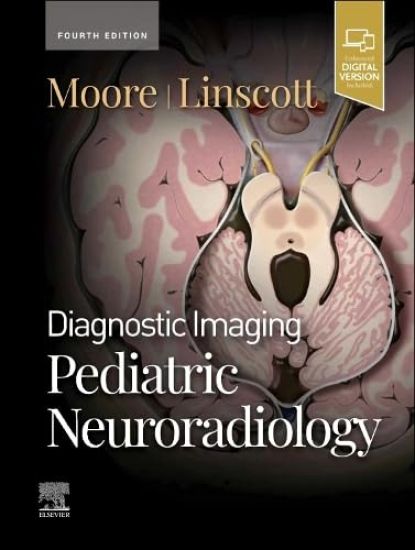
Diagnostic Imaging: Pediatric Neuroradiology
Kevin R. Moore; Luke L. Linscott
Elsevier Health Sciences
2024
sidottu
Covering the entire spectrum of this fast-changing field, the fourth edition of Diagnostic Imaging: Pediatric Neuroradiology is an invaluable resource for general radiologists, pediatric neuroradiologists, neurologists and neurosurgeons, and trainees-anyone who requires an easily accessible, highly visual reference in this complex area of imaging. Drs. Kevin R. Moore, Luke L. Linscott, and a team of highly regarded experts provide up-to-date information on nearly 280 diagnoses in short, detailed chapters to help you make informed decisions at the point of care. The text is lavishly illustrated, delineated, and referenced, making it a useful learning tool for readers at all levels of experience as well as a handy reference for daily practice. Provides a comprehensive, expert reference for quickly accessible, detailed information about neoplastic and nonneoplastic disorders affecting the brain, head, neck, and spine of children to help you make specific diagnoses and recommendations for further imaging or referral Contains numerous new chapters and sweeping updates throughout, covering advances in vessel wall imaging that provide more specific diagnoses of focal cerebral arteriopathy in children; newly identified pediatric infectious diseases, including human parechovirus; congenital brain malformations; MOGAD and NMOSD correlating to newly developed consensus standards; an up-to-date approach to pediatric demyelinating disorders; and more Includes current tumor criteria from the WHO Classification of Tumours: Central Nervous System Tumours (fifth edition), including advancements in molecular genomics and newly determined categories that identify tumor types/subtypes and facilitate differentiating subtypes Features nearly 6,000 images (in print and online-only), including radiologic images, full-color medical illustrations, clinical and gross pathology photographs, and histologic images Clearly demonstrates procedural steps, complications, treatment alternatives, variant anatomy, and more?all fully annotated to highlight the most important diagnostic information Offers a vivid, full-color design that makes the material easy to read, with an extensive image gallery and “thumbnail” visual differential diagnoses for each entity Uses bulleted, succinct text and highly templated chapters for quick comprehension of essential information at the point of care Includes an eBook version that enables you to access all text, figures, and references, with the ability to search, customize your content, make notes and highlights, and have content read aloud
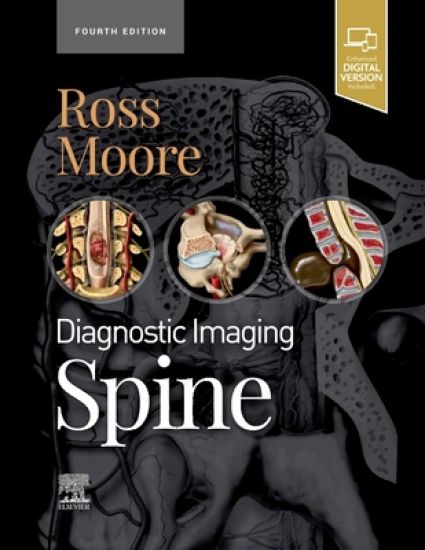
Diagnostic Imaging: Spine
Jeffrey S. Ross; Kevin R. Moore
Elsevier - Health Sciences Division
2020
sidottu
Covering the entire spectrum of this fast-changing field, Diagnostic Imaging: Spine, fourth edition, is an invaluable resource for general radiologists, neuroradiologists, and trainees-anyone who requires an easily accessible, highly visual reference on today's spinal imaging. Drs. Jeffrey Ross, Kevin Moore, and their team of highly regarded experts provide updated information on disease identification and imaging techniques to help you make informed decisions at the point of care. The text is lavishly illustrated, delineated, and referenced, making it a useful learning tool as well as a handy reference for daily practice. Serves as a one-stop resource for key concepts and information on radiologic imaging and interpretation of spine, spinal cord, and bony vertebral conditions Features more than 2,600 full-color illustrations, including radiologic, pathologic, and clinical images Contains new chapters on recent surgery protocols such as spine instability neoplastic scoring (SINS) and epidural spinal cord compression scale (ESSC) Features updates from cover to cover including revisions in accordance with new information on inflammatory and autoimmune disorders and systemic manifestations of diseases Provides expanded imaging details for metastatic diseases to accommodate recent significant changes, including new categories of oncologic surgery driven by the use of proton beam radiotherapy, PET MR as a diagnostic modality, and new FDA-approved hardware Includes new information on areas of demyelinating diseases related to better understanding of MS, neuromyelitis optica spectrum disorder, and anti-MOG disorders; a variety of spinal CSF leak pathologies that cause intracranial hypotension; genetic and disease information on schwannomatosis; and much more Uses bulleted, succinct text and highly templated chapters for quick comprehension of essential information at the point of care Enhanced eBook version included with purchase. Your enhanced eBook allows you to access all of the text, figures, and references from the book on a variety of devices
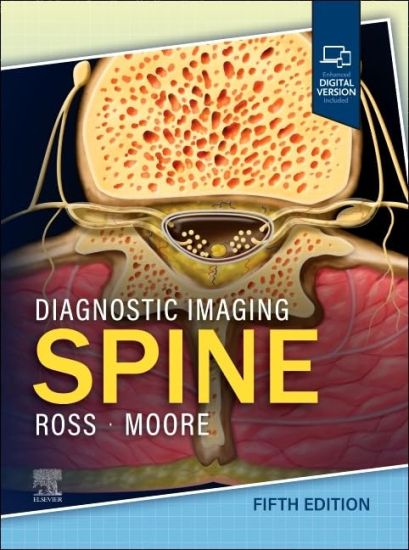
Covering the entire spectrum of this fast-changing field, Diagnostic Imaging: Spine, fifth edition, is an invaluable resource for general radiologists, neuroradiologists, and trainees?anyone who requires an easily accessible, highly visual reference on today’s spinal imaging. Drs. Jeffrey Ross, Kevin Moore, and their team of highly regarded experts provide updated information on disease identification and imaging techniques to help you make informed decisions at the point of care. The text is image-rich, with succinct bullets that quickly convey details, and includes the latest literature references, making it a useful learning tool as well as a handy reference for daily practice. Serves as a one-stop resource for key concepts and information on radiologic imaging and interpretation of the spine, neck, and central nervous system Contains six robust sections, each beginning with normal imaging anatomy and covering all aspects of this challenging field: Congenital and Genetic Disorders, Trauma, Degenerative Diseases and Arthritides, Infection and Inflammatory Disorders, Peripheral Nerve and Plexus, and Spine Postprocedural/Posttreatment Imaging Features 3,200+ high-quality print images (with an additional 2,100+ images in the complimentary eBook), including radiologic images, full-color medical illustrations, clinical photographs, histologic images, and gross pathologic photographs Provides new and expanded content on CSF leak disorder and root sleeve leak; CSF-venous fistulas; demyelinating disease based upon better knowledge of MS; neuromyelitis optica spectrum disorder; anti-MOG disorders; malignant nerve sheath tumor and paragangliomas; and spinal ependymomas, including myxopapillary and classical cellular spinal ependymoma Contains new chapters on both imaging technique and diseases/disorders, and existing chapters have been rearranged to better represent current information on inflammatory and autoimmune disorders and systemic manifestations of diseases Provides updates from cover to cover, including overviews and new recommendations for evaluation of transitional spinal anatomy (spine enumeration), which have important and practical applications in routine imaging with downstream effects on spine intervention Uses bulleted, succinct text and highly templated chapters for quick comprehension of essential information at the point of care Includes an eBook that allows you access to everything in the print version as well as additional images, text, and references, with the ability to search, customize your content, make notes and highlights, and have content read aloud; additional digital ancillary content may publish up to 6 weeks following the publication date
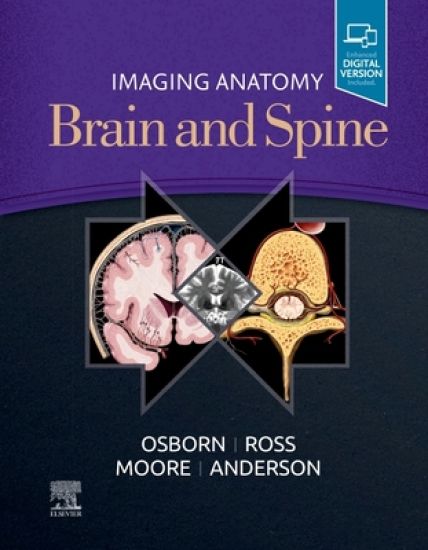
Imaging Anatomy Brain and Spine
Anne G. Osborn; Karen L. Salzman; Jeffrey S. Anderson; Arthur W. Toga; Meng Law; Jeffrey Ross; Kevin R. Moore
Elsevier - Health Sciences Division
2020
sidottu
This richly illustrated and superbly organized text/atlas is an excellent point-of-care resource for practitioners at all levels of experience and training. Written by global leaders in the field, Imaging Anatomy: Brain and Spine provides a thorough understanding of the detailed normal anatomy that underlies contemporary imaging. This must-have reference employs a templated, highly formatted design; concise, bulleted text; and state-of- the-art images throughout that identify the clinical entities in each anatomic area. Features more than 2,500 high-resolution images throughout, including 7T MR, fMRI, diffusion tensor MRI, and multidetector row CT images in many planes, combined with over 300 correlative full-color anatomic drawings that show human anatomy in the projections that radiologists use. Covers only the brain and spine, presenting multiplanar normal imaging anatomy in all pertinent modalities for an unsurpassed, comprehensive point-of-care clinical reference. Incorporates recent, stunning advances in imaging such as 7T and functional MR imaging, surface and segmented anatomy, single-photon emission computed tomography (SPECT) scans, dopamine transporter (DAT) scans, and 3D quantitative volumetric scans. Places 7T MR images alongside 3T MR images to highlight the benefits of using 7T MR imaging as it becomes more widely available in the future. Presents essential text in an easy-to-digest, bulleted format, enabling imaging specialists to find quick answers to anatomy questions encountered in daily practice. Includes the Expert ConsultT version of the book, allowing you to search all the text, figures, and references on a variety of devices.

Earn College Credit with REA's Test Prep for CLEP Chemistry Everything you need to pass the exam and get the college credit you deserve. REA leads the way in helping students pass their College Board CLEP exams and earn college credit while reducing their tuition costs. With 25+ years of experience in test prep for the College-Level Examination Program (CLEP), REA is your trusted source for the most up-to-date test-aligned content. Whether you're an adult returning to finish your degree, a traditional-age college student, a military service member, or a high school or home-schooled student looking to get a head start on college and shorten your path to graduation, CLEP is perfect for you. REA's expert authors know the CLEP tests inside out. And thanks to our partners at Proctortrack (proctortrack.com/clep), you can now take your exam at your convenience, from the comfort of home. Prep for success on the CLEP Chemistry exam with REA's personalized three-step plan: (1) focus your study, (2) review with the book, and (3) measure your test-readiness. Our Book + Online prep gives you all the tools you need to make the most of your study time: Diagnostic exam: Pinpoint what you already know and what you need to study. Targeted subject review: Learn what you'll be tested on. Two full-length practice exams: Zero in on the topics that give you trouble now so you'll be confident and prepared on test day. Glossary of key terms: Round out your prep with must-know vocabulary.REA is America's recognized leader in CLEP preparation. Our test prep helps you earn valuable college credit, save on tuition, and accelerate your path to a college degree.
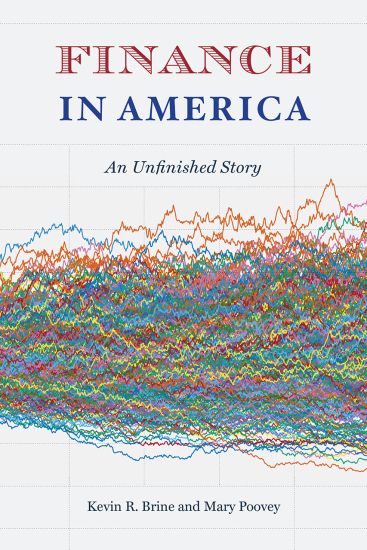
The economic crisis of 2008 led to an unprecedented focus on the world of high finance and revealed it to be far more arcane and influential than most people could ever have imagined. Any hope of avoiding future crises, it's clear, rest on understanding finance itself. To understand finance, however, we have to learn its history, and this book fills that need. Kevin R. Brine, an industry veteran, and Mary Poovey, an acclaimed historian, show that finance as we know it today emerged gradually in the late nineteenth century and only coalesced after World War II, becoming ever more complicated and ever more central to the American economy. The authors explain the models, regulations, and institutions at the heart of modern finance and uncover the complex and sometimes surprising origins of its critical features, such as corporate accounting standards, the Federal Reserve System, risk management practices, and American Keynesian and New Classic monetary economics. This book sees finance through its highs and lows, from pre-Depression to post-Recession, exploring the myriad ways in which the practices of finance and the realities of the economy influenced one another through the years. A masterwork of collaboration, Finance in America lays bare the theories and practices that constitute finance, opening up the discussion of its role and risks to a broad range of scholars and citizens.

Drawing Lines in the Forest
Kevin R. Marsh; William Cronon
University of Washington Press
2007
sidottu
Drawing boundaries around wilderness areas often serves a double purpose: protection of the land within the boundary and release of the land outside the boundary to resource extraction and other development. In Drawing Lines in the Forest, Kevin R. Marsh discusses the roles played by various groups—the Forest Service, the timber industry, recreationists, and environmentalists—in arriving at these boundaries. He shows that pragmatic, rather than ideological, goals were often paramount, with all sides benefiting.After World War II, representatives of both logging and recreation use sought to draw boundaries that would serve to guarantee access to specific areas of public lands. The logging industry wanted to secure a guaranteed supply of timber, as an era of stewardship of the nation's public forests gave way to an emphasis on rapid extraction of timber resources. This spawned a grassroots preservationist movement that ultimately challenged the managerial power of the Forest Service. The Wilderness Act of 1964 provided an opportunity for groups on all sides to participate openly and effectively in the political process of defining wilderness boundaries.The often contentious debates over the creation of wilderness areas in the Cascade Mountains in Oregon and Washington represent the most significant stages in the national history of wilderness conservation since World War II: Three Sisters, North Cascades and Glacier Peak, Mount Jefferson, Alpine Lakes, French Pete, and the state-wide wilderness acts of 1984.

Drawing Lines in the Forest
Kevin R. Marsh; William Cronon
University of Washington Press
2010
pokkari
Drawing boundaries around wilderness areas often serves a double purpose: protection of the land within the boundary and release of the land outside the boundary to resource extraction and other development. In Drawing Lines in the Forest, Kevin R. Marsh discusses the roles played by various groups—the Forest Service, the timber industry, recreationists, and environmentalists—in arriving at these boundaries. He shows that pragmatic, rather than ideological, goals were often paramount, with all sides benefiting.After World War II, representatives of both logging and recreation use sought to draw boundaries that would serve to guarantee access to specific areas of public lands. The logging industry wanted to secure a guaranteed supply of timber, as an era of stewardship of the nation's public forests gave way to an emphasis on rapid extraction of timber resources. This spawned a grassroots preservationist movement that ultimately challenged the managerial power of the Forest Service. The Wilderness Act of 1964 provided an opportunity for groups on all sides to participate openly and effectively in the political process of defining wilderness boundaries.The often contentious debates over the creation of wilderness areas in the Cascade Mountains in Oregon and Washington represent the most significant stages in the national history of wilderness conservation since World War II: Three Sisters, North Cascades and Glacier Peak, Mount Jefferson, Alpine Lakes, French Pete, and the state-wide wilderness acts of 1984.

Biomarkers in Urologic Cancer, An Issue of Urologic Clinics of North America
Kevin R. Loughlin
Elsevier - Health Sciences Division
2015
sidottu
The past decade has been marked by the acceleration of our understanding of the molecular biology of cancer. Simultaneously, there have been increasing exigencies to diagnose, treat and follow cancer patients more economically. Biomarkers represent the marriage of science and economics. Biomarkers offer the potential to increase the precision of diagnosis, prognosis, and surveillance of urological malignancies. This issue presents the cutting-edge advances of biomarker technology to urologic oncology.

Multivariable Calculus and Mathematica®
Kevin R. Coombes; Ronald L. Lipsman; Jonathan M. Rosenberg
Springer-Verlag New York Inc.
1998
nidottu
One of the authors' stated goals for this publication is to "modernize" the course through the integration of Mathematica. Besides introducing students to the multivariable uses of Mathematica, and instructing them on how to use it as a tool in simplifying calculations, they also present intoductions to geometry, mathematical physics, and kinematics, topics of particular interest to engineering and physical science students. In using Mathematica as a tool, the authors take pains not to use it simply to define things as a whole bunch of new "gadgets" streamlined to the taste of the authors, but rather they exploit the tremendous resources built into the program. They also make it clear that Mathematica is not algorithms. At the same time, they clearly see the ways in which Mathematica can make things cleaner, clearer and simpler. The problem sets give students an opportunity to practice their newly learned skills, covering simple calculations with Mathematica, simple plots, a review of one-variable calculus using Mathematica for symbolic differentiation, integration and numberical integration. They also cover the practice of incorporating text and headings into a Mathematica notebook. A DOS-formatted diskette accompanies the printed work, containing both Mathematica 2.2 and 3.0 version notebooks, as well as sample examination problems for students. This supplementary work can be used with any standard multivariable calculus textbook. It is assumed that in most cases students will also have access to an introductory primer for Mathematica.

Project Management Accounting, with Website
Kevin R. Callahan; Gary S. Stetz; Lynne M. Brooks
John Wiley Sons Inc
2011
sidottu
Over the past few decades, Project Management has shifted from its roots in construction and defense into mainstream American business. However, many project managers' areas of expertise lie outside the perimeters of business, and most do not have the formal education in business, accounting, or finance required to take their skills to the next level. In order to succeed, today's project managers (PMs) who wish to soar to the top or remain at the helm of their profession need to have a comprehensive grasp of the business context within which they work. Providing a resourceful introduction to the interrelationships between finance, accounting, and Project Management, Project Management Accounting, Second Edition is designed to help PMs at various skill levels improve their business skills, provide advanced contributions to their organizations, and perform with greater proficiency. Authors and industry experts Kevin Callahan, Gary Stetz, and Lynne Brooks combine their decades of Project Management experience and insights to provide professionals in the field with a 360-degree understanding of how costs interact with the general ledger. Through the authors' seasoned expertise, PMs are better equipped to assess all facets of a project with a broader understanding of the "big picture" to determine whether to continue as planned, find an alternative solution, or scrap the project altogether. Rich with new content as well as many new case studies, this Second Edition of Project Management Accounting includes: Updated information on Project Management and its link to Project AccountingA new chapter on assessing risk when managing projectsHow to determine the greatest tax/cost savingsProject Management in relation to a company's mission, objectives, and strategyProject Management in an agile businessCoverage of agile Project Management as applied to software and technical projectsNew, updated, and timely case studiesSample checklists to help readers get started and apply concepts to their business Project managers must make vital decisions every day that impact the schedule, costs, or resources committed to a given project. Project Management Accounting, Second Edition, provides the tools and skills to help PMs establish with greater certainty whether these costs should be capitalized or expensed to stay on budget and improve a company's bottom line.
Essentials of Strategic Project Management
Kevin R. Callahan; Lynn M. Brooks
John Wiley Sons Inc
2004
nidottu
A high-level overview of project management With Essentials of Strategic Project Management, executives get practical guidance, useful advice, tools, and techniques to navigate project management. This strategically focused book demystifies project management by defining many terms that project managers use that may not be familiar to executives. It also equips executives with the critical knowledge and background to implement sound project management methods, as well as gain a better understanding of project management and increase the success of existing projects. Kevin R. Callahan, PMP (St. Charles, IL), is the founder and President of PMCi, a registered education provider for the Project Management Institute (PMI). Lynne M. Brooks, PMP (St. Charles, IL), is Vice President of PMCi and President of Lynne Brooks Associates, Inc., a consulting firm specializing in performance and project management, and training and development.
The Mathematica ® Primer
Kevin R. Coombes; Brian R. Hunt; Ronald L. Lipsman; John E. Osborn; Garrett J. Stuck
Cambridge University Press
1998
pokkari
This book is a short, focused introduction to Mathematica, the comprehensive software system for doing mathematics. Written for the beginning user, this engaging book contains an explanation of essential Mathematica commands, as well as the rich Mathematica interface for preparing polished technical documents. Mathematica can be used to graph functions, solve equations, perform statistics tests, and much more. In addition, it incorporates word processing and desktop publishing features for combining mathematical computations with text and graphics, and producing polished, integrated, interactive documents. You can even use it to create documents and graphics for the Web. This book explains everything you need to know to begin using Mathematica to do all these things and more. Written for Mathematica Version 3, this book can also be used with earlier versions of Mathematica, and even intermediate and advanced users may find useful information here, especially if they are making the switch to Version 3 from an earlier version.