Kirjojen hintavertailu. Mukana 11 342 296 kirjaa ja 12 kauppaa.

Kirjahaku

Etsi kirjoja tekijän nimen, kirjan nimen tai ISBN:n perusteella.

1000 tulosta hakusanalla Kevin R. Williams

Nothing More Important Than Others: Why Loving People Is So Important in Near-Death Experiences
Nothing is more important than other people. Near-death experiences affirms this fact. Why? Because God is manifest within other people; and how we treat other people is how we treat God. Loving other people unconditionally is the goal for every human being because God is love, and love is God. How we treat other people will determine exactly which afterlife realm we will inhabit after death. Those people who love others the most will inhabit the highest heaven. In other words, the afterlife is about deeds - not creeds - and loving others unconditioinally is where God is manifest the most. Giving and receiving love is what produces heaven - it's the only thing we can take with us after death. Loving others is heaven. And love is joy The more love we have for other people, the more joy we have in our lives. And there are a multidude of heavens of varying degree of love and joy, so that no one goes where they are unwelcome or do not fit in. Birds of a feather flock together. This book reveals the importance of loving others. Three exceptional near-death experiences are provided to make this point. The author's research conclusions includes topis such as the Earth as the "School of Hard Knocks;" the problem of war and evil; the death process; the soul as an orb; the homecoming experienced by NDErs; the intense emoptions experienced in NDEs; forgotten knowledge people receive during their NDE; and a description of some of the afterlife realms. This book also includes articles from the author's website showing how love is supreme when it dcomes to NDEs.
Nothing Better Than Death: Insights from Sixty-Two Profound Near-Death Experiences
Nothing Better Than Death, by Kevin R. Williams, provides the full near-death testimonies (NDEs) of nine extraordinary experiencers along with summaries of fifty-three of the most profound near-death experiences documented. The author has gleaned insights involving thirteen categories of research conclusions about such topics as pre-existence, life, humanity, religion, spirituality, the future, science, God, heaven, hell, spirit guides, music, time, and reincarnation. A defense of near-death testimony in light of Christian doctrine is presented which proves that NDEs are not unscriptural, are not of the devil, that NDEs and the Bible affirm God is unconditional love, that NDEs and the Bible affirm universal salvation, and that NDEs and the Bible affirm the reality of reincarnation. The Appendix of this book presents the following sections: (a) Notes from this book, (b) A complete NDE bibliography, and (c) Information about the author. The title of this book originated from a profound insight found in NDE testimony which is that NDEs reveal how death is the greatest blessing human beings can ever experience. According to a great number of people who have had an NDE, there is nothing better on Earth than death. One experiencer, Dianne Morrissey said, "If I lived a billion years more, in my body or yours, there's not a single experience on Earth that could ever be as good as being dead. Nothing." Kevin R. Williams is the webmaster of "Near-Death Experiences and the Afterlife" at www.near-death.com.
Loose Leaf for Financial and Managerial Accounting

Loose Leaf for Financial and Managerial Accounting

Jan Williams; Mark S. Bettner; Kevin R. Smith

McGraw-Hill Companies
2023
irtolehti
Financial and Managerial Accounting: The Basis for Business Decisions continues to offer a solid foundation for students who are learning basic accounting concepts. Known for giving equal weight to financial and managerial topics, the authors emphasize the need for a strong foundation in both aspects of accounting. The authors made data driven revisions focusing on where students were struggling and updated content accordingly. Updates have also been made to the high-quality end of chapter problems and new Guided Example hint videos in Connect.
Drawing Lines in the Forest

Drawing Lines in the Forest

Kevin R. Marsh; William Cronon

University of Washington Press
2007
sidottu
Drawing boundaries around wilderness areas often serves a double purpose: protection of the land within the boundary and release of the land outside the boundary to resource extraction and other development. In Drawing Lines in the Forest, Kevin R. Marsh discusses the roles played by various groups—the Forest Service, the timber industry, recreationists, and environmentalists—in arriving at these boundaries. He shows that pragmatic, rather than ideological, goals were often paramount, with all sides benefiting.After World War II, representatives of both logging and recreation use sought to draw boundaries that would serve to guarantee access to specific areas of public lands. The logging industry wanted to secure a guaranteed supply of timber, as an era of stewardship of the nation's public forests gave way to an emphasis on rapid extraction of timber resources. This spawned a grassroots preservationist movement that ultimately challenged the managerial power of the Forest Service. The Wilderness Act of 1964 provided an opportunity for groups on all sides to participate openly and effectively in the political process of defining wilderness boundaries.The often contentious debates over the creation of wilderness areas in the Cascade Mountains in Oregon and Washington represent the most significant stages in the national history of wilderness conservation since World War II: Three Sisters, North Cascades and Glacier Peak, Mount Jefferson, Alpine Lakes, French Pete, and the state-wide wilderness acts of 1984.
Drawing Lines in the Forest

Drawing Lines in the Forest

Kevin R. Marsh; William Cronon

University of Washington Press
2010
pokkari
Drawing boundaries around wilderness areas often serves a double purpose: protection of the land within the boundary and release of the land outside the boundary to resource extraction and other development. In Drawing Lines in the Forest, Kevin R. Marsh discusses the roles played by various groups—the Forest Service, the timber industry, recreationists, and environmentalists—in arriving at these boundaries. He shows that pragmatic, rather than ideological, goals were often paramount, with all sides benefiting.After World War II, representatives of both logging and recreation use sought to draw boundaries that would serve to guarantee access to specific areas of public lands. The logging industry wanted to secure a guaranteed supply of timber, as an era of stewardship of the nation's public forests gave way to an emphasis on rapid extraction of timber resources. This spawned a grassroots preservationist movement that ultimately challenged the managerial power of the Forest Service. The Wilderness Act of 1964 provided an opportunity for groups on all sides to participate openly and effectively in the political process of defining wilderness boundaries.The often contentious debates over the creation of wilderness areas in the Cascade Mountains in Oregon and Washington represent the most significant stages in the national history of wilderness conservation since World War II: Three Sisters, North Cascades and Glacier Peak, Mount Jefferson, Alpine Lakes, French Pete, and the state-wide wilderness acts of 1984.
The Catastrophe Ahead

The Catastrophe Ahead

William B. Johnston; Kevin R. Hopkins

Praeger Publishers Inc
1990
sidottu
The result of an intensive two-year research study, this volume examines the likely course of the AIDS epidemic over the next fifteen years. Extremely well-documented and based largely on sophisticated statistical analysis, the study makes detailed forecasts of who will become sick; explores the social, political, and economic consequences of the spread of the disease; and analyzes the controversial policy choices that must be made if the epidemic is to be contained. The authors argue that current policies have failed in their efforts to combat the spread of AIDS and suggest new public policy measures aimed at dramatically reducing the spread of the virus. AIDS researchers, health care practitioners, and policymakers will find The Catastrophe Ahead both an invaluable source of detailed statistical information about the AIDS epidemic and an urgent call to action.Based on the study results, the authors conclude that by 2002, a million and a half people may die of AIDS and more than 4 million others may be infected with the disease. They explore various scenarios--worst, best, and middle cases--demonstrating that blacks face by far the greatest risks: under the most likely scenario some 15 percent of all blacks between the ages of 15 and 50 will carry the virus by 2002. The authors propose a universal routine voluntary testing program to avert this catastrophe, enabling people to sexually self-segregate themselves based on whether or not they carry the HIV virus. While the authors concede that this program cannot completely stem the tide of infection, they argue that it offers one of the best defenses available against the epidemic. Well written and illustrated with numerous tables and figures, this volume should be required reading for anyone involved in AIDS counseling and policymaking.
Enterprise Level Security 1 & 2

Enterprise Level Security 1 & 2

Kevin Foltz; William R. Simpson

CRC Press
2020
muu
This set comprises of Enterprise Level Security and Enterprise Level Security 2. ELS provides a modern alternative to the fortress approach to security. ELS 2 follows on from the first book, which covered the basic concepts of ELS, to give a discussion of advanced topics and solutions.
Enterprise Level Security 1 & 2

Enterprise Level Security 1 & 2

Kevin Foltz; William R. Simpson

TAYLOR FRANCIS LTD
2022
muu
This set comprises of Enterprise Level Security and Enterprise Level Security 2. ELS provides a modern alternative to the fortress approach to security. ELS 2 follows on from the first book, which covered the basic concepts of ELS, to give a discussion of advanced topics and solutions.
Enterprise Level Security 2

Enterprise Level Security 2

Kevin E. Foltz; William R. Simpson

CRC Press
2020
sidottu
Enterprise Level Security 2: Advanced Topics in an Uncertain World follows on from the authors’ first book on Enterprise Level Security (ELS), which covered the basic concepts of ELS and the discoveries made during the first eight years of its development. This book follows on from this to give a discussion of advanced topics and solutions, derived from 16 years of research, pilots, and operational trials in putting an enterprise system together. The chapters cover specific advanced topics derived from painful mistakes and numerous revisions of processes. This book covers many of the topics omitted from the first book including multi-factor authentication, cloud key management, enterprise change management, entity veracity, homomorphic computing, device management, mobile ad hoc, big data, mediation, and several other topics.The ELS model of enterprise security is endorsed by the Secretary of the Air Force for Air Force computing systems and is a candidate for DoD systems under the Joint Information Environment Program.The book is intended for enterprise IT architecture developers, application developers, and IT security professionals.This is a unique approach to end-to-end security and fills a niche in the market.
Enterprise Level Security 2

Enterprise Level Security 2

Kevin E. Foltz; William R. Simpson

TAYLOR FRANCIS LTD
2023
nidottu
Enterprise Level Security 2: Advanced Topics in an Uncertain World follows on from the authors’ first book on Enterprise Level Security (ELS), which covered the basic concepts of ELS and the discoveries made during the first eight years of its development. This book follows on from this to give a discussion of advanced topics and solutions, derived from 16 years of research, pilots, and operational trials in putting an enterprise system together. The chapters cover specific advanced topics derived from painful mistakes and numerous revisions of processes. This book covers many of the topics omitted from the first book including multi-factor authentication, cloud key management, enterprise change management, entity veracity, homomorphic computing, device management, mobile ad hoc, big data, mediation, and several other topics.The ELS model of enterprise security is endorsed by the Secretary of the Air Force for Air Force computing systems and is a candidate for DoD systems under the Joint Information Environment Program.The book is intended for enterprise IT architecture developers, application developers, and IT security professionals.This is a unique approach to end-to-end security and fills a niche in the market.
Environmental Law Handbook

Environmental Law Handbook

Kevin A. Ewing; Duke K. McCall; David R. Case; Marshall Lee Miller; Daniel M. Steinway; Karen J. Nardi; Christopher Bell; Stanley W. Landfair; Austin P. Olney; Thomas Richichi; F. William Brownell; Jessica O. King; John M. Scagnelli; James W. Spensley; Rolf R. von Oppenfeld; Andrew N. Davis

Bernan Press
2019
sidottu
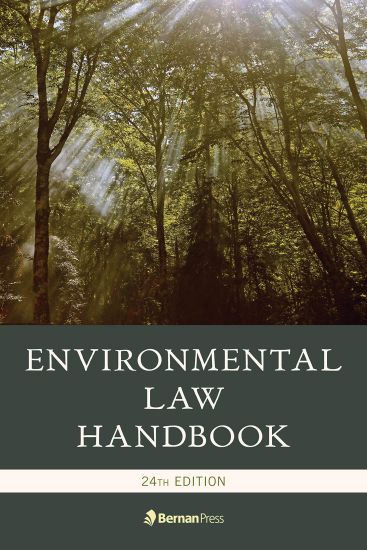
The environmental field and its regulations have evolved significantly since Congress passed the first environmental law in 1970, and the Environmental Law Handbook, published just three years later, has been indispensable to students and professionals ever since. The authors provide clear and accessible explanations, expert legal insight into new and evolving regulations, and reliable compliance and management guidance. The Environmental Law Handbook continues to provide individuals across the country—professionals, professors, and students—with a comprehensive, up-to-date, and easy-to-read look at the major environmental, health, and safety laws affecting U.S. businesses and organizations. Because it is written by the country's leading environmental law firms, it provides the best, most reliable guidance anywhere. Both professional environmental managers and students aspiring to careers in environmental management should keep the Environmental Law Handbook within arm's reach for thoughtful answers to regulatory questions like: ·How do I ensure compliance with the regulations? ·How do the latest environmental developments impact my operations? ·How do we keep our operations efficient and our community safe? The Handbook begins with chapters on the fundamentals of environmental law and on issues of enforcement and liability. It then dives headfirst into the major laws, examining their history, scope, and requirements with a chapter devoted to each. The 24th edition of this well-known Handbook has been thoroughly updated, covering major changes to the law and enforcement in the areas of Clean Air, Clean Water, Climate Change, Oil Pollution, and Pollution Prevention. This is an essential reference for environmental students and professionals, and anyone who wants the most up-to-date information available on environmental laws.
Clep(r) Chemistry Book + Online

Clep(r) Chemistry Book + Online

Kevin R. Reel

Research Education Association
2013
nidottu
Earn College Credit with REA's Test Prep for CLEP Chemistry Everything you need to pass the exam and get the college credit you deserve. REA leads the way in helping students pass their College Board CLEP exams and earn college credit while reducing their tuition costs. With 25+ years of experience in test prep for the College-Level Examination Program (CLEP), REA is your trusted source for the most up-to-date test-aligned content. Whether you're an adult returning to finish your degree, a traditional-age college student, a military service member, or a high school or home-schooled student looking to get a head start on college and shorten your path to graduation, CLEP is perfect for you. REA's expert authors know the CLEP tests inside out. And thanks to our partners at Proctortrack (proctortrack.com/clep), you can now take your exam at your convenience, from the comfort of home. Prep for success on the CLEP Chemistry exam with REA's personalized three-step plan: (1) focus your study, (2) review with the book, and (3) measure your test-readiness. Our Book + Online prep gives you all the tools you need to make the most of your study time: Diagnostic exam: Pinpoint what you already know and what you need to study. Targeted subject review: Learn what you'll be tested on. Two full-length practice exams: Zero in on the topics that give you trouble now so you'll be confident and prepared on test day. Glossary of key terms: Round out your prep with must-know vocabulary.REA is America's recognized leader in CLEP preparation. Our test prep helps you earn valuable college credit, save on tuition, and accelerate your path to a college degree.
Finance in America

Finance in America

Kevin R. Brine; Mary Poovey

University of Chicago Press
2017
nidottu
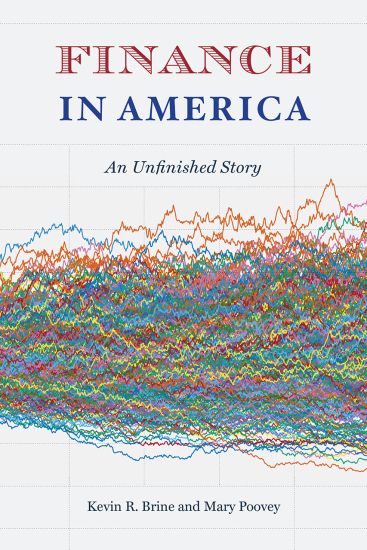
The economic crisis of 2008 led to an unprecedented focus on the world of high finance and revealed it to be far more arcane and influential than most people could ever have imagined. Any hope of avoiding future crises, it's clear, rest on understanding finance itself. To understand finance, however, we have to learn its history, and this book fills that need. Kevin R. Brine, an industry veteran, and Mary Poovey, an acclaimed historian, show that finance as we know it today emerged gradually in the late nineteenth century and only coalesced after World War II, becoming ever more complicated and ever more central to the American economy. The authors explain the models, regulations, and institutions at the heart of modern finance and uncover the complex and sometimes surprising origins of its critical features, such as corporate accounting standards, the Federal Reserve System, risk management practices, and American Keynesian and New Classic monetary economics. This book sees finance through its highs and lows, from pre-Depression to post-Recession, exploring the myriad ways in which the practices of finance and the realities of the economy influenced one another through the years. A masterwork of collaboration, Finance in America lays bare the theories and practices that constitute finance, opening up the discussion of its role and risks to a broad range of scholars and citizens.
Biomarkers in Urologic Cancer, An Issue of Urologic Clinics of North America

Biomarkers in Urologic Cancer, An Issue of Urologic Clinics of North America

Kevin R. Loughlin

Elsevier - Health Sciences Division
2015
sidottu
The past decade has been marked by the acceleration of our understanding of the molecular biology of cancer. Simultaneously, there have been increasing exigencies to diagnose, treat and follow cancer patients more economically. Biomarkers represent the marriage of science and economics. Biomarkers offer the potential to increase the precision of diagnosis, prognosis, and surveillance of urological malignancies. This issue presents the cutting-edge advances of biomarker technology to urologic oncology.
Multivariable Calculus and Mathematica®

Multivariable Calculus and Mathematica®

Kevin R. Coombes; Ronald L. Lipsman; Jonathan M. Rosenberg

Springer-Verlag New York Inc.
1998
nidottu
One of the authors' stated goals for this publication is to "modernize" the course through the integration of Mathematica. Besides introducing students to the multivariable uses of Mathematica, and instructing them on how to use it as a tool in simplifying calculations, they also present intoductions to geometry, mathematical physics, and kinematics, topics of particular interest to engineering and physical science students. In using Mathematica as a tool, the authors take pains not to use it simply to define things as a whole bunch of new "gadgets" streamlined to the taste of the authors, but rather they exploit the tremendous resources built into the program. They also make it clear that Mathematica is not algorithms. At the same time, they clearly see the ways in which Mathematica can make things cleaner, clearer and simpler. The problem sets give students an opportunity to practice their newly learned skills, covering simple calculations with Mathematica, simple plots, a review of one-variable calculus using Mathematica for symbolic differentiation, integration and numberical integration. They also cover the practice of incorporating text and headings into a Mathematica notebook. A DOS-formatted diskette accompanies the printed work, containing both Mathematica 2.2 and 3.0 version notebooks, as well as sample examination problems for students. This supplementary work can be used with any standard multivariable calculus textbook. It is assumed that in most cases students will also have access to an introductory primer for Mathematica.