Kirjojen hintavertailu. Mukana 11 244 527 kirjaa ja 12 kauppaa.

Kirjahaku

Etsi kirjoja tekijän nimen, kirjan nimen tai ISBN:n perusteella.

1000 tulosta hakusanalla Khalid Sayood

Introduction to Data Compression

Introduction to Data Compression

Khalid Sayood

Morgan Kaufmann Publishers In
2017
nidottu
Introduction to Data Compression, Fifth Edition, builds on the success of what is widely considered the best introduction and reference text on the art and science of data compression. Data compression techniques and technology are ever-evolving with new applications in image, speech, text, audio and video. This new edition includes all the latest developments in the field. Khalid Sayood provides an extensive introduction to the theory underlying today’s compression techniques, with detailed instruction for their applications using several examples to explain the concepts. Encompassing the entire field of data compression, the book includes lossless and lossy compression, Huffman coding, arithmetic coding, dictionary techniques, context based compression, and scalar and vector quantization. The book provides a comprehensive working knowledge of data compression, giving the reader the tools to develop a complete and concise compression package.
Understanding Circuits

Understanding Circuits

Khalid Sayood

Springer International Publishing AG
2007
nidottu
This book/lecture is intended for a college freshman level class in problem solving, where the particular problems deal with electrical and electronic circuits. It can also be used in a junior/senior level class in high school to teach circuit analysis. The basic problem-solving paradigm used in this book is that of resolution of a problem into its component parts. The reader learns how to take circuits of varying levels of complexity using this paradigm. The problem-solving exercises also familiarize the reader with a number of different circuit components including resistors, capacitors, diodes, transistors, and operational amplifiers and their use in practical circuits. The reader should come away with both an understanding of how to approach complex problems and a “feel” for electrical and electronic circuits.
Learning Programming Using Matlab

Learning Programming Using Matlab

Khalid Sayood

Springer International Publishing AG
2007
nidottu
This book is intended for anyone trying to learn the fundamentals of computer programming. The chapters lead the reader through the various steps required for writing a program, introducing the MATLABr® constructs in the process. MATLABr® is used to teach programming because it has a simple programming environment. It has a low initial overhead which allows the novice programmer to begin programming immediately and allows the users to easily debug their programs. This is especially useful for people who have a “mental block” about computers. Although MATLABr® is a high-level language and interactive environment that enables the user to perform computationally intensive tasks faster than with traditional programming languages such as C, C++, and Fortran, the author shows that it can also be used as a programming learning tool for novices. There are a number of exercises at the end of each chapter which should help users become comfortable with the language.
Signals and Systems

Signals and Systems

Khalid Sayood

Springer International Publishing AG
2021
nidottu
This book is designed for use as a textbook for a one semester Signals and Systems class. It is sufficiently user friendly to be used for self study as well. It begins with a gentle introduction to the idea of abstraction by looking at numbers—the one highly abstract concept we use all the time. It then introduces some special functions that are useful for analyzing signals and systems. It then spends some time discussing some of the properties of systems; the goal being to introduce the idea of a linear time-invariant system which is the focus of the rest of the book. Fourier series, discrete and continuous time Fourier transforms are introduced as tools for the analysis of signals. The concepts of sampling and modulation which are very much a part of everyday life are discussed as applications of the these tools. Laplace transform and Z transform are then introduced as tools to analyze systems. The notions of stability of systems and feedback are analyzed using these tools. The book is divided into thirty bite-sized modules. Each module also links up with a video lecture through a QR code in each module. The video lectures are approximately thirty minutes long. There are a set of self study questions at the end of each module along with answers to help the reader reinforce the concepts in the module.
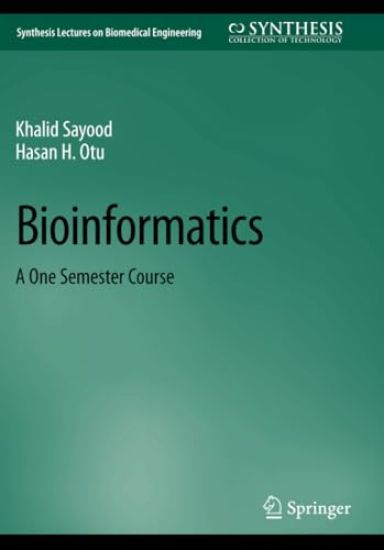
Bioinformatics

Bioinformatics

Khalid Sayood; Hasan H. Otu

Springer International Publishing AG
2023
sidottu
This book focuses on bioinformatics, the study of the management and analysis of information used in biological systems. Particular emphasis explains to the reader how to study and extract useful information, such as relatedness of species, function of specific sequences, and genome organization from genomic sequences. This book focuses on the algorithmic aspects of bioinformatics and not on databases and software packages. There are two important discriminating characteristics that sets the book apart. It connects the algorithmic aspects and approaches to bioinformatics with the biological context while maintaining a user friendly and accessible description of the algorithms. The authors have curated the content for use a stand alone reference or the book will fit a one semester course on the subject.
Bioinformatics

Bioinformatics

Khalid Sayood; Hasan H. Otu

Springer International Publishing AG
2024
nidottu
This book focuses on bioinformatics, the study of the management and analysis of information used in biological systems. Particular emphasis explains to the reader how to study and extract useful information, such as relatedness of species, function of specific sequences, and genome organization from genomic sequences. This book focuses on the algorithmic aspects of bioinformatics and not on databases and software packages. There are two important discriminating characteristics that sets the book apart. It connects the algorithmic aspects and approaches to bioinformatics with the biological context while maintaining a user friendly and accessible description of the algorithms. The authors have curated the content for use a stand alone reference or the book will fit a one semester course on the subject.
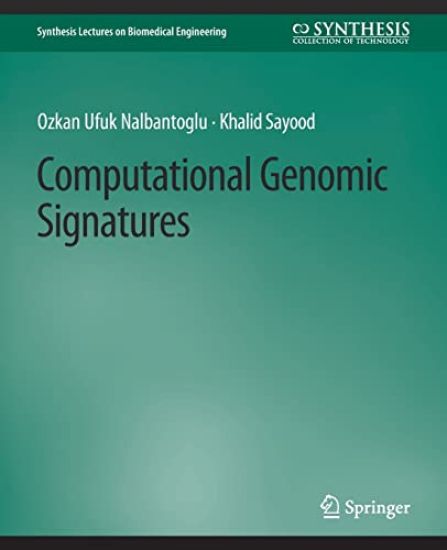
Computational Genomic Signatures

Computational Genomic Signatures

Ozkan Ufuk Nalbantoglu; Khalid Sayood

Springer International Publishing AG
2011
nidottu
Recent advances in development of sequencing technology has resulted in a deluge of genomic data. In order to make sense of this data, there is an urgent need for algorithms for data processing and quantitative reasoning. An emerging in silico approach, called computational genomic signatures, addresses this need by representing global species-specific features of genomes using simple mathematical models. This text introduces the general concept of computational genomic signatures, and it reviews some of the DNA sequence models which can be used as computational genomic signatures. The text takes the position that a practical computational genomic signature consists of both a model and a measure for computing the distance or similarity between models. Therefore, a discussion of sequence similarity/distance measurement in the context of computational genomic signatures is presented. The remainder of the text covers various applications of computational genomic signatures in the areas ofmetagenomics, phylogenetics and the detection of horizontal gene transfer. Table of Contents: Genome Signatures, Definition and Background / Other Computational Characterizations as Genome Signatures / Measuring Distance of Biological Sequences Using Genome Signatures / Applications: Phylogeny Construction / Applications: Metagenomics / Applications: Horizontal DNA Transfer Detection
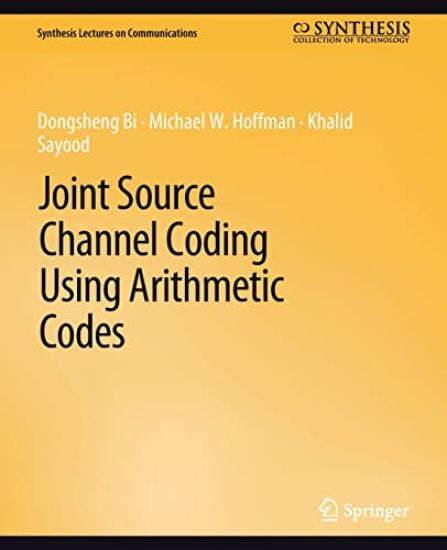
Joint Source Channel Coding Using Arithmetic Codes

Joint Source Channel Coding Using Arithmetic Codes

Bi Dongsheng; Khalid Sayood; Michael Hoffman

Springer International Publishing AG
2009
nidottu
Based on the encoding process, arithmetic codes can be viewed as tree codes and current proposals for decoding arithmetic codes with forbidden symbols belong to sequential decoding algorithms and their variants. In this monograph, we propose a new way of looking at arithmetic codes with forbidden symbols. If a limit is imposed on the maximum value of a key parameter in the encoder, this modified arithmetic encoder can also be modeled as a finite state machine and the code generated can be treated as a variable-length trellis code. The number of states used can be reduced and techniques used for decoding convolutional codes, such as the list Viterbi decoding algorithm, can be applied directly on the trellis. The finite state machine interpretation can be easily migrated to Markov source case. We can encode Markov sources without considering the conditional probabilities, while using the list Viterbi decoding algorithm which utilizes the conditional probabilities. We can also use context-based arithmetic coding to exploit the conditional probabilities of the Markov source and apply a finite state machine interpretation to this problem. The finite state machine interpretation also allows us to more systematically understand arithmetic codes with forbidden symbols. It allows us to find the partial distance spectrum of arithmetic codes with forbidden symbols. We also propose arithmetic codes with memories which use high memory but low implementation precision arithmetic codes. The low implementation precision results in a state machine with less complexity. The introduced input memories allow us to switch the probability functions used for arithmetic coding. Combining these two methods give us a huge parameter space of the arithmetic codes with forbidden symbols. Hence we can choose codes with better distance properties while maintaining the encoding efficiency and decoding complexity. A construction and search method is proposed and simulation results show that we can achieve a similar performance as turbo codes when we apply this approach to rate 2/3 arithmetic codes. Table of Contents: Introduction / Arithmetic Codes / Arithmetic Codes with Forbidden Symbols / Distance Property and Code Construction / Conclusion
Khalid - Free Spirit

Khalid - Free Spirit

Khalid

Hal Leonard Publishing Corporation
2019
nidottu
(Piano/Vocal/Guitar Artist Songbook). As one of the most-streamed artists in the world, it was no surprise that Khalid's 2019 album debuted at the top of the BILLBOARD album charts. Our matching folio includes all 17 tracks arranged for piano and voice with guitar chord frames. Songs include: Alive * Bad Luck * Better * Bluffin' * Don't Pretend * Free Spirit * Heaven * Hundred * Intro * My Bad * Outta My Head * Paradise * Right Back * Saturday Nights * Self * Talk * Twenty One.
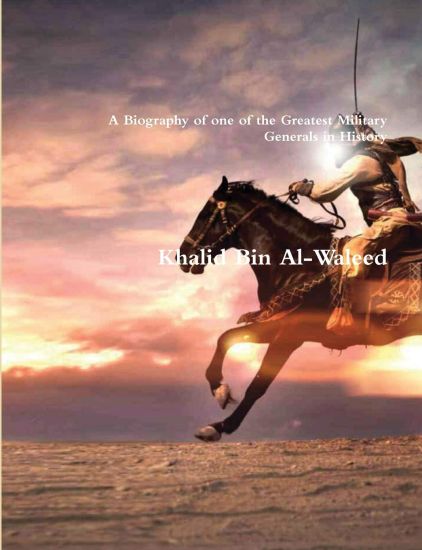
Khalid Ibn Al-Walid

Khalid Ibn Al-Walid

Omer Yilmaz

The Light Inc
2015
nidottu
Khalid ibn al-Walid was born to be a leader of men. Growing up as one of three brothers in a military family, he always played commander to his brothers' soldiers. After honing his skills as a soldier, his natural leadership qualities and courage on the battlefield made him a natural choice as commander of the cavalry. This book charts his career as an illustrious and successful warrior, Khalid ibn al Walid, first against the Muslim army, and later as leader of the Muslim army. This change of heart was something even the mighty warrior couldn't resist. For, however great Khalid's struggles on the battlefield, his greatest struggle took place within his own heart. Influenced first by his brother Walid's conversion to Islam, and secondly by his personal encounter wit the noble Prophet, peace and blessings be upon him, Khalid could not resist the call of Islam, and became a Muslim. The story goes on to tell how, thanks to his victories in battle, Islam spread rapidly through Arabia and Syria. Khalid won a fearsome reputation as "the Sword of Allah" and, under the blessed Prophet's guidance, fought his greatest battles to win wars, but also to win people's hearts and bring the beautiful religion of Islam to all humanity. Throughout his life, Khalid was the personification of the advice he gave to his soldiers: "Patience is the highest virtue; defeat is feebleness; victory is only won with patience."
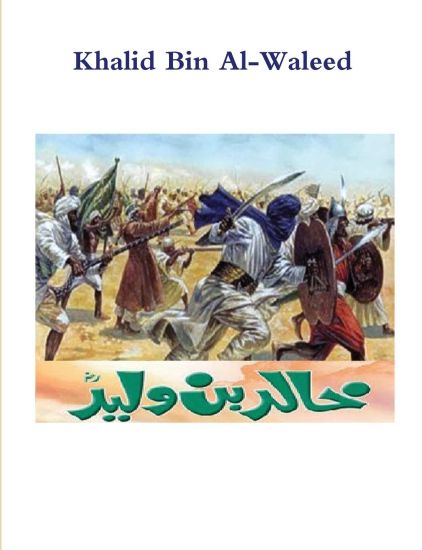
Khalid Bin Al-Waleed

Khalid Bin Al-Waleed

Akram

Noaha Foundation
1979
pokkari
Khalid ibn Walid was also known as Sayf Allah al-Maslūl (Drawn Sword of God), a companion of the Prophet and noted for his military tactics and prowess. It was under his military leadership that Arabia, for the first time in history, was united under a single political entity, the Caliphate. His strategic achievements include the conquest of Arabia, Persian Mesopotamia and Roman Syria. He is also remembered for his decisive victories at Yamamah, Ullais and Firaz, and his tactical successes at Walaja and Yarmouk.