

Kirjahaku
Etsi kirjoja tekijän nimen, kirjan nimen tai ISBN:n perusteella.
1000 tulosta hakusanalla Kim B Miller


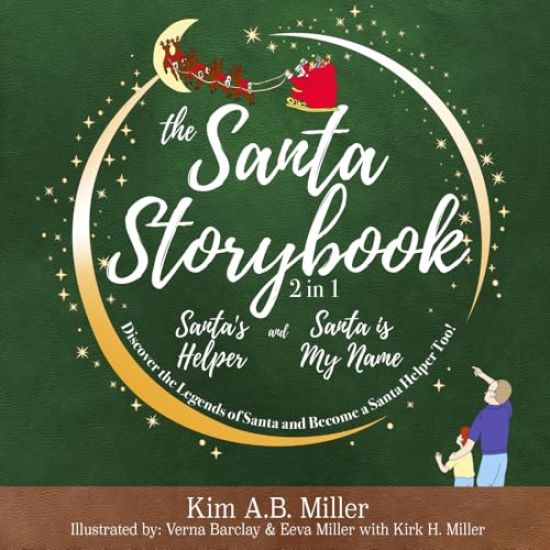
The Santa Storybook - Santa's Helper and Santa is My Name
Kim A B Miller; Eeva Miller
Purple Pineapple Press
2024
pokkari
In this 2-in-1 Storybook You Will Discover the Legends of Santa and Become a Santa Helper Too When your kids are little, it can be a struggle to decide which Christmas traditions will be right for your family as they grow up. You want to make choices that will keep the magic alive, while also teaching them the true history and meaning of Christmas. That is where the inspiration for this book of stories emerged. The stories in this book, along with some fun traditions, will allow your kids to gradually come to understand the fun and magic we all create in Christmas, at their own pace and in their own time. There are so many legends around the world that have made up who we see Santa as today, and how we celebrate Christmas. Out of all of them, the most important to shine a spotlight on is how the legends of Santa stemmed from a real man, St. Nicholas, who did so much to help the people around him, without expecting anything in return. You will be happily surprised to learn how his story parallels the true meaning of Christmas. Santa IS real and the story of his life is an incredible one. Included are stories & pictures of other legends based on St. Nicholas that bring the fun of Christmas alive. In the end, Santa Claus and what he stands for is an inspiration for the magical feeling & giving spirit of Christmas. We all can enjoy more Christmas spirit by learning about Santa's real life through these cute stories.Santa's Helper - The first story in this 2-in-1 storybook, Santa's Helper, is a treasure to families who want to bring the spirit of giving to their homes during the Christmas season. It follows the story of Timmy, who learns that Santa is real and that giving brings magic to Christmas. & Santa is My Name - The second story, called Santa is My Name, brings us the true history & legends of Santa, along with many of his helpers. It helps us see how we can be a SANTA helper too "These stories are a treasured part of our family's Christmas season. They've helped our kids understand the true story of St. Nicholas and have brought so much excitement to our home. As we've created traditions from these stories, it has kept the magic of Christmas alive in our home for the young and old alike. We truly love this book set and hope your family loves it too " -Kirk and Kim
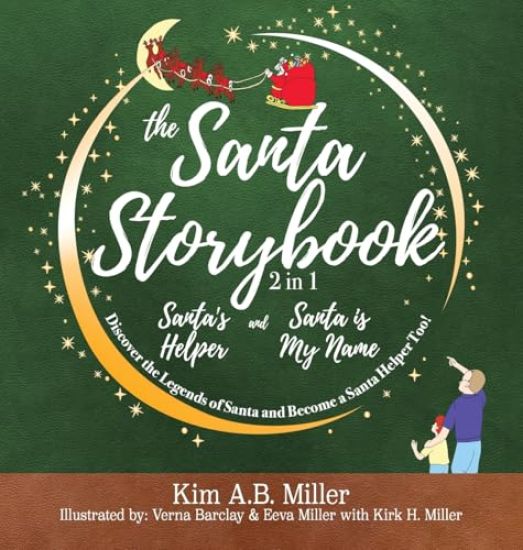
The Santa Storybook - Santa's Helper and Santa is My Name
Kim A B Miller; Eeva Miller
Purple Pineapple Press
2024
sidottu
In this 2-in-1 Storybook You Will Discover the Legends of Santa and Become a Santa Helper Too When your kids are little, it can be a struggle to decide which Christmas traditions will be right for your family as they grow up. You want to make choices that will keep the magic alive, while also teaching them the true history and meaning of Christmas. That is where the inspiration for this book of stories emerged. The stories in this book, along with some fun traditions, will allow your kids to gradually come to understand the fun and magic we all create in Christmas, at their own pace and in their own time. There are so many legends around the world that have made up who we see Santa as today, and how we celebrate Christmas. Out of all of them, the most important to shine a spotlight on is how the legends of Santa stemmed from a real man, St. Nicholas, who did so much to help the people around him, without expecting anything in return. You will be happily surprised to learn how his story parallels the true meaning of Christmas. Santa IS real and the story of his life is an incredible one. Included are stories & pictures of other legends based on St. Nicholas that bring the fun of Christmas alive. In the end, Santa Claus and what he stands for is an inspiration for the magical feeling & giving spirit of Christmas. We all can enjoy more Christmas spirit by learning about Santa's real life through these cute stories.Santa's Helper - The first story in this 2-in-1 storybook, Santa's Helper, is a treasure to families who want to bring the spirit of giving to their homes during the Christmas season. It follows the story of Timmy, who learns that Santa is real and that giving brings magic to Christmas. & Santa is My Name - The second story, called Santa is My Name, brings us the true history & legends of Santa, along with many of his helpers. It helps us see how we can be a SANTA helper too "These stories are a treasured part of our family's Christmas season. They've helped our kids understand the true story of St. Nicholas and have brought so much excitement to our home. As we've created traditions from these stories, it has kept the magic of Christmas alive in our home for the young and old alike. We truly love this book set and hope your family loves it too " -Kirk and Kim

Developing Effective Physical Activity Programs
Lynda B. Ransdell; Mary K. Dinger; Jennifer L. Huberty; Kim H. Miller
Human Kinetics
2009
pokkari
Developing Effective Physical Activity Programs emphasizes the move away from a one-size-fits-all approach to physical activity interventions by providing evidence-based recommendations for designing, implementing, and evaluating more effective and appropriate physical activity interventions for diverse populations. Part of Human Kinetics' Physical Activity Intervention series, the book provides research, methods, techniques, and support to health professionals seeking ways to promote physical activity programs that meet the specific needs of women, overweight and obese populations, older adults, and ethnically diverse populations—those shown as most likely to be sedentary and in need of the benefits of physical activity interventions.Developing Effective Physical Activity Programs offers background information to guide the planning process:-Physical activity recommendations for adults from various federal agencies and professional organizations, including the Centers for Disease Control and Prevention, the U.S. Department Health and Human Services, and the American College of Sports Medicine-An overview of scientific literature, which serves as a foundation for the physical activity recommendations-Detailed information regarding the four cornerstones of physical activity promotion: needs assessment, program planning, program implementation, and program evaluation -Descriptions of various physical activity measurement techniques and factors to consider when choosing one of these techniques The authors explain how careful consideration of the needs of specific populations can increase the success of physical activity interventions. They present evidence-based recommendations for working with various populations. Key considerations are discussed for each population, including the elements that make up the most successful interventions, unique barriers, and techniques for overcoming those barriers. Helpful tables summarize the barriers and solutions for each group, providing quick reference for designing programs. The final section of the text examines how the built environment, setting, and technology can influence intervention planning. You'll look at the ways in which neighborhood and community design can affect a person's physical activity levels. You'll also consider the various settings in which a program can be held, including homes, churches, and worksites, and how those settings will affect your program. This section also shows you how technology, such as Web- and phone-based interventions and podcasts, can be used to expand the reach of your program and positively influence the physical activity levels of participants.Throughout the book are summaries of current research studies examining physical activity interventions in various populations and settings along with descriptions and examples of successful programs and explanations for their success. In addition, each chapter concludes with helpful checklists that provide recommendations for developing and implementing physical activity interventions in various populations and settings. Unique in its comprehensive coverage of special populations, Developing Effective Physical Activity Programs shows practitioners how to answer the physical activity needs of each client or client group, address issues relevant to sedentary populations, and offer viable physical activity programs to improve the lives of the unique individuals they serve.Developing Effective Physical Activity Programs is part of the Physical Activity Intervention series. This timely series provides educational resources for professionals interested in promoting and implementing physical activity programs to a diverse and often resistant population.
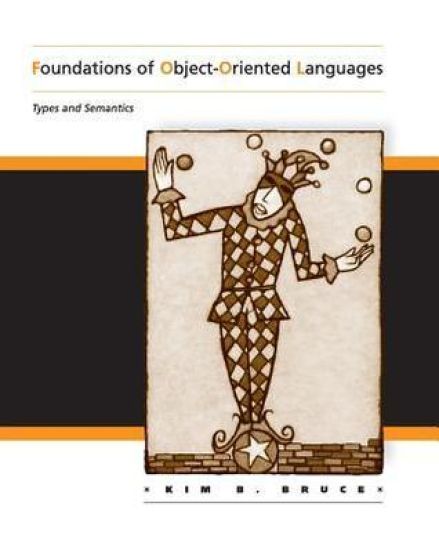
In recent years, object-oriented programming has emerged as the dominant computer programming style, and object-oriented languages such as C++ and Java enjoy wide use in academia and industry. This text explores the formal underpinnings of object-oriented languages to help the reader understand the fundamental concepts of these languages and the design decisions behind them. The text begins by analyzing existing object-oriented languages, paying special attention to their type systems and impediments to expressiveness. It then examines two key features: subtypes and subclasses. After a brief introduction to the lambda calculus, it presents a prototypical object-oriented language, SOOL, with a simple type system similar to those of class-based object-oriented languages in common use. The text offers proof that the type system is sound by showing that the semantics preserves typing information. It concludes with a discussion of desirable features, such as parametric polymorphism and a MyType construct, that are not yet included in most statically typed object-oriented languages.

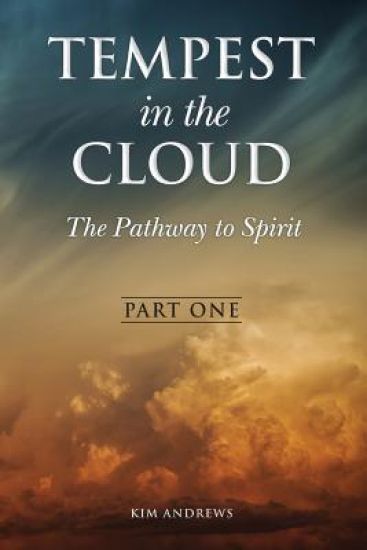
Tempest in the Cloud is a profound book that gives the reader an understanding of the esoteric knowledge hidden within the Bible. The Bible is a manual for raising consciousness to the Spirit level and includes specific meditation instructions on how to commune with God personally and directly. The Bible is a set of instructions on how to make the elusive God into a knowable God. Tempest in the Cloud interprets significant scriptural passages to bring clarity for the modern person on how the pathway to Spirit is to be taken. If you think the Bible is simply Jewish mythology, or a book just about the political and religious life of ancient people, you will need to intellectually move beyond those confining points of view to be open to the profound, and confounding, reality of our own energetic make-up. The Bible is a tapestry woven with three threads: literal, contextual, and esoteric. Organized religion tends to focus on the literal rendition of the biblical stories. Intellectuals and academia seem to focus on the historical/political/cultural context of the stories. Tempest in the Cloudfocuses on the esoteric aspects of the Bible since it is the hidden knowledge of the scriptures that leads to the radical transformation of the soul. The Bible is a guide to the human body, as it is the human body that is the mechanism for resurrection. Resurrection (the second birth or ascension) that was available to Jesus andavailable to us all. The purpose of this book is threefold: To illustrate that God exists and can be personally, directly knowable. To uncover the hidden secrets within the Bible, secret and sacred wisdom that teaches the pathway to the knowable God which happens through deep meditation practices. To show the universality of the pathway to God among the world's true religions.
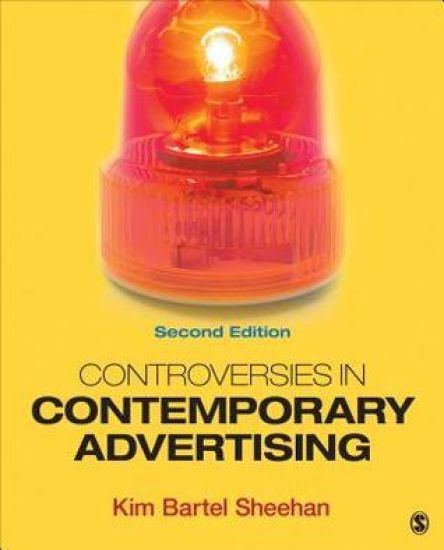
Presenting a range of perspectives on advertising in a global society, this Second Edition of Controversies in Contemporary Advertising examines economic, political, social, and ethical perspectives and covers a number of topics including stereotyping, controversial products, consumer culture, and new technology. The book is divided equally between macro and micro issues, providing a balanced portrait of the role advertising has in society today. Author Kim Bartel Sheehan's work recognizes the plurality of opinions towards advertising, allowing the reader to form and analyze their own judgments. It encourages readers to obtain a critical perspective on advertising issues.

But Your Mother Loves You is the witty and candid tale of how a renowned psychotherapist moved from “not good enough” to “the right person” despite childhood neglect and a toxic relationship with her mother. Everyone knows at least one person who demonstrates toxic love, someone who consistently jabs a straw in others and sucks the life right out of them. Without an in-depth understanding of how to navigate these relationships, most people continue to emotionally regress and remain paralyzed in familiar, pain-soaked patterns. But Your Mother Loves You helps readers overcome this cycle of toxicity. Kim Honeycutt shares the real-life experience of how a shame-based, self-destructive little girl grew up to be a recovered alcoholic, entered the world of psychology as a professional, and created her own strategies to address and conquer toxicity. This story, both witty and practical, is told through the lens of personal life experience and expert psychological strategies combined with Godly intervention. Readers learn how to either walk away from or walk with a toxic loved one without losing themselves. Covered in both vulnerability and clinical information, But Your Mother Loves You provides a step-by-step approach on how to stop toxic love and the subsequent self-abuse.
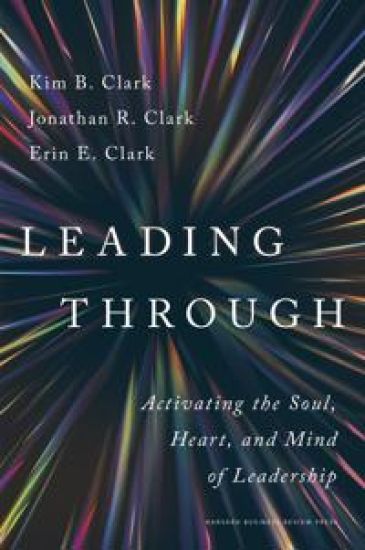
Leading Through
Kim B. Clark; Jonathan R. Clark; Erin E. Clark
Harvard Business Review Press
2024
sidottu
Generative AI and the remote-work revolution show us every day that we're in a new era. The rules and norms have changed—and so must leadership.And yet, coercive bureaucracy, hierarchy, and control—old ways of thinking and working—are still with us, a deep-seated and powerful legacy. We are living through a profound transition from an old, industrial era to a new one that is digital, transparent, and complex.In this important new book by former dean of Harvard Business School Kim Clark, written with his business school professor son, Jonathan, and management consultant daughter, Erin, the dynamic struggle between two competing paradigms of leadership is compellingly illustrated: an old paradigm that involves control and power over people versus a new one that enables and inspires power through people.With rich examples and stories, the authors show how deeply ingrained the legacy model of leadership remains and how destructive it is, causing waste and loss of human potential, stifling innovation, and ultimately resulting in what the authors call "organizational darkness." They go on to articulate a new, positive model, one that consciously seeks to do good and to make things better; that cares for people, helping them to thrive; and that mobilizes people to solve tough problems. These three elements, they argue, are the soul, heart, and mind of leadership, and activating them requires careful attention to both the personal and the organizational dimensions of leadership.The narrative is interwoven with probing analysis and reflection, and the authors speak clearly and frankly about the moral aspects and impact of leadership. They also provide a concrete frame and approach for scaling the new model and creating a vibrant leadership system.Leading Through is a deep and essential account of the evolution of our leadership thinking and practice that is both timely and timeless.

Arlington National Cemetery
George W Dodge; Kim B Holien
Arcadia Publishing Library Editions
2006
sidottu
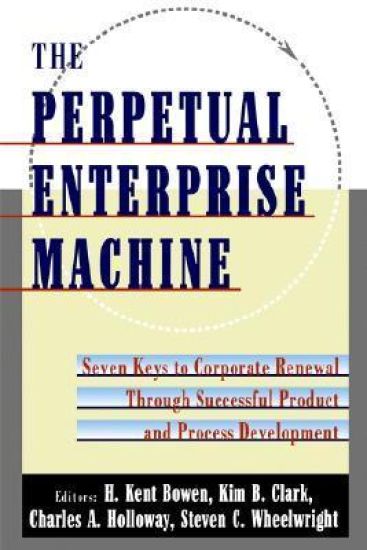
The Perpetual Enterprise Machine
H. Kent Bowen; Kim B. Clark; Charles A. Holloway; Steven C. Wheelwright
Oxford University Press Inc
1994
sidottu
US manufacturing is today in a critical period. As a consequence of new global competitors, changes in technologies, and significant shifts in national priorities, our manufacturing base has shrunk alarmingly and thousands of manufacturing jobs have been lost. To address this problem, a unique team was formed called the Manufacturing Vision Group, which included members from five major companies (Chaparral Steel, DEC, Ford Motor Company, Hewlett-Packard, and Eastman Kodak) and four major universities (Harvard, MIT, Purdue, and Stanford). In The Perpetual Enterprise Machine, this group argues that the manufacturer that can initiate successful projects--leading to new products and processes--will be the one that prospers in the years ahead. They reveal how to launch a successful project and how projects can be mechanisms for growth and learning for the firm. The Perpetual Enterprise Machine outlines seven critical elements that outstanding development projects have in common, principles that can be powerful engines of success for the manufacturer facing the challenges of today's fiercely competitive environment. Successful firms are able to use their Core Capabilities across functions, to bring together disciplines and personnel crucial to the success of the program. They have a Guiding Vision, shared by all members of the project team, that helps coordinate the actions of workers with different skills and priorities. They Push the Performance Envelope, striving to make the improvements needed to cope with a rapidly changing competitive environment. They have Leadership, someone who can navigate uncertain terrain, who sees the project's essential elements and how they fit together. They instill the team with a sense of Ownership and Commitment, linking their personal success, status, and esteem to accomplishing project goals. They use Prototyping to learn rapidly and reduce mistakes. And they Integrate within Projects, approaching individual tasks in terms of a system-wide solution. Throughout the book, the authors illustrate these seven principles with real life case histories. We see the story behind Kodak's development of the FunSaver camera (done on a unique CAD/CAM system that greatly helped integration and shortened the lead time from design to production); Ford's 1991 Crown Victoria, the first project launched under their Concept-to-Customer system; Chaparral Steel's development of the world's first horizontal steel caster; and Hewlett-Packard's wildly successful DeskJet printer. The Perpetual Enterprise Machine delivers the insights of some of the top minds from industry and academia on one of the primary concerns of American business--how to revitalize our manufacturing industries. Visionary--yet engaging and immediately accessible--it gives managers the opportunity to profit from the trials and triumphs of five major corporations, and helps them shape the kinds of projects that will thrive and prosper in the years ahead.
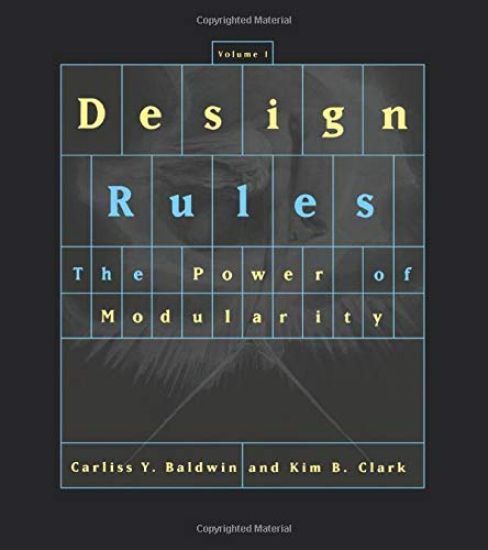
We live in a dynamic economic and commerical world, surrounded by objects of remarkable complexity and power. In many industries, changes in products and technologies have brought with them new kinds of firms and forms of organization. We are discovering news ways of structuring work, of bringing buyers and sellers together, and of creating and using market information. Although our fast-moving economy often seems to be outside of our influence or control, human beings create the things that create the market forces. Devices, software programs, production processes, contracts, firms, and markets are all the fruit of purposeful action: they are designed. Using the computer industry as an example, Carliss Y. Baldwin and Kim B. Clark develop a powerful theory of design and industrial evolution. They argue that the industry has experienced previously unimaginable levels of innovation and growth because it embraced the concept of modularity, building complex products from smaller subsystems that can be designed independently yet function together as a whole. Modularity freed designers to experiment with different approaches, as long as they obeyed the established design rules. Drawing upon the literatures of industrial organization, real options, and computer architecture, the authors provide insight into the forces of change that drive today's economy.

Spatial Analysis in Epidemiology
Dirk U. Pfeiffer; Timothy P. Robinson; Mark Stevenson; Kim B. Stevens; David J. Rogers; Archie C.A. Clements
Oxford University Press
2008
sidottu
This book provides a practical, comprehensive and up-to-date overview of the use of spatial statistics in epidemiology - the study of the incidence and distribution of diseases. Used appropriately, spatial analytical methods in conjunction with GIS and remotely sensed data can provide significant insights into the biological patterns and processes that underlie disease transmission. In turn, these can be used to understand and predict disease prevalence. This user-friendly text brings together the specialised and widely-dispersed literature on spatial analysis to make these methodological tools accessible to epidemiologists for the first time. With its focus is on application rather than theory, Spatial Analysis in Epidemiology includes a wide range of examples taken from both medical (human) and veterinary (animal) disciplines, and describes both infectious diseases and non-infectious conditions. Furthermore, it provides worked examples of methodologies using a single data set from the same disease example throughout, and is structured to follow the logical sequence of description of spatial data, visualisation, exploration, modelling and decision support. This accessible text is aimed at graduate students and researchers dealing with spatial data in the fields of epidemiology (both medical and veterinary), ecology, zoology and parasitology, environmental science, geography and statistics.

Spatial Analysis in Epidemiology
Dirk U. Pfeiffer; Timothy P. Robinson; Mark Stevenson; Kim B. Stevens; David J. Rogers; Archie C.A. Clements
Oxford University Press
2008
nidottu
This book provides a practical, comprehensive and up-to-date overview of the use of spatial statistics in epidemiology - the study of the incidence and distribution of diseases. Used appropriately, spatial analytical methods in conjunction with GIS and remotely sensed data can provide significant insights into the biological patterns and processes that underlie disease transmission. In turn, these can be used to understand and predict disease prevalence. This user-friendly text brings together the specialised and widely-dispersed literature on spatial analysis to make these methodological tools accessible to epidemiologists for the first time. With its focus is on application rather than theory, Spatial Analysis in Epidemiology includes a wide range of examples taken from both medical (human) and veterinary (animal) disciplines, and describes both infectious diseases and non-infectious conditions. Furthermore, it provides worked examples of methodologies using a single data set from the same disease example throughout, and is structured to follow the logical sequence of description of spatial data, visualisation, exploration, modelling and decision support. This accessible text is aimed at graduate students and researchers dealing with spatial data in the fields of epidemiology (both medical and veterinary), ecology, zoology and parasitology, environmental science, geography and statistics.

Handbook of Mine Safety
W. David Yates; Daniel J. Schmutz; Kim B. Redding
TAYLOR FRANCIS LTD
2025
sidottu
The field of mining safety is rapidly evolving and staying abreast of regulations and standards is crucial for any mining professional. However, with a growing scarcity of seasoned professionals, the industry faces a pressing need for comprehensive resources.Addressing this gap, the Handbook of Mine Safety: Compliance, Strategies, and Examples provides essential guidance for practitioners. From navigating complex hazards to interpreting evolving standards, this handbook offers indispensable insights tailored to the unique challenges of the mining sector. Inside the book, readers will find a wealth of practical information aimed at enhancing safety protocols and compliance. Beyond theoretical discussion, this handbook offers practical and actionable strategies and real-world examples to aid in the implementation of safety measures. From legal requirements to corrective measures, each chapter is written by an expert in the field and has been crafted to equip professionals with the tools they need to navigate the complexities of mining safety effectively. This will be the only guide the professional will need to gain a full understanding of all facets of safety in the mining industry.This handbook is a must-have resource for professionals in the fields of Occupational Health and Safety, Mining Engineering, Safety Engineering and Fire Safety. Whether you're a seasoned practitioner seeking to deepen your understanding or a newcomer looking to establish a solid foundation in mining safety, this book offers invaluable theory and practical guidance to enhance safety practices and mitigate risks in the dynamic world of mining operations.

Using Qualitative Research in Advertising
Margaret A. Morrison; Eric E. Haley; Kim B. Sheehan; Ronald E. Taylor
SAGE Publications Inc
2011
nidottu
This Second Edition remains the only book to discuss both theory and application of qualitative research techniques to inspire great advertising and build strong brands. Using a step-by-step approach, designed for students considering advertising careers and for those currently working in the advertising industry, this book explains what qualitative research techniques are designed to do. The text describes how these techniques aid in uncovering insights useful for advertising strategy development, creative development, and post-campaign evaluation. Practical information and discussions on interviewing, projective techniques, focus groups, and online/social media applications positioned within a theoretical context illustrate the value of qualitative research in the real world.

A Scientific Forum on the Gulf of Mexico: The Islands in the Stream Concept
Brian D. Keller; U. S. Department of Commerce; Kim B. Ritchie
Createspace Independent Publishing Platform
2008
nidottu