

Kirjahaku
Etsi kirjoja tekijän nimen, kirjan nimen tai ISBN:n perusteella.
1000 tulosta hakusanalla Klaus D. Emrich

"Kuchen bei Klaus" ist das erste Backbuch des Autors. Klaus ist ein leidenschaftlicher Koch und B cker. Seit seiner Kindheit war es sein Traum, in der K che zu spielen, neue Rezepte und Gerichte zu erfinden. "Cakes by Klaus" is the author's first baking book. Klaus is a passionate cook and baker. Since childhood, it was his dream to play in the kitchen, inventing new recipes, creating new dishes.

Forever Loved: LELU, 1997-2010 a CAT's love story
Klaus D. Emrich
Von Der Alps Publishing Corporation
2010
nidottu



The Squirrels and I: An afternoon in the Park
Klaus D. Emrich
Von Der Alps Publishing Corporation
2014
nidottu

Die Eichhörnchen und Ich: Ein nachmittag im Park
Klaus D. Emrich
Von Der Alps Publishing Corporation
2015
nidottu
"Die Eichh rnchen und Ich " ist ein lustiges Buch, es ist eine Inspiration f r die Fotografie und familienorientierte Veranstaltungen, an denen jeder teilnehmen kann. The Photographed STORY in this book developed during one afternoon while visiting a wonderful park. I had no idea that such fun was possible in interaction with the park's resident squirrels. Of course, I could not resist but publish the story.

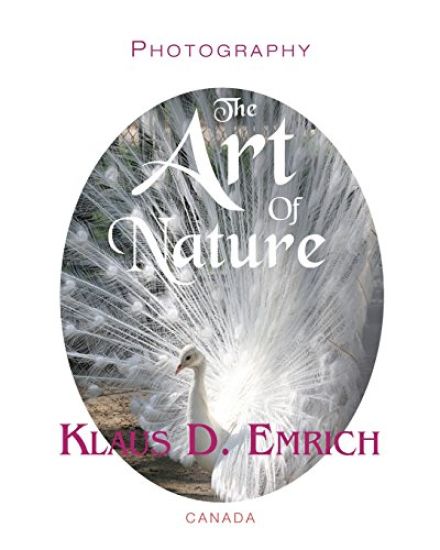
Dieses Buch ist ein Spiegelbild der Natur, es ist ein angebot f r die Menschheit. Seine Herrlichkeit beinhaltet Tiere, Pflanzen / Blumen, B ume, usw. PHOTOGRAPHY - The spectacular beauty of Canada's nature via the lenses of Author/Photographer Klaus D. Emrich.

Klaus D. Emrich schafft Faszination ber Digital Kunst in diesem Buch. Er schaffte es, die Fotografie in einer angenehmen Kunstform, um Kreativit t zu f rdern, Transformation. In this book, Klaus D. Emrich creates allure via Digital ART. In order to encourage creativity, he transformed photography in a pleasant art form.

Kreative Kunst ist ein perfektes beispiel ber die F higkeiten des K nstlers zur Fotografie, die Bilder in k nstlerischen Spa zu verwandeln. Creative Art is a perfect example of the artist's capabilities to transform photography into artistic fun images.

Blends biology, clinical science, genetics, and molecular biology of the immune system to provide a complete account of our knowledge of immunologyNew features include full-color artwork and design, over 50 new figures, and text that has been completely revised to reflect the very latest referencesIncorporates a variety of pedagogical aids to assist students in the learning process, including chapter outlines, objectives, and summaries, as well as a self-evaluation section
Advances in Cryogenic Engineering, V4: Proceedings of the 1958 Cryogenic Engineering Conference
Klaus D. Timmerhaus
Literary Licensing, LLC
2012
nidottu

Advances in Cryogenic Engineering, V7: Proceedings of the 1961 Cryogenic Engineering Conference, August 15-17, 1961
Klaus D. Timmerhaus
Literary Licensing, LLC
2012
nidottu

Core Undertones are eigenmodes of the Earth's fluid outer core. In this reprint of the authors dissertation thesis different analytical and numerical solution routines to calculate those eigenvalues are described. An implementation of high precision computer arithmetics serves as basis for the numerical solution. .......... .......... .......... .......... .......... .......... .......... .......... .......... .......... .......... .......... .......... .......... .......... .......... .......... .......... Core Undertones nennt man die Eigenschwingungen des fl ssigen usseren Erdkerns. In diesem Nachdruck der Dissertation des Autors werden verschiedene analytische und numerische L sungsans tze zur Berechnung dieser Eigenschwingungen vorgestellt. Eine Implementierung hochgenauer Computerarithmetik dient hierbei als Basis der numerischen Simulation.
This book presents a comprehensive overview of medical image analysis. Practical in approach, the text is uniquely structured by potential applications. Features: presents learning objectives, exercises and concluding remarks in each chapter, in addition to a glossary of abbreviations; describes a range of common imaging techniques, reconstruction techniques and image artefacts; discusses the archival and transfer of images, including the HL7 and DICOM standards; presents a selection of techniques for the enhancement of contrast and edges, for noise reduction and for edge-preserving smoothing; examines various feature detection and segmentation techniques, together with methods for computing a registration or normalisation transformation; explores object detection, as well as classification based on segment attributes such as shape and appearance; reviews the validation of an analysis method; includes appendices on Markov random field optimization, variational calculus and principal component analysis.
This comprehensive guide provides a uniquely practical, application-focused introduction to medical image analysis. This fully updated new edition has been enhanced with material on the latest developments in the field, whilst retaining the original focus on segmentation, classification and registration. Topics and features: presents learning objectives, exercises and concluding remarks in each chapter; describes a range of common imaging techniques, reconstruction techniques and image artifacts, and discusses the archival and transfer of images; reviews an expanded selection of techniques for image enhancement, feature detection, feature generation, segmentation, registration, and validation; examines analysis methods in view of image-based guidance in the operating room (NEW); discusses the use of deep convolutional networks for segmentation and labeling tasks (NEW); includes appendices on Markov random field optimization, variational calculus and principal component analysis.
This comprehensive guide provides a uniquely practical, application-focused introduction to medical image analysis. This fully updated new edition has been enhanced with material on the latest developments in the field, whilst retaining the original focus on segmentation, classification and registration. Topics and features: presents learning objectives, exercises and concluding remarks in each chapter; describes a range of common imaging techniques, reconstruction techniques and image artifacts, and discusses the archival and transfer of images; reviews an expanded selection of techniques for image enhancement, feature detection, feature generation, segmentation, registration, and validation; examines analysis methods in view of image-based guidance in the operating room (NEW); discusses the use of deep convolutional networks for segmentation and labeling tasks (NEW); includes appendices on Markov random field optimization, variational calculus and principal component analysis.
Cryogenic Process Engineering
Klaus D. Timmerhaus; Thomas M. Flynn
Springer-Verlag New York Inc.
2013
nidottu
Cryogenics, a term commonly used to refer to very low temperatures, had its beginning in the latter half of the last century when man learned, for the first time, how to cool objects to a temperature lower than had ever existed na tu rally on the face of the earth. The air we breathe was first liquefied in 1883 by a Polish scientist named Olszewski. Ten years later he and a British scientist, Sir James Dewar, liquefied hydrogen. Helium, the last of the so-caBed permanent gases, was finally liquefied by the Dutch physicist Kamerlingh Onnes in 1908. Thus, by the beginning of the twentieth century the door had been opened to astrange new world of experimentation in which aB substances, except liquid helium, are solids and where the absolute temperature is only a few microdegrees away. However, the point on the temperature scale at which refrigeration in the ordinary sense of the term ends and cryogenics begins has ne ver been weB defined. Most workers in the field have chosen to restrict cryogenics to a tem perature range below -150°C (123 K). This is a reasonable dividing line since the normal boiling points of the more permanent gases, such as helium, hydrogen, neon, nitrogen, oxygen, and air, lie below this temperature, while the more common refrigerants have boiling points that are above this temperature. Cryogenic engineering is concerned with the design and development of low-temperature systems and components.
Die Einführung von Client/Server-Architekturen ist ein Prüfstein für die Methodik und Organisation der Anwendungsentwicklung im Unternehmen. Eine Software-Architektur mit modularen Programmstrukturen und wiederverwendbaren Bausteinen ist die Voraussetzung für eine erfolgreiche Migration in die Client/Server-Welt. Bestehende Strategien der Anwendungsentwicklung müssen kritisch geprüft und an neue Anforderungen angepaßt werden. In diesem Buch wird eine Vorgehensweise für die konsequente Umsetzung der Leitideen einer Client/Server-Architektur ausgehend von Praxisbeispielen dargestellt.