Kirjojen hintavertailu. Mukana 11 244 527 kirjaa ja 12 kauppaa.

Kirjahaku

Etsi kirjoja tekijän nimen, kirjan nimen tai ISBN:n perusteella.

1000 tulosta hakusanalla Klaus Schittkowski

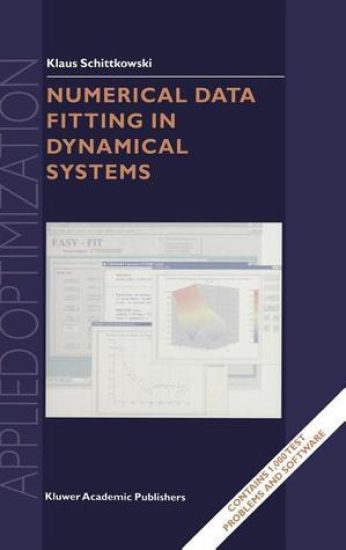
Numerical Data Fitting in Dynamical Systems

Numerical Data Fitting in Dynamical Systems

Klaus Schittkowski

Springer-Verlag New York Inc.
2002
sidottu
Real life phenomena in engineering, natural, or medical sciences are often described by a mathematical model with the goal to analyze numerically the behaviour of the system. Advantages of mathematical models are their cheap availability, the possibility of studying extreme situations that cannot be handled by experiments, or of simulating real systems during the design phase before constructing a first prototype. Moreover, they serve to verify decisions, to avoid expensive and time consuming experimental tests, to analyze, understand, and explain the behaviour of systems, or to optimize design and production. As soon as a mathematical model contains differential dependencies from an additional parameter, typically the time, we call it a dynamical model. There are two key questions always arising in a practical environment: 1 Is the mathematical model correct? 2 How can I quantify model parameters that cannot be measured directly? In principle, both questions are easily answered as soon as some experimental data are available. The idea is to compare measured data with predicted model function values and to minimize the differences over the whole parameter space. We have to reject a model if we are unable to find a reasonably accurate fit. To summarize, parameter estimation or data fitting, respectively, is extremely important in all practical situations, where a mathematical model and corresponding experimental data are available to describe the behaviour of a dynamical system.
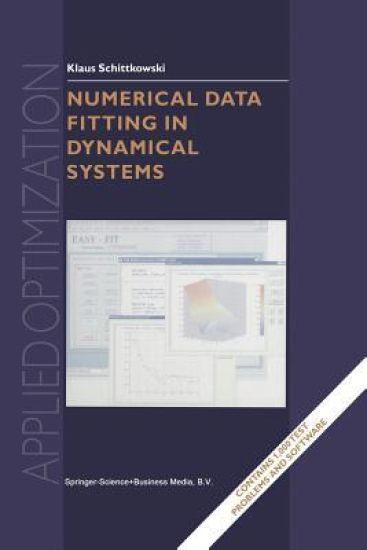
Numerical Data Fitting in Dynamical Systems

Numerical Data Fitting in Dynamical Systems

Klaus Schittkowski

Springer-Verlag New York Inc.
2013
nidottu
Real life phenomena in engineering, natural, or medical sciences are often described by a mathematical model with the goal to analyze numerically the behaviour of the system. Advantages of mathematical models are their cheap availability, the possibility of studying extreme situations that cannot be handled by experiments, or of simulating real systems during the design phase before constructing a first prototype. Moreover, they serve to verify decisions, to avoid expensive and time consuming experimental tests, to analyze, understand, and explain the behaviour of systems, or to optimize design and production. As soon as a mathematical model contains differential dependencies from an additional parameter, typically the time, we call it a dynamical model. There are two key questions always arising in a practical environment: 1 Is the mathematical model correct? 2 How can I quantify model parameters that cannot be measured directly? In principle, both questions are easily answered as soon as some experimental data are available. The idea is to compare measured data with predicted model function values and to minimize the differences over the whole parameter space. We have to reject a model if we are unable to find a reasonably accurate fit. To summarize, parameter estimation or data fitting, respectively, is extremely important in all practical situations, where a mathematical model and corresponding experimental data are available to describe the behaviour of a dynamical system.
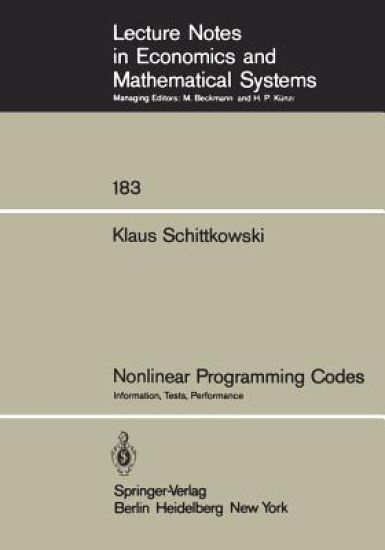
Nonlinear Programming Codes

Nonlinear Programming Codes

Klaus Schittkowski

Springer-Verlag Berlin and Heidelberg GmbH Co. K
1980
nidottu
...The increasing importance of mathematical programming for the solution of complex nonlinear systems arising in practical situations requires the development of qualified optimization software. In recent years, a lot of effort has been made to implement efficient and reliable optimization programs and we can observe a wide distribution of these programs both for research and industrial applications. In spite of their practical importance only a few attempts have been made in the past to come to comparative conclusions and to give a designer the possibility to decide which optimization program could solve his individual problems in the most desirable way. Box [BO 1966J, Huang, Levy [HL 1970J, Himmelblau [HI 1971J, Dumi- tru [DU 1974], and More, Garbow, Hillstrom [MG 1978] for example compared algorithms for unres~ricied u~~illii~Gtiv~ y~~~le~~, B~~n [BD 1970], McKeown [MK 1975], and Ramsin, Wedin [RW 1977l studied codes for nonlinear least squares problems. Codes for the linear case are compared by Bartels [BA 1975.J and Schittkowski, Stoer [SS 1979J. Extensive tests for geometric programming algorithms are found in Dembo [DE 1976bJ, Rijckaert [RI 1977], and Rijckaert, Martens [RM 1978J.
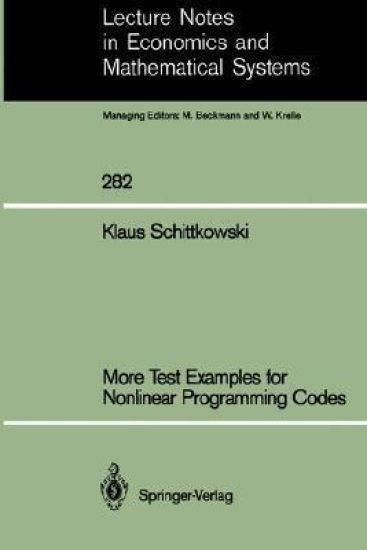
More Test Examples for Nonlinear Programming Codes

More Test Examples for Nonlinear Programming Codes

Klaus Schittkowski

Springer-Verlag Berlin and Heidelberg GmbH Co. K
1986
nidottu
This collection of 188 nonlinear programming test examples is a supplement of the test problem collection published by Hock and Schittkowski [2]. As in the former case, the intention is to present an extensive set of nonlinear programming problems that were used by other authors in the past to develop, test or compare optimization algorithms. There is no distinction between an "easy" or "difficult" test problem, since any related classification must depend on the underlying algorithm and test design. For instance, a nonlinear least squares problem may be solved easily by a special purpose code within a few iterations, but the same problem can be unsolvable for a general nonlinear programming code due to ill-conditioning. Thus one should consider both collections as a possible offer to choose some suitable problems for a specific test frame. One difference between the new collection and the former one pub­ lished by Hock and Schittkowski [2], is the attempt to present some more realistic or "real world" problems. Moreover a couple of non­ linear least squares test problems were collected which can be used e. g. to test data fitting algorithms. The presentation of the test problems is somewhat simplified and numerical solutions are computed only by one nonlinear programming code, the sequential quadratic programming algorithm NLPQL of Schittkowski [3]. But both test problem collections are implemeted in the same way in form of special FORTRAN­ subroutines, so that the same test programs can be used.
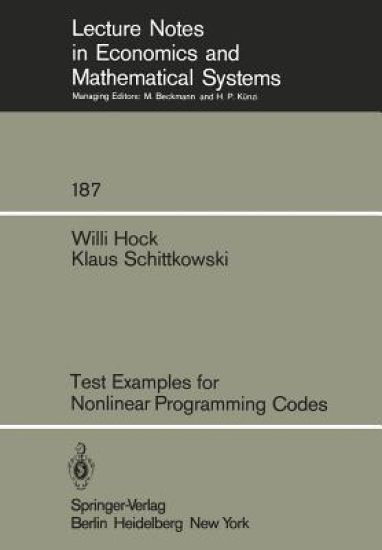
Test Examples for Nonlinear Programming Codes

Test Examples for Nonlinear Programming Codes

W. Hock; Klaus Schittkowski

Springer-Verlag Berlin and Heidelberg GmbH Co. K
1981
nidottu
................................................................. The performance of a nonlinear programming algorithm can only be ascertained by numerical experiments requiring the collection and implementation of test examples in dependence upon the desired performance criterium. This book should be considered as an assis­ tance for a test designer since it presents an extensive collec­ tion of nonlinear programming problems which have been used in the past to test or compare optimization programs. He will be in­ formed about the optimal solution, about the structure of the problem in the neighbourhood of the solution, and, in addition, about the usage of the corresp,onding FORTRAN subroutines if he is interested in obtaining them -ofi a magnetic tape. Chapter I shows how the test examples are documented. In par­ ticular, the evaluation of computable information about the solu­ tion of a problem is outlined. It is explained how the optimal solution, the optimal Lagrange-multipliers, and the condition number of the projected Hessian of the Lagrangian are obtained. Furthermore, a classification number is defined allowing a formal description of a test problem, and the documentation scheme is described which is used in Chapter IV to present the problems.
Klaus

Klaus

Klaus Krippendorff

Estate of Klaus Krippendorff
2023
sidottu
Klaus Krippendorff (1932-2022) was a pioneering academic in the fields of content analysis, cybernetics, and design. Perhaps best known for his namesake, Krippendorff's Alpha, this actually represents only a small part of the work he advanced throughout his long and distinguished career. In his memoirs, Klaus takes us from his childhood in 1930s Germany to his studies at the avant-garde Ulm School of Design to his career at the University of Pennsylvania's Annenberg School for Communication. In doing so he also shares the non-academic formative moments that shaped him, such as living in post-war East Germany and his family's journey to escape Soviet rule. The intersection of Klaus's life with the many historical events of the twentieth century reminds us all of how much of a difference just one person can make.
Klaus

Klaus

Allan Massie

Vagabond Voices
2014
nidottu
Klaus is a novella that recounts the last days of Klaus Mann's life, while referring back to the trials of the Mann family (Klaus being Thomas Mann's son) and Klaus's own autobiographical novel, Mephisto, one of his better known works partly because it was banned in West Germany for decades. This unlocks his relationship with both his father and his former lover, Gustaf, who was a communist before collaborating with the Nazi regime and becoming one of its most celebrated actors. On his return to Germany after the war, Klaus was outraged to see that Gustaf had now switched seamlessly to the post-war regime, and was once more the darling of the theatre world. Klaus, who had been isolated as both a homosexual and an anti-fascist, felt that Germans or rather those Germans in prominent positions were refusing to acknowledge their culpability. His isolation was now complete.
Klaus

Klaus

Magnus Ottosson; Henrik Nilsson Thelander; Jeanette Niemi; Angela Rizzo; Anna-Maria Ekblad; A.D Ripman; Renée Ripman; Christoffer Sorner

Storify Publishing AB
2023
nidottu
Årets mest spännande och hemlighetsfulla julupplevelse!Släpp julstressen och stig in i en värld av mysterier, där granar, mistel och hemliga sällskap går hand i hand. Denna antologi med åtta fascinerande noveller bjuder på en helt ny tolkning av julen, fylld med glimten i ögat och en dos spänning som får hjärtat att klappa lite snabbare. Tänk dig en jul där tomten inte bara ser dig han övervakar dig. Föreställ dig en värld där julklappar inte är det enda som döljer sig under granen. I Klaus får du uppleva en helt annan sida av den traditionsenliga högtiden, där konspirationsteorier tar plats bredvid pepparkakor och glögg. Åtta framstående indieförfattare har bidragit med sina unika visioner om en konspiratorisk jul. Följ med när Illuminati, Big Pharma och AI tar kontroll över julen och ditt liv. Utforska 15-minutersstädernas hemliga agenda och följ med när klonerna tar dig till en jul du aldrig kommer glömma. Glöm allt du tror dig veta om julen och dyk ner i dessa åtta konspiratoriska julberättelser. Gör dig redo för en jul som är full av överraskningar och ge bort den perfekta julgåvan till alla fans av konspirationsteorier.
Klaus Rifbjerg

Klaus Rifbjerg

Charl S. Gray

Praeger Publishers Inc
1986
sidottu
Although Klaus Rifbjerg's output is prodigious--including more than 25 novels and 15 volumes of poetry--only two works, a volume of selected poems and one novel are thus far available in English. Charlotte Gray has provided a comprehensive introduction to the works of this versatile man of letters, who enjoys a reputation not only as a novelist and poet but as a critic, playwright, journalist, and editor. She discusses Rifbjerg's place both in the contemporary Danish literary scene and in modern letters. Offering a thorough analysis of each work, she traces Rifbjerg's development chronologically and in terms of his contributions to various genres--particularly modernist poetry and psychological fiction--and points out the underlying unity of his work within these different forms. The author's generous use of quotations and her sensitive commentary give a keen impression of Rifbjerg's style and central concerns and convey his sense of the comic and tragic dimensions of modern existence.
Klaus and Fanaroff's Care of the High-Risk Neonate

Klaus and Fanaroff's Care of the High-Risk Neonate

Elsevier - Health Sciences Division
2019
sidottu
Trusted by neonatologists for more than 40 years, Klaus and Fanaroff's Care of the High-Risk Neonate provides unique, authoritative coverage of technological and medical advances in this challenging field, and includes personal and practical editorial comments that are the hallmark of this renowned text. The 7th Edition helps you take advantage of recent advances in the NICU that have improved patient care, outcomes, and quality of life, with new coverage of genetics and imaging, new cases and commentary throughout, new contributors, and much more. Covers all aspects of high-risk neonatal care, including resuscitation, transport, nutrition, respiratory problems and assisted ventilation, and organ-specific care. Includes two new chapters: Genetics, Inborn Errors of Metabolism, and Newborn Screening; and Neonatal Imaging. Features new case studies, new editorial comments that provide pearls and red herrings, and question-and-answer sections at the end of each chapter. These popular features set this book apart from other NICU-related titles. Uses a new two-color format for readability and quick reference. Contains updated content throughout; easy-to-follow clinical workflow algorithms; numerous tables and illustrations; useful appendices with drug information, normal values, and conversion charts. Enhanced eBook version included with purchase, which allows you to access all of the text, figures, and references from the book on a variety of devices
Klaus and Fanaroff's Care of the High-Risk Neonate
**Selected for 2025 Doody’s Core Titles® in Perinatal** Now in full color for the first time, Klaus and Fanaroff's Care of the High-Risk Neonate, Eighth Edition, remains your reference of choice for concise, authoritative guidance in today’s NICU. Top experts offer comprehensive yet easily accessible coverage of recent advances in this challenging field, and include personal and practical editorial comments that are the hallmark of this highly regarded text. This fully revised edition helps you take advantage of recent advances in the NICU that have improved patient care, outcomes, and quality of life, with expanded coverage of genetics and newborn screening, new diagrams and tables, many new contributing authors, and much more. Covers all aspects of high-risk neonatal care, including resuscitation, transport, nutrition, respiratory problems and assisted ventilation, and organ-specific care Features case studies, editorial comments that provide pearls and red herrings, question-and-answer sections at the end of each chapter, and interactive questions online. These popular features set this book apart from other NICU-related titles Contains updated content throughout; easy-to-follow clinical workflow algorithms; numerous tables and illustrations; useful appendices with drug information, normal values, and conversion charts Offers vastly expanded coverage of genetics, inborn errors of metabolism, and newborn screening, as well as an all-new chapter on Essential Neonatal Pharmacology for Clinical Providers in the NICU Includes expanded chapters on Genetics and Inborn Errors of Metabolism; also discusses the many diseases and conditions that once had poor survival prognoses, but now have improved outcomes (erythroblastosis fetalis, group B streptococcal sepsis, respiratory distress syndrome, and many more) Uses a new full-color format for visual appeal, readability, and quick reference. An ideal everyday reference for neonatologists and trainees, pediatricians, neonatal nurse practitioners, and NICU nurses An eBook version is included with purchase. The eBook allows you to access all of the text, figures, and references, with the ability to search, customize your content, make notes and highlights, and have content read aloud. Additional digital ancillary content may publish up to 6 weeks following the publication date
Klaus Kinski, Beast of Cinema
With more than 130 films and a career spanning four decades, Klaus Kinski (1926-1991) was one of the most controversial actors of his generation. Known for his wild tantrums on set and his legendary collaborations with auteur Werner Herzog--Aguirre, the Wrath of God (1972), Nosferatu the Vampyre (1979)--Kinski's intense performances made him the darling of European arthouse and exploitation/horror cinema. A genius in front of the camera, he was capable of lighting up the most risible films. Yet behind his public persona lurked a depraved man who took his art to the darkest extremes. This first ever collection of essays focusing on Kinski examines his work in exploitation and art house films and spaghetti westerns, along with his performances in such cult classics as Doctor Zhivago (1965), Crawlspace (1986), Venus in Furs (1965), The Great Silence (1968), Android (1982) and his only directorial credit, Paganini (1989). More than 50 reviews of Kinski's films are included, along with exclusive interviews with filmmakers and actors who worked with him.
Klaus and Other Stories

Klaus and Other Stories

Allan Massie

Vagabond Voices
2010
nidottu
Klaus, the core work in this collection, is a a novella that recounts the last days of Klaus Mann's life, while referring back to the trials of the Mann family (Klaus being Thomas Mann's son) and Klaus's own autobiographical novel, Mephisto, one of his better known works partly because it was banned in West Germany for decades for its portrayal of his ex-lover Gustaf Grundgens, before being turned into an Academy Award-winning film. Massie's novella attempts to unlock Klaus's relationship with his father, his former lover and his art. Klaus is an appropriate follow-on from Surviving (Vagabond Voices, 2009) in that writing is a major theme. With his usual thoroughness disguised by concision and a masterly light touch, Massie sets about examining how human relatinoships and artistic endeavour interact, and this book also goes back to those "public" themes that dominate so much of his other works of fiction set in the twentieth century. The novella alone would make this collection worthy of note, but the short stories will also fascinate the many who know Massie's work and admire it. They come from his long writing career and have been published under one cover for the first time. Klaus and two other stories has just been written, while there are others from the nineties, the eighties and even the seventies.
Kuchen bei Klaus

Kuchen bei Klaus

Klaus D. Emrich

Von Der Alps Publishing Corporation
2015
nidottu
"Kuchen bei Klaus" ist das erste Backbuch des Autors. Klaus ist ein leidenschaftlicher Koch und B cker. Seit seiner Kindheit war es sein Traum, in der K che zu spielen, neue Rezepte und Gerichte zu erfinden. "Cakes by Klaus" is the author's first baking book. Klaus is a passionate cook and baker. Since childhood, it was his dream to play in the kitchen, inventing new recipes, creating new dishes.