Studienarbeit aus dem Jahr 2018 im Fachbereich Didaktik - Deutsch - Literatur, Werke, Note: 1,0, Bergische Universit t Wuppertal, Sprache: Deutsch, Abstract: In dieser Arbeit wird das Werk "Wir sind nachher wieder da, wir m ssen kurz nach Afrika" von Oliver Scherz und seine didaktische Umsetzbarkeit in der Grundschule thematisiert. Hierf r wird zun chst die Biographie des Autors dargestellt. Anschlie end werden Inhalt und Thematik des Buches kurz und knapp zusammengefasst und der Aufbau des Buches wird n her betrachtet. Hierbei wird auch auf die Gattung des Buches eingegangen. Im nachfolgenden Hauptteil wird kritisch Bezug darauf genommen, ob dieses Werk als Klassenlekt re ausgew hlt und eingesetzt werden kann. Dabei wird auf die Grenzen und M glichkeiten des Werkes aufmerksam gemacht und diese werden genauer er rtert. Zum Schluss werden exemplarische Umsetzungsm glichkeiten f r den Unterricht angeboten und einige Arbeitsbl tter vorgestellt.
Bachelorarbeit aus dem Jahr 2018 im Fachbereich Didaktik - Mathematik, Note: 2,0, Bergische Universit t Wuppertal, Sprache: Deutsch, Abstract: Bei Fermi-Aufgaben handelt es sich um Sachaufgaben, die sich au er durch ihre Offenheit auch durch Realit tsbezug und eine besondere Zug nglichkeit auszeichnen. Dadurch sollen sie authentische Lernanl sse darbieten und die SuS zur L sung der Aufgabe motivieren. In dieser Arbeit wird berpr ft, inwiefern sich Fermi-Aufgaben von Standardsachaufgaben abheben und welche mathematischen Bereiche sich in der Grundschule f r Fermi-Aufgaben eignen. Zudem liegt der Schwerpunkt dieser Arbeit darin, herauszufinden, ob die inhalts- und prozessbezogenen Kompetenzen des Kernlehrplans der Mathematik f r die Grundschule bei Fermi-Aufgaben umsetzbar sind. Im Kontext von Sachaufgaben besteht in vielen Grundschulen des fteren das Problem, dass Sch lerinnen und Sch ler (SuS) die Bearbeitungen desinteressiert und lustlos durchf hren. In den Sachaufgaben sind Sachsituationen vorhanden, die die Alltagswelt der SuS widerspiegeln sollen, sodass in den SuS Interesse ausgel st wird. In den meisten F llen werden jedoch die Alltagsbez ge in den Sachaufgaben erzwungen, damit die Sachsituationen auf der einen Seite Themen aus dem Alltag der SuS beinhalten, aber auf der anderen Seite in dem Ausma in der Realit t mit geringer Wahrscheinlichkeit auftreten. F r einen gelungen Sachrechenunterricht in der Grundschule gilt es bei der Auswahl der Sachaufgaben authentische Lernanl sse zu schaffen, wodurch sich die SuS in die Sachsituationen hineindenken, dadurch die Aufgabe l sen und Alltagsprobleme damit bew ltigen k nnen.
Title: Koray's Letters written from Paris, 1788-92. Translated from the original Greek, and edited by P. Ralli.Publisher: British Library, Historical Print EditionsThe British Library is the national library of the United Kingdom. It is one of the world's largest research libraries holding over 150 million items in all known languages and formats: books, journals, newspapers, sound recordings, patents, maps, stamps, prints and much more. Its collections include around 14 million books, along with substantial additional collections of manuscripts and historical items dating back as far as 300 BC.The HISTORY OF EUROPE collection includes books from the British Library digitised by Microsoft. This collection includes works chronicling the development of Western civilisation to the modern age. Highlights include the development of language, political and educational systems, philosophy, science, and the arts. The selection documents periods of civil war, migration, shifts in power, Muslim expansion into Central Europe, complex feudal loyalties, the aristocracy of new nations, and European expansion into the New World. ++++The below data was compiled from various identification fields in the bibliographic record of this title. This data is provided as an additional tool in helping to insure edition identification: ++++ British Library Koraes, Adamantios I.; Ralli, Pandeli; 1898. viii, 108 p.; 4 . 9225.aaa.28.
The cryptocurrency world has transformed in a few short years from a niche subculture to a parallel economic universe, reaching a market capitalization of more than $2.5 trillion in 2021 before plummeting in 2022. For their advocates, cryptocurrencies represent a revolution of world-historical significance. To critics, crypto is more of a speculative tool than a true currency. How do tens of thousands of financial actors make these new monies? What forces give cryptocurrencies their value—or take it away? And what does crypto’s spectacular ascent reveal about the nature of money? In this groundbreaking ethnographic analysis of crypto economies and their global markets and communities, Koray Caliskan offers an inside view of how cryptocurrencies are made and traded. He argues that cryptocurrency should be understood as “data money,” a historically novel money type, created as the right to send data privately over an accounting infrastructure called blockchain. Drawing on two years of fieldwork among global cryptocurrency communities and in crypto markets, Caliskan makes visible the production principles of cryptocurrencies and explores how crypto exchanges work from within. He explains why and how we have been misunderstanding, underregulating, and improperly taxing crypto exchanges and actors. He also proposes a radically new way to make sense of new finance and its actors. An invaluable book for all readers seeking to understand cryptocurrency, Data Money sheds new light on a profound transformation of finance and its possible future trajectories.
The cryptocurrency world has transformed in a few short years from a niche subculture to a parallel economic universe, reaching a market capitalization of more than $2.5 trillion in 2021 before plummeting in 2022. For their advocates, cryptocurrencies represent a revolution of world-historical significance. To critics, crypto is more of a speculative tool than a true currency. How do tens of thousands of financial actors make these new monies? What forces give cryptocurrencies their value—or take it away? And what does crypto’s spectacular ascent reveal about the nature of money? In this groundbreaking ethnographic analysis of crypto economies and their global markets and communities, Koray Caliskan offers an inside view of how cryptocurrencies are made and traded. He argues that cryptocurrency should be understood as “data money,” a historically novel money type, created as the right to send data privately over an accounting infrastructure called blockchain. Drawing on two years of fieldwork among global cryptocurrency communities and in crypto markets, Caliskan makes visible the production principles of cryptocurrencies and explores how crypto exchanges work from within. He explains why and how we have been misunderstanding, underregulating, and improperly taxing crypto exchanges and actors. He also proposes a radically new way to make sense of new finance and its actors. An invaluable book for all readers seeking to understand cryptocurrency, Data Money sheds new light on a profound transformation of finance and its possible future trajectories.
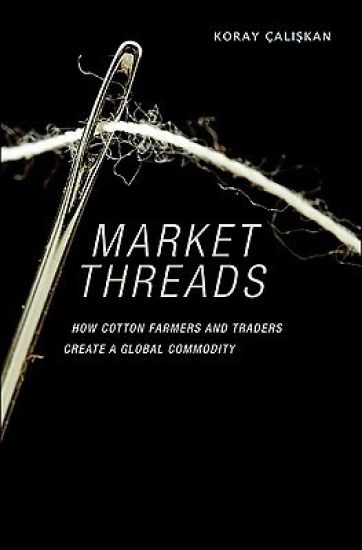
What is a global market? How does it work? At a time when new crises in world markets cannot be satisfactorily resolved through old ideas, "Market Threads" presents a detailed analysis of the international cotton trade and argues for a novel and groundbreaking understanding of global markets. The book examines the arrangements, institutions, and power relations on which cotton trading and production depend, and provides an alternative approach to the analysis of pricing mechanisms. Drawing upon research from such diverse places as the New York Board of Trade and the Turkish and Egyptian countrysides, the book explores how market agents from peasants to global merchants negotiate, accept, reject, resist, reproduce, understand, and misunderstand a global market. The book demonstrates that policymakers and researchers must focus on the specific practices of market maintenance in order to know how they operate. Markets do not simply emerge as a relationship among self-interested buyers and sellers, governed by appropriate economic institutions. Nor are they just social networks embedded in wider economic social structures. Rather, global markets are maintained through daily interventions, the production of prosthetic prices, and the waging of struggles among those who produce and exchange commodities. The book illustrates the crucial consequences that these ideas have on economic reform projects and market studies. Spanning a variety of disciplines, "Market Threads" offers an original look at the world commodity trade and revises prevailing explanations for how markets work.
Creating Global Music in Turkey looks at the rise of ”world music” in Turkey by analyzing this country’s various “traditional” or ethnic music forms. The book focuses on the uniquely Turkish musical forms exemplified by Gypsy, Sufi, and Folk music, and explores how these have been incorporated into the global discourses of world music. In doing so, the book also shows how the place-making strategies of globalization are embodied through the construction of an “authentic” Istanbul sound under the label of world music. The reader is invited to consider each musical tradition as being a unique realm in its incorporation into world music. The process of incorporation and appropriation is explained by examination of the specificities of each realm. This book is unique within the relevant literature, focusing on the production of a global cultural form outside of the Western world. It uses the findings of comprehensive ethnographic research to reveal to the reader the strategies of actors, the discursive mechanisms in the field, and how the world music markets operate.
This book is first in its category to reflect a lived experience from a phenomenological viewpoint within the Hizmet Movement (HM). Through the author’s lens, you will read about the transformation of HM along with his own over a span of three decades. Moreover, the book does not shy away from sensitive subjects such as LGBTQA+ topics in this Turkey-based, Muslim educational movement. This book took more than five years to complete and includes a brief history of the Turkish Republic and the HM, details from Gülen’s life, his and other HM participants’ overlapping philosophies on education and language, and the arduous interview process to put this book together. A full copy of the interview with Mr. Fethullah Gülen on education and language is available at the end of the book. This would be an excellent source for educational psychology departments, teacher training programs, political science, and theology majors.
Aims of the here presented study are, on the one hand, the establishment and demonstration of organotypic three-dimensional human skin equivalents as a new valid test system alternative to animal testing to investigate dermatological severe side-effects of the novel clinical and experimental endothelial growth factor receptor-inhibitors on human skin differentiation. On the other hand, the investigations of time-dependent toxicological properties, and carcinogenetic induction of environmental pollutant and chemotherapeutic agent arsenic trioxide in human epidermal keratinocytes in monolayer cell culture. In the end, the aim is here, the demonstration of skin-related impacts of chronic arsenic trioxide exposure in three-dimensional human skin equivalents.