Kirjojen hintavertailu. Mukana 11 244 527 kirjaa ja 12 kauppaa.

Kirjahaku

Etsi kirjoja tekijän nimen, kirjan nimen tai ISBN:n perusteella.

1000 tulosta hakusanalla Kurt Richardson

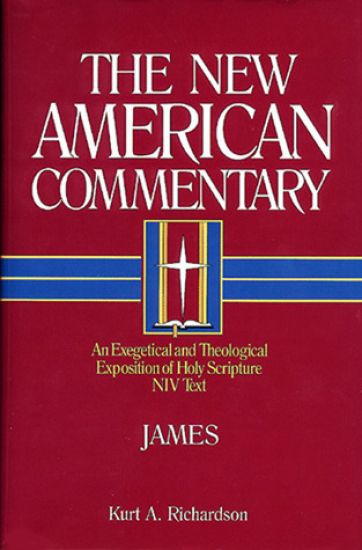
James

James

Kurt Richardson

Broadman Holman Publishers
1997
sidottu
THE NEW AMERICAN COMMENTARY is for the minister or Bible student who wants to understand and expound the Scriptures. Notable features include: * commentary based on THE NEW INTERNATIONAL VERSION; * the NIV text printed in the body of the commentary; * sound scholarly methodology that reflects capable research in the original languages; * interpretation that emphasizes the theological unity of each book and of Scripture as a whole; * readable and applicable exposition.
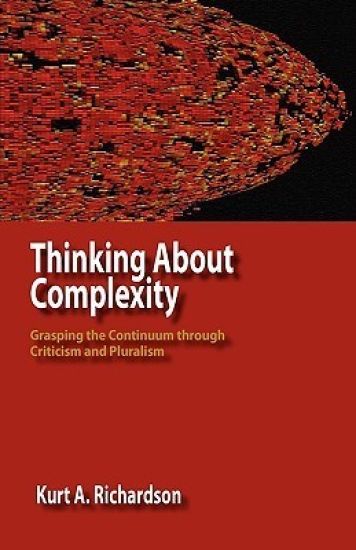
Thinking About Complexity

Thinking About Complexity

Kurt Richardson

Re-Emerge Book
2022
sidottu
The aim of this essay is to introduce some of the basic ideas concerning the science of complex systems, and to develop a philosophical stance that is sensitive to complexity itself. In doing so, it is assumed that the Universe in which we find ourselves can be well-described at some arbitrarily deep level as a complex system, in particular, a cellular automaton, much like John Conway's famous Game-of-Life. It is argued that in Life there are no real and absolute boundaries, although many patterns can be uncovered that can be used to build sufficient levels of understanding to allow us to interact with our environment in useful ways, although always accepting that this understanding must be regarded as both approximate and always under review. In short, Dr. Richardson is suggesting that the notion of existence itself must be problematized, so that through constructive criticism and pluralism local 'truths' (with a small 't') can be discovered and temporarily applied. Such a view regards the Universe as simultaneously both deterministic and non-deterministic, and that our own sentience is little more than an illusion derived from a particularly limited perspective. The distinction between what is absolutely real and what is substantially real is a subtle one, but it is such subtleties that differentiate between Capitalists, Scientists, Marxists, Theologists, as well as what makes each of us intellectually unique. These postmodern-esque conclusions are not new. The fact that they can be derived from a strongly realist approach, however, may surprise some.
Reality and Evangelical Theology

Reality and Evangelical Theology

Thomas F Torrance; Kurt Anders Richardson

Wipf Stock Publishers
2003
pokkari
T.F. Torrance is widely recognized as one of our most important twentieth-century theologians. And scholars of Torrance suggest 'Reality & Scientific Theology' is one of his most accessible works. Torrance's insights on Christian epistemology are remarkably relevant in light of recent discussions on realism and antirealism in philosophy and theology. Torrance brilliantly sets forth no naive or even critical realism, but rather an evangelical realism - knowledge grounded in the revelation of God in Jesus Christ. He not only constructively argues the case for an evangelical realism but compares and contrasts theological knowledge with natural scientific knowledge, and shows how the Bible can function authoritatively in a fragmented church.This edition of 'Reality and Evangelical Theology' includes an in-depth foreword that contextualizes Torrance's seminal theological work in light of recent debates over postmodern and postcritical hermeneutics to Scripture. It will handsomely repay engagement (or reengagement) by theologians, philosophers, students and thoughtful pastors.
Kurt

Kurt

Dale Mayer

Valley Publishing Ltd.
2021
pokkari
Being a badass growing up had been fine for a while, but Kurt knew his life had to change. His best option? The US Navy. Fourteen years later a serendipitous request from Badger to check out reports of a missing War Dog hidden in the bushes and attacking people sends Kurt to the very place he couldn't wait to get out of.When Kurt chose the navy over Laurie Ann so long ago, he left her with a gift she'd fought long and hard to keep. Plus she didn't give up on her dream of becoming a doctor. When Kurt returns, it's hard not to see the same person she'd loved in this older version. Yet the town has a long memory, and at least one person isn't willing to see who Kurt is now.But, as always, he's a trouble magnet. Was he capable of handling the nightmare they were in, or would he leave, just like he had last time?
Kurt

Kurt

Lori Wilde

Independently Published
2019
nidottu
TMZ News Flash Why is Hollywood starlet, Elizabeth Destiny, in Rascal, Texas at the ranch of her ex-fianc and billionaire cowboy Kurt McNally? Have they buried the hatchet and patched things up? Or is Kurt just feeling sorry for Elizabeth after a head injury left her with amnesia?Paparazzies have reported that snotty Elizabeth is suddenly sweet as pie. Maybe someone should have whacked her with a 2x4 years ago? Kurt and Elizabeth have been spotted holding hands and canoodling in public. Do we hear wedding bells? Or is Kurt in over his head?Kurt is the fourth book in the heartwarming Texas Rascals series by NYT and USA Today bestselling author, Lori Wilde.
Kurt Vonnegut: Letters

Kurt Vonnegut: Letters

Kurt Vonnegut

Vintage Publishing
2014
pokkari
This collection of Vonnegutâ??s letters is the autobiography he never wrote â?? from the letter he posted home upon being freed from a German POW camp, to notes of advice to his children: â??Donâ??t let anybody tell you that smoking and boozing are bad for you.
Kurt Cobain

Kurt Cobain

Kurt Cobain

Penguin Books Ltd
2003
nidottu
The first publication of Kurt Cobain's diaries, which were found after his death in 1994. Genuinely moving, provocative and candid, and suprisingly funny, pieces of writing which, as a whole, provide a unique account of the rise and fall of a greatpopular artist and icon.
Kurt Weill's America

Kurt Weill's America

Naomi Graber

Oxford University Press Inc
2021
sidottu
Throughout his life, German-Jewish composer Kurt Weill was fascinated by the idea of America. His European works depict America as a Capitalist dystopia. But in 1935, it became clear that Europe was no longer safe for Weill, and he set sail for New World, and his engagement with American culture shifted. From that point forward, most of his works concerned the idea of "America," whether celebrating her successes, or critiquing her shortcomings. As an outsider-turned-insider, Weill's insights into American culture were unique. He was keenly attuned to the difficult relationship America had with her immigrants, but was slower to grasp the subtleties of others, particularly those surrounding race relations, even though his works reveal that he was devoted to the idea of racial equality. The book treats Weill as a node in a transnational network of musicians, writers, artists, and other stage professionals, all of whom influenced each other. Weill sought out partners from a range of different sectors, including the Popular Front, spoken drama, and the commercial Broadway stage. His personal papers reveal his attempts to navigate not only the shifting tides of American culture, but the specific demands of his institutional and individual collaborators. In reframing Weill's relationship with immigration and nationality, the book also puts nuance contemporary ideas about the relationships of immigrants to their new homes, moving beyond ideas that such figures must either assimilate and abandon their previous identities, or resist the pull of their new home and stay true to their original culture.
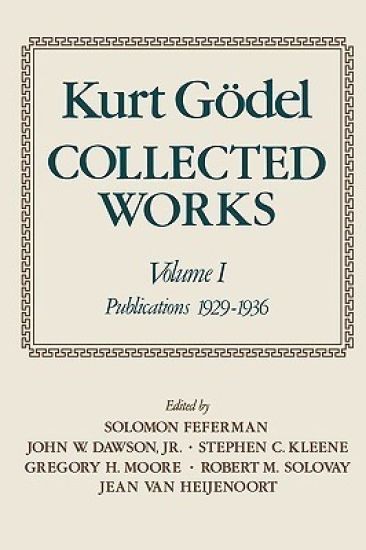
Kurt Gödel: Collected Works: Volume I

Kurt Gödel: Collected Works: Volume I

Kurt Gödel

Oxford University Press Inc
1986
sidottu
Kurt Gödel (1906 - 1978) was the most outstanding logician of the twentieth century, famous for his hallmark works on the completeness of logic, the incompleteness of number theory, and the consistency of the axiom of choice and the continuum hypothesis. He is also noted for his work on constructivity, the decision problem, and the foundations of computability theory, as well as for the strong individuality of his writings on the philosophy of mathematics. He is less well known for his discovery of unusual cosmological models for Einstein's equations, in theory permitting time travel into the past. The Collected Works is a landmark resource that draws together a lifetime of creative thought and accomplishment. The first two volumes were devoted to Gödel's publications in full (both in original and translation), and the third volume featured a wide selection of unpublished articles and lecture texts found in Gödel's Nachlass. These long-awaited final two volumes contain Gödel's correspondence of logical, philosophical, and scientific interest. Volume IV covers A to G, with H to Z in volume V; in addition, Volume V contains a full inventory of Gödel's Nachlass. All volumes include introductory notes that provide extensive explanatory and historical commentary on each body of work, English translations of material originally written in German (some transcribed from the Gabelsberger shorthand), and a complete bibliography of all works cited. Kurt Gödel: Collected Works is designed to be useful and accessible to as wide an audience as possible without sacrificing scientific or historical accuracy. The only comprehensive edition of Gödel's work available, it will be an essential part of the working library of professionals and students in logic, mathematics, philosophy, history of science, and computer science and all others who wish to be acquainted with one of the great minds of the twentieth century.
Kurt Gödel: Collected Works: Volume II

Kurt Gödel: Collected Works: Volume II

Kurt Gödel

Oxford University Press Inc
1990
sidottu
Kurt Gödel (1906 - 1978) was the most outstanding logician of the twentieth century, famous for his hallmark works on the completeness of logic, the incompleteness of number theory, and the consistency of the axiom of choice and the continuum hypothesis. He is also noted for his work on constructivity, the decision problem, and the foundations of computability theory, as well as for the strong individuality of his writings on the philosophy of mathematics. He is less well known for his discovery of unusual cosmological models for Einstein's equations, in theory permitting time travel into the past. The Collected Works is a landmark resource that draws together a lifetime of creative thought and accomplishment. The first two volumes were devoted to Gödel's publications in full (both in original and translation), and the third volume featured a wide selection of unpublished articles and lecture texts found in Gödel's Nachlass. These long-awaited final two volumes contain Gödel's correspondence of logical, philosophical, and scientific interest. Volume IV covers A to G, with H to Z in volume V; in addition, Volume V contains a full inventory of Gödel's Nachlass. All volumes include introductory notes that provide extensive explanatory and historical commentary on each body of work, English translations of material originally written in German (some transcribed from the Gabelsberger shorthand), and a complete bibliography of all works cited. Kurt Gödel: Collected Works is designed to be useful and accessible to as wide an audience as possible without sacrificing scientific or historical accuracy. The only comprehensive edition of Gödel's work available, it will be an essential part of the working library of professionals and students in logic, mathematics, philosophy, history of science, and computer science and all others who wish to be acquainted with one of the great minds of the twentieth century.
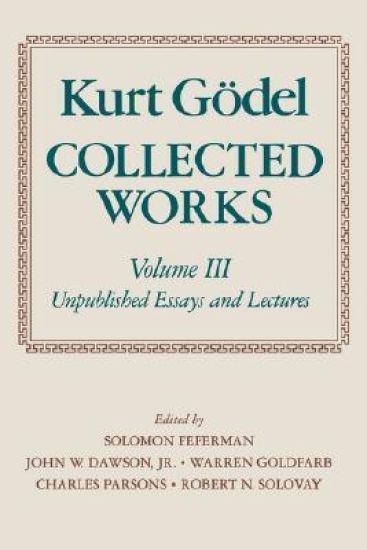
Kurt Gödel: Collected Works: Volume III

Kurt Gödel: Collected Works: Volume III

Kurt Gödel

Oxford University Press Inc
1995
sidottu
Kurt Gödel (1906 - 1978) was the most outstanding logician of the twentieth century, famous for his hallmark works on the completeness of logic, the incompleteness of number theory, and the consistency of the axiom of choice and the continuum hypothesis. He is also noted for his work on constructivity, the decision problem, and the foundations of computability theory, as well as for the strong individuality of his writings on the philosophy of mathematics. He is less well known for his discovery of unusual cosmological models for Einstein's equations, in theory permitting time travel into the past. The Collected Works is a landmark resource that draws together a lifetime of creative thought and accomplishment. The first two volumes were devoted to Gödel's publications in full (both in original and translation), and the third volume featured a wide selection of unpublished articles and lecture texts found in Gödel's Nachlass. These long-awaited final two volumes contain Gödel's correspondence of logical, philosophical, and scientific interest. Volume IV covers A to G, with H to Z in volume V; in addition, Volume V contains a full inventory of Gödel's Nachlass. All volumes include introductory notes that provide extensive explanatory and historical commentary on each body of work, English translations of material originally written in German (some transcribed from the Gabelsberger shorthand), and a complete bibliography of all works cited. Kurt Gödel: Collected Works is designed to be useful and accessible to as wide an audience as possible without sacrificing scientific or historical accuracy. The only comprehensive edition of Gödel's work available, it will be an essential part of the working library of professionals and students in logic, mathematics, philosophy, history of science, and computer science and all others who wish to be acquainted with one of the great minds of the twentieth century.
Kurt Gödel: Collected Works

Kurt Gödel: Collected Works

Kurt Gödel

Oxford University Press Inc
2001
nidottu
Kurt Gödel (1906 - 1978) was the most outstanding logician of the twentieth century, famous for his hallmark works on the completeness of logic, the incompleteness of number theory, and the consistency of the axiom of choice and the continuum hypothesis. He is also noted for his work on constructivity, the decision problem, and the foundations of computability theory, as well as for the strong individuality of his writings on the philosophy of mathematics. He is less well known for his discovery of unusual cosmological models for Einstein's equations, in theory permitting time travel into the past. The Collected Works is a landmark resource that draws together a lifetime of creative thought and accomplishment. The first two volumes were devoted to Gödel's publications in full (both in original and translation), and the third volume featured a wide selection of unpublished articles and lecture texts found in Gödel's Nachlass. These long-awaited final two volumes contain Gödel's correspondence of logical, philosophical, and scientific interest. Volume IV covers A to G, with H to Z in volume V; in addition, Volume V contains a full inventory of Gödel's Nachlass. All volumes include introductory notes that provide extensive explanatory and historical commentary on each body of work, English translations of material originally written in German (some transcribed from the Gabelsberger shorthand), and a complete bibliography of all works cited. Kurt Gödel: Collected Works is designed to be useful and accessible to as wide an audience as possible without sacrificing scientific or historical accuracy. The only comprehensive edition of Gödel's work available, it will be an essential part of the working library of professionals and students in logic, mathematics, philosophy, history of science, and computer science and all others who wish to be acquainted with one of the great minds of the twentieth century.
Kurt Gödel: Collected Works: Volume II

Kurt Gödel: Collected Works: Volume II

Kurt Gödel

Oxford University Press Inc
2001
nidottu
Kurt Gödel (1906 - 1978) was the most outstanding logician of the twentieth century, famous for his hallmark works on the completeness of logic, the incompleteness of number theory, and the consistency of the axiom of choice and the continuum hypothesis. He is also noted for his work on constructivity, the decision problem, and the foundations of computability theory, as well as for the strong individuality of his writings on the philosophy of mathematics. He is less well known for his discovery of unusual cosmological models for Einstein's equations, in theory permitting time travel into the past. The Collected Works is a landmark resource that draws together a lifetime of creative thought and accomplishment. The first two volumes were devoted to Gödel's publications in full (both in original and translation), and the third volume featured a wide selection of unpublished articles and lecture texts found in Gödel's Nachlass. These long-awaited final two volumes contain Gödel's correspondence of logical, philosophical, and scientific interest. Volume IV covers A to G, with H to Z in volume V; in addition, Volume V contains a full inventory of Gödel's Nachlass. All volumes include introductory notes that provide extensive explanatory and historical commentary on each body of work, English translations of material originally written in German (some transcribed from the Gabelsberger shorthand), and a complete bibliography of all works cited. Kurt Gödel: Collected Works is designed to be useful and accessible to as wide an audience as possible without sacrificing scientific or historical accuracy. The only comprehensive edition of Gödel's work available, it will be an essential part of the working library of professionals and students in logic, mathematics, philosophy, history of science, and computer science and all others who wish to be acquainted with one of the great minds of the twentieth century.
Kurt Gödel: Collected Works: Volume III

Kurt Gödel: Collected Works: Volume III

Kurt Gödel

Oxford University Press Inc
2001
nidottu
Kurt Gödel (1906 - 1978) was the most outstanding logician of the twentieth century, famous for his hallmark works on the completeness of logic, the incompleteness of number theory, and the consistency of the axiom of choice and the continuum hypothesis. He is also noted for his work on constructivity, the decision problem, and the foundations of computability theory, as well as for the strong individuality of his writings on the philosophy of mathematics. He is less well known for his discovery of unusual cosmological models for Einstein's equations, in theory permitting time travel into the past. The Collected Works is a landmark resource that draws together a lifetime of creative thought and accomplishment. The first two volumes were devoted to Gödel's publications in full (both in original and translation), and the third volume featured a wide selection of unpublished articles and lecture texts found in Gödel's Nachlass. These long-awaited final two volumes contain Gödel's correspondence of logical, philosophical, and scientific interest. Volume IV covers A to G, with H to Z in volume V; in addition, Volume V contains a full inventory of Gödel's Nachlass. All volumes include introductory notes that provide extensive explanatory and historical commentary on each body of work, English translations of material originally written in German (some transcribed from the Gabelsberger shorthand), and a complete bibliography of all works cited. Kurt Gödel: Collected Works is designed to be useful and accessible to as wide an audience as possible without sacrificing scientific or historical accuracy. The only comprehensive edition of Gödel's work available, it will be an essential part of the working library of professionals and students in logic, mathematics, philosophy, history of science, and computer science and all others who wish to be acquainted with one of the great minds of the twentieth century.
Kurt Gödel: Collected Works: Volume IV

Kurt Gödel: Collected Works: Volume IV

Kurt Gödel

Clarendon Press
2003
sidottu
Kurt Gödel (1906 - 1978) was the most outstanding logician of the twentieth century, famous for his hallmark works on the completeness of logic, the incompleteness of number theory, and the consistency of the axiom of choice and the continuum hypothesis. He is also noted for his work on constructivity, the decision problem, and the foundations of computability theory, as well as for the strong individuality of his writings on the philosophy of mathematics. He is less well known for his discovery of unusual cosmological models for Einstein's equations, in theory permitting time travel into the past. The Collected Works is a landmark resource that draws together a lifetime of creative thought and accomplishment. The first two volumes were devoted to Gödel's publications in full (both in original and translation), and the third volume featured a wide selection of unpublished articles and lecture texts found in Gödel's Nachlass. These long-awaited final two volumes contain Gödel's correspondence of logical, philosophical, and scientific interest. Volume IV covers A to G, with H to Z in volume V; in addition, Volume V contains a full inventory of Gödel's Nachlass. All volumes include introductory notes that provide extensive explanatory and historical commentary on each body of work, English translations of material originally written in German (some transcribed from the Gabelsberger shorthand), and a complete bibliography of all works cited. Kurt Gödel: Collected Works is designed to be useful and accessible to as wide an audience as possible without sacrificing scientific or historical accuracy. The only comprehensive edition of Gödel's work available, it will be an essential part of the working library of professionals and students in logic, mathematics, philosophy, history of science, and computer science and all others who wish to be acquainted with one of the great minds of the twentieth century.