Kirjojen hintavertailu. Mukana 11 244 527 kirjaa ja 12 kauppaa.

Kirjahaku

Etsi kirjoja tekijän nimen, kirjan nimen tai ISBN:n perusteella.

1000 tulosta hakusanalla Léon Walras

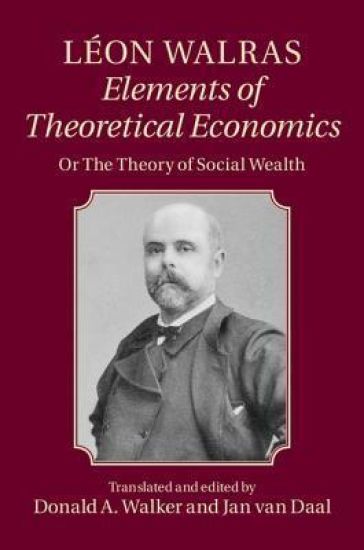
Léon Walras: Elements of Theoretical Economics

Léon Walras: Elements of Theoretical Economics

Léon Walras

Cambridge University Press
2014
sidottu
In his fourth edition of Éléménts d'économie politique pure (1900), León Walras introduced the device of written pledges to eliminate path dependency: sellers of products and services write out commitments to supply certain quantities at suggested prices with no commodities actually produced and supplied until a set of prices is found at which supply and demand are equal simultaneously in every market. This brought about very serious alterations to the character of the book. Unfortunately, these changes resulted in an incomplete, internally contradictory, and occasionally incoherent text. This translation, therefore, by two leading scholars of León Walras' work, Donald A. Walker and Jan van Daal, revisits the third edition of this seminal work, including Walras' brilliant explanation of his comprehensive model, with all its richness derived from reality. Growing research into Walras' work indicates that it was this third edition that contained his best theoretical research and a translation of this edition of the book is now a necessity.
Léon Walras: Elements of Theoretical Economics

Léon Walras: Elements of Theoretical Economics

Léon Walras

Cambridge University Press
2019
pokkari
In his fourth edition of Éléménts d'économie politique pure (1900), León Walras introduced the device of written pledges to eliminate path dependency: sellers of products and services write out commitments to supply certain quantities at suggested prices with no commodities actually produced and supplied until a set of prices is found at which supply and demand are equal simultaneously in every market. This brought about very serious alterations to the character of the book. Unfortunately, these changes resulted in an incomplete, internally contradictory, and occasionally incoherent text. This translation, therefore, by two leading scholars of León Walras' work, Donald A. Walker and Jan van Daal, revisits the third edition of this seminal work, including Walras' brilliant explanation of his comprehensive model, with all its richness derived from reality. Growing research into Walras' work indicates that it was this third edition that contained his best theoretical research and a translation of this edition of the book is now a necessity.
Léon Walras’s Economic Thought

Léon Walras’s Economic Thought

Kayoko Misaki

TAYLOR FRANCIS LTD
2023
sidottu
This book sheds new light on the general equilibrium theory of Léon Walras (1834–1910) from a historical perspective. Walras's construction of general equilibrium theory marked the dawn of modern economics, and the theory was greatly developed in the 20th century. However, Walras's own intentions and ideas behind the theory are still not fully understood.This book aims to clarify the intellectual background of Walras’s economics by delving into his original writings, which have not received much attention until now. Part 1 of the book reconsiders the relationship between Walras and his predecessors, Adam Smith (1723–1790), Jean-Baptiste Say (1767–1832), and Achylle Nicolas Isnard (1749–1803), who are believed to have had a decisive influence on Walras's general equilibrium theory. In Part 2, the book explores Walras's views on the labor market, entrepreneurship, and non-selfish human nature, including concepts like sympathy, which have been overlooked in his general equilibrium theory and subsequently misunderstood to this day. Walras’s economic thought is one of the foundational sources of modern economics. An accurate and in-depth understanding of it will provide a new perspective on the problems faced by modern economics and open future possibilities for economics as a social science. This book offers new insights not only to researchers and students of the history of economics but also to all those interested in the origins of modern economics.
Léon Walras’s Economic Thought

Léon Walras’s Economic Thought

Kayoko Misaki

TAYLOR FRANCIS LTD
2025
nidottu
This book sheds new light on the general equilibrium theory of Léon Walras (1834–1910) from a historical perspective. Walras's construction of general equilibrium theory marked the dawn of modern economics, and the theory was greatly developed in the 20th century. However, Walras's own intentions and ideas behind the theory are still not fully understood.This book aims to clarify the intellectual background of Walras’s economics by delving into his original writings, which have not received much attention until now. Part 1 of the book reconsiders the relationship between Walras and his predecessors, Adam Smith (1723–1790), Jean-Baptiste Say (1767–1832), and Achylle Nicolas Isnard (1749–1803), who are believed to have had a decisive influence on Walras's general equilibrium theory. In Part 2, the book explores Walras's views on the labor market, entrepreneurship, and non-selfish human nature, including concepts like sympathy, which have been overlooked in his general equilibrium theory and subsequently misunderstood to this day. Walras’s economic thought is one of the foundational sources of modern economics. An accurate and in-depth understanding of it will provide a new perspective on the problems faced by modern economics and open future possibilities for economics as a social science. This book offers new insights not only to researchers and students of the history of economics but also to all those interested in the origins of modern economics.
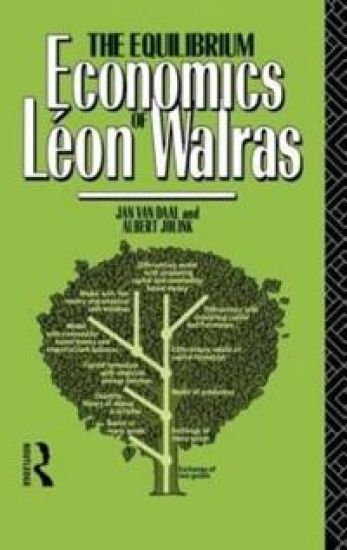
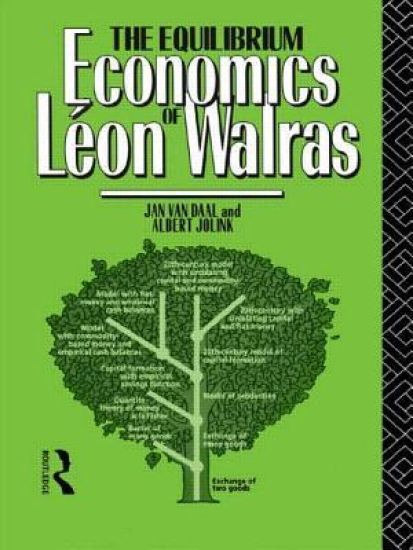
The Equilibrium Economics of Leon Walras

The Equilibrium Economics of Leon Walras

Albert Jolink; Jan Van Daal

Routledge
1993
sidottu
The existing literature on Walras has focused on his Elements of Pure Economics to an extent which has unbalanced our view of his work. Jan van Daal and Albert Jolink pay very careful attention to Walras' general equilibrium models, tracing their development through the five editions of his Elements. But they also place his equilibrium exercises in a broader context, arguing that these models should be considered as an instrument in Walras' design for optimal economic order.
The Evolutionist Economics of Leon Walras
This study offers a new perspective of Walras' pure, applied and social economics. Through archival research at the University of Lausanne, Jolink considers Walras' ideas on philosophy and philosophy of science based on a newly constructed taxonomy. Walras' work is placed in a broader context by stressing the nineteenth century cultural and historical background in which he lived. This further gives an insight into the relationship between the romanticism of the early nineteenth century and logical positivism of the twentieth century.
The Evolutionist Economics of Leon Walras
This study offers a new perspective of Walras' pure, applied and social economics. Through archival research at the University of Lausanne, Jolink considers Walras' ideas on philosophy and philosophy of science based on a newly constructed taxonomy. Walras' work is placed in a broader context by stressing the nineteenth century cultural and historical background in which he lived. This further gives an insight into the relationship between the romanticism of the early nineteenth century and logical positivism of the twentieth century.
The Equilibrium Economics of Leon Walras

The Equilibrium Economics of Leon Walras

Albert Jolink; Jan Van Daal

Routledge
2014
nidottu
The existing literature on Walras has focused on his Elements of Pure Economics to an extent which has unbalanced our view of his work. Jan van Daal and Albert Jolink pay very careful attention to Walras' general equilibrium models, tracing their development through the five editions of his Elements. But they also place his equilibrium exercises in a broader context, arguing that these models should be considered as an instrument in Walras' design for optimal economic order.
The Legacy of Léon Walras

The Legacy of Léon Walras

Edward Elgar Publishing Ltd
2001
sidottu
This important two-volume collection of over sixty published articles presents a major study of Leon Walras's intellectual legacy and reveals how Walras's ideas contributed significantly to the formation of the mainstream of modern microeconomic theory. The collection comprises two groups of writings. The first, consisting of interpretations of his ideas, discuss his contributions to the theory of general equilibrium, including his special models of capital and of money, his applications of theory to the formation of economic policies, and his use of it in connection with his concepts of economic justice and an ideal economy. The second group shows current uses of Walras's ideas, including models dealing with Walrasian equilibrium, Walras's law, Cournot-Walras models, Walrasian ideas in the context of game-theoretic analysis, the Walras correspondence, and WALRAS, an econometric model of the general equilibrium effects of agricultural policies. The Legacy of Leon Walras will be an invaluable source to all those interested in the development of modern microeconomic theory, including teachers of economics, researchers, historians of economic thought and students.
Elements of Pure Economics

Elements of Pure Economics

Léon Walras

Routledge
2003
sidottu
Elements of Pure Economics was one of the most influential works in the history of economics, and the single most important contribution to the marginal revolution. Walras' theory of general equilibrium remains one of the cornerstones of economic theory more than 100 years after it was first published.
Studies in Applied Economics
Léon Walras (1834-1910) was one of the key thinkers behind the development of marginal utility theory and his introduction of general equilibrium theory is one of the cornerstones of modern economic thought. Now, his seminal work Études d'économie politique appliquée, first published in 1898, is available in English, in both hardback and paperback.This work sits aside Éléménts d'économie politique pure (1874) and Études d'économie sociale (1896, English translation, Routledge 2010) as one of Walras' crowning achievements.Walras’s Études d’économie politique appliquée contains his best work on applied economics. In this book, he investigates where free competition is and is not possible, and how to organize and regulate economic life in these differing situations. Furthermore, he deals with other features that are important for the functioning of the economic system such as money, capital, credit, banking, securities markets and speculation.This two-volume translation of a text that still holds vibrant relevance for economists today will be of immense interest to working economists and students of the history of economic thought.
Studies in Social Economics

Studies in Social Economics

Léon Walras

Routledge
2010
sidottu
Léon Walras (1834–1910) is one of the four or five most important economic theorists in the history of the science. The present book is a complete English translation of the second edition (1936) of his Études d’économie sociale (1896), in which he applies economic theory to real problems, presents the essence of his normative economic ideas, and reveals himself to have also been a great thinker on human nature, justice, mores, and the structure of scientific inquiry and knowledge. The book will be of interest to researchers and postgraduate students in the area of the history of economics as well as those interested in Walrasian topics, such as social justice, taxation, intellectual property, and land ownership.
Elements of Pure Economics

Elements of Pure Economics

Léon Walras

Routledge
2010
nidottu
Elements of Pure Economics was one of the most influential works in the history of economics, and the single most important contribution to the marginal revolution. Walras' theory of general equilibrium remains one of the cornerstones of economic theory more than 100 years after it was first published.
Studies in Applied Economics

Studies in Applied Economics

Léon Walras

Routledge
2025
nidottu
Léon Walras (1834-1910) was one of the key thinkers behind the development of marginal utility theory and his introduction of general equilibrium theory is one of the cornerstones of modern economic thought. Now, his seminal work Études d'économie politique appliquée, first published in 1898, is available in English, in both hardback and paperback.This work sits aside Éléménts d'économie politique pure (1874) and Études d'économie sociale (1896, English translation, Routledge 2010) as one of Walras' crowning achievements.Walras’s Études d’économie politique appliquée contains his best work on applied economics. In this book, he investigates where free competition is and is not possible, and how to organize and regulate economic life in these differing situations. Furthermore, he deals with other features that are important for the functioning of the economic system such as money, capital, credit, banking, securities markets and speculation.This two-volume translation of a text that still holds vibrant relevance for economists today will be of immense interest to working economists and students of the history of economic thought.
Studies in Applied Economics

Studies in Applied Economics

Léon Walras

TAYLOR FRANCIS LTD
2025
nidottu
First Published in 2004. Studies in Applied Economics is an English translation of Études d’économie politique appliquée (1898) by Léon Walras (1834–1910). Until now, Éléments d’économie politique pure (1874) was the only book by Walras available in English (Elements of Pure Economics, 1954). It contains the theory of general economic equilibrium under free competition, with the concept of utility maximization as its core. Walras’s conclusion was that where free competition is possible, it should be the rule. So, in the present book, he advocates protective regulation, within which economic agents may compete freely. For water, gas or railway transport, for instance, where free competition is impossible, rules are formulated to maintain its advantages. Issues such as money, capital, credit, banking and the stock markets are also dealt with. The book’s final chapter recapitulates the themes of Walras’s three main works: Éléments, Études d’économie sociale and this volume, Études d’économie politique appliquée. Walras’s aim was to provide an economic blueprint for a social ideal where poverty and similar evils could be banished.
Studies in Applied Economics, Volume II

Studies in Applied Economics, Volume II

Léon Walras

TAYLOR FRANCIS LTD
2025
nidottu
This is Volume II in a series on Studies in Applied Economics and looks at the theory of the production of social wealth in the areas of agriculture, industry, commerce banking and stock markets. The two volumes form a translation from French of Walras’s two main books, Études d’économie politique appliquée (Théorie de la production de la richesse sociale) (1898) and Études d’économie sociale (Théorie de la répar[1]tition de la richesse sociale) (1896).
Studies in Social Economics

Studies in Social Economics

Léon Walras

Routledge
2014
nidottu
Léon Walras (1834–1910) is one of the four or five most important economic theorists in the history of the science. The present book is a complete English translation of the second edition (1936) of his Études d’économie sociale (1896), in which he applies economic theory to real problems, presents the essence of his normative economic ideas, and reveals himself to have also been a great thinker on human nature, justice, mores, and the structure of scientific inquiry and knowledge. The book will be of interest to researchers and postgraduate students in the area of the history of economics as well as those interested in Walrasian topics, such as social justice, taxation, intellectual property, and land ownership.