Kirjahaku
Etsi kirjoja tekijän nimen, kirjan nimen tai ISBN:n perusteella.
1000 tulosta hakusanalla Larry M James

A compelling memoir by an urban minister and community development practitioner with more than thirty years of experience in the field.
Glide Path
Larry Gorsuch; James M. Frishkey
Createspace Independent Publishing Platform
2016
nidottu
Murder and Mayhem
James M. Smallwood; Barry A. Crouch; Larry Peacock
Texas A M University Press
2003
sidottu
In the states of the former Confederacy, Reconstruction amounted to a second Civil War, one that white southerners were determined to win. An important chapter in that undeclared conflict played out in northeast Texas, in the Corners region. This book details the violent events that played out.
Endocrinology Adult and Pediatric: Reproductive Endocrinology
J. Larry Jameson; David M. de Kretser; John C. Marshall; Leslie J. De Groot
Saunders
2013
nidottu
Effectively manage reproductive endocrinology issues with Reproductive Endocrinology, a new book derived from the highly acclaimed two-volume textbook, Endocrinology: Adult and Pediatric. Never before available as a stand-alone offering, this compilation of chapters will enable you to give your patients the benefit of today's best know-how from the leading resource in endocrinology. Stay abreast of the newest knowledge in reproductive endocrinology, including. endocrinology of sexual behavior and gender identity genetic pathways that control gonadal development and sex differentiation management of PCOS and hirsutism, male androgen deficiency, and gynecomastia and much more. Effectively review the causes and management of precocious or delayed puberty. Count on all the authority that has made Endocrinology, 6th Edition, edited by leading endocrinologists Drs. Jameson and De Groot, the go-to clinical medical reference for endocrinologists worldwide. Make the best clinical decisions in reproductive endocrinology with an enhanced emphasis on evidence-based practice in conjunction with expert opinion.
A Twenty-First Century Approach to Community Change
Larry M. Gant; Leslie Hollingsworth; Patricia L. Miller

Oxford University Press Inc
2017
sidottu
Urban renewal has been the dominant approach to revitalizing industrialized communities that fall into decline. A national, community-based organization, the Skillman Foundation sought to engage in a joint effort with the University of Michigan's School of Social Work to bring six neighborhoods in one such declining urban center, Detroit, back to positions of strength and national leadership. A Twenty-First Century Approach to Community Change introduces readers to the basis for the Foundation's solicitation of social work expertise and the social context within which the work of technical assistance began. Building on research, the authors introduce the theory and practice knowledge of earlier scholars, including the conduct of needs assessments at multiple levels, engagement of community members in identifying problem-solving strategies, assistance in developing community goals, and implementation of social work field instruction opportunities. Lessons learned and challenges are described as they played out in the process of creating partnerships for the Foundation with community leaders, engaging and maintaining youth involvement, managing roles and relationships with multiple partners recruited by the Foundation for their specialized expertise, and ultimately conducting the work of technical assistance within a context of increasing influence of the city's surrounding systems (political, economic, educational, and social). Readers will especially note the role of technical assistance in an evolving theory of change.
Larry M. Jorgensen provides a systematic reappraisal of Leibniz's philosophy of mind, revealing the full metaphysical background that allowed Leibniz to see farther than most of his contemporaries. In recent philosophy much effort has been put into discovering a naturalized theory of mind. Leibniz's efforts to reach a similar goal three hundred years earlier offer a critical stance from which we can assess our own theories. But while the goals might be similar, the content of Leibniz's theory significantly diverges from that of today's thought. Perhaps surprisingly, Leibniz's theological commitments yielded a thoroughgoing naturalizing methodology: the properties of an object are explicable in terms of the object's nature. Larry M. Jorgensen shows how this methodology led Leibniz to a fully natural theory of mind.
The Politics of Social Change
Larry M. Bartels; Katherine J. Cramer
THE UNIVERSITY OF CHICAGO PRESS
2026
sidottu
How did we get to this point in American politics? Drawing on insights from an unprecedented decades-long study of ordinary Americans’ political lives, this book tells the story of how, why, and when our politics fractured. Few time periods have been as defined by waves of monumental social change as the United States during the 1960s. Even today, almost sixty years later, the era is often depicted as a triumph of social progress. Yet, as Larry M. Bartels and Katherine J. Cramer show in The Politics of Social Change, it was Americans’ diverse reactions to the milestone events of the time—from the welcoming, to the fiercely resistant, to the largely oblivious—that planted the seeds of our current political turmoil. Their masterful analysis draws on a unique historical resource: the longest-running systematic tracking of individual Americans’ political attitudes and behavior ever attempted. The study began in 1965 when researchers interviewed hundreds of high school students across the country and then periodically reinterviewed them over the next three decades. Bartels and Cramer supplement this historical record with in-depth interviews with dozens of the original students, painting a detailed picture of the generation’s individual and collective political development. By tracing the responses of the Class of ’65 to major events of their political lifetimes—including the Civil Rights and Women’s Rights movements, the Vietnam War, the shifting role of religion, escalating economic inequality, immigration, and the rise of Donald Trump—Bartels and Cramer shed new light on the evolution of public opinion and the unsteady progress of American democracy.
The Politics of Social Change
Larry M. Bartels; Katherine J. Cramer
THE UNIVERSITY OF CHICAGO PRESS
2026
nidottu
How did we get to this point in American politics? Drawing on insights from an unprecedented decades-long study of ordinary Americans’ political lives, this book tells the story of how, why, and when our politics fractured. Few time periods have been as defined by waves of monumental social change as the United States during the 1960s. Even today, almost sixty years later, the era is often depicted as a triumph of social progress. Yet, as Larry M. Bartels and Katherine J. Cramer show in The Politics of Social Change, it was Americans’ diverse reactions to the milestone events of the time—from the welcoming, to the fiercely resistant, to the largely oblivious—that planted the seeds of our current political turmoil. Their masterful analysis draws on a unique historical resource: the longest-running systematic tracking of individual Americans’ political attitudes and behavior ever attempted. The study began in 1965 when researchers interviewed hundreds of high school students across the country and then periodically reinterviewed them over the next three decades. Bartels and Cramer supplement this historical record with in-depth interviews with dozens of the original students, painting a detailed picture of the generation’s individual and collective political development. By tracing the responses of the Class of ’65 to major events of their political lifetimes—including the Civil Rights and Women’s Rights movements, the Vietnam War, the shifting role of religion, escalating economic inequality, immigration, and the rise of Donald Trump—Bartels and Cramer shed new light on the evolution of public opinion and the unsteady progress of American democracy.
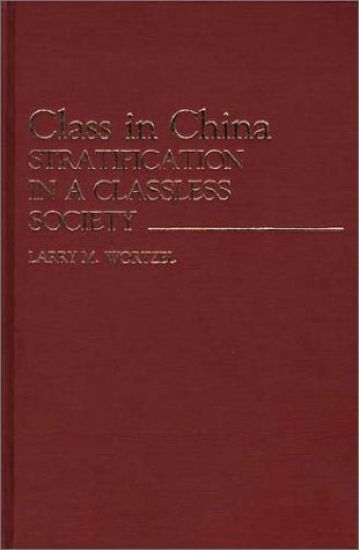
[T]he book is splendid. Wortzel combines his expertise in Sinology with his meticulous attention to epistemology and methodology in studying the class structure and stratification in Maoist China, accomplishing the rare feat of freeing himself from ideological bias and parochial ethnic subjectivity. . . . It is indeed refreshing to read Wortzel's realistic book. Journal of Third World StudiesAlthough the hierarchy of class is said to have been replaced with distinctions between the friends and enemies of Communism, Larry Wortzel argues that the Chinese Communist Party has in reality evolved into a ruling class which serves its own interests. Drawing on literature from dissident Marxists and using analyses of writings from underground journals and the Beijing publication People's Literature, the author examines perceptions of social stratification and finds that the determinants of social and economic standing now appear to depend on lines of management and authority, residence in urban or rural areas, and Party membership, especially when combined with positions of authority This work presents one of the first comprehensive analyses of the class system in socialist China as it exists in practice rather as conceived in theory.
Some of the key aspects of doctrinal, manpower, and technical modernization of China's armed forces are the subject of this unique collection of essays. The volume goes beyond a limited assessment of China's military modernization, to stress the implications of modernization with respect to regional Asian security and the broader international scene. Varying perspectives on China's military modernization are presented against a framework that considers U.S. national security policy, the Strategic Defense Initiative, and strategic trade with China, in addition to China's own nuclear deterrent and its military posture vis-a-vis the Soviet Union, Japan, and Southeast Asia. The critical issue of China's defense modernization is presented in light of practical, domestic, political, and economic constraints on defense modernization facing the Beijing government.
Tracking the evolution of the Red Army through the war against Japan and the Chinese civil war, Wortzel's book provides a comprehensive basic reference focusing on the major events, people, and issues that have produced the historical legacy of the People's Liberation Army. Placing contemporary Chinese military history in the context of China's 19th century clashes with the West and Japan, Wortzel illustrates how the imposition of unequal treaties by foreign powers conditioned China's 20th century defense forces and actions and explains how the Communist military forces developed. It also shows how fractionalization in the Communist military leadership led to the Cultural Revolution and Mao Zedong's purges.Drawing on a substantial number of sources available only in Chinese as well as on English-language secondary sources, the book provides a basic reference aimed at orienting the nonspecialist to the significant events and people in China's recent military history. The book will also provide a quick reference for the specialist in Chinese history.
Race, Ethnicity, and Disability
Larry M. Logue; Peter Blanck; Dick Thornburgh

Cambridge University Press
2010
sidottu
Using data from more than 40,000 soldiers of the Union army, this book focuses on the experience of African Americans and immigrants with disabilities, investigating their decision to seek government assistance and their resulting treatment. Pension administrators treated these ex-soldiers differently from native-born whites, but the discrimination was far from seamless - biased evaluations of worthiness intensified in response to administrators' workload and nativists' late-nineteenth-century campaigns. This book finds a remarkable interplay of social concepts, historical context, bureaucratic expediency, and individual initiative. Examining how African Americans and immigrants weighed their circumstances in deciding when to request a pension, whether to employ a pension attorney, or if they should seek institutionalization, it contends that these veterans quietly asserted their right to benefits. Shedding new light on the long history of challenges faced by veterans with disabilities, the book underscores the persistence of these challenges in spite of the recent revolution in disability rights.
Few self-help books can tell the reader exactly what to do to imprint the subconscious mind to bring about a realization of their goals. However, this book is a "one of a kind" in that it gives exact techniques and methods whereby the reader will realize immediate results in goal achievement!
In New York City, database developers Haley and Willi foil an attempt to blow up the Manhattan Bridge. Home again, in Centreville, Virginia, a snobbish waiter brings out Willi's darker side, so Haley insists she see a psychiatrist. Then, outside events intrude. A serial killer is murdering pedophiles. A second killer is eliminating famous people who escaped justice, leaving behind a cryptic note-To the determined protector of my just reward. A third killer is murdering parents and daughters, then leaving bizarre notes citing songs about Bill. A hostile takeover of their employer is underway, using The Stroller, an assassin, to ensure the sale. Nora Kelly, an evangelical friend presumed dead in the Sudan, returns, mysteriously saved by Raven H2O, a security contractor known for its ruthlessness. When friends are killed, the twosome are drawn into the tangled web of serial murders, and Haley must deal with the distinct possibility Willi may be one of the killers.
Presidential Primaries and the Dynamics of Public Choice
Larry M. Bartels
Princeton University Press
1988
pokkari
This innovative study blends sophisticated statistical analyses, campaign anecdotes, and penetrating political insight to produce a fascinating exploration of one of America's most controversial political institutions--the process by which our major parties nominate candidates for the presidency. Larry Bartels focuses on the nature and impact of "momentum" in the contemporary nominating system. He describes the complex interconnections among primary election results, expectations, and subsequent primary results that have made it possible for candidates like Jimmy Carter, George Bush, and Gary Hart to emerge from relative obscurity into political prominence in recent nominating campaigns. In the course of his analysis, he addresses questions central to any understanding--or evaluation--of the modern nominating process. How do fundamental political predispositions influence the behavior of primary voters? How quickly does the public learn about new candidates? Under what circumstances will primary success itself generate subsequent primary success? And what are the psychological processes underlying this dynamic tendency? Professor Bartels examines the likely consequences of some proposed alternatives to the current nominating process, including a regional primary system and a one-day national primary. Thus the work will be of interest to political activists, would-be reformers, and interested observers of the American political scene, as well as to students of public opinion, voting behavior, the news media, campaigns, and electoral institutions.
The first edition of Unequal Democracy was an instant classic, shattering illusions about American democracy and spurring scholarly and popular interest in the political causes and consequences of escalating economic inequality. This revised and expanded edition includes two new chapters on the political economy of the Obama era. One presents the Great Recession as a "stress test" of the American political system by analyzing the 2008 election and the impact of Barack Obama's "New New Deal" on the economic fortunes of the rich, middle class, and poor. The other assesses the politics of inequality in the wake of the Occupy Wall Street movement, the 2012 election, and the partisan gridlock of Obama's second term. Larry Bartels offers a sobering account of the barriers to change posed by partisan ideologies and the political power of the wealthy. He also provides new analyses of tax policy, partisan differences in economic performance, the struggle to raise the minimum wage, and inequalities in congressional representation. President Obama identified inequality as "the defining challenge of our time." Unequal Democracy is the definitive account of how and why our political system has failed to rise to that challenge. Now more than ever, this is a book every American needs to read.
An acclaimed examination of how the American political system favors the wealthy—now fully revised and expandedThe first edition of Unequal Democracy was an instant classic, shattering illusions about American democracy and spurring scholarly and popular interest in the political causes and consequences of escalating economic inequality. This revised, updated, and expanded second edition includes two new chapters on the political economy of the Obama era. One presents the Great Recession as a "stress test" of the American political system by analyzing the 2008 election and the impact of Barack Obama's "New New Deal" on the economic fortunes of the rich, middle class, and poor. The other assesses the politics of inequality in the wake of the Occupy Wall Street movement, the 2012 election, and the partisan gridlock of Obama’s second term. Larry Bartels offers a sobering account of the barriers to change posed by partisan ideologies and the political power of the wealthy. He also provides new analyses of tax policy, partisan differences in economic performance, the struggle to raise the minimum wage, and inequalities in congressional representation.President Obama identified inequality as "the defining challenge of our time." Unequal Democracy is the definitive account of how and why our political system has failed to rise to that challenge. Now more than ever, this is a book every American needs to read.