This is a work on the role of fungi in processed and unprocessed foods. In addition to offering practical and applied information on fungi associated with food and beverages this second edition now covers poisonous mushrooms. Topics include water activity, specific commodities, fungi and metabolities as human dietary components, health hazards and mycotoxin producers, and mycotoxin and fungal contaminant detection.
The desirability, indeed the necessity, for standardization of methods for the examination of foods for contaminant and spoilage mycoflora has been apparent for some time. The concept of a specialist workshop to address this problem was borne during conversations at the Gordon Research Conference on "Hicrobiological Safety of Foods" in Plymouth, New Hampshire, in July 1982. Discussions at that time resulted in an Organizing Committee of four, who became the Editors, and a unique format: all attendees would be expected to contribute and, in most cases, more than once; and papers in nearly all sessions would be presented as a set of data on a single topic, not as a complete research paper. Each session would be followed by general discussion, and then a panel would formulate recommendations for approval by a final plenary session. The idea for this format was derived from the famous "Kananaskis I" workshop on Hyphomycete taxonomy and terminology organized by Bryce Kendrick of the University of Waterloo, Ontario in 1969. Attendance would necessarily be limited to a small group of specialists in food mycology. The scope of the workshop developed from answers to questionnaires circulated to prospective participants. To generate new data which would allow valid comparisons to be drawn, intending participants were given a variety of topics as assignments and asked to bring information obtained to the workshop.
Most of us desire to be moral people, but too often we struggle to translate philosophical concepts about morality and ethics to everyday life. One way we can bridge this gap is by approaching ethics as skills that we can develop rather than a set of ideas we must grasp. Taking this practical approach, and writing especially for medicine, law, and business students trying to understand ethics in the real world Larry R. Churchill examines morality in the context of human experience. His book builds readers' understanding of ethics from the raw materials of moral life: the curiosity we feel when confronted with moral differences, the perplexities of practical life, and the satisfactions of moral growth. The book orients ethics around the skills that are needed for sound ethical reflection and deliberation, acknowledging that ethical issues change as we change, and their concerns extend over a lifespan. To Churchill, learning and honing these personal and relational skills is the fundamental work of ethics and the foundation for judicious use of more theoretical approaches. A succinct and compassionate guide to ethical living, this book draws from literature, as well as philosophical and religious writings. It encompasses both popular and underemphasized concepts, and demonstrates their centrality to ethics. Exercises and case studies reinforce the practical skills it teaches. Ethics for Everyone shows the wide range of skills and human capacities that make the field of ethics true to human experience. It is a book to be read and then re-read at life's major junctures.
Being a patient is a unique interpersonal experience but it is also a universal human experience. The relationships formed when we are patients can also teach some of life's most important lessons, and these relationships provide a special window into ethics, especially the ethics of healthcare professionals. This book answers two basic questions: As patients see it, what things allow relationships with healthcare providers to become therapeutic? What can this teach us about healthcare ethics? This volume presents detailed descriptions and analyses of 50 interviews with 58 patients, representing a wide spectrum of illnesses and clinician specialties. The authors argue that the structure, rhythm, and horizon of routine patient care are ultimately grounded in patient vulnerability and clinician responsiveness. From the short interview segments, the longer vignettes and the full patient stories presented here emerge the neglected dimensions of healthcare and healthcare ethics. What becomes visible is an ethics of everyday interdependence, with mutual responsibilities that follow from this moral symbiosis. Both professional expressions of healthcare ethics and the field of bioethics need to be informed and reformed by this distinctive, more patient-centered, turn in how we understand both patient care as a whole and the ethics of care more specifically. The final chapters present revised codes of ethics for health professionals, as well as the implications for medical and health professions education.
Being a patient is a unique interpersonal experience but it is also a universal human experience. The relationships formed when we are patients can also teach some of life's most important lessons, and these relationships provide a special window into ethics, especially the ethics of healthcare professionals. This book answers two basic questions: As patients see it, what things allow relationships with healthcare providers to become therapeutic? What can this teach us about healthcare ethics? This volume presents detailed descriptions and analyses of 50 interviews with 58 patients, representing a wide spectrum of illnesses and clinician specialties. The authors argue that the structure, rhythm, and horizon of routine patient care are ultimately grounded in patient vulnerability and clinician responsiveness. From the short interview segments, the longer vignettes and the full patient stories presented here emerge the neglected dimensions of healthcare and healthcare ethics. What becomes visible is an ethics of everyday interdependence, with mutual responsibilities that follow from this moral symbiosis. Both professional expressions of healthcare ethics and the field of bioethics need to be informed and reformed by this distinctive, more patient-centered, turn in how we understand both patient care as a whole and the ethics of care more specifically. The final chapters present revised codes of ethics for health professionals, as well as the implications for medical and health professions education.
Authors Jones and McCaffery provide perspectives on Canadian government actions to manage financial contingency and restraint. Although the primary focus is on provincial government, attention is also paid to the actions of the federal government. The authors begin by presenting a theoretical framework through which government financial restraint management may be evaluated. In the following chapters, criteria derived from this framework are then applied to provincial government financial stress and restraint management actions. They examine the provincial economic base, revenue and expenditure trends, and financial condition. In particular, annual and cumulative budget deficits and debt loads are reviewed as indicators of the degree of financial stress faced by provincial governments. Actions taken by provinces to increase revenues and productivity, and to control expenditures, are reviewed from the early 1970s to 1987, with emphasis on the period 1983-1987. A comparison of financial stress management in the Province of Ontario and the State of California is also presented, and this comparative approach is continued in a chapter on Canadian federal government financial stress management. Finally, Canadian federal efforts to institute budget control under the Policy and Expenditure Management system are compared to budget control approaches utilized by the U.S. federal government.This unique study will improve our understanding of how the Canadian provincial and federal governments manage budgeting and financial stress. Both for the increased knowledge it offers of Canadian fiscal practices and for the insight into our own government's fiscal difficulties, scholars and students of Canadian studies, political science, public policy and administration, and economics will want to read Government Response to Financial Constraints.
Illustrated by the world-renowned Frank H. Netter, MD and artists working in his tradition, Netter's Atlas of Human Embryology, Second Edition, provides a rich pictorial overview of human prenatal development. For each stage of development and for each body system, you'll find a brief description of the developmental plan, with key concepts and terminology, followed by discussions of histological principles, the classification of congenital anomalies, and basic cellular, molecular, and genetic concepts. An emphasis on morphological patterns in the embryo and fetus makes it easy to understand the structure and function of the adult body and the embryonic basis of natural variation as well as birth anomalies. Uses vibrant, high-quality illustrations and concise text to teach key points quickly, effectively, and memorably Includes new Inclusionary Consideration Points that detail key information such as differences between sex and gender-particularly for the embryology of sex determination; and perspectives on disability and disability advocacy-including person-first vs. identity-first language; plus new illustrations with more diversity and better representation of skin tones, sex, and body habitus Discusses topics new to this edition, including Conjoined Twins, Early Detection of Pregnancy, Exstrophy of the Bladder, Genetic Sex Variations, Congenital Limb Anomalies, Holoprosencephaly, and more Provides expanded coverage of clinical correlations and congenital anomalies and new Clinical Notes boxes throughout Contains summary tables and terminology sections at the end of each chapter, plus an appendix with all major congenital anomalies and their embryonic basis, making it easy to review course material and prepare for the USMLE An eBook version is included with purchase. The eBook allows you to access all of the text, figures and references, with the ability to search, make notes and highlights, and have content read aloud Evolve Instructor site with an image collection is available to instructors through their Elsevier sales rep or via request at https://evolve.elsevier.com.
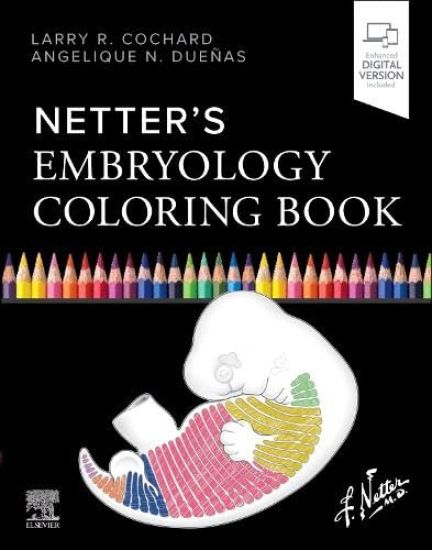
An all-new addition to the Netter Coloring Books family, Netter’s Embryology Coloring Book makes learning embryology easier and more enjoyable through active and engaging review! The study of embryology is particularly suited for coloring exercises because the actions of coloring and tracing reinforce spatial understanding and changes following the development of structures over time. With artwork based on the highly regarded and familiar Netter collection, you know you’re benefiting from reliable, up-to-date anatomical information. This new Netter coloring book also contains review questions and clinical notes, making it an excellent, high-yield embryology resource for foundational learning as well as review. Netter's Embryology Coloring Book is a perfect companion to Netter’s Anatomy Coloring Book as well as Netter’s Atlas of Human Embryology, Netter’s Physiology Coloring Book, Netter’s Neuroscience Coloring Book, Netter’s Anatomy Flash Cards, and Netter’s Physiology Flash Cards. Emphasizes the continuity between the primordia (precursors) in the early embryo and their derivatives in the fetus and adult Uses standard color coding for the three early embryo (gastrula) germ layers of cells: ectoderm blue, endoderm yellow, and mesoderm red reflect common conventions used in life sciences education Features Clinical Notes throughout that emphasize important aspects of development in a clinical context Includes review questions at the end of each section for convenient self-assessment and review Presents each topic in two-page spreads?with outlines of Netter anatomical illustrations for coloring on one side; and high-yield information and coloring guide on the other Features illustrations small enough for quick coloring, but large enough to provide important details Offers tips for coloring key structures that emphasize how a coloring exercise can reinforce learning Provides online access where you can view completed coloring pages for reference An eBook version is included with purchase. The eBook allows you to access all of the text and figures, with the ability to search, make notes and highlights, and have content read aloud
Larry Williams has never backed away from authority, especially government authority - the U.S. or any other. Including two battles all the way to the Supreme Court. Libertarian, trader, would be politician, and Indiana Jones-like adventurer, Larry has gone wherever his spirit moved him and bucked state constraints whenever he found them stifling. Throughout his life, his rebellious spirit served him well - huge successes in trading, to adventures right out of a Graham Greene novel in Saudi Arabia, two boisterous runs for the U.S. Senate, a famous actress daughter entangled with an even more famous actor, a new grandchild - the life well lived that would be the envy of most people. Along the way, Larry became a tax protester in the spirit of John Cheek and Irwin Schiff. However, Larry was far too free a spirit to give up his freedom for his beliefs, and figured that he was smarter than the zealot tax protesters now making license plates, particularly after meeting a man with an actual and real document from the IRS acknowledging the legitimacy of a certain kind of trust. But things are not always what they seem. Annoying letters from the IRS called for hiring an attorney to "work things out," which he thought (based on the bills he was paying) was in the works. Enjoying a pleasant flight in first class from South Africa to Australia, Larry, at the age of 64 with a new granddaughter and 5 children settled in successful lives of their own, reflected that life was pretty sweet. Then his plane landed in Australia and he was summarily arrested and jailed and taken to prison There began a nearly 4 year fight for his freedom at a huge financial cost; worse was the toll it took on his psyche. This is the story of Larry's war with the IRS and U.S. Dept. of Treasury and inside view of the world of tax protesters. Larry explains why the tax protest movement exists, where it is dead wrong and why it will most often lead followers to prison. He also weighs in on what can be done to correct the unfairness of the tax codes, and why tax rates are so astronomical, that the 'fair share' idea should be applied to what is the 'fair share' of your income the government is 'entitled' to.
Because of the wide variety of choices in available instrumentation to perform various types of analyses (of varying sensitivity and selectivity), this book provides an invaluable service to analysts in labs everywhere who need to decide which method to use, which instrumentation to purchase, who hesitate between one method or another, or are simply curious about methods they have not yet used. This book is adressed to analytical chemists and all other chemists and technicians who analyze samples. It is also a helpful tool for chemists, technicians and managers who need to recommend the purchase of instrumentation to their supervisors. The book will help relieve the pressure on the chemist who is expected to provide 'faster, more accurate, more precise, and less expensive' results. (From an article in C&E News, cited in the introduction.)
A must-read for accountants and professionals with a business valuation accreditation or certification, pension actuaries, ERISA lawyers, Financial Valuation of Employee Stock Ownership Plan Shares identifies, explains, and explores the ins and outs of ESOPs, with a focus on what benefits a company/shareholder/plan participant would receive by transacting shares of stock with an ESOP, the formula for an Employee Stock Ownership Plan, stock incentives and their attractiveness to employees, the nature and function of ERISA, Department of Labor, and IRS. It includes training material, the full text of Department of Labor–proposed regulations, details of important court cases, various examples and illustrations to be used as reference and research tools for the experienced and trained valuation professional, and more.
This definitive guide to modern organic electro-optic and photonic technologies provides critical insight into recent advances in organic electro-optic materials, from the underlying quantum and statistical concepts through to the practical application of materials in modern devices and systems. • Introduces theoretical and experimental methods for improving organic electro-optic and photonic technologies • Reviews the central concepts of nonlinear optics, focusing on multi-scale theoretical methods • Provides clear insight into the structure and function relationships critical to optimizing the performance of devices based on organic electro-optic materials. Serving as a primer for the systematic nano-engineering of soft matter materials, this is an invaluable resource for those involved in the development of modern telecommunication, computing, and sensing technologies depending on electro-optic technology. It is also an indispensable work of reference for academic researchers and graduate students in the fields of chemistry, physics, electrical engineering, materials science and engineering, and chemical engineering.