Kirjojen hintavertailu. Mukana 11 342 296 kirjaa ja 12 kauppaa.

Kirjahaku

Etsi kirjoja tekijän nimen, kirjan nimen tai ISBN:n perusteella.

1000 tulosta hakusanalla Larry T. Taylor

Supercritical Fluid Extraction

Supercritical Fluid Extraction

Larry T. Taylor

John Wiley Sons Inc
1996
sidottu
Clear, Practical Coverage of an Important Reemerging Technology Supercritical Fluid Extraction provides a clear, practical, step-by-step introduction to a sample preparation method that helps laboratories reduce or eliminate the use of halogenated solvents, extract samples more quickly and efficiently, and improve the accuracy of their results. By encouraging a deliberate, systematic approach to supercritical fluid extraction (SFE) methods and techniques, this book enables scientists and technicians to avoid disappointing results and erroneous conclusions and develop reliable guidelines for using this versatile technology. It demonstrates how to make the most of a process that is highly reproducible, fast, and quantitative at sub-ppb levels; preserves the chemical integrity of the analyte to be extracted; and yields a concentrated sample solution that can be easily manipulated. Topics covered include: Properties of supercritical fluidsFunctional group solubility in supercritical fluidsCollection efficiency in off-line SFEExtraction strategiesApplications of analytical SFE For analytical chemists, technicians, and laboratory managers, this book is the key to a technology that can make every sample extraction and analysis cleaner, more efficient, and more reliable.

Modern Supercritical Fluid Chromatography

Modern Supercritical Fluid Chromatography

Larry M. Miller; J. David Pinkston; Larry T. Taylor

John Wiley Sons Inc
2020
sidottu
Explains why modern supercritical fluid chromatography (SFC) is the leading "green" analytical and purification separations technology. Modern supercritical fluid chromatography (SFC) is the leading method used to analyze and purify chiral and achiral chemical compounds, many of which are pharmaceuticals, pharmaceutical candidates, and natural products including cannabis-related compounds. This book covers current SFC instrumentation as it relates to greater robustness, better reproducibility, and increased analytical sensitivity. Modern Supercritical Fluid Chromatography: Carbon Dioxide Containing Mobile Phases covers the history, instrumentation, method development and applications of SFC. The authors provided readers with an overview of analytical and preparative SFC equipment, stationary phases, and mobile phase choices. Topics covered include: Milestones of Supercritical Fluid Chromatography; Physical Properties of Supercritical Fluids; Instrumentation for SFC; Detection in SFC; Achiral SFC Method Development; Chiral SFC Method Development; and Preparative Scale SFC. The book also includes highlights of modern applications of SFC in the final chapters—namely pharmaceuticals, consumer products, foods, polymers, petroleum-related mixtures, and cannabis—and discusses the future of SFC. Provides a clear explanation of the physical and chemical properties of supercritical fluids, which gives the reader a better understanding of the basis for improved performance in SFC compared to HPLC and GCDescribes the advantages of SFC as a green alternative to HPLC and GC for the analysis of both polar, water-soluble, and non-polar analytesDetails both achiral and chiral SFC method development, including modifiers, additives, the impact of temperature and pressure, and stationary phase choicesDetails why SFC is the premier modern preparative chromatographic technique used to purify components of mixtures for subsequent uses, both from performance and economic perspectivesCovers numerous detectors, with an emphasis on SFC-MS, SFC-UV, and SFC-ELSD (evaporative light scattering detection)Describes the application of SFC to numerous high-value application areas Modern Supercritical Fluid Chromatography: Carbon Dioxide Containing Mobile Phases will be of great interest to professionals, students, and professors involved in analytical, bioanalytical, separations science, medicinal, petroleum, and environmental chemistries. It will also appeal to pharmaceutical scientists, natural-product scientists, food and consumer-products scientists, chemical engineers, and managers in these areas.
Interactionism

Interactionism

Larry T. Reynolds

General Hall Inc.,U.S.
1993
nidottu
This book presents an overview of that theoretical framework known as symbolic interactionism. It details the major intellectual and philosophical antecedents of the interactionist perspective, i.e., evolutionism, Scottish moral philosophy, German idealism, pragmatism, and functional psychology. Under the heading evolutionism, the Darwinian notion of the mutually determinative relationship existing between environments and organisms is discussed, as are Henri Bergson's conceptions of the nature of radical, abrupt departures from earlier life forms and of the emergence of novel events. Scottish moral philosophers are dealt with in terms of their contribution to the conceptual inventory of symbolic interactionism. Of particular relevance here are concepts such as the impartial spectator "sympathy", the "I", the "Me", "role taking", "generalized other", and "looking-glass self." Those German idealists exerting an impact on George Herbert Mead and symbolic interactionism, namely, Fichte, Von Schelling, Kant, and Hegel receive mention. American pragmatic philosophy is then summarized, and special attention is given to the writings of Charles S. Pierce, William James, and John Dewey. The second chapter discusses the major early interactionists, i.e., Charles Horton Cooley, William Isaac Thomas, and George Herbert Mead. Part two discusses the principal varieties of contemporary symbolic interactionism. Major "schools" receiving attention are the "Chicago School", the "Iowa School", the "Dramaturgical Genre", and "Ethnomethodology." A unique feature of this section is that it ends with an attempt to provide a single sentence description of the symbolic interactionist viewpoint. Mead's writings are dealt with in terms of his utilization of such pivotal concepts as symbols, role taking, self, society, and mind. A listing of the primary characteristics of the early interactionism closes out this section of the book. The third section provides a representative set of criticisms of interactionism. They are provid
Interactionism

Interactionism

Larry T. Reynolds

General Hall Inc.,U.S.
1993
sidottu
This book presents an overview of that theoretical framework known as symbolic interactionism. It details the major intellectual and philosophical antecedents of the interactionist perspective, i.e., evolutionism, Scottish moral philosophy, German idealism, pragmatism, and functional psychology. Under the heading evolutionism, the Darwinian notion of the mutually determinative relationship existing between environments and organisms is discussed, as are Henri Bergson's conceptions of the nature of radical, abrupt departures from earlier life forms and of the emergence of novel events. Scottish moral philosophers are dealt with in terms of their contribution to the conceptual inventory of symbolic interactionism. Of particular relevance here are concepts such as the impartial spectator 'sympathy', the 'I', the 'Me', 'role taking', 'generalized other', and 'looking-glass self.' Those German idealists exerting an impact on George Herbert Mead and symbolic interactionism, namely, Fichte, Von Schelling, Kant, and Hegel receive mention. American pragmatic philosophy is then summarized, and special attention is given to the writings of Charles S. Pierce, William James, and John Dewey. The second chapter discusses the major early interactionists, i.e., Charles Horton Cooley, William Isaac Thomas, and George Herbert Mead. Part two discusses the principal varieties of contemporary symbolic interactionism. Major 'schools' receiving attention are the 'Chicago School', the 'Iowa School', the 'Dramaturgical Genre', and 'Ethnomethodology.' A unique feature of this section is that it ends with an attempt to provide a single sentence description of the symbolic interactionist viewpoint. Mead's writings are dealt with in terms of his utilization of such pivotal concepts as symbols, role taking, self, society, and mind. A listing of the primary characteristics of the early interactionism closes out this section of the book. The third section provides a representative set of criticisms of interactionism. They are provided by interactionists and also by those who favor other sociological orientations. Both early and contemporary interactionism come under fire, and the criticisms range from the mild to the sharp. The perspective stands accused, by friend and foe alike, of being quaint, ahistorical, noneconomic, imprecise, and apolitical. It has also ignored the unconscious and emotive components in human behavior, and it manifests a rather strong astructural bias. Interactionists may now be in the process of correcting these defects.
The River of Life

The River of Life

Larry T Smith

Independently Published
2019
pokkari
Jesus explained that every word we speak will be judged, indicating words are the fruit from the trees of our hearts. A good tree cannot bring forth evil fruit. The River of Life consists of life that flows from true believers. Learn how the Tree of Life continually bearing good fruit and the flow of the River of Life speaks of the will of God for us to only speak words that give Life to others.
Mrs. Gaskell (Edition1)

Mrs. Gaskell (Edition1)

Larry T Shaw

Alpha Editions
2024
nidottu
Stairway to the Stars, a classical book, has been considered important throughout the human history, and so that this work is never forgotten we at Alpha Editions have made efforts in its preservation by republishing this book in a modern format for present and future generations. This whole book has been reformatted, retyped and designed. These books are not made of scanned copies of their original work and hence the text is clear and readable.
Larry Achiampong: If It Don't Exist, Build It
If It Don't Exist, Build It addresses all of Larry Achiampong's major work over the course of his career in film, sculpture, installation, sound, collage and performance. It explores the broader themes and ideas that have informed his artistic practice and shaped the creation of his most ambitious projects, including the multi-disciplinary Relic Traveller series. Featuring an intimate extended interview with the artist, this is an insightful monograph that will appeal to admirers of Achiampong and his work. It will also interest anyone excited by bold art that continually pushes at the boundaries of form and medium, and that responds profoundly to many of the most pressing social issues of our time.
The Difference Between God and Larry Ellison: *God Doesn't Think He's Larry Ellison
Larry Ellison started the high-flying tech company Oracle with $1,200 in 1977 and turned it into a billion-dollar Silicon Valley giant. If Bill Gates is the tech world's nerd king, Ellison is its Warren Beatty: racing yachts, buying jets, and romancing beautiful women. His rise to fame and fortune is a tale of entrepreneurial brilliance, ruthless tactics, and a constant stream of half-truths and outright fabrications for which the man and his company are notorious.Investigative reporter Mike Wilson, with access to Ellison himself and more than 125 of his friends, enemies, and former Oracle employees, has created an eye-opening, utterly fascinating portrayal of a Silicon Valley success story ... filled with the stuff that dreams and cultural icons are made of.
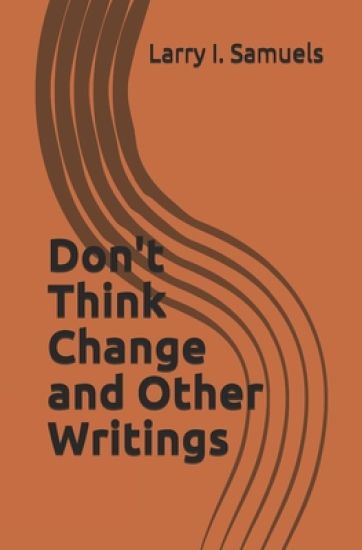
Don't Think Change and Other Writings

Don't Think Change and Other Writings

Larry I. Samuels

Steam Press
2020
nidottu
A collection of personal essays and family stories reflecting life's remembrances and transitions against the backdrops of changing cultural and historical landscapes. These reminiscenses are poignant, funny, and highlight a variety of experiences and perspectives in various settings.