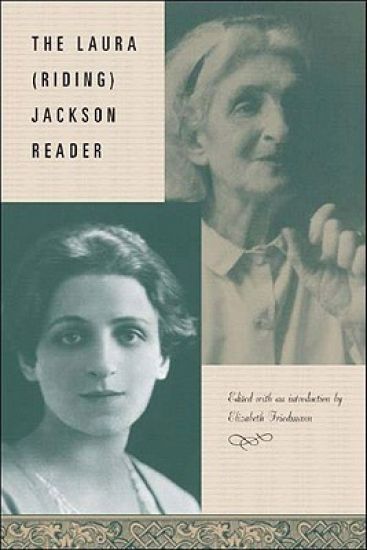
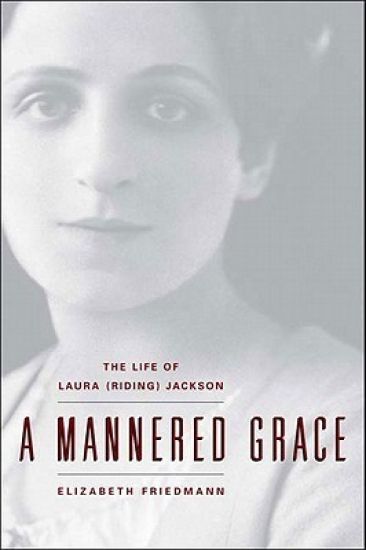
A decade in the making and eagerly anticipated, here is the authorized biography, written by the woman Laura (Riding) Jackson took into her confidence. Elizabeth Friedmann met Laura (Riding) Jackson in 1985, after five years of correspondence, and worked with her until her death in 1991. From the vantage point of a close friend and with access to all of (Riding) Jackson's papers, Friedmann now sheds new light on the life and work of one of the most important yet perplexing figures in American and British literary history. With fascinating detail, Friedmann recreates the writer and her world. We share a young Laura's excitement when, in the early 1920s, her poems attract the attention of John Crowe Ransom and Allen Tate. We recognize her sense of destiny when she goes to England and begins her productive collaboration with Robert Graves. Friedmann shows the life and world circumstances that led to such historic works as A Survey of Modernist Poetry (written with Graves) and the Collected Poems of 1938. She takes us into Laura's diverse circle of associates that included Hart Crane, Gertrude Stein, and Virginia Woolf. So intimate is this portrait that the "scandals" of (Riding) Jackson's personal and professional lifeher "three-life" with Graves and Nancy Nicholson, her attempted suicide, her role in the breakup of Schuyler Jackson's first marriage, and her renunciation of poetryare demystified, put into perspective, made understandable. Friedmann shows that (Riding) Jackson was not a divided woman, as some have said. Rather, she maintained a "mannered grace" and possessed an inner consistency of thought and purpose. Beautifully written, fair-minded, and compassionate, A Mannered Grace humanizes a complex and often demonized figure, and allows for a reassessment of her remarkable achievement.
This book takes up the utopian desire for a perfect language of words that give direct expression to the real, known in Western thought as Cratylism, and its impact on the social visions and poetic projects of three of the most intellectually ambitious of American writers: Walt Whitman, Laura (Riding) Jackson, and Charles Olson.
Always ahead of her time, no other major poet of the last century enters the twenty-first so fresh, so essentially unexplored as does Laura Riding. Her formidable credentials as a modernist need no longer distract attention from the class-of-her-own this writer occupies. Beginning in spiritual respect for Shelley, Whitman, and Francis Thompson, Riding's resolve to work toward nothing less than "the essence of the good in language" carries her across an entire poetic world within this volume -- as it afterwards carried her out of poetry altogether.This centennial volume presents the entire content of the 1980 edition, together with the author's retrospective Introduction and Appendices, corrected and reset. The poem-text reproduces, with the few errata corrected, the typography and design of the celebrated first edition of 1938, as supervised by the author herself. Included are the ten memorable full-page illustrations by John Aldridge.
A volume in the Poets on Poetry series, which collects critical works by contemporary poets, gathering together the articles, interviews, and book reviews by which they have articulated the poetics of a new generation.In The Failure of Poetry, The Promise of Language, Laura (Riding) Jackson examines the subjects of poetry, language, and truth; the conflict between truth and art; and the range of human attitudes to the prospect of truth-speaking. Also included are a series of comments on and judgments of the poets Coleridge, Clare, Eliot, Frost, Vachel Lindsay, Lowell, Pound, Dylan Thomas, and W. C. Williams and selections from her correspondence ranging from 1948 to 1984.Laura (Riding) Jackson’s first published poems appeared in 1923 in magazines such as The Fugitive. In 1925 she moved to England, and during thirteen years abroad wrote some twenty books of poetry, criticism, and fiction. In 1941 she renounced poetry, married Schuyler B. Jackson, and collaborated with him on what would become Rational Meaning: A New Foundation for the Definition of Words. The Telling, her spiritual testament, was published in 1972. In 1991 she was awarded the Bollingen Prize for her lifetime contribution to poetry. She died on September 2, 1991.John Nolan is a member of the Laura (Riding) Jackson Board of Literary Management, and co-editor, with Alan J. Clark, of Laura (Riding) Jackson’s Under the Mind’s Watch (2004). He lives in London, England.
A volume in the Poets on Poetry series, which collects critical works by contemporary poets, gathering together the articles, interviews, and book reviews by which they have articulated the poetics of a new generation.In The Failure of Poetry, The Promise of Language, Laura (Riding) Jackson examines the subjects of poetry, language, and truth; the conflict between truth and art; and the range of human attitudes to the prospect of truth-speaking. Also included are a series of comments on and judgments of the poets Coleridge, Clare, Eliot, Frost, Vachel Lindsay, Lowell, Pound, Dylan Thomas, and W. C. Williams and selections from her correspondence ranging from 1948 to 1984.Laura (Riding) Jackson’s first published poems appeared in 1923 in magazines such as The Fugitive. In 1925 she moved to England, and during thirteen years abroad wrote some twenty books of poetry, criticism, and fiction. In 1941 she renounced poetry, married Schuyler B. Jackson, and collaborated with him on what would become Rational Meaning: A New Foundation for the Definition of Words. The Telling, her spiritual testament, was published in 1972. In 1991 she was awarded the Bollingen Prize for her lifetime contribution to poetry. She died on September 2, 1991.John Nolan is a member of the Laura (Riding) Jackson Board of Literary Management, and co-editor, with Alan J. Clark, of Laura (Riding) Jackson’s Under the Mind’s Watch (2004). He lives in London, England.
Begun as a dictionary in the 1930's, this project developed into a re-evaluation of language itself. The author concentrated on the discovery of the principles that embed truth and meaning in words, and thus this study touches on literature, philosophy, linguistics and lexicography.
In A Survey of Modernist Poetry, Laura Riding and Robert Graves explore the work of the most influential poets of the modernist movement. They provide a comprehensive overview of the movement's key themes and styles, and analyze some of its most famous works. This book is a must-read for anyone interested in modernist poetry or the literary history of the early 20th century.This work has been selected by scholars as being culturally important, and is part of the knowledge base of civilization as we know it.This work is in the "public domain in the United States of America, and possibly other nations. Within the United States, you may freely copy and distribute this work, as no entity (individual or corporate) has a copyright on the body of the work.Scholars believe, and we concur, that this work is important enough to be preserved, reproduced, and made generally available to the public. We appreciate your support of the preservation process, and thank you for being an important part of keeping this knowledge alive and relevant.
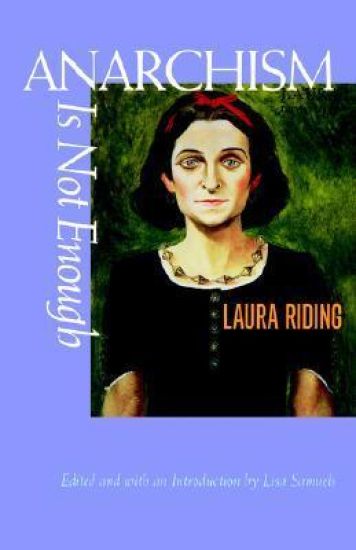
Anarchism is Not Enough is a manifesto against systematic thinking, a difficult book by a famously difficult writer. For the scope of its critical imagination, it is the most radical work of Laura Riding's early period. This period extends from the end of 1925, when she left America for Europe and Robert Graves, to 1939, the year she returned to America, renounced any further writing of poetry, and soon after married Schuyler Jackson. Published in 1928, when Riding was twenty-seven, Anarchism is a kind of early autobiographia literaria. Long out of print and now available for the first time in paperback, this is one of the most imaginative and daring works of literary theory ever written by a modernist figure. Lisa Samuels's edition sets the work in its historical context and elucidates its central intellectual difficulties. Her introduction and notes are a valuable aid to an understanding of Riding's work.
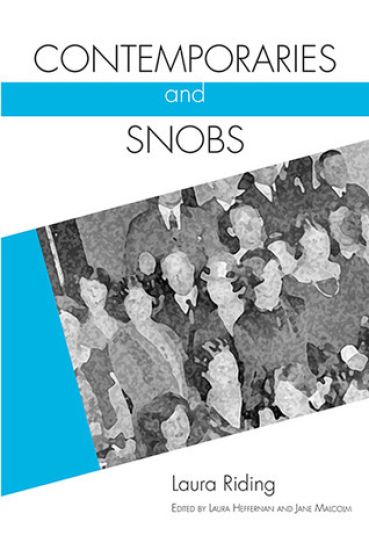
This new edition of Contemporaries and Snobs, a landmark collection of essays by Laura Riding, offers a counter-history of high modernist poetics. Laura Riding’s Contemporaries and Snobs (1928) was the first volume of essays to engage critically with high modernist poetics from the position of the outsider. For readers today, it offers a compelling account—by turns personal, by turns historical—of how the institutionalization of modernism denuded experimental poetry. Most importantly, Contemporaries and Snobs offers a counter-history of the idiosyncratic, of what the institution of modernism left (and leaves) behind. With Gertrude Stein as its figurehead, the book champions the noncanonical, the “barbaric,” and the undertheorized.Riding’s nuanced defense of a poetics of the person in Contemporaries and Snobs represents a forgotten but essential first attempt to identify and foster what is now a well-defined poetic lineage that leads from Stein to the contemporary experimental avant-garde. In these essays, Riding takes her readers on a remarkably thorough tour through the critical scene of the 1920s. Among other influential treatises, she considers T. S. Eliot’s The Sacred Wood and his editorial essays in The Criterion, Allen Tate’s “Poetry and the Absolute,” John Crowe Ransom’s essays on the modernist poet, Edgell Rickword’s essays in The Calendar of Modern Letters, and Herbert Read’s posthumous publication of T. E. Hulme’s essays. All of this criticism, Riding notes, gave modern poets a sheen of seriousness and professionalism, but was it good for poetry? Her decisive answer is “no.” This new edition includes an introduction by Laura Heffernan and Jane Malcolm that makes legible the many connections between Contemporaries and Snobs and the critical debates and poetic experiments of the 1920s, as well as explanatory notes, a chronological bibliography of Riding’s work, and an index of proper names.
Are you a fearful rider? Have you been searching for help in overcoming your fear so that you can finally achieve your horseback riding dreams? Or are you a riding instructor who struggles to convince your students that they can ride with confidence?If so, Riding Fear Free can help.Riding Fear Free goes beyond the traditional equitation and horse training advice and goes straight to the heart of the matter by addressing the true problem: fear. Learn how the scientific principles of fear extinction and memory replacement can be applied at the barn and under saddle so that you will never have another fearful ride.You will learn to: * Rate your fear level* See the reality of your situation* Deal with emotions* Replace fear memoriesThis book features full color images and illustrations to inspire readers as they take the journey to Riding Fear Free.Please Note: Riding Fear Free is available in two paperback editions to suit any budget. This is the full-color edition