
Kirjahaku
Etsi kirjoja tekijän nimen, kirjan nimen tai ISBN:n perusteella.
1000 tulosta hakusanalla Laurence Dermott
Notes on Laurence Dermott G.S. and His Work
Witham Matthew Bywater
KESSINGER PUBLISHING, LLC
2010
sidottu
Notes on Laurence Dermott G.S. and His Work
Witham Matthew Bywater
Literary Licensing, LLC
2014
nidottu
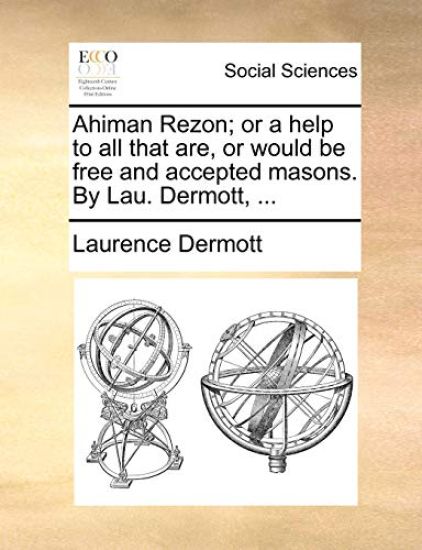
Ahiman Rezon; Or a Help to All That Are, or Would Be Free and Accepted Masons. by Lau. Dermott, ...
Laurence Dermott
Gale Ecco, Print Editions
2010
pokkari
Ahiman Rezon; or a Help to all That are, or Would be Free and Accepted Masons. By Lau. Dermott,
Laurence Dermott
Gale Ecco, Print Editions
2018
sidottu
The 18th century was a wealth of knowledge, exploration and rapidly growing technology and expanding record-keeping made possible by advances in the printing press. In its determination to preserve the century of revolution, Gale initiated a revolution of its own: digitization of epic proportions to preserve these invaluable works in the largest archive of its kind. Now for the first time these high-quality digital copies of original 18th century manuscripts are available in print, making them highly accessible to libraries, undergraduate students, and independent scholars.Delve into what it was like to live during the eighteenth century by reading the first-hand accounts of everyday people, including city dwellers and farmers, businessmen and bankers, artisans and merchants, artists and their patrons, politicians and their constituents. Original texts make the American, French, and Industrial revolutions vividly contemporary.++++The below data was compiled from various identification fields in the bibliographic record of this title. This data is provided as an additional tool in helping to insure edition identification: ++++Harvard University LibrariesN029511 London]: Printed for the benefit of the general charity, and sold by Brother John Feakins. London, 1787. 4], iv, lxii, 2],232p., plate; 8
The Constitution of Free-Masonry; Or, Ahiman Rezon
Laurence Dermott
Gale Ecco, Print Editions
2010
pokkari
The 18th century was a wealth of knowledge, exploration and rapidly growing technology and expanding record-keeping made possible by advances in the printing press. In its determination to preserve the century of revolution, Gale initiated a revolution of its own: digitization of epic proportions to preserve these invaluable works in the largest archive of its kind. Now for the first time these high-quality digital copies of original 18th century manuscripts are available in print, making them highly accessible to libraries, undergraduate students, and independent scholars.The Age of Enlightenment profoundly enriched religious and philosophical understanding and continues to influence present-day thinking. Works collected here include masterpieces by David Hume, Immanuel Kant, and Jean-Jacques Rousseau, as well as religious sermons and moral debates on the issues of the day, such as the slave trade. The Age of Reason saw conflict between Protestantism and Catholicism transformed into one between faith and logic -- a debate that continues in the twenty-first century.++++The below data was compiled from various identification fields in the bibliographic record of this title. This data is provided as an additional tool in helping to insure edition identification: ++++British LibraryT084745The text is continuous despite pagination.London: printed for James Jones; and sold by Peter Shatwell, 1778. 4], iv, lvi, lvi-lxii, 1],232p., plates; 8
The 18th century was a wealth of knowledge, exploration and rapidly growing technology and expanding record-keeping made possible by advances in the printing press. In its determination to preserve the century of revolution, Gale initiated a revolution of its own: digitization of epic proportions to preserve these invaluable works in the largest archive of its kind. Now for the first time these high-quality digital copies of original 18th century manuscripts are available in print, making them highly accessible to libraries, undergraduate students, and independent scholars.Western literary study flows out of eighteenth-century works by Alexander Pope, Daniel Defoe, Henry Fielding, Frances Burney, Denis Diderot, Johann Gottfried Herder, Johann Wolfgang von Goethe, and others. Experience the birth of the modern novel, or compare the development of language using dictionaries and grammar discourses. ++++The below data was compiled from various identification fields in the bibliographic record of this title. This data is provided as an additional tool in helping to insure edition identification: ++++Bodleian Library (Oxford)N029512Titlepage in red and black. Solomon's temple is by James Eyre Weeks.London: printed for the editor, and sold by Brother James Bedford, 1756. 2], xvii, 9],208, 2]p.; 8
The 18th century was a wealth of knowledge, exploration and rapidly growing technology and expanding record-keeping made possible by advances in the printing press. In its determination to preserve the century of revolution, Gale initiated a revolution of its own: digitization of epic proportions to preserve these invaluable works in the largest archive of its kind. Now for the first time these high-quality digital copies of original 18th century manuscripts are available in print, making them highly accessible to libraries, undergraduate students, and independent scholars.The Age of Enlightenment profoundly enriched religious and philosophical understanding and continues to influence present-day thinking. Works collected here include masterpieces by David Hume, Immanuel Kant, and Jean-Jacques Rousseau, as well as religious sermons and moral debates on the issues of the day, such as the slave trade. The Age of Reason saw conflict between Protestantism and Catholicism transformed into one between faith and logic -- a debate that continues in the twenty-first century.++++The below data was compiled from various identification fields in the bibliographic record of this title. This data is provided as an additional tool in helping to insure edition identification: ++++British LibraryT084744With a half-title.Belfast: printed, by Wm. Magee, 1795. xxiii, 1],192p.; 12
The Constitution of Free-masonry; or, Ahiman Rezon
Laurence Dermott
Gale Ecco, Print Editions
2018
sidottu
The 18th century was a wealth of knowledge, exploration and rapidly growing technology and expanding record-keeping made possible by advances in the printing press. In its determination to preserve the century of revolution, Gale initiated a revolution of its own: digitization of epic proportions to preserve these invaluable works in the largest archive of its kind. Now for the first time these high-quality digital copies of original 18th century manuscripts are available in print, making them highly accessible to libraries, undergraduate students, and independent scholars.Western literary study flows out of eighteenth-century works by Alexander Pope, Daniel Defoe, Henry Fielding, Frances Burney, Denis Diderot, Johann Gottfried Herder, Johann Wolfgang von Goethe, and others. Experience the birth of the modern novel, or compare the development of language using dictionaries and grammar discourses. ++++The below data was compiled from various identification fields in the bibliographic record of this title. This data is provided as an additional tool in helping to insure edition identification: ++++British LibraryT224171'Solomon's temple' is by James Eyre Weeks. With a colophon. The dedication leaf is engraved.London: printed by T. Burton, for the editor, 1800. 5], viii-xii, lxii,245, 1]p., plates; 8
The 18th century was a wealth of knowledge, exploration and rapidly growing technology and expanding record-keeping made possible by advances in the printing press. In its determination to preserve the century of revolution, Gale initiated a revolution of its own: digitization of epic proportions to preserve these invaluable works in the largest archive of its kind. Now for the first time these high-quality digital copies of original 18th century manuscripts are available in print, making them highly accessible to libraries, undergraduate students, and independent scholars.The Age of Enlightenment profoundly enriched religious and philosophical understanding and continues to influence present-day thinking. Works collected here include masterpieces by David Hume, Immanuel Kant, and Jean-Jacques Rousseau, as well as religious sermons and moral debates on the issues of the day, such as the slave trade. The Age of Reason saw conflict between Protestantism and Catholicism transformed into one between faith and logic -- a debate that continues in the twenty-first century.++++The below data was compiled from various identification fields in the bibliographic record of this title. This data is provided as an additional tool in helping to insure edition identification: ++++Bodleian Library (Oxford)T184515Drogheda: printed by John Fleming, 1780?]. 2], xii,182, 4]p.; 8

Ahiman Rezon, Or A Help To All That Are (or Would Be) Free And Accepted Masons
Lawrence Dermott
Hutson Street Press
2025
sidottu

Ahiman Rezon, Or A Help To All That Are (or Would Be) Free And Accepted Masons
Lawrence Dermott
Hutson Street Press
2025
pokkari

Laurence Sterne was in his mid-forties when the publication of Tristram Shandy catapulted him from obscurity into unprecedented literary fame. The story of how a provincial clergyman became the most fashionable writer of his day is extraordinary, and all the more remarkable for having been engineered by its subject. 'I wrote not to be fed, but to be famous', Laurence Sterne declared of his comic masterpiece, and in order to achieve his ambiton he became an assiduous networked, as astute a self-publicist as any modern author could hope to be. Shocked critics of Tristram Shandy denounced his bawdy novel as a scandal to the cloth but Sterne revelled in the celebrity his age's obsession with novelty and fashion allowed him. He at last found compensation for a life characterized by alternating moods of gaiety and gloom. Unhappily married to a woman who suffered a nervous breakdown and at one time believed herself to be the Queen of Bohemia, Sterne became notorious for his sexual and sentimental liaisons with other women. His second book, A Sentimental Journey, transmuted his experiences into literary expressions of moral feeling. Dependent for so much of his life on patrons, it was the patronage of the reading public that was to secure his livelihood. Tristram Shandy remains one of the most innovative and influential novels in world literature, and Ian Campbell Ross makes full use of important new materials to examine Sterne's life and career and the cult of the celebrity author.
Laurence Sterne's Tristram Shandy
Oxford University Press Inc
2006
sidottu
The responsiveness of Sterne's writing to a wide range of approaches and topics of recent and ongoing interest--among them narrative, interpretation, intertextuality, gender, the body, sentimentalism, and print culture--has ensured a wealth of recent activity in the journals. Two specialist periodicals, the Shandean and Eighteenth-Century Fiction, have become major repositories for innovative work on Sterne since their foundation in the late 1980s, and important new readings continue to appear in the established journals. The proliferation of periodical articles means, in turn, access to the full range of this material is now a problem in all but the largest institutions. This situation creates a major opportunity for a volume designed to reprint the best essays of the last fifteen years. The book is divided into five sections. Section one looks at one of the most contentious recent debates about Tristram Shandy, on the issue of generic definition, and is designed to help students orient themselves in their encounters with this convention-breaking text in terms of prior traditions and intertexts. Section two's essays on print culture represent a major new area of interest in literary study as a whole. In this context "print culture" denotes not only Sterne's experimental deformation of typographical resources in Tristram Shandy (the black, marbled, and blank pages being the famous instances) but also his engagement with a literary marketplace in which reviewers and other readers could influence the text as it serially emerged. Section three focuses on topics about the body in Sterne. These essays, related closely to the essays in section four, go beyond run of the mill "body in literature" criticism by linking the topic to other issues of current interest: narrative, language, and scientific discourse and/or medical practices in the period. Political readings, another growth area in recent years, is the subject of the final, fifth section.