Kirjojen hintavertailu. Mukana 11 244 527 kirjaa ja 12 kauppaa.

Kirjahaku

Etsi kirjoja tekijän nimen, kirjan nimen tai ISBN:n perusteella.

1000 tulosta hakusanalla Lawrence Susskind

Managing Climate Risks in Resilient Cities

Managing Climate Risks in Resilient Cities

Lawrence Susskind

University of Utah Press,U.S.
2017
nidottu
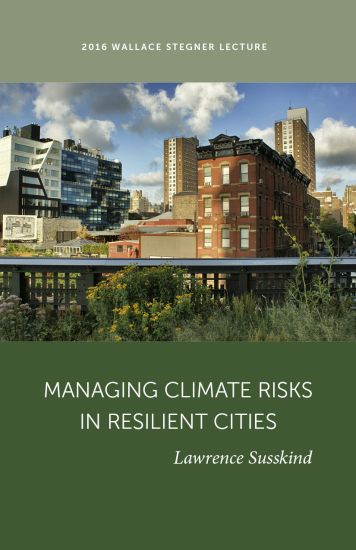
Discussions on climate change generally focus on the necessity of reducing carbon emissions, while recognizing that such action will take a long time to materialize. MIT professor Lawrence Susskind contends that communities can take action to combat climate change now, through steps that have the co-benefit of moderating the effects of flooding, heat waves, and drought—events already occurring with increasing frequency. Measures such as strengthening basic utilities and infrastructure so they are less vulnerable to high winds and floodingwill provide short-term and long-term advantages.But such changes will happen only with widespread public engagement. Public education and public opinion surveys are not enough. Susskind and colleagues have been facilitating workshops with role-playing sessions where people consider how what they want and need can be meshed with the different wants and needs of others. Dialogue focuses not on worldwideclimate change but on localized weather catastrophes.Climate risk is thereby translated into public health risk and people emerge with ideas for change rather than a mere summary of problems and disagreements.Susskind’s discourse serves as a blueprint for ways that government agencies and citizens can work together toward building climate-resilient communities.Presented on March 30, 2016 at the 21st annual Wallace Stegner Center Symposium.Copublished with the Stegner Center for Land, Resources and the Environment; S.J. Quinney School of Law; and Special Collections Department, J. Willard Marriott Library, the University of Utah.
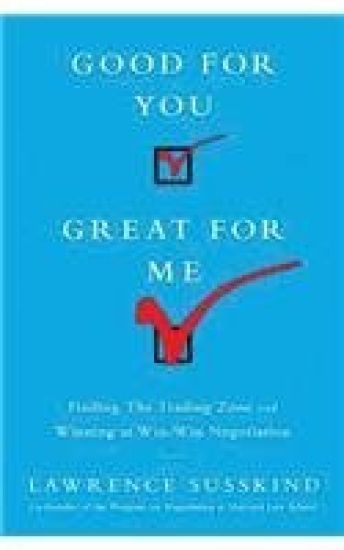
Good for You, Great for Me (INTL ED)

Good for You, Great for Me (INTL ED)

Lawrence Susskind

PublicAffairs,U.S.
2014
pokkari
You've read the classic on win-win negotiating, Getting to Yes , but so have they , the folks you are now negotiating with. How can you get a leg up , and win?By showing how to win at win-win negotiating, Lawrence Susskind provides the operational advice you need to satisfy the interests of your back table,the people to whom you report. He also shows you how to deal with irrational people, whose vocabulary seems limited to no," or with the proverbial 900-pound gorilla. He explains how to find trades that create much more value than either you or your opponent thought possible. His brilliant concept of the trading zone",the space where you can create deals that are good for them but great for you," while still maintaining trust and keeping relationships intact,is a fresh way to re-think your approach to negotiating. The outcome is often the best of both possible worlds: You claim a disproportionate share of the value you've created while your opponents still look good to the people to whom they report. Written by one of America's leaders in the field of conflict resolution, this wonderful new book contains a wealth of sophisticated, practical advice on how to succeed as a negotiator: it teaches (a) how to manage your'back table', i.e., clients and constituents (b) how to design a process that is fair to yourself and others and (c) how to create value and expand the pie so that the outcome is good for them and great for you." ,Robert H. Mnookin, Williston Professor of Law, Harvard director, Harvard Negotiation Research Project and chair, Program on Negotiation
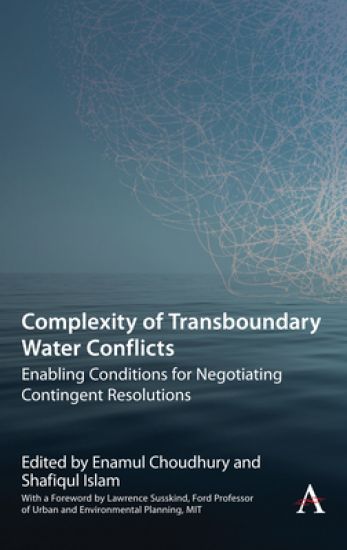
Complexity of Transboundary Water Conflicts

Complexity of Transboundary Water Conflicts

Lawrence Susskind

Anthem Press
2018
sidottu
‘Complexity of Transboundary Water Conflicts’ seeks to understand transboundary water issues as complex systems with contingent conditions and possibilities. To address those conditions and leverage the possibilities it introduces the concept of enabling conditions as a pragmatic way to identify and act on the emergent possibilities to resolve transboundary water issues. Based on this theoretical frame, the book applies the ideas and tools from complexity science, contingency and enabling conditions to account for events in the formulation of treaties/agreements between disputing riparian states in river basins across the world (Indus, Jordan, Nile, Ganges, Brahmaputra, Colorado, Danube, Senegal and Zayandehrud). It also includes a section with scholars’ reflections on the relevance and weakness of the theoretical framework.
Complexity of Transboundary Water Conflicts

Complexity of Transboundary Water Conflicts

Lawrence Susskind

Anthem Press
2020
nidottu
‘Complexity of Transboundary Water Conflicts’ seeks to understand transboundary water issues as complex systems with contingent conditions and possibilities. To address those conditions and leverage the possibilities it introduces the concept of enabling conditions as a pragmatic way to identify and act on the emergent possibilities to resolve transboundary water issues. Based on this theoretical frame, the book applies the ideas and tools from complexity science, contingency and enabling conditions to account for events in the formulation of treaties/agreements between disputing riparian states in river basins across the world (Indus, Jordan, Nile, Ganges, Brahmaputra, Colorado, Danube, Senegal and Zayandehrud). It also includes a section with scholars’ reflections on the relevance and weakness of the theoretical framework.
Paternalism, Conflict, and Coproduction

Paternalism, Conflict, and Coproduction

Lawrence Susskind; Michael Elliott

Kluwer Academic/Plenum Publishers
1983
sidottu
A research team from the United States has completed an examination of citizen participation experiments in seven European countries. The team included Donald Appleyard, Marc Draisen, David Godschalk, Chester Hartman, Janice Perlman, Hans Spiegel, John Zeisel, and ourselves. This book is a product of our joint efforts. Our studies are aimed at summarizing and sharing what can be learned from recent European efforts to enhance the effectiveness of local government through increased public involvement in the organization and management of public services and urban redevelopment. Almost a year was spent assembling the team, developing a shared framework for analysis and identifying appropriate case­ study cities. European and American public officials and citizen activists helped us assess the potential impact of such a study on current practice. A second year was spent visiting the European cities and preparing the case-study drafts. Finally, team members gathered in Washington, D. C. , with fifty American and European public officials, citizen activists, and scholars. A two-day symposium provided an exciting opportunity to present preliminary research findings and encourage an exchange of ideas between researchers, activists, and policymakers. The final versions of the case studies that appear in this book, along with several commentaries by symposium participants, are written especially for city officials and citizen activists. We have tried to translate the results of our scholarly inquiry into pragmatic suggestions for officials and activists.
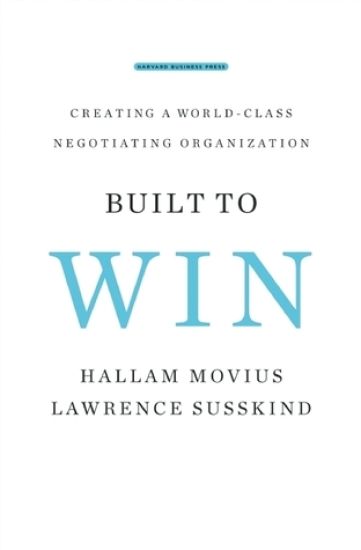
Built to Win

Built to Win

Lawrence Susskind; Hallam Movius

Harvard Business Review Press
2009
sidottu
Companies that consistently negotiate more valuable agreements?in ways that protect key relationships?enjoy an important but often overlooked competitive advantage. Until now, most companies have sought to improve their negotiation outcomes by sending individuals to training workshops. But this new groundbreaking book, using real-world examples from leading companies, shows a more powerful and less expensive way to achieve this. In Built to Win, authors Susskind and Movius argue that negotiation must be a strategic core competency. Drawing on their decades of training and consulting work, as well as a robust theory of negotiation, the authors provide a step-by-step model for building organizational competence. They show why the approach of ?training and more training? is a weak strategy. The authors also describe the organizational barriers that so often plague even experienced negotiators, and recommend ways of overcoming them. Built to Win explains the crucial role that leaders must play in setting goals, aligning incentives, pinpointing metrics, and supporting learning platforms to promote long-term success. A final chapter provides practical ?how-to? tools to help you start your own organizational improvement process. This book will be invaluable to CEOs, senior-level managers, HR business leaders, human resource professionals, sales and purchasing managers, and others who negotiate regularly.
Paternalism, Conflict, and Coproduction

Paternalism, Conflict, and Coproduction

Lawrence Susskind; Michael Elliott

Springer-Verlag New York Inc.
2013
nidottu
A research team from the United States has completed an examination of citizen participation experiments in seven European countries. The team included Donald Appleyard, Marc Draisen, David Godschalk, Chester Hartman, Janice Perlman, Hans Spiegel, John Zeisel, and ourselves. This book is a product of our joint efforts. Our studies are aimed at summarizing and sharing what can be learned from recent European efforts to enhance the effectiveness of local government through increased public involvement in the organization and management of public services and urban redevelopment. Almost a year was spent assembling the team, developing a shared framework for analysis and identifying appropriate case­ study cities. European and American public officials and citizen activists helped us assess the potential impact of such a study on current practice. A second year was spent visiting the European cities and preparing the case-study drafts. Finally, team members gathered in Washington, D. C. , with fifty American and European public officials, citizen activists, and scholars. A two-day symposium provided an exciting opportunity to present preliminary research findings and encourage an exchange of ideas between researchers, activists, and policymakers. The final versions of the case studies that appear in this book, along with several commentaries by symposium participants, are written especially for city officials and citizen activists. We have tried to translate the results of our scholarly inquiry into pragmatic suggestions for officials and activists.
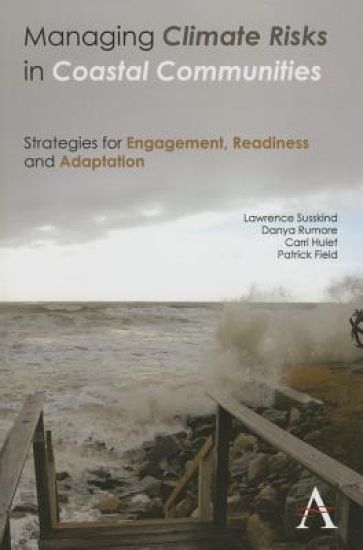
Managing Climate Risks in Coastal Communities

Managing Climate Risks in Coastal Communities

Lawrence Susskind; Danya Rumore; Carri Hulet; Patrick Field

Anthem Press
2015
sidottu
Drawing on research from the New England Climate Adaptation Project, “Managing Climate Risks for Coastal Communities” introduces a framework for building local capacity to respond to climate change. The authors maintain that local climate adaptation efforts require collective commitments to risk management, but that many communities are not ready to take on the challenge and urgently need enhanced capacity to support climate adaptation planning. To this end, the book offers statistical assessments of one readiness enhancement strategy, using tailored role-play simulations as part of a broader engagement approach. It also introduces methods for forecasting local climate change risks, as well as for evaluating the social and political context in which collective action must take place. With extensive illustration and example engagement materials, this volume is tailored for use by researchers, policy makers and practitioners.
Managing Climate Risks in Coastal Communities

Managing Climate Risks in Coastal Communities

Lawrence Susskind; Danya Rumore; Carri Hulet; Patrick Field

Anthem Press
2015
nidottu
Drawing on research from the New England Climate Adaptation Project, “Managing Climate Risks for Coastal Communities” introduces a framework for building local capacity to respond to climate change. The authors maintain that local climate adaptation efforts require collective commitments to risk management, but that many communities are not ready to take on the challenge and urgently need enhanced capacity to support climate adaptation planning. To this end, the book offers statistical assessments of one readiness enhancement strategy, using tailored role-play simulations as part of a broader engagement approach. It also introduces methods for forecasting local climate change risks, as well as for evaluating the social and political context in which collective action must take place. With extensive illustration and example engagement materials, this volume is tailored for use by researchers, policy makers and practitioners.
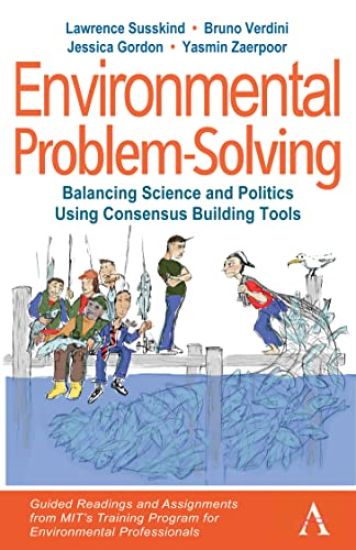
Environmental Problem-Solving: Balancing Science and Politics Using Consensus Building Tools

Environmental Problem-Solving: Balancing Science and Politics Using Consensus Building Tools

Lawrence Susskind; Bruno Verdini; Jessica Gordon; Yasmin Zaerpoor

Anthem Press
2020
sidottu
‘Environmental Problem-Solving' presents short excerpts from carefully selected readings, expert commentaries on those readings, assignments, and the best MIT student responses to the assignments and exam questions with excellent student response. The book presents four main models of environmental policy-making: competing theories of environmental ethics; tools for environmental assessment and environmental decision-making; and techniques for public engagement and group decision-making. The book covers the material presented in the semester-long course required of all students enrolled in MIT’s Environmental Policy and Planning Specialization.
Environmental Problem-Solving: Balancing Science and Politics Using Consensus Building Tools

Environmental Problem-Solving: Balancing Science and Politics Using Consensus Building Tools

Lawrence Susskind; Bruno Verdini; Jessica Gordon; Yasmin Zaerpoor

ANTHEM PRESS
2022
nidottu
‘Environmental Problem-Solving' presents short excerpts from carefully selected readings, expert commentaries on those readings, assignments, and the best MIT student responses to the assignments and exam questions with excellent student response. The book presents four main models of environmental policy-making: competing theories of environmental ethics; tools for environmental assessment and environmental decision-making; and techniques for public engagement and group decision-making. The book covers the material presented in the semester-long course required of all students enrolled in MIT’s Environmental Policy and Planning Specialization.
Judicial Dispute Resolution

Judicial Dispute Resolution

Lawrence Susskind; Justice William Tilleman; Nicolas Parra Herrera

ANTHEM PRESS
2023
sidottu
This book describes the ways in which judges, using JDR, have been facilitating problem-solving among litigants, and in the process, ensuring more just outcomes. JDR or judicial dispute resolution is similar to mediation (or alternative dispute resolution – ADR, as it is sometimes called), but it is provided by a judge, not a private mediator. Very little has been written about JDR, especially in Canada where it has been pioneered for several decades, because all the records have remained confidential. The story can now be told because the authors were given exclusive access to the records and the parties (including the JDR judges) in nine illustrative cases. The authors provide a complete Teaching Appendix summarizing the JDR cases from the standpoint of a variety of legal specialties, while highlighting the differences between JDR and ADR.
Judicial Dispute Resolution

Judicial Dispute Resolution

Lawrence Susskind; Justice William Tilleman; Nicolas Parra Herrera

ANTHEM PRESS
2023
nidottu
This book describes the ways in which judges, using JDR, have been facilitating problem-solving among litigants, and in the process, ensuring more just outcomes. JDR or judicial dispute resolution is similar to mediation (or alternative dispute resolution – ADR, as it is sometimes called), but it is provided by a judge, not a private mediator. Very little has been written about JDR, especially in Canada where it has been pioneered for several decades, because all the records have remained confidential. The story can now be told because the authors were given exclusive access to the records and the parties (including the JDR judges) in nine illustrative cases. The authors provide a complete Teaching Appendix summarizing the JDR cases from the standpoint of a variety of legal specialties, while highlighting the differences between JDR and ADR.
Breaking The Impasse

Breaking The Impasse

Jeffrey Cruikshank; Lawrence Susskind

Basic Books
1989
pokkari
Drawing on his experience in the MIT-Harvard Public Disputes Program, a leading mediator and his co-author provide the first jargon-free guide to consensual strategies for resolving public disputes,indispensable to citizen activists and to business and government leaders.
Dealing with an Angry Public

Dealing with an Angry Public

Patrick Field; Lawrence Susskind

The Free Press
2010
pokkari
Some portion of the American public will react negatively to almost any new corporate initiative, as Disney discovered when it announced its plans to build an historical theme park in Virginia. Similarly, government efforts to change policy or shift budget priorities are invariably met with stiff resistance. In this enormously practical book, Lawrence Susskind and Patrick Field analyze scores of both private and public-sector cases, as well as crisis scenarios such as the Alaskan oil spill, the silicone breast implant controversy, and nuclear plant malfunction at Three Mile Island. They show how resistance to both public and private initiatives can be overcome by a mutual gains approach involving face-to-face negotiation, a strategy applied successfully by over fifteen hundred executives and officials who have attended Professor Susskind's MIT-Harvard "Angry Public" seminars.Susskind and Field outline the six key elements of this approach in order to help business and government leaders negotiate, rather than fight, with their critics. In the process, they show how to identify who the public is, whose concerns to address first, which people and organizations must be convinced of the legitimacy of action taken, and how to assess and respond to different types of anger effectively. Acknowledging the crucial role played by the media in shaping public perception and understanding, Susskind and Field suggest a way to develop media interaction which is consistent with the six mutual gains principles, and also discuss the type of leadership that corporate and government managers must provide in order to combine these ideas into a useful whole.We all need to be concerned about a society in which the public's concerns, fears and anger are not adequately addressed. When corporate and government agencies must spend crucial time and resources on rehashing and defending each decision they make, a frustrated and angry public contributes to the erosion of confidence in our basic institutions and undermines our competitiveness in the international marketplace. In this valuable book, Susskind and Field have produced a strong, clear framework which will help reduce these hidden costs for hundreds of executives, managers, elected and appointed officials, entrepreneurs, and the public relations, legal and other professionals who advise them.
Cure for Our Broken Political, the

Cure for Our Broken Political, the

Sol Erdman; Lawrence Susskind

Potomac Books Inc
2008
sidottu
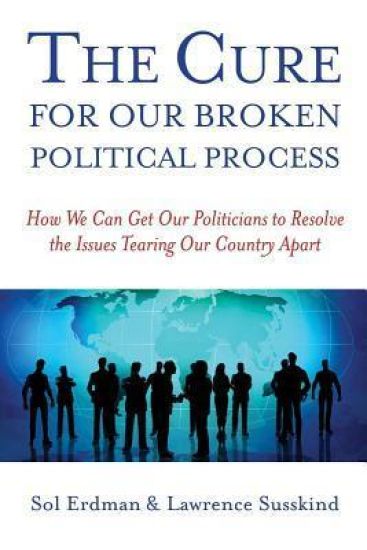
Record numbers of Americans fear that our political process is broken—for good reason. Our nation faces unprecedented challenges, yet our politicians spend most of their energy attacking one another. All the while, no one in public life has offered a practical way to neutralize the bitter partisanship that paralyzes Washington.The Cure for Our Broken Political Process fills that void. The authors show exactly how concerned citizens can get politicians from all camps to negotiate genuine solutions to the most vexing issues. Sol Erdman and Lawrence Susskind base their case on their thirty years of experience in resolving political conflict.The Cure begins with hard evidence that our country could work out practical solutions to nearly every major issue that now divides us, solutions that all sides could support. Why, then, don’t our politicians seek out those solutions? The authors debunk all the accepted explanations and then uncover the real reason. By telling the story of a concerned citizen who runs for Congress, the book shows that two basic features of our elections virtually compel politicians to bicker endlessly over major problems. So, as long as our elections work as they do today, our lawmakers will keep on fighting, leaving the critical issues unresolved.The authors then spell out how to redesign elections so that politicians would win only if they produced useful results—only if they negotiated practical solutions to pressing problems. The book concludes with a step-by-step plan proving that ordinary citizens have the power to bring about these changes. To anyone who fears that our country’s future is in peril, The Cure offers a realistic path to a political process they can genuinely believe in.
Entrepreneurial Negotiation

Entrepreneurial Negotiation

Samuel Dinnar; Lawrence Susskind; Edward Roberts

Springer Nature Switzerland AG
2019
nidottu
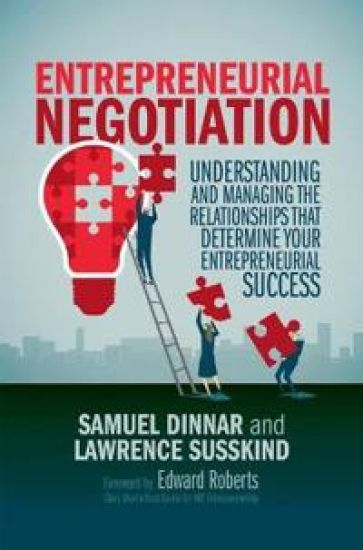
The great majority of startups fail, and most entrepreneurs who have succeeded have had to bounce back from serious mistakes. Entrepreneurs fumble key interactions because they don’t know how to handle the negotiation challenges that almost always arise. They mistakenly believe that deals are about money when they are much more complicated than that.This book presents entrepreneurship as a series of interactions between founders, partners, potential partners, investors and others at various stages of the entrepreneurial process - from seed to exit. There are plenty of authors offering ‘tips’ on how to succeed as an entrepreneur, but no one else scrutinizes the negotiation mistakes that successful entrepreneurs talk about with the authors.As Dinnar and Susskind show, learning to handle emotions, manage uncertainty, cope with technical complexity and build long-term relationships are equally or even more important. This book spotlights eight big mistakes that entrepreneurs often make and shows how most can be prevented with some forethought. It includes interviews with high-profile entrepreneurs about their own mistakes. It also covers gender biases, cultural challenges, and when to employ agents to negotiate on your behalf.Aspiring and experienced entrepreneurs should pay attention to the negotiation errors that even the most successful entrepreneurs commonly make.
Entrepreneurial Negotiation

Entrepreneurial Negotiation

Samuel Dinnar; Lawrence Susskind; Edward Roberts

Springer International Publishing AG
2018
sidottu
The great majority of startups fail, and most entrepreneurs who have succeeded have had to bounce back from serious mistakes. Entrepreneurs fumble key interactions because they don’t know how to handle the negotiation challenges that almost always arise. They mistakenly believe that deals are about money when they are much more complicated than that.This book presents entrepreneurship as a series of interactions between founders, partners, potential partners, investors and others at various stages of the entrepreneurial process - from seed to exit. There are plenty of authors offering ‘tips’ on how to succeed as an entrepreneur, but no one else scrutinizes the negotiation mistakes that successful entrepreneurs talk about with the authors.As Dinnar and Susskind show, learning to handle emotions, manage uncertainty, cope with technical complexity and build long-term relationships are equally or even more important. This book spotlights eight big mistakes that entrepreneurs often make and shows how most can be prevented with some forethought. It includes interviews with high-profile entrepreneurs about their own mistakes. It also covers gender biases, cultural challenges, and when to employ agents to negotiate on your behalf.Aspiring and experienced entrepreneurs should pay attention to the negotiation errors that even the most successful entrepreneurs commonly make.