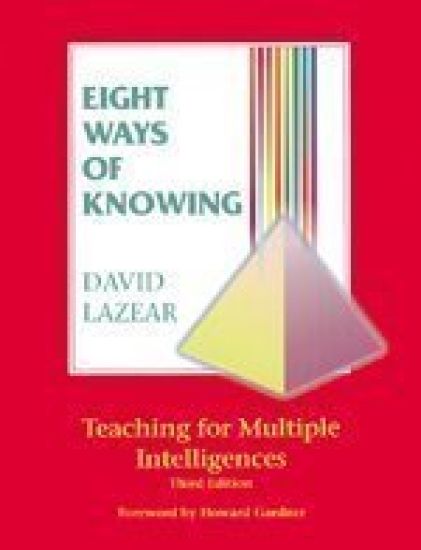
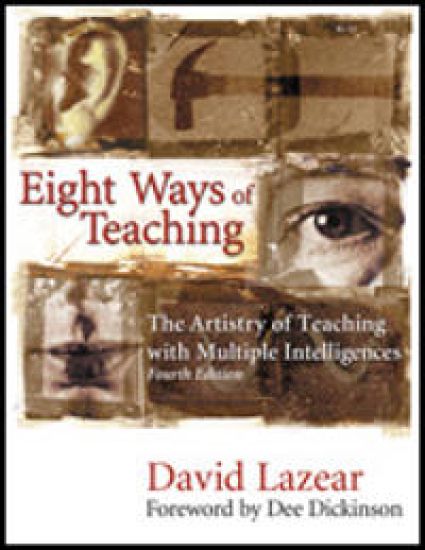
This 4th edition of Eight Ways of Teaching: The Artistry of Teaching with Multiple Intelligences is includes author David Lazear's description of what "intelligence-focused" lessons look like, and an examination of the process for creating them. A brand-new section features lessons incorporating all eight intelligences into a single learning experience, including step-by-step explanations and examples from elementary, middle, and high school levels. This resource also highlights suggestions and examples for integrating technology with the multiple intelligences.
Markets and Ideology in the City of London is the first fieldwork-based sociological study of how participants in City of London financial markets view the markets in which they work and the market mechanism in general. But it is more than a narrow study of financial market participants because it is also an empirical investigation into how ideologies function and it develops a critique of pro-market ideologies such as 'Thatcherism'. Finally, it is one of a small number of sociological studies into the privileged world of high earners and the wealthy - sociologists too frequently study the powerless and the 'deviant' or 'marginal' groups.
In his new collection of essays, Occasional Desire, David Lazar meditates on random violence and vanished phone booths, on the excessive relationship to jewelry that links Kobe Bryant and Elizabeth Taylor, on Hitchcock, Francis Bacon, and M. F. K. Fisher. He explores, in his concentrically self-aware, amused, and ironic voice, what it means to be occasionally aware that we are surviving by our wits, and that our desires, ulterior or obvious, are what keep us alive. Lazar also turns his attention on the essay itself, affording us a three-dimensional look at the craft and the art of reading and writing a literary form that maps the world as it charts the peregrinations of the mind.Lazar is especially interested in the trappings of memory, the trapdoors of memory, the way we gild or codify, select, soften, and self-delude ourselves based on our understanding of the past. His own process of selection and reflection reminds us of how far this literary form can take us, bound only by the limits of desire and imagination.
David Lazar extends the language of prose poetry, mixing the classical and the high modern, the song and dance man and the Odyssean. Nothing, he finds, is as far apart as we think, except for the chaos and order, innocence and experience. Lazar's voice is a sacred last resort: something's gotta give.The voice in these poems is semi-autobiographical and performative: masked yet emotionally raw. Each poem draws on the features of modernist poetry, using an arch, cadenced sentence as its primary unit, but drawing on the Iliad, Odyssey , and other classical myths as part of its internal cosmos.
Markets and Ideology in the City of London is the first fieldwork-based sociological study of how participants in City of London financial markets view the markets in which they work and the market mechanism in general. But it is more than a narrow study of financial market participants because it is also an empirical investigation into how ideologies function and it develops a critique of pro-market ideologies such as 'Thatcherism'. Finally, it is one of a small number of sociological studies into the privileged world of high earners and the wealthy - sociologists too frequently study the powerless and the 'deviant' or 'marginal' groups.
Longlisted for the PEN/Diamonstein-Spielvogel Award for the Art of the Essay In this essay collection David Lazar looks to our intimate relationships with characters, both well-known and lesser known, from Hollywood’s Golden Age. Veering through considerations of melancholy and wit, sexuality and gender, and the surrealism of comedies of the self in an uncanny world, mixed with his own autobiographical reflections of cinephilia, Lazar creates an alluring hybrid of essay forms as he moves through the movies in his mind.Character actors from the classical era of the 1930s through the 1950s including Thelma Ritter, Oscar Levant, Martin Balsam, Nina Foch, Elizabeth Wilson, Eric Blore, Edward Everett Horton, and the eponymous Celeste Holm all make appearances in these considerations of how essential character actors were, and remain, to cinema.
In his third book of essays, David Lazar blends personal meditations on sex and death with considerations of popular music and coping with anxiety through singing, bowling, and other distractions. He sets his work apart as both in the essay and of the essay by throwing himself into the form’s past-interviewing or speaking to past masters and turning over rocks to find lost gems of the essay form.I’ll Be Your Mirror further expands the dimensions of contemporary nonfiction writing by concluding with a series of aphorisms. Surreal, comical, and urban moments of being, they are part Cioran, part Kafka, and part Lenny Bruce. These are accompanied by Heather Frise’s illustrations, whose looking-glass visions of motherhood-funny and grotesque-meet the vision of the aphorist in this most unusual nonfiction book.
When walking down the street, it is not uncommon to see lost items that have escaped their proper receptacles, but how often does one stop to read the messages left behind? David Lazar has stopped often, capturing the pieces of a “lost world on the streets” and thinking about the life of the discarder from the fragments left behind.Stories of the Street is a series of imaginative meditations-through prose poems, short-short essays, microfictions, and prose pieces without precise genre distinction-of what it means to encounter lost or discarded texts. Rather than simply deconstructing the lists, notes, receipts, or book pages he finds strewn in various cities, Lazar uses them as suggestive, capable of inspiring possible narratives that are at most latent in the text itself. The encounter, then, is an encounter with oneself and the mysteries of cities, where detritus frequently doubles as a sign saying, “Consider this.” Lazar’s narrative voice ranges in tone from the comically antic to the melancholy. By photographing what he describes as “messages that had escaped their bottles” on-location as found, Lazar has become a flaneur of paper debris, puzzling over the evidence of urban human life.
Revolutions of the Heart is a genre-bending book where literature, social activism, and mysticism intersect. In this follow-up to Lababidi's first essay collection, Trial by Ink: From Nietzsche to Bellydancing (2010), the author is undergoing an inner change, as is the world around him. The multifaceted meditations in Revolutions--essays, poems, aphorisms, conversations, and even fiction--explore the edifying power of art, Islamophobia and its antidotes, the Egyptian Revolution and its aftermath, American popular culture, and much else in our complex modern world. A series of rich conversations with Lababidi, and his various provocative interlocutors, shed more intimate light on the subjects under discussion. At times serious, playful, and seriously playful, these exuberant exchanges chart the personal evolution of Lababidi from angst-ridden existentialist thinker, besotted with the life of the mind, to someone chastened, drawn to Sufism and seeking to surrender before the primacy of spiritual life. On a political level, as the work of an immigrant and Muslim (living in Trump's divided America and our wounded world), Revolutions is a book of hope and healing, arguing for nuance and compassion, as it attempts to present art as a form of cultural diplomacy and tool for transformation.
Revolutions of the Heart is a genre-bending book where literature, social activism, and mysticism intersect. In this follow-up to Lababidi's first essay collection, Trial by Ink: From Nietzsche to Bellydancing (2010), the author is undergoing an inner change, as is the world around him. The multifaceted meditations in Revolutions--essays, poems, aphorisms, conversations, and even fiction--explore the edifying power of art, Islamophobia and its antidotes, the Egyptian Revolution and its aftermath, American popular culture, and much else in our complex modern world. A series of rich conversations with Lababidi, and his various provocative interlocutors, shed more intimate light on the subjects under discussion. At times serious, playful, and seriously playful, these exuberant exchanges chart the personal evolution of Lababidi from angst-ridden existentialist thinker, besotted with the life of the mind, to someone chastened, drawn to Sufism and seeking to surrender before the primacy of spiritual life. On a political level, as the work of an immigrant and Muslim (living in Trump's divided America and our wounded world), Revolutions is a book of hope and healing, arguing for nuance and compassion, as it attempts to present art as a form of cultural diplomacy and tool for transformation.
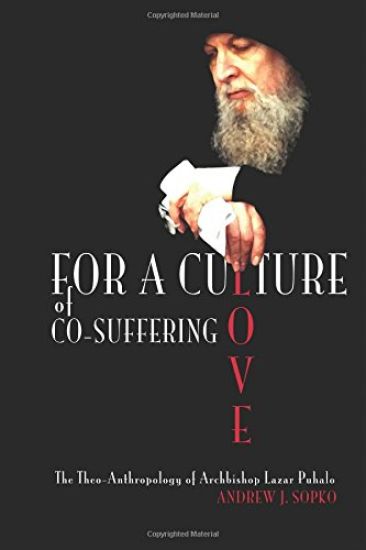
One of the most original thinkers in the Orthodox Church today, Archbishop Lazar is also one of the most thoroughly patristic in his theology. Known primarily as a "theologian of culture," his writings cover a vast array of subjects, from Patristic theology to neurobiology, from existentialism to feminism, and on to eschatology. Dr. Andrew Sopko has given us a concise overview and analysis of the Archbishop's under the label 'Theo-anthropology.' Archbishop Lazar is a hesychastic theologian and his works are of immense value as we begin our journey through the 21st century.Archbishop Lazar Puhalo is, without doubt, the most prolific Orthodox theologian in Canada, and he is certainly one of the most prolific Orthodox theologians in North America. It is about time that Archbishop Lazar was given his due, and For a Culture of Co-Suffering Love does such a deed well. The book is divided into eight sections: 1) Introduction: Orthodox Christianity and Culture 2) Christian Existentialism, 3)Gender as Prophecy, 4) Beyond Morality and Ethics, 5) Science and Theology as Empirical Quest, 6) The Aesthetics of Reality, 7) Last Things and 8) Epilogue: Church and/or World. In each of these probing chapters, Sopko carefully examines and explores how Lazar has engaged the world he lives in on a variety of key cultural issues.The strength of For a Culture of Co-Suffering Love is the way Andrew Sopko has highlighted for the interested reader how and why Archbishop Lazar, as an Orthodox theologian, has engaged the culture he has lived in rather than retreating into an idealized past, an ethnic subculture or a reactionary and right of centre political theology.
In a world where Reapers prey on the souls of the living, imprisoning them in the shadow-land of Mortem, there is one last hope for humanity. Her name is September Mourning. Half human, half Reaper, she takes the souls of the wicked so the innocent can live again. September has joined forces with a woman who was murdered and restored to life, and a young blind girl who sees only the dead. Together, as The Trinity, they set out to fulfill a prophecy that will finally free all the lost souls who are trapped in Mortem.Collects SEPTEMBER MOURNING #1-4
Scholars have long recognized that interpersonal networks play a role in mobilizing social movements. Yet, many questions remain. This Element addresses these questions by theorizing about three dimensions of ties: emotionally strong or weak, movement insider or outsider, and ingroup or cross-cleavage. The survey data on the 2020 Black Lives Matter protests show that weak and cross-cleavage ties among outsiders enabled the movement to evolve from a small provocation into a massive national mobilization. In particular, the authors find that Black people mobilized one another through social media and spurred their non-Black friends to protest by sharing their personal encounters with racism. These results depart from the established literature regarding the civil rights movement that emphasizes strong, movement-internal, and racially homogenous ties. The networks that mobilize appear to have changed in the social media era. This title is also available as Open Access on Cambridge Core.
Scholars have long recognized that interpersonal networks play a role in mobilizing social movements. Yet, many questions remain. This Element addresses these questions by theorizing about three dimensions of ties: emotionally strong or weak, movement insider or outsider, and ingroup or cross-cleavage. The survey data on the 2020 Black Lives Matter protests show that weak and cross-cleavage ties among outsiders enabled the movement to evolve from a small provocation into a massive national mobilization. In particular, the authors find that Black people mobilized one another through social media and spurred their non-Black friends to protest by sharing their personal encounters with racism. These results depart from the established literature regarding the civil rights movement that emphasizes strong, movement-internal, and racially homogenous ties. The networks that mobilize appear to have changed in the social media era. This title is also available as Open Access on Cambridge Core.
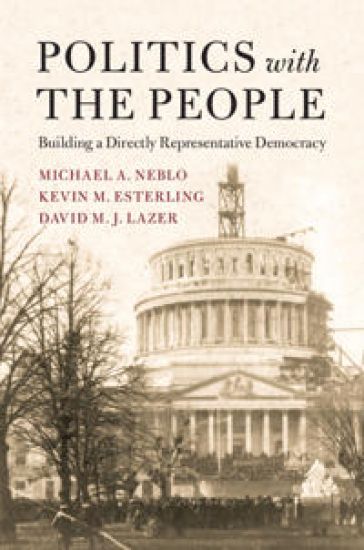
Many citizens in the US and abroad fear that democratic institutions have become weak, and continue to weaken. Politics with the People develops the principles and practice of 'directly representative democracy' - a new way of connecting citizens and elected officials to improve representative government. Sitting members of Congress agreed to meet with groups of their constituents via online, deliberative town hall meetings to discuss some of the most important and controversial issues of the day. The results from these experiments reveal a model of how our democracy could work, where politicians consult with and inform citizens in substantive discussions, and where otherwise marginalized citizens participate and are empowered. Moving beyond our broken system of interest group politics and partisan bloodsport, directly representative reforms will help restore citizens' faith in the institutions of democratic self-government, precisely at a time when those institutions themselves feel dysfunctional and endangered.