Kirjojen hintavertailu. Mukana 11 590 110 kirjaa ja 12 kauppaa.

Kirjahaku

Etsi kirjoja tekijän nimen, kirjan nimen tai ISBN:n perusteella.

1000 tulosta hakusanalla Leo H Hoffman

Correlationen III. Wärme- und Wasserhaushalt. Umwelt- faktoren. Schlaf. Altern und Sterben. Konstitution und Vererbung

Correlationen III. Wärme- und Wasserhaushalt. Umwelt- faktoren. Schlaf. Altern und Sterben. Konstitution und Vererbung

Professor Dr. Leo Adler; Privatdozent Dr. Julius Bauer; Professor Dr. W. Caspari; Professor Dr. U. Ebbecke; C. v. Economo; Professor Dr. Hermann Freund; Professor Dr. Curt Herbst; Dr. S. Hirsch; Geheimrat Professor Dr. A. Hoche; Privatdozent Dr. Hermann Hoffmann; Professor Dr. R. W. Hoffmann; Privatdozent Dr. R. Isenschmid; Professor Dr. A. Jodlbauer; Professor Dr. Otto Kestner; H. W. Knipping; Geheimrat Professor Dr. Eugen Korschelt; Professor Dr. Fritz Lenz; Professor Dr. F. Linke; Professor Dr. Erich Meyer

Springer-Verlag Berlin and Heidelberg GmbH Co. KG
1926
nidottu
Dieser Buchtitel ist Teil des Digitalisierungsprojekts Springer Book Archives mit Publikationen, die seit den Anfängen des Verlags von 1842 erschienen sind. Der Verlag stellt mit diesem Archiv Quellen für die historische wie auch die disziplingeschichtliche Forschung zur Verfügung, die jeweils im historischen Kontext betrachtet werden müssen. Dieser Titel erschien in der Zeit vor 1945 und wird daher in seiner zeittypischen politisch-ideologischen Ausrichtung vom Verlag nicht beworben.
Regression Basics

Regression Basics

Leo H. Kahane

TAYLOR FRANCIS LTD
2024
sidottu
Using an accessible, nontechnical approach, the third edition of Regression Basics introduces readers to the fundamentals of statistical regression. Accessible to anyone with an introductory statistics background, the book draws on engaging examples using real-world data and software programs SPSS®, Stata®, and R to illustrate the key concepts of the least squares regression methodology.The book emphasizes the intuition of regression methodology and provides a hands-on approach, as well as helpful end-of-chapter summaries and questions to consolidate learning. This new edition has been substantially revised and enhanced, with features including the following:Fully updated to show procedures in R, SPSS®, and Stata® Color images and substantially revised visual presentationA suite of online resources including data sets, software instructions, and PowerPoint slides for instructorsNew and updated examples throughoutExpanded material to help students overcome "math anxiety"Expanded material on multicollinearity, heteroskedasticity, and robust standard errorsThis well-paced book is ideal for advanced undergraduate and graduate students focusing on quantitative methods, research design, and statistical regression in the social and behavioral sciences, political science, and economics.
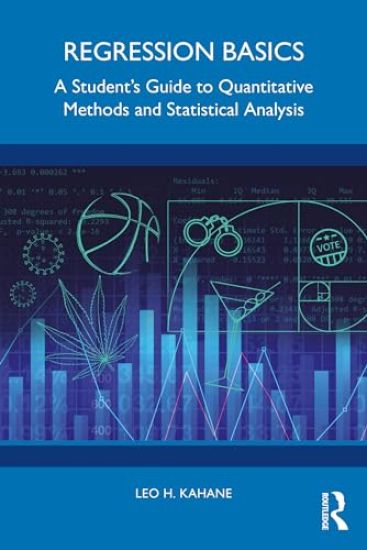
Regression Basics

Regression Basics

Leo H. Kahane

TAYLOR FRANCIS LTD
2024
nidottu
Using an accessible, nontechnical approach, the third edition of Regression Basics introduces readers to the fundamentals of statistical regression. Accessible to anyone with an introductory statistics background, the book draws on engaging examples using real-world data and software programs SPSS®, Stata®, and R to illustrate the key concepts of the least squares regression methodology.The book emphasizes the intuition of regression methodology and provides a hands-on approach, as well as helpful end-of-chapter summaries and questions to consolidate learning. This new edition has been substantially revised and enhanced, with features including the following:Fully updated to show procedures in R, SPSS®, and Stata® Color images and substantially revised visual presentationA suite of online resources including data sets, software instructions, and PowerPoint slides for instructorsNew and updated examples throughoutExpanded material to help students overcome "math anxiety"Expanded material on multicollinearity, heteroskedasticity, and robust standard errorsThis well-paced book is ideal for advanced undergraduate and graduate students focusing on quantitative methods, research design, and statistical regression in the social and behavioral sciences, political science, and economics.
Behind the Dictators: A Factual Analysis of the Relationship of Nazi-Fascism and Roman Catholicism
Behind The Dictators is a comprehensive and factual analysis of the relationship between Nazi-Fascism and Roman Catholicism. Written by Leo H. Lehmann, the book explores the role that the Catholic Church played in the rise of fascist dictators such as Hitler, Mussolini, and Franco. It delves into the historical context of the time, examining the political, social, and economic factors that led to the emergence of these dictators and their ideologies.The book also examines the Catholic Church's complicity in the crimes committed by these regimes, including the persecution of Jews and other minorities. It explores the ways in which the Church collaborated with these regimes, both through direct support and through its silence in the face of atrocities.Throughout the book, Lehmann provides a wealth of evidence and historical documentation to support his arguments. He draws on a range of primary sources, including official documents, speeches, and personal accounts, to paint a vivid and compelling picture of the relationship between Nazi-Fascism and Roman Catholicism.Overall, Behind The Dictators is an important and thought-provoking work that sheds light on a little-known aspect of the history of fascism and the Catholic Church. It is a must-read for anyone interested in understanding the complex and often troubling relationship between religion and politics.This scarce antiquarian book is a facsimile reprint of the old original and may contain some imperfections such as library marks and notations. Because we believe this work is culturally important, we have made it available as part of our commitment for protecting, preserving, and promoting the world's literature in affordable, high quality, modern editions, that are true to their original work.
Yeast Cell Envelopes Biochemistry Biophysics and Ultrastructure
A comprehensive review of the yeast cell envelope has not appeared previously and therefore this book is timely. The title of this volume was chosen to reflect the three major areas of contribution to our current understanding of the cell envelope, but we have not attempted to group chapters into subdivisions. The approach was to describe phenomena, to review the literature and to illuminate outstanding problems. It was also attempted to generate working hypotheses which may stimulate further studies. The some of these ideas be of germinal value is of more concern to us than that all of the hypotheses should stand the test of further experimentation.
Yeast Cell Envelopes Biochemistry Biophysics and Ultrastructure
A comprehensive review of the yeast cell envelope has not appeared previously and therefore this book is timely. The title of this volume was chosen to reflect the three major areas of contribution to our current understanding of the cell envelope, but we have not attempted to group chapters into subdivisions. The approach was to describe phenomena, to review the literature and to illuminate outstanding problems. It was also attempted to generate working hypotheses which may stimulate further studies. The some of these ideas be of germinal value is of more concern to us than that all of the hypotheses should stand the test of further experimentation.
School Law for Public, Private, and Parochial Educators
School Law for Public, Private, and Parochial Educators serves educators from all types of school systems in preservice or professional development. It is designed as an academic text for master’s and doctoral level, and administrative licensure (postmaster’s). Since educators often work in both the public and the private sector, this text prepares them for a career in either domain. This is a unique feature of the book, since school law books usually concentrate on either the public or the private domain. The following relevant issues in school law are covered: ·The legal system ·The federal and state role in education ·Church-state relationships and accomodations ·Attendance law ·Instructional programs ·Student rights ·Teacher contracts, rights, and freedoms ·Teacher negligence ·Law for students with disabilities ·Desegregation ·Title IX To facilitate research efforts, the book provides case summaries, which include briefs, ramifications, and topics of interest at the end of each chapter. School Law for Public, Private, and Parochial Educators is a concise presentation of the constitutional, statutory, and case law knowledge necessary for the effective day-to-day operation of all types of school systems. Contemporary issues having a large impact on school law, such as the charter school movement, home schooling, public and private vouchers, common core, and the persistent evolution verses intelligent design controversy, are also included.
School Law for Public, Private, and Parochial Educators
School Law for Public, Private, and Parochial Educators serves educators from all types of school systems in preservice or professional development. It is designed as an academic text for master’s and doctoral level, and administrative licensure (postmaster’s). Since educators often work in both the public and the private sector, this text prepares them for a career in either domain. This is a unique feature of the book, since school law books usually concentrate on either the public or the private domain. The following relevant issues in school law are covered: ·The legal system ·The federal and state role in education ·Church-state relationships and accomodations ·Attendance law ·Instructional programs ·Student rights ·Teacher contracts, rights, and freedoms ·Teacher negligence ·Law for students with disabilities ·Desegregation ·Title IX To facilitate research efforts, the book provides case summaries, which include briefs, ramifications, and topics of interest at the end of each chapter. School Law for Public, Private, and Parochial Educators is a concise presentation of the constitutional, statutory, and case law knowledge necessary for the effective day-to-day operation of all types of school systems. Contemporary issues having a large impact on school law, such as the charter school movement, home schooling, public and private vouchers, common core, and the persistent evolution verses intelligent design controversy, are also included.

Curriculum Leadership

Curriculum Leadership

Leo H. Bradley; Mark Meyers; Shirley Curtis; Thomas Kessinger

Rowman Littlefield
2017
sidottu
This 2nd edition presents strategies and answers questions, based on research and best practices, on how to develop curriculum and instruction, from philosophical base through assessment, to ensure excellence in curriculum beyond boiler plate standards. Current vocabulary describes this process as Value Added. However, since the current political paradigm requires school systems to map the curriculum to state and national assessments, attention is also given to curriculum mapping, pacing guides and other contemporary strategies designed to meet common cores, and other accountability issues. The book provides a process for school systems to follow in order to maximize teacher expertise and involvement, which creates the highest level of ownership and responsiveness from those charged with instruction and assessment. The text is a platform to encourage and enable school systems and universities to lead curriculum, instruction, and assessment that addresses, but goes beyond boiler plate standards, moves away from “teaching to the test,” and toward critical thinking, innovative thinking, and maximizing student potential.
Curriculum Leadership

Curriculum Leadership

Leo H. Bradley; Mark Meyers; Shirley Curtis; Thomas Kessinger

Rowman Littlefield
2017
nidottu
This 2nd edition presents strategies and answers questions, based on research and best practices, on how to develop curriculum and instruction, from philosophical base through assessment, to ensure excellence in curriculum beyond boiler plate standards. Current vocabulary describes this process as Value Added. However, since the current political paradigm requires school systems to map the curriculum to state and national assessments, attention is also given to curriculum mapping, pacing guides and other contemporary strategies designed to meet common cores, and other accountability issues. The book provides a process for school systems to follow in order to maximize teacher expertise and involvement, which creates the highest level of ownership and responsiveness from those charged with instruction and assessment. The text is a platform to encourage and enable school systems and universities to lead curriculum, instruction, and assessment that addresses, but goes beyond boiler plate standards, moves away from “teaching to the test,” and toward critical thinking, innovative thinking, and maximizing student potential.
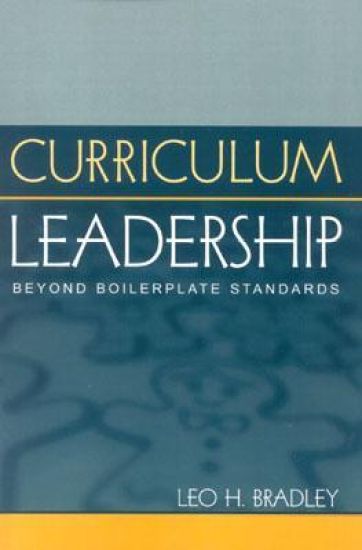
Curriculum Leadership

Curriculum Leadership

Leo H. Bradley

Rowman Littlefield Education
2003
nidottu
Moving beyond alignment and national boilerplate standards, this book takes the position that curriculum and instruction are inseparable concepts from the institutional point of view, and presents strategies to ensure their congruency. To achieve student success it is imperative that educational leaders have superb knowledge and skills in curriculum and instructional leadership whether they operate from the central office or the building level. Bradley contends that paper and pencil tests to measure student achievement on basic and minimum skills will certainly remain as one criterion of school evaluation. However, the public and the educational community will continue to demand the maximizing of potential for all students as an evaluation component of equal value and importance. The educational leader of today and tomorrow will need the knowledge and skills to facilitate this two-pronged approach to student achievement through curriculum design, development, implementation, and evaluation. Curriculum Leadership has, as its purpose, the preparation of leaders to facilitate this process.