Na hun kennismaking tijdens een congres in Mexico verliezen longarts May en statisticus Herbert elkaar weer uit het oog. Als May dan voor haar proefschrift de hulp inroept van Herbert wordt de relatie nieuw leven ingeblazen. Maar makkelijk verloopt de relatie niet.
May en Herbert kijken in Mexico, in de stad waar ze elkaar leerden kennen, terug op hun leven samen. Als hun relatie na veel pieken en dalen eindelijk in rustiger vaarwater belandt, gooit een dramatische gebeurtenis opnieuw het roer om.
The Later Prehistory of North-West Europe provides a unique, up-to-date, and easily accessible synthesis of the later prehistoric archaeology of north-west Europe, transcending political and language barriers that can hinder understanding. By surveying changes in social forms, landscape organization, monument types, and ritual practices over six millennia, the volume reassesses the prehistory of north-west Europe from the late Mesolithic to the end of the pre-Roman Iron Age. It explores how far common patterns of social development are apparent across north-west Europe, and whether there were periods when local differences were emphasized instead. In relation to this, it also examines changes through time in the main axes of contact between the various regions of continental Europe, Britain, and Ireland. Key to the volume's broad scope is its focus on the vast mass of new evidence provided by recent development-led excavations. The authors collate data that has been gathered on thousands of sites across Britain, Ireland, northern France, the Low Countries, western Germany, and Denmark, using sources including unpublished 'grey literature' reports. The results challenge many aspects of previous narratives of later prehistory, allowing the volume to present a distinctively fresh perspective.
Since the late 1990s, city councils have become increasingly aware of the potential for information technologies (ICTs) to improve the management of cities and as an instrument for economic and social policy. This has resulted in a wave of urban ICT strategies and policies, such as the adoption of ICTs within the city administration itself, projects that facilitate access to ICTs by weaker social groups and policies to improve the urban electronic infrastructure. By comparing eight cities - Barcelona, Cape Town, Eindhoven, Johnnesburg, Manchester, Tampere, the Hague and Venice - this book examines a range of innovative urban e-governance strategies and develops a framework of analysis that permits a common approach. Throughout the book, a distinction is made between access policies (aimed at improving access to ICTs for all citizens), content policies (directed to improve the use of ICTs in the city administration and semi-public domains) and infrastructure policies (to improve the provision of broadband infrastructure). For each of the cities, e-strategies and policies are critically reviewed and compared. The book reveals that urban e-strategies have evolved from an internal and technology-centred orientation to a more outward-looking approach.
Reflecting on two decades of ’competitiveness-oriented’ urban policies in Europe, this book investigates the current challenges cities face to sustain their economic position and how this can be balanced with social progress and environmental improvements. Complementing previous surveys on local and urban development and competitiveness-based strategies, this volume provides longer term views on the evolution of such policies at the city level, from the personal perspective of city officials in eight European cities. More concretely, it looks at how the urban dimension in EU policies have evolved over time, the kinds of urban policy supported by the EU over the last two decades and how cities have been involved with this process. The book investigates the portfolios of competitiveness-oriented policies which have been developed by European cities and how they see the link between urban/spatial development policies and sustainable competitiveness. Finally the book fleshes out a number of challenges and initiatives taken by the eight European cities and their governments in the face of current challenges in order to pave the way towards more competitive and sustainable urban economies.
Since the late 1990s, city councils have become increasingly aware of the potential for information technologies (ICTs) to improve the management of cities and as an instrument for economic and social policy. This has resulted in a wave of urban ICT strategies and policies, such as the adoption of ICTs within the city administration itself, projects that facilitate access to ICTs by weaker social groups and policies to improve the urban electronic infrastructure. By comparing eight cities - Barcelona, Cape Town, Eindhoven, Johnnesburg, Manchester, Tampere, the Hague and Venice - this book examines a range of innovative urban e-governance strategies and develops a framework of analysis that permits a common approach. Throughout the book, a distinction is made between access policies (aimed at improving access to ICTs for all citizens), content policies (directed to improve the use of ICTs in the city administration and semi-public domains) and infrastructure policies (to improve the provision of broadband infrastructure). For each of the cities, e-strategies and policies are critically reviewed and compared. The book reveals that urban e-strategies have evolved from an internal and technology-centred orientation to a more outward-looking approach.
Reflecting on two decades of ’competitiveness-oriented’ urban policies in Europe, this book investigates the current challenges cities face to sustain their economic position and how this can be balanced with social progress and environmental improvements. Complementing previous surveys on local and urban development and competitiveness-based strategies, this volume provides longer term views on the evolution of such policies at the city level, from the personal perspective of city officials in eight European cities. More concretely, it looks at how the urban dimension in EU policies have evolved over time, the kinds of urban policy supported by the EU over the last two decades and how cities have been involved with this process. The book investigates the portfolios of competitiveness-oriented policies which have been developed by European cities and how they see the link between urban/spatial development policies and sustainable competitiveness. Finally the book fleshes out a number of challenges and initiatives taken by the eight European cities and their governments in the face of current challenges in order to pave the way towards more competitive and sustainable urban economies.
Published in 1997. The environment of cities has become increasingly competitive. Tradition location factors, that once tied economic activities firmly to particular areas have become less important. Increasingly the ability of a city to anticipate, respond to and cope with internal and external changes is getting attention. Organizing capacity of cities, or of metropolitan regions is becoming indispensible for sustainable economic and social development. The authors have carried out investigations into eight European cities to increase the insight into the practice of organizing capacity. The analysis of the development and implementation of 15 revitalization projects in these cities shows that organizing capacity calls for a new style of entrepreneurial urban management with public and private networking, leadership, long term strategies and organizing political and public support as key concepts.
Published in 1997. The environment of cities has become increasingly competitive. Tradition location factors, that once tied economic activities firmly to particular areas have become less important. Increasingly the ability of a city to anticipate, respond to and cope with internal and external changes is getting attention. Organizing capacity of cities, or of metropolitan regions is becoming indispensible for sustainable economic and social development. The authors have carried out investigations into eight European cities to increase the insight into the practice of organizing capacity. The analysis of the development and implementation of 15 revitalization projects in these cities shows that organizing capacity calls for a new style of entrepreneurial urban management with public and private networking, leadership, long term strategies and organizing political and public support as key concepts.
A comprehensive IFRS practice resource from leading accounting authorities In the newly revised fifth edition of Applying IFRS® Standards, a team of accounting experts delivers a comprehensive practice resource designed for accountancy students and accounting practitioners seeking to better understand the complexities of International Financial Reporting Standards (IFRS). The book begins with an overview of the International Accounting Standards Board (IASB) and explains how it establishes accounting standards, before moving on to a discussion of the key concepts and applications of IFRS. It offers insights and examples sourced from the international business world and addresses the skills you need to apply the standards in real-world business environments. In addition to a comprehensive factual breakdown of the IFRS Standards, parts of the book are accompanied by an academic perspective, which offers key relevant research findings. Applying IFRS® Standards provides discussion questions, exercises, and references, as well as complimentary access to a companion website that contains additional chapters, instructor slides, test banks, more exercises, a solutions manual, and new IFRS Learning Resources. This is an essential learning tool for students and early-career accounting professionals, as well as a useful desk reference for established accounting practitioners.
Understanding the main concepts of IFRS StandardsThe fourth edition of Applying IFRS Standards explains the core principles of International Financial Reporting (IFRS) Standards. It also addresses the skills needed to apply the standards in business environments. The book begins with an overview of the International Accounting Standards Board (IASB) and how it establishes accounting standards. The general book topics are then covered in detail and include: income taxes, financial instruments, fair value measurement, property, inventories, employee benefits and more. Discussion questions, exercises and references are provided throughout the book.
By looking at the processes of change over time - by carrying out longitudinal studies - researchers answer questions about learning, development, educational growth, social change and medical outcomes. However, longitudinal research has many faces. This book examines all the main approaches as well as newer developments (such as structural equation modelling, multilevel modelling and optimal scaling) to enable the reader to gain a thorough understanding of the approach and make appropriate decisions about which technique can be applied to the research problem. Conceptual explanations are used to keep technical terms to a minimum; examples are provided for each approach; issues of design, measurement and significance are considered; and a standard notation is used throughout.
By looking at the processes of change over time - by carrying out longitudinal studies - researchers answer questions about learning, development, educational growth, social change and medical outcomes. However, longitudinal research has many faces. This book examines all the main approaches as well as newer developments (such as structural equation modelling, multilevel modelling and optimal scaling) to enable the reader to gain a thorough understanding of the approach and make appropriate decisions about which technique can be applied to the research problem. Conceptual explanations are used to keep technical terms to a minimum; examples are provided for each approach; issues of design, measurement and significance are considered; and a standard notation is used throughout.
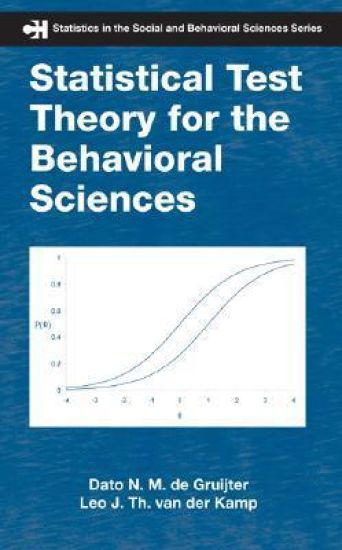
Since the development of the first intelligence test in the early 20th century, educational and psychological tests have become important measurement techniques to quantify human behavior. Focusing on this ubiquitous yet fruitful area of research, Statistical Test Theoryfor the Behavioral Sciences provides both a broad overview and a critical survey of assorted testing theories and models used in psychology, education, and other behavioral science fields.Following a logical progression from basic concepts to more advanced topics, the book first explains classical test theory, covering true score, measurement error, and reliability. It then presents generalizability theory, which provides a framework to deal with various aspects of test scores. In addition, the authors discuss the concept of validity in testing, offering a strategy for evidence-based validity. In the two chapters devoted to item response theory (IRT), the book explores item response models, such as the Rasch model, and applications, including computerized adaptive testing (CAT). The last chapter looks at some methods used to equate tests. Equipped with the essential material found in this book, advanced undergraduate and graduate students in the behavioral sciences as well as researchers involved in measurement and testing will gain valuable insight into the research methodologies and statistical data analyses of behavioral testing.
Since the development of the first intelligence test in the early 20th century, educational and psychological tests have become important measurement techniques to quantify human behavior. Focusing on this ubiquitous yet fruitful area of research, Statistical Test Theoryfor the Behavioral Sciences provides both a broad overview and a critical survey of assorted testing theories and models used in psychology, education, and other behavioral science fields.Following a logical progression from basic concepts to more advanced topics, the book first explains classical test theory, covering true score, measurement error, and reliability. It then presents generalizability theory, which provides a framework to deal with various aspects of test scores. In addition, the authors discuss the concept of validity in testing, offering a strategy for evidence-based validity. In the two chapters devoted to item response theory (IRT), the book explores item response models, such as the Rasch model, and applications, including computerized adaptive testing (CAT). The last chapter looks at some methods used to equate tests. Equipped with the essential material found in this book, advanced undergraduate and graduate students in the behavioral sciences as well as researchers involved in measurement and testing will gain valuable insight into the research methodologies and statistical data analyses of behavioral testing.
First published in 1998 this boo responds to the dynamics of Industrializing Asia and the behavioural changes of actors which, in response to changing internal and external forces, have given rise to and are constantly giving rise to alterations in patterns of growth. From a geographical perspective, these are expressed in regional change, understood as a reconstruction of spatial organization. The imperatives of dynamic comparative advantage, changing global or regional competitiveness, and regional competition, faced by different actors, entities or territorial units can be identified as important forces underlying and shaping regional change. This volume provides further illumination, contextualization and interpretation of the spatiality of the economic reality in Industrializing Asia, as well as the role played by, and the implications for, different actors.The objectives of this book are 1) to outline the processes of regional change, linked to responses in the form of restructuring and integrative and regionalization tendencies, as well as the realignment of the global-regional-local divide in production systems/complexes and the operation of firms associated with reorganization of production in the process of maintaining and reconfiguring comparative advantage; 2) to highlight the wide scope of the process by considering differential units of analysis, linked to the agents and manifestations of regional change, and the role of scale in terms of the spatial units involved; 3) to highlight the implications as to the current and future position or role of differential actors/agents (particularly nation state) in shaping the new economic reality in the region and as a corollary, its positioning in the global economic order.
First published in 1998 this boo responds to the dynamics of Industrializing Asia and the behavioural changes of actors which, in response to changing internal and external forces, have given rise to and are constantly giving rise to alterations in patterns of growth. From a geographical perspective, these are expressed in regional change, understood as a reconstruction of spatial organization. The imperatives of dynamic comparative advantage, changing global or regional competitiveness, and regional competition, faced by different actors, entities or territorial units can be identified as important forces underlying and shaping regional change. This volume provides further illumination, contextualization and interpretation of the spatiality of the economic reality in Industrializing Asia, as well as the role played by, and the implications for, different actors.The objectives of this book are 1) to outline the processes of regional change, linked to responses in the form of restructuring and integrative and regionalization tendencies, as well as the realignment of the global-regional-local divide in production systems/complexes and the operation of firms associated with reorganization of production in the process of maintaining and reconfiguring comparative advantage; 2) to highlight the wide scope of the process by considering differential units of analysis, linked to the agents and manifestations of regional change, and the role of scale in terms of the spatial units involved; 3) to highlight the implications as to the current and future position or role of differential actors/agents (particularly nation state) in shaping the new economic reality in the region and as a corollary, its positioning in the global economic order.
Across Western Europe, the emphasis has shifted from physical manufacturing to the development of ideas, new products and creative processes. This has become known as the knowledge economy. While much has been written about this concept, so far there has been little focus on the role of the city. Bringing together comparative case studies from Amsterdam, Dortmund, Eindhoven, Helsinki, Manchester, Munich, Münster, Rotterdam and Zaragoza, this volume examines the cities' roles, as well as how the knowledge economy affects urban management and policies. In doing so, it demonstrates that the knowledge economy is a trend that affects every city, but in different ways depending on the specific local situation. It describes a number of policy options that can be applied to improve cities' positions in this new environment.