Kirjojen hintavertailu. Mukana 11 244 527 kirjaa ja 12 kauppaa.

Kirjahaku

Etsi kirjoja tekijän nimen, kirjan nimen tai ISBN:n perusteella.

1000 tulosta hakusanalla Leo van den Berg

European Cities in the Knowledge Economy
Across Western Europe, the emphasis has shifted from physical manufacturing to the development of ideas, new products and creative processes. This has become known as the knowledge economy. While much has been written about this concept, so far there has been little focus on the role of the city. Bringing together comparative case studies from Amsterdam, Dortmund, Eindhoven, Helsinki, Manchester, Munich, Münster, Rotterdam and Zaragoza, this volume examines the cities' roles, as well as how the knowledge economy affects urban management and policies. In doing so, it demonstrates that the knowledge economy is a trend that affects every city, but in different ways depending on the specific local situation. It describes a number of policy options that can be applied to improve cities' positions in this new environment.
European Cities in the Knowledge Economy

European Cities in the Knowledge Economy

Leo van den Berg

CRC Press Inc
2017
sidottu
Across Western Europe, the emphasis has shifted from physical manufacturing to the development of ideas, new products and creative processes. This has become known as the knowledge economy. While much has been written about this concept, so far there has been little focus on the role of the city. Bringing together comparative case studies from Amsterdam, Dortmund, Eindhoven, Helsinki, Manchester, Munich, Münster, Rotterdam and Zaragoza, this volume examines the cities' roles, as well as how the knowledge economy affects urban management and policies. In doing so, it demonstrates that the knowledge economy is a trend that affects every city, but in different ways depending on the specific local situation. It describes a number of policy options that can be applied to improve cities' positions in this new environment.
Sports and City Marketing in European Cities

Sports and City Marketing in European Cities

Leo van den Berg; Erik Braun; Alexander H.J. Otgaar

Ashgate Publishing Limited
2002
sidottu
In our increasingly global and commercial world, where once sport would only have been seen by a few thousand on the terraces it is now watched by many millions via satellite. This mass global audience is invited not only to watch the sporting event, but also to visit the city where it takes place. Such events may help promote the host city as a tourist destination and business location. City governors are becoming increasingly aware of the possibilities of using sport as an instrument of reaching objectives of urban management. This engaging book investigates the state of the art of sports and city marketing in five European cities: Rotterdam, Barcelona, Helsinki, Manchester and Turin. In each of these cities, the book examines how sports (accommodations, clubs and events) have been made an instrument of city marketing and how the cities have attempted to maximize their potential through sports and city marketing policies. A comparison of the findings highlights the merits or disadvantages of sports clusters and strategic co-operation in sports and city marketing.
The Student City

The Student City

Leo van den Berg; Antonio Russo

Ashgate Publishing Limited
2004
sidottu
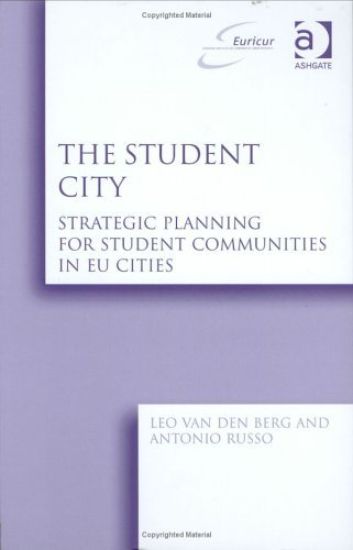
Student communities are without doubt a strategic resource for urban development and students are the citizens and the high-skilled working class of tomorrow. They are seen as an 'invisible population' with little say in local policy and decision-making. Co-operation between educational institutions and city planners is often missing and cities tend to neglect the universities' foreign relations. This volume argues that the importance of human capital in the competitiveness of cities demands pro-active, integral city policies targeting this community. Bringing together nine case studies of European cities (Rotterdam, Utrecht, Eindhoven, Munich, Lyon, Lille, Venice, Birmingham and Helsinki), it puts forward a comprehensive strategic plan of action, aiming at the integration of student communities in urban development. The book analyses the essential characteristics of the relationship between students and their host communities, as well as the role of higher education institutions and other actors in building the 'student friendly' city.
National Policy Responses to Urban Challenges in Europe

National Policy Responses to Urban Challenges in Europe

Leo van den Berg; Erik Braun

Ashgate Publishing Limited
2007
sidottu
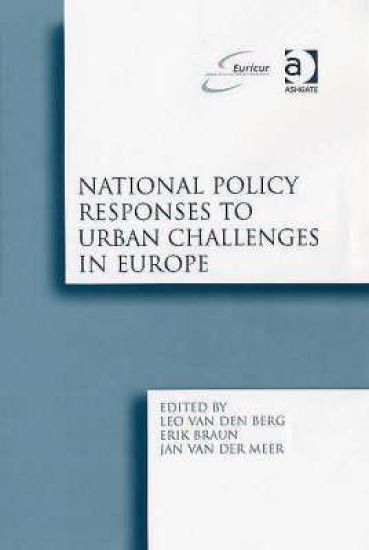
This book presents a unique overview of urban policy conducted by national authorities in the fifteen 'old' member states of the EU. Focussing on recent changes in the development of the larger cities and changes in policymaking by national authorities with respect to urban development, the book is structured around 15 'country chapters', written by national experts in the field of urban development. The book provides an up-to-date source of information, and will be of importance to anyone involved in the role and development of European cities as well as the formulation and delivery of associated national policies.
E-Governance in European and South African Cities

E-Governance in European and South African Cities

Leo van den Berg; Andre van der Meer; Willem van Winden; Paulus Woets

CRC Press Inc
2017
sidottu
Since the late 1990s, city councils have become increasingly aware of the potential for information technologies (ICTs) to improve the management of cities and as an instrument for economic and social policy. This has resulted in a wave of urban ICT strategies and policies, such as the adoption of ICTs within the city administration itself, projects that facilitate access to ICTs by weaker social groups and policies to improve the urban electronic infrastructure. By comparing eight cities - Barcelona, Cape Town, Eindhoven, Johnnesburg, Manchester, Tampere, the Hague and Venice - this book examines a range of innovative urban e-governance strategies and develops a framework of analysis that permits a common approach. Throughout the book, a distinction is made between access policies (aimed at improving access to ICTs for all citizens), content policies (directed to improve the use of ICTs in the city administration and semi-public domains) and infrastructure policies (to improve the provision of broadband infrastructure). For each of the cities, e-strategies and policies are critically reviewed and compared. The book reveals that urban e-strategies have evolved from an internal and technology-centred orientation to a more outward-looking approach.
Sports and City Marketing in European Cities

Sports and City Marketing in European Cities

Leo van den Berg; Erik Braun; Alexander H.J. Otgaar

Routledge
2017
nidottu
In our increasingly global and commercial world, where once sport would only have been seen by a few thousand on the terraces it is now watched by many millions via satellite. This mass global audience is invited not only to watch the sporting event, but also to visit the city where it takes place. Such events may help promote the host city as a tourist destination and business location. City governors are becoming increasingly aware of the possibilities of using sport as an instrument of reaching objectives of urban management. This engaging book investigates the state of the art of sports and city marketing in five European cities: Rotterdam, Barcelona, Helsinki, Manchester and Turin. In each of these cities, the book examines how sports (accommodations, clubs and events) have been made an instrument of city marketing and how the cities have attempted to maximize their potential through sports and city marketing policies. A comparison of the findings highlights the merits or disadvantages of sports clusters and strategic co-operation in sports and city marketing.
National Policy Responses to Urban Challenges in Europe

National Policy Responses to Urban Challenges in Europe

Leo van den Berg; Erik Braun

Routledge
2017
nidottu
This book presents a unique overview of urban policy conducted by national authorities in the fifteen 'old' member states of the EU. Focussing on recent changes in the development of the larger cities and changes in policymaking by national authorities with respect to urban development, the book is structured around 15 'country chapters', written by national experts in the field of urban development. The book provides an up-to-date source of information, and will be of importance to anyone involved in the role and development of European cities as well as the formulation and delivery of associated national policies.
The Student City

The Student City

Leo van den Berg; Antonio Russo

Routledge
2017
nidottu
Student communities are without doubt a strategic resource for urban development and students are the citizens and the high-skilled working class of tomorrow. They are seen as an 'invisible population' with little say in local policy and decision-making. Co-operation between educational institutions and city planners is often missing and cities tend to neglect the universities' foreign relations. This volume argues that the importance of human capital in the competitiveness of cities demands pro-active, integral city policies targeting this community. Bringing together nine case studies of European cities (Rotterdam, Utrecht, Eindhoven, Munich, Lyon, Lille, Venice, Birmingham and Helsinki), it puts forward a comprehensive strategic plan of action, aiming at the integration of student communities in urban development. The book analyses the essential characteristics of the relationship between students and their host communities, as well as the role of higher education institutions and other actors in building the 'student friendly' city.
Cities as Engines of Sustainable Competitiveness

Cities as Engines of Sustainable Competitiveness

Leo van den Berg; Jan van der Meer

Routledge
2016
nidottu
Reflecting on two decades of ’competitiveness-oriented’ urban policies in Europe, this book investigates the current challenges cities face to sustain their economic position and how this can be balanced with social progress and environmental improvements. Complementing previous surveys on local and urban development and competitiveness-based strategies, this volume provides longer term views on the evolution of such policies at the city level, from the personal perspective of city officials in eight European cities. More concretely, it looks at how the urban dimension in EU policies have evolved over time, the kinds of urban policy supported by the EU over the last two decades and how cities have been involved with this process. The book investigates the portfolios of competitiveness-oriented policies which have been developed by European cities and how they see the link between urban/spatial development policies and sustainable competitiveness. Finally the book fleshes out a number of challenges and initiatives taken by the eight European cities and their governments in the face of current challenges in order to pave the way towards more competitive and sustainable urban economies.
Metropolitan Organising Capacity

Metropolitan Organising Capacity

Leo van den Berg; Erik Braun; Jan van der Meer

Routledge
2018
sidottu
Published in 1997. The environment of cities has become increasingly competitive. Tradition location factors, that once tied economic activities firmly to particular areas have become less important. Increasingly the ability of a city to anticipate, respond to and cope with internal and external changes is getting attention. Organizing capacity of cities, or of metropolitan regions is becoming indispensible for sustainable economic and social development. The authors have carried out investigations into eight European cities to increase the insight into the practice of organizing capacity. The analysis of the development and implementation of 15 revitalization projects in these cities shows that organizing capacity calls for a new style of entrepreneurial urban management with public and private networking, leadership, long term strategies and organizing political and public support as key concepts.
Metropolitan Organising Capacity

Metropolitan Organising Capacity

Leo van den Berg; Erik Braun; Jan van der Meer

Routledge
2020
nidottu
Published in 1997. The environment of cities has become increasingly competitive. Tradition location factors, that once tied economic activities firmly to particular areas have become less important. Increasingly the ability of a city to anticipate, respond to and cope with internal and external changes is getting attention. Organizing capacity of cities, or of metropolitan regions is becoming indispensible for sustainable economic and social development. The authors have carried out investigations into eight European cities to increase the insight into the practice of organizing capacity. The analysis of the development and implementation of 15 revitalization projects in these cities shows that organizing capacity calls for a new style of entrepreneurial urban management with public and private networking, leadership, long term strategies and organizing political and public support as key concepts.
E-Governance in European and South African Cities

E-Governance in European and South African Cities

Leo van den Berg; Andre van der Meer; Willem van Winden; Paulus Woets

TAYLOR FRANCIS LTD
2022
nidottu
Since the late 1990s, city councils have become increasingly aware of the potential for information technologies (ICTs) to improve the management of cities and as an instrument for economic and social policy. This has resulted in a wave of urban ICT strategies and policies, such as the adoption of ICTs within the city administration itself, projects that facilitate access to ICTs by weaker social groups and policies to improve the urban electronic infrastructure. By comparing eight cities - Barcelona, Cape Town, Eindhoven, Johnnesburg, Manchester, Tampere, the Hague and Venice - this book examines a range of innovative urban e-governance strategies and develops a framework of analysis that permits a common approach. Throughout the book, a distinction is made between access policies (aimed at improving access to ICTs for all citizens), content policies (directed to improve the use of ICTs in the city administration and semi-public domains) and infrastructure policies (to improve the provision of broadband infrastructure). For each of the cities, e-strategies and policies are critically reviewed and compared. The book reveals that urban e-strategies have evolved from an internal and technology-centred orientation to a more outward-looking approach.
Information and Communications Technology as Potential Catalyst for Sustainable Urban Development
This title was first published in 2002: The information revolution has deeply influenced the development of Europe’s large cities. They are faced with new opportunities and threats from the information and communication technologies (ICTs) and require strategic policy responses. By examining and comparing five European cities - Eindhoven, Helsinki, Manchester, Marseilles and the Hague - this book sheds light on the impact of ICTs on urban development and considers the consequences for urban management. Case studies show how cities use new technologies to improve the delivery of municipal services, to increase civil participation and local democracy, to help their citizens and businesses make the shift to the information society, and to fight the digital divide. These analyses reveal strategic challenges and potential pitfalls for ICT policy. The book offers a unique international perspective on the impact and potential of information technologies on urban development. The integrative approach - taking economic, social and accessibility issues into account - reveals many new insights.
Information and Communications Technology as Potential Catalyst for Sustainable Urban Development
This title was first published in 2002: The information revolution has deeply influenced the development of Europe’s large cities. They are faced with new opportunities and threats from the information and communication technologies (ICTs) and require strategic policy responses. By examining and comparing five European cities - Eindhoven, Helsinki, Manchester, Marseilles and the Hague - this book sheds light on the impact of ICTs on urban development and considers the consequences for urban management. Case studies show how cities use new technologies to improve the delivery of municipal services, to increase civil participation and local democracy, to help their citizens and businesses make the shift to the information society, and to fight the digital divide. These analyses reveal strategic challenges and potential pitfalls for ICT policy. The book offers a unique international perspective on the impact and potential of information technologies on urban development. The integrative approach - taking economic, social and accessibility issues into account - reveals many new insights.
Cities as Engines of Sustainable Competitiveness

Cities as Engines of Sustainable Competitiveness

Leo van den Berg; Jan van der Meer

Routledge
2014
sidottu
Reflecting on two decades of ’competitiveness-oriented’ urban policies in Europe, this book investigates the current challenges cities face to sustain their economic position and how this can be balanced with social progress and environmental improvements. Complementing previous surveys on local and urban development and competitiveness-based strategies, this volume provides longer term views on the evolution of such policies at the city level, from the personal perspective of city officials in eight European cities. More concretely, it looks at how the urban dimension in EU policies have evolved over time, the kinds of urban policy supported by the EU over the last two decades and how cities have been involved with this process. The book investigates the portfolios of competitiveness-oriented policies which have been developed by European cities and how they see the link between urban/spatial development policies and sustainable competitiveness. Finally the book fleshes out a number of challenges and initiatives taken by the eight European cities and their governments in the face of current challenges in order to pave the way towards more competitive and sustainable urban economies.
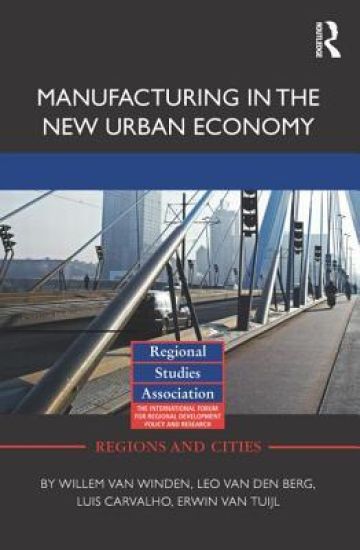
Manufacturing in the New Urban Economy

Manufacturing in the New Urban Economy

Willem van Winden; Leo van den Berg; Luis Carvalho; Erwin van Tuijl

Routledge
2010
sidottu
In large cities in developed countries, the share of manufacturing has declined drastically in the last decades and the share of service has grown as many manufacturing firms have closed or moved to lower-cost locations. The process of deindustrialization is often seen as part of the inevitable shift towards a knowledge based economy and urban economies come to rely on research and development, financial services, tourism and the creative industries. This book looks at the changing link between manufacturing and knowledge-based activities in urban regions. The authors develop a new framework drawing on insights from organization studies and regional economic literature looking at various international case studies in Western and Eastern Europe, South America and Asia.
Manufacturing in the New Urban Economy

Manufacturing in the New Urban Economy

Willem van Winden; Leo van den Berg; Luis Carvalho; Erwin van Tuijl

Routledge
2013
nidottu
In large cities in developed countries, the share of manufacturing has declined drastically in the last decades and the share of service has grown as many manufacturing firms have closed or moved to lower-cost locations. The process of deindustrialization is often seen as part of the inevitable shift towards a knowledge based economy and urban economies come to rely on research and development, financial services, tourism and the creative industries. This book looks at the changing link between manufacturing and knowledge-based activities in urban regions. The authors develop a new framework drawing on insights from organization studies and regional economic literature looking at various international case studies in Western and Eastern Europe, South America and Asia.