
Kirjahaku
Etsi kirjoja tekijän nimen, kirjan nimen tai ISBN:n perusteella.
1000 tulosta hakusanalla Leonard N. Giles

This is a study of Thoreau's participation in the economic discourse of his time, when New England and America underwent an unprecedented transformation in economic thinking and behaviour. The first part of the book examines Thoreau's responses to economic and cultural conditions as a literary artist, who identified his writing as his vocation. The second part, which uses Walden as an example, attempts to offer an answer to the question of why and how Thoreau, who was very much contained by his culture and its conventions, also contested the limitations of those conventions and used his condition to transform them.

Carl B. Stokes and the Rise of Black Political Power
Leonard N. Moore
University of Illinois Press
2003
nidottu
As the first elected black mayor of a major U.S. city, Cleveland's Carl B. Stokes embodied the transformation of the civil rights movement from a vehicle of protest to one of black political power. In this wide-ranging political biography, Leonard N. Moore examines the convictions and alliances that brought Stokes to power. Impelled by the problems plaguing Cleveland's ghettos in the decades following World War II, Stokes and other Clevelanders questioned how the sit-ins and marches of the civil rights movement could correct the exclusionary zoning practices, police brutality, substandard housing, and de facto school segregation that African Americans in the country's northern urban centers viewed as evidence of their oppression. As civil unrest in the country's ghettos turned to violence in the 1960s, Cleveland was one of the first cities to heed the call of Malcolm X's infamous "The Ballot or the Bullet" speech. Understanding the importance of controlling the city's political system, Cleveland's blacks utilized their substantial voting base to put Stokes in office in 1967. Stokes was committed to showing the country that an African American could be an effective political leader. He employed an ambitious and radically progressive agenda to clean up Cleveland's ghettos, reform law enforcement, move public housing to middle-class neighborhoods, and jump-start black economic power. Hindered by resistance from the black middle class and the Cleveland City Council, spurned by the media and fellow politicians who deemed him a black nationalist, and unable to prove that black leadership could thwart black unrest, Stokes finished his four years in office with many of his legislative goals unfulfilled. Focusing on Stokes and Cleveland, but attending to themes that affected many urban centers after the second great migration of African Americans to the North, Moore balances Stokes's failures and successes to provide a thorough and engaging portrait of his life and his pioneering contributions to a distinct African American political culture that continues to shape American life.
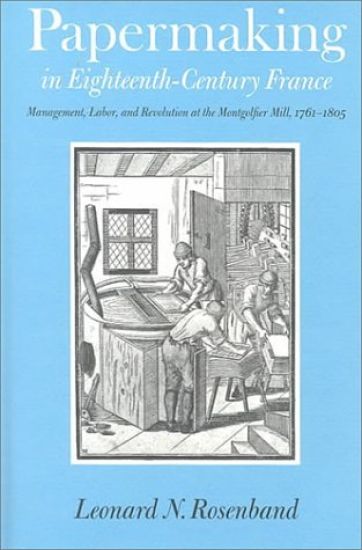
Papermaking in Eighteenth-Century France
Leonard N. Rosenband
Johns Hopkins University Press
2000
sidottu
Eight years before the French Revolution, the paper mill at Vidalon-le-Haut was the setting for a bitter strike and successful lockout. This labor dispute, resulting from conflicts between master papermakers and skilled journeymen, ultimately benefitted the mill's owners and administrators-the Montgolfier family. They converted the 1781 lockout into an opportunity to train a new kind of worker, a malleable employee, and to fashion a new sort of workplace, a theater of technological experiment. Papermaking in Eighteenth-Century France: Management, Labor, and Revolution at the Montgolfier Mill, 1761-1805, gives us history from the workshop up, offering the most comprehensive exploration available of the historical experience of papermaking. Leonard N. Rosenband explains how paper was made, depicting the tools, techniques, raw materials, and seasonable flows of the craft, and explores the many conflicts and compromises between masters and men. Rosenband provides a compelling account of how technological change affected the papermaking industry, transforming an elaborate, established system of production. The Montgolfier archives are a rich source of information, providing records of daily output and procedures, including complex rules ranging from the precise hours of meals and prayer to matters of propriety and personal sanitation. They also provide insight into the attitudes of the Montgolfier family and their workers-what they made of their trade, their labor, and one another. This case study of the Montgolfier mill, adding details about technological innovation and shopfloor relations during a time of social unrest, enriches the current debate about the nature and impact of capitalism in France during the years leading up to the French Revolution.
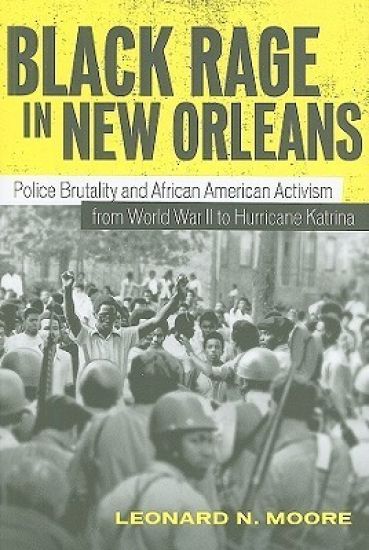
In Black Rage in New Orleans, Leonard N. Moore traces the shocking history of police corruption in the Crescent City from World War II to Hurricane Katrina and the concurrent rise of a large and energized black opposition to it. In New Orleans, crime, drug abuse, and murder were commonplace, and an underpaid, inadequately staffed, and poorly trained police force frequently resorted to brutality against African Americans. Endemic corruption among police officers increased as the city's crime rate soared, generating anger and frustration among New Orleans's black community. Rather than remain passive, African Americans in the city formed antibrutality organizations, staged marches, held sit-ins, waged boycotts, vocalized their concerns at city council meetings, and demanded equitable treatment. Moore explores a staggering array of NOPD abuses -- police homicides, sexual violence against women, racial profiling, and complicity in drug deals, prostitution rings, burglaries, protection schemes, and gun smuggling -- and the increasingly vociferous calls for reform by the city's black community. Documenting the police harassment of civil rights workers in the 1950s and 1960s, Moore then examines the aggressive policing techniques of the 1970s, and the attempts of Ernest ""Dutch"" Morial -- the first black mayor of New Orleans -- to reform the force in the late 1970s and early 1980s. Even when the department hired more African American officers as part of that reform effort, Moore reveals, the corruption and brutality continued unabated in the late 1980s and early 1990s. Dramatic changes in departmental leadership, together with aid from federal grants, finally helped professionalize the force and achieved long-sought improvements within the New Orleans Police Department. Community policing practices, increased training, better pay, and a raft of other reform measures for a time seemed to signal real change in the department. The book's epilogue, ""Policing Katrina,"" however, looks at how the NOPD's ineffectiveness compromised its ability to handle the greatest natural disaster in American history, suggesting that the fruits of reform may have been more temporary than lasting. The first book-length study of police brutality and African American protest in a major American city, Black Rage in New Orleans will prove essential for anyone interested in race relations in America's urban centers.

For three days in 1972 in Gary, Indiana, eight thousand American civil rights activists and Black Power leaders gathered at the National Black Political Convention, hoping to end a years-long feud that divided black America into two distinct camps: integrationists and separatists. While some form of this rift existed within black politics long before the 1968 assassination of Dr. Martin Luther King, Jr., his death- and the power vacuum it created- heightened tensions between the two groups, and convention leaders sought to merge these competing ideologies into a national, unified call to action. What followed, however, effectively crippled the Black Power movement and fundamentally altered the political strategy of civil rights proponents. An intense and revealing history, Leonard N. Moore's The Defeat of Black Power provides the first in-depth evaluation of this critical moment in American history.During the brief but highly charged meeting in March 1972, attendees confronted central questions surrounding black people's involvement in the established political system: reject or accept integration and assimilation; determine the importance or futility of working within the broader white system; and assess the perceived benefits of running for public office. These issues illuminated key differences between integrationists and separatists, yet both sides understood the need to mobilize under a unified platform of black self-determination. At the end of the convention, determined to reach a consensus, officials produced ""The National Black Political Agenda,"" which addressed the black constituency's priorities. While attendees and delegates agreed with nearly every provision, integrationists maintained their rejection of certain planks, namely the call for a U.S. constitutional convention and separatists' demands for reparations. As a result, black activists and legislators withdrew their support less than ten weeks after the convention, dashing the promise of the 1972 assembly and undermining the prerogatives of black nationalists. In The Defeat of Black Power, Moore shows how the convention signaled a turning point for the Black Power movement, whose leaders did not hold elective office and were now effectively barred access to the levers of social and political power. Thereafter, their influence within black communities rapidly declined, leaving civil rights activists and elected officials holding the mantle of black political leadership in 1972 and beyond.

In Black Rage in New Orleans, Leonard N. Moore traces the shocking history of police corruption in the Crescent City from World War II to Hurricane Katrina and the concurrent rise of a large and energized black opposition to it. In New Orleans, crime, drug abuse, and murder were commonplace, and an underpaid, inadequately staffed, and poorly trained police force frequently resorted to brutality against African Americans. Endemic corruption among police officers increased as the city's crime rate soared, generating anger and frustration among New Orleans's black community. Rather than remain passive, African Americans in the city formed antibrutality organizations, staged marches, held sit-ins, waged boycotts, vocalized their concerns at city council meetings, and demanded equitable treatment.Moore explores a staggering array of NOPD abuses—police homicides, sexual violence against women, racial profiling, and complicity in drug deals, prostitution rings, burglaries, protection schemes, and gun smuggling—and the increasingly vociferous calls for reform by the city's black community. Documenting the police harassment of civil rights workers in the 1950s and 1960s, Moore then examines the aggressive policing techniques of the 1970s, and the attempts of Ernest "Dutch" Morial—the first black mayor of New Orleans—to reform the force in the late 1970s and early 1980s. Even when the department hired more African American officers as part of that reform effort, Moore reveals, the corruption and brutality continued unabated in the late 1980s and early 1990s. Dramatic changes in departmental leadership, together with aid from federal grants, finally helped professionalize the force and achieved long-sought improvements within the New Orleans Police Department. Community policing practices, increased training, better pay, and a raft of other reform measures for a time seemed to signal real change in the department. The book's epilogue, "Policing Katrina," however, looks at how the NOPD's ineffectiveness compromised its ability to handle the greatest natural disaster in American history, suggesting that the fruits of reform may have been more temporary than lasting. The first book-length study of police brutality and African American protest in a major American city, Black Rage in New Orleans will prove essential for anyone interested in race relations in America's urban centers.

Leonard N. Simons (1904-1995) was one of Detroit's most prominent benefactors. Here, republished on the occasion of his eighty-fifth birthday, is presented a selection of his talks and addresses that illustrate a rare combination of wit, sensitivity, and boundless energy that made him a leader in the Detroit community.This collection need not be read in sequence. Let the reader dip into the book here and there to catch revealing glimpses of the people and personalities, of the spirit and beliefs that have animated a community. The author was by profession an advertising agency executive. By inclination he was a lover of books, chronicler of his city's past and present. Here he displays his strong social and religious commitments with brevity and laughter.
Leonard Moore has been teaching Black history for twenty-five years, mostly to white people. Drawing on decades of experience in the classroom and on college campuses throughout the South, as well as on his own personal history, Moore illustrates how an understanding of Black history is necessary for everyone. With Teaching Black History to White People, which is "part memoir, part Black history, part pedagogy, and part how-to guide," Moore delivers an accessible and engaging primer on the Black experience in America. He poses provocative questions, such as "Why is the teaching of Black history so controversial?" and "What came first: slavery or racism?" These questions don't have easy answers, and Moore insists that embracing discomfort is necessary for engaging in open and honest conversations about race. Moore includes a syllabus and other tools for actionable steps that white people can take to move beyond performative justice and toward racial reparations, healing, and reconciliation.
Leonard Moore has been teaching Black history for twenty-five years, mostly to white people. Drawing on decades of experience in the classroom and on college campuses throughout the South, as well as on his own personal history, Moore illustrates how an understanding of Black history is necessary for everyone. With Teaching Black History to White People, which is "part memoir, part Black history, part pedagogy, and part how-to guide," Moore delivers an accessible and engaging primer on the Black experience in America. He poses provocative questions, such as "Why is the teaching of Black history so controversial?" and "What came first: slavery or racism?" These questions don't have easy answers, and Moore insists that embracing discomfort is necessary for engaging in open and honest conversations about race. Moore includes a syllabus and other tools for actionable steps that white people can take to move beyond performative justice and toward racial reparations, healing, and reconciliation.
Explore the Unreached Frontier of Global Mission In a world full of digital connections and globalization, a startling truth remains hidden in plain sight: countless communities have yet to hear the transformative message of the gospel. A mere fraction of global missionaries--less than 4 percent--are devoted to the unreached people groups (UPGs). This glaring disparity reveals a challenge in modern missiology. People Vision is a benchmark study of the people group paradigm that underscores its vital role in the twenty-first century. Leveraging insights from those in the Majority World, over sixty authors reexamine our understand-ing of people group missiology from the lens of Scripture, reflection, conversation, prayer, and case studies from field workers and church/mission leaders. Readers are equipped with the tools to navigate and overcome the barriers hindering effective mission work among UPGs and envision innovative approaches. Engage with this transformative guide and be part of a movement that redefines mission work, ensuring no people group is left behind.





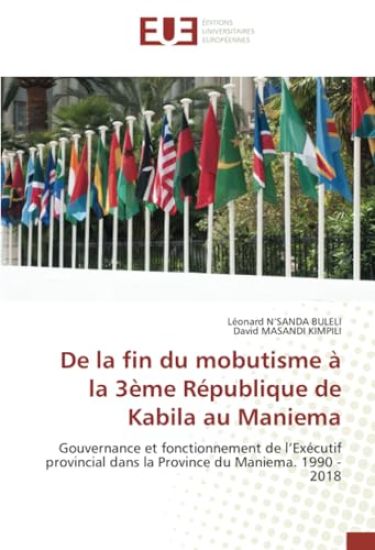
De la fin du mobutisme à la 3ème République de Kabila au Maniema
Léonard N'Sanda Buleli; David Masandi Kimpili
Editions Universitaires Europeennes
2024
pokkari
Lorsqu'on observe le Maniema, on a l'impression d' tre en face d'un terrain meuble o chaque mouvement reste soumis des variations soudaines et impr visibles. Cette perception, transpos e la situation g n rale du Congo, montre jusqu' quel point la n gociation entre des p riodes politiques instables et l'aspiration une gouvernance constante et solide, d mocratique et garantie du d veloppement social, demeure un terrain difficile.Cette lecture de la Province du Maniema ausculte plusieurs probl mes de gestion et de gouvernance, notamment ceux li s aux animateurs et leur mode de d signation. La politique de cette province pendant la p riode concern e (1990-2018) montre en effet que la gouvernance du Maniema va vers des pannes pr visibles notamment avec les nominations pr f rentielles, s lectives et souvent hors normes des dirigeants provinciaux et territoriaux - hommes et des femmes, acteurs politiques - constamment plac s ou remplac s selon les humeurs et les int r ts de ceux qui les y ont plac s. Ceux- ci - tous ou presque - sont d'abord des r sidents de Kinshasa et participants actifs des cercles du pouvoir.

Vom Ende des Mobutismus zur dritten Republik Kabilas in Maniema
Léonard N'Sanda Buleli; David Masandi Kimpili
Verlag Unser Wissen
2025
pokkari