

Kirjahaku
Etsi kirjoja tekijän nimen, kirjan nimen tai ISBN:n perusteella.
1000 tulosta hakusanalla Leonard W. Levy
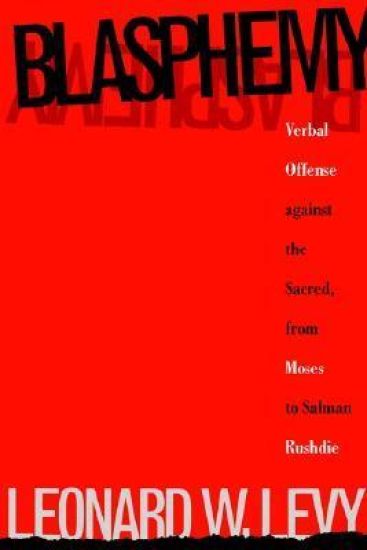
Leonard Levy traces the varied meanings of blasphemy throughout Western law. He argues that while past sanctions against the crime have inhibited all manner of cultural, political, scientific, and literary expression, we also pay a price for our extraordinary expansion of the scope of permissible speech. We have become, he charges, not only a free society but one that is 'numb' to outrage. |Pfanz provides the definitive account of the fighting between the Army of the Potomac and Robert E. Lee's Army of Northern Virginia at Cemetery Hill and Culp's Hill--two of the most critical engagements fought at Gettysburg on July 2 and 3, 1863. ""A defin
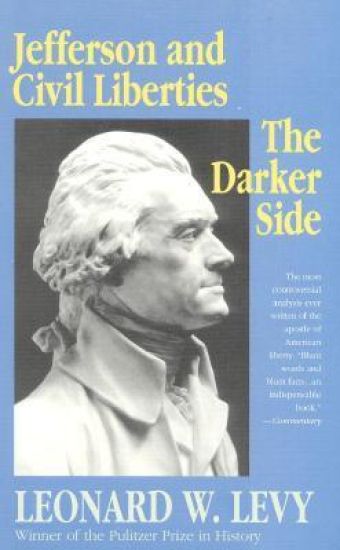
In the most controversial analysis ever written of the apostle of American liberty, the distinguished constitutional historian Leonard W. Levy examines Jefferson’s record on civil liberties and finds it strikingly wanting. Clearing away the saintliness that surrounds the hero, Mr. Levy tries to understand why the “unfamiliar” Jefferson supported loyalty oaths; countenanced internment camps for political suspects; drafted a bill of attainder; urged prosecutions for seditious libel; condoned military despotism; used the Army to enforce laws in time of peace; censored reading; chose professors for their political opinions; and endorsed the doctrine that means, however odious, are justified by ends. "Implicitly," Mr. Levy writes, "this book is a study of libertarian leadership in time of power and time of danger...Jefferson should be seen [by his biographers] as a whole man in the perspective of his times, but my task is to determine the validity of his historical reputation as the apostle of liberty." "Blunt words and blunt facts...an indispensable book."—Commentary.


For more than two hundred years a debate has raged between those who believe that jurists should follow the original intentions of the Founding Fathers and those who argue that the Constitution is a living document subject to interpretation by each succeeding generation. The controversy has flared anew in our own time as a facet of the battle between conservatives and liberals. In Original Intent and the Framers' Constitution, the distinguished constitutional scholar Leonard Levy cuts through the Gordian Knot of claim and counterclaim with an argument that is clear, logical, and compelling. Rejecting the views of both left and right, he evaluates the doctrine of "original intent" by examining the sources of constitutional law and landmark cases. Finally, he finds no evidence for grounding the law in original intent. Judicial activism—the constant reinterpretation of the Constitution—he sees as inevitable.

Trial by jury is the mainstay of the accusatorial system of criminal justice. Here one of our most distinguished constitutional scholars, the Pulitzer Prize-winning Leonard Levy, brings his formidable skills to bear in tracing the development of what many great legal minds have called the “Palladium of Justice.” Mr. Levy identifies the roots of trial by jury in the inquest, a medieval investigatory body whose members were sworn to tell the truth and whose verdicts of guilt or innocence were used by royal courts. From about 1376 the custom of requiring a unanimous verdict from twelve jurors developed. By the mid-fifteenth century, juries—supposedly representative of the community—were beginning to hear evidence that was produced in court. No one could lose life, limb, liberty, or property in a civil or criminal case without a unanimous verdict of guilt. In the American colonies, trial by jury thrived, and from the time of Peter Zenger’s famous test of press freedom in 1735, the jury decided the law as well as the facts. By 1776 trail by jury was a common right. Recounting the history with his characteristic clarity, vigor, and elegance of expression, Mr. Levy has given us a brilliant and useful summary of one of our most cherished freedoms.
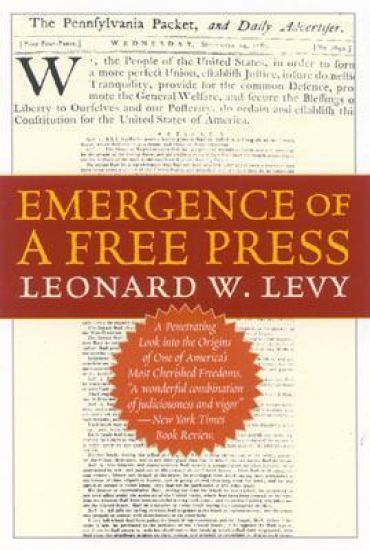
What did "freedom of the press" really mean to the framers of the First Amendment and their contemporaries? This masterful book by a Pulitzer Prize–winning constitutional historian answers that question. In Emergence of a Free Press (a greatly revised and enlarged edition of his landmark Legacy of Suppression), Leonard W. Levy argues that the First Amendment was not designed to be the bulwark of a free press that many thought, nor had the amendment's framers intended to overturn the common law of seditious libel that was the principal means of stifling political dissent. Yet he notes how robust and rambunctious the early press was, and he takes that paradox into account in tracing the succession of cases and reforms that figured in the genesis of a free press. Mr. Levy's brilliant account offers a new generation of readers a penetrating look into the origins of one of America's most cherished freedoms.
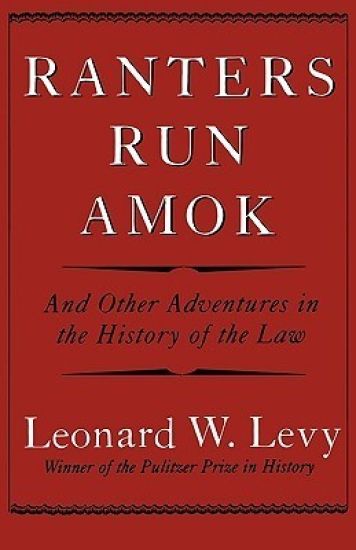
The Pulitzer Prize-winning constitutional historian Leonard Levy here collects eight of his most important essays of recent years. Written with his characterstic erudition, clarity, directness, and verve, these explorations into the history of the law are at once an entertainment and an education. One of the clearest and most eloquent liberal interpreters of law. New York Times Book Review.
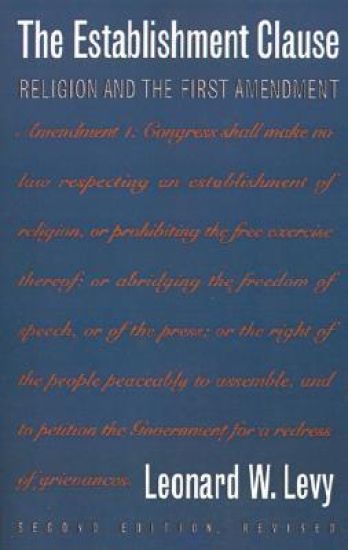
Leonard Levy's classic work examines the circumstances that led to the writing of the establishment clause of the First Amendment: 'Congress shall make no law respecting an establishment of religion. . . .' He argues that, contrary to popular belief, the framers of the Constitution intended to prohibit government aid to religion even on an impartial basis. He thus refutes the view of 'nonpreferentialists,' who interpret the clause as allowing such aid provided that the assistance is not restricted to a preferred church. For this new edition, Levy has added to his original arguments and incorporated much new material, including an analysis of Jefferson's ideas on the relationship between church and state and a discussion of the establishment clause cases brought before the Supreme Court since the book was originally published in 1986.

Leonard Levy traces the development and implementation of forfeiture and contends that it is a questionable practice, which, because it is so often abused, serves only to undermine civil society. Arguing that civil forfeiture is unconstitutional, Levy provides examples of the victimization of innocent people and demonstrates that it has been used primarily against petty offienders rather than against its original targets, members of organized crime.

This book, the result of the author's experience in psychology and forestry studies, studies the relation between these two seemingly different disciplines. The author indicates how human actions and programs affect a range of threatened or endangered situations ranging from forests and species of animals to our own traditional values and cultural groups. Sustainers, the persons who advocate and support sustainability, possess or must come to possess certain characteristics that are shown to be renunciation, knowledge, attitude, controllability, and patterning. This book seeks to discover and advocates how and why those attributes must be strengthened if we are to sustain our environment and ourselves.

The pursuit of perfection is one of humanity's most basic aspirations. In the tradition of meliorism, this volume addresses timeless questions such as: How can we lead a better or more satisfying existence? How can we be happier than we are now? What must we know or do to achieve such an important, elusive goal? In the absence of everlastingly valid principles, the author proposes seven useful, if imperfect, guides for us to follow as we edge towards perfection—determinism, imperfection, singularity, perspective, evaluation, searching, and surprise. Drawing upon the findings of psychologists, sociologists, philosophers, and anthropologists, this volume challenges and helps its readers to improve their existence as individuals and as members of groups and society.

In this wide-ranging and fascinating book, Leonard Doob explores what we know about human action and interaction in order to show how people succeed or fail in their constant attempts to understand each other. He organizes our ways of knowing each other into two sorts of “pathways to people.”The first pathways are those that have been investigated by psychiatrists, psychologists, and social scientists. Mr. Doob offers a critical summary of our systematic knowledge in the area of what is sometimes called “person perception.” By and large, he is dissatisfied with what we think we know, because too much of the research stems from a convenient, but not typical, sample of mankind – the college student. The second set of pathways are those intended to improve judgment or avoid error, and they come not only from the scientific disciplines but also from the humanities, along with common sense. Together, the pathways constitute the factors or variables that determine how and why human judgments are made – and how they should be made.The exposition is occasionally interrupted by a devil’s advocate offering lively and cutting criticism of what is being said. In this manner, Leonard Doob opens another pathway – between reader and author – which makes reading this book a rich and provocative experience.




Doob's central thesis is that some beliefs function mainly to help the believer cope with life's uncertainties. The coping mechanism that is the focus of Doob's book is a belief that certain things in life are inevitable. . . . Doob methodically explores the origin and nature of inevitablility beliefs, and like his pervious titles in social psychology, this is a theoretical analysis. . . . The book is well written and carefully organized but demanding to read; Doob attributes this to the inherent difficulty of the subject--he is probably right. ChoiceThis book examines the ways in which human beings seek to cope with uncertainty by means of doctrines that postulate degrees of inevitability. These doctrines originate in natural science, social science, philosophy, and religion. Their adequacies and inadequacies are carefully assessed, with special reference to the ways in which they deal with intervention by the very persons who would reduce uncertainty. The possibility of intervention in turn raises questions concerning freedom and responsibility that challenge people in all societies and throughout the lifespan.

This book provides an analysis of the human phenomenon of hesitation, the time elapsing between the stimulation of a person and that person's response. The views of disciplines as diverse as physiology and philosophy are examined, with special emphasis placed on psychology and the social sciences. Leonard Doob seeks to determine when and why human beings are impulsive or reflective, and whether, from their standpoint and that of others, their own hesitation should be extremely brief, long, or protractive. The volume also cites and summarizes relevant studies and derives guidelines related to subjective and objective hesitation. Although partially treated in other books and articles, this work represents the first book-length study of hesitation.The volume covers a full range of explanations for hesitation, starting with reflex actions (the central nervous system) and moving out to encompass an individual's culture and society, his personality development, and the influence that others may have over him. The study is divided into three main parts. An introduction serves to clarify the starting point for analysis, addressing the explanation and morality of hesitation and the questions of judgment that affect it. The next part, (Section 2) analyzes hesitation in terms of culture and society, personality traits and interrelations, other persons, and situations. The final section is devoted to selection, discussing the value of three degrees of hesitation and the techniques that can be employed to modify impulsivity and reflection. The book concludes with a list of recommended readings and a comprehensive index. This important study will be a valuable resource for psychologists, psychiatrists, and social scientists, and for courses in psychology, sociology, and anthropology. It will also be a significant addition to both public and academic libraries.