Kirjojen hintavertailu. Mukana 11 238 995 kirjaa ja 12 kauppaa.

Kirjahaku

Etsi kirjoja tekijän nimen, kirjan nimen tai ISBN:n perusteella.

1000 tulosta hakusanalla Leonhard Euler

Leonhard Euler

Leonhard Euler

Elsevier Science Ltd
2007
sidottu
The year 2007 marks the 300th anniversary of the birth of one of the Enlightenment’s most important mathematicians and scientists, Leonhard Euler. This volume is a collection of 24 essays by some of the world’s best Eulerian scholars from seven different countries about Euler, his life and his work. Some of the essays are historical, including much previously unknown information about Euler’s life, his activities in the St. Petersburg Academy, the influence of the Russian Princess Dashkova, and Euler’s philosophy. Others describe his influence on the subsequent growth of European mathematics and physics in the 19th century. Still others give technical details of Euler’s innovations in probability, number theory, geometry, analysis, astronomy, mechanics and other fields of mathematics and science.
Leonhard Euler

Leonhard Euler

Ronald S. Calinger

PRINCETON UNIVERSITY PRESS
2015
sidottu
This is the first full-scale biography of Leonhard Euler (1707-83), one of the greatest mathematicians and theoretical physicists of all time. In this comprehensive and authoritative account, Ronald Calinger connects the story of Euler's eventful life to the astonishing achievements that place him in the company of Archimedes, Newton, and Gauss. Drawing chiefly on Euler's massive published works and correspondence, which fill more than eighty volumes so far, this biography sets Euler's work in its multilayered context--personal, intellectual, institutional, political, cultural, religious, and social. It is a story of nearly incessant accomplishment, from Euler's fundamental contributions to almost every area of pure and applied mathematics--especially calculus, number theory, notation, optics, and celestial, rational, and fluid mechanics--to his advancements in shipbuilding, telescopes, ballistics, cartography, chronology, and music theory. The narrative takes the reader from Euler's childhood and education in Basel through his first period in St. Petersburg, 1727-41, where he gained a European reputation by solving the Basel problem and systematically developing analytical mechanics. Invited to Berlin by Frederick II, Euler published his famous Introductio in analysin infinitorum, devised continuum mechanics, and proposed a pulse theory of light. Returning to St. Petersburg in 1766, he created the analytical calculus of variations, developed the most precise lunar theory of the time that supported Newton's dynamics, and published the best-selling Letters to a German Princess--all despite eye problems that ended in near-total blindness. In telling the remarkable story of Euler and how his achievements brought pan-European distinction to the Petersburg and Berlin academies of sciences, the book also demonstrates with new depth and detail the central role of mathematics in the Enlightenment.
Leonhard Euler

Leonhard Euler

Ronald S. Calinger

Princeton University Press
2019
pokkari
An acclaimed biography of the Enlightenment's greatest mathematicianThis is the first full-scale biography of Leonhard Euler (1707–1783), one of the greatest mathematicians and theoretical physicists of all time. In this comprehensive and authoritative account, Ronald Calinger connects the story of Euler's eventful life to the astonishing achievements that place him in the company of Archimedes, Newton, and Gauss. Drawing on Euler's massive published works and correspondence, this biography sets Euler's work in its multilayered context—personal, intellectual, institutional, political, cultural, religious, and social. It is a story of nearly incessant accomplishment, from Euler's fundamental contributions to almost every area of pure and applied mathematics in his time—especially calculus, mechanics, and optics—to his advances in shipbuilding, telescopes, acoustics, ballistics, cartography, chronology, and music theory.
Correspondence of Leonhard Euler with Christian Goldbach
When Leonhard Euler first arrived at the Russian Academy of Sciences, at the age of 20, his career was supported and promoted by the Academy’s secretary, the Prussian jurist and amateur mathematician Christian Goldbach (1690-1764). Their encounter would grow into a lifelong friendship, as evinced by nearly 200 letters sent over 35 years.This exchange – Euler’s most substantial long-term correspondence – has now been edited for the first time with an English translation, ample commentary and documentary indices. These present an overview of 18th-century number theory, its sources and repercussions, many details of the protagonists’ biographies, and a wealth of insights into academic life in St. Petersburg and Berlin between 1725 and 1765.Part I includes an introduction and the original texts of the Euler-Goldbach letters, while Part II presents the English translations and documentary indices.
Correspondence of Leonhard Euler with Christian Goldbach
When Leonhard Euler first arrived at the Russian Academy of Sciences, at the age of 20, his career was supported and promoted by the Academy’s secretary, the Prussian jurist and amateur mathematician Christian Goldbach (1690-1764). Their encounter would grow into a lifelong friendship, as evinced by nearly 200 letters sent over 35 years.This exchange – Euler’s most substantial long-term correspondence – has now been edited for the first time with an English translation, ample commentary and documentary indices. These present an overview of 18th-century number theory, its sources and repercussions, many details of the protagonists’ biographies, and a wealth of insights into academic life in St. Petersburg and Berlin between 1725 and 1765.Part I includes an introduction and the original texts of the Euler-Goldbach letters, while Part II presents the English translations and documentary indices.
Leonhard Euler vollständige Anleitung zur Algebra
Leonhard Euler vollst ndige Anleitung zur Algebra - Erster Teil.: Von den verschiedenen Rechnungsarten, Verh ltnissen und Proportionen ist ein unver nderter, hochwertiger Nachdruck der Originalausgabe aus dem Jahr 1771. Hansebooks ist Herausgeber von Literatur zu unterschiedlichen Themengebieten wie Forschung und Wissenschaft, Reisen und Expeditionen, Kochen und Ern hrung, Medizin und weiteren Genres. Der Schwerpunkt des Verlages liegt auf dem Erhalt historischer Literatur. Viele Werke historischer Schriftsteller und Wissenschaftler sind heute nur noch als Antiquit ten erh ltlich. Hansebooks verlegt diese B cher neu und tr gt damit zum Erhalt selten gewordener Literatur und historischem Wissen auch f r die Zukunft bei.
Leonhard Euler

Leonhard Euler

Emil A. Fellmann

Birkhauser Verlag AG
2006
sidottu
Euler was not only by far the most productive mathematician in the history of mankind, but also one of the greatest scholars of all time. He attained, like only a few scholars, a degree of popularity and fame which may well be compared with that of Galilei, Newton, or Einstein. Moreover he was a cosmopolitan in the truest sense of the word; he lived during his first twenty years in Basel, was active altogether for more than thirty years in Petersburg and for a quarter of a century in Berlin. Leonhard Euler’s unusually rich life and broadly diversified activity in the immediate vicinity of important personalities which have made history, may well justify an exposition. This book is based in part on unpublished sources and comes right out of the current research on Euler. It is entirely free of formulae as it has been written for a broad audience with interests in the history of culture and science.
Leonhard Euler

Leonhard Euler

Andreas K. Heyne; Alice K. Heyne

Birkhauser Verlag AG
2006
sidottu
In seinem Kopf stellte er die mathematische Welt auf den Kopf. Er berechnete Flüssigkeitsströmungen, das Trägheitsmoment, entwickelte die Variationsrechnung und die moderne Zahlentheorie. Als Wissenschaftler steht er auf einer Stufe mit Newton und Einstein. Konstrukteure in aller Welt arbeiten tagtäglich mit seinen Formeln – egal ob es um den Schiffsrumpf der "Alinghi" geht oder um die Schwingungen des "Viaduc de Millau", der Welt höchster Autobahnbrücke. Dabei war er ein Mensch, der bürgerliche Behaglichkeit und Ruhe liebte. Nicht ganz einfach zur Gründungszeit von St. Petersburg inmitten russischer Kaisermorde oder im Berlin zur Zeit der schlesischen Kriege. Und erst recht nicht inmitten einer grossen Kinderschar. Der Comic von Elena Pini (Graphik) und Alice und Andreas K. Heyne (Text) zeichnet das Leben des genialen Baslers nach, der vor 300 Jahren geboren wurde, mit zwanzig Jahren seine Heimatstadt verliess – und nie wieder zurückkehrte.
Leonhard Euler

Leonhard Euler

Emil A. Fellmann

Basam Books
2024
sidottu
Leonhard Euler (1707–1783) oli oman aikakautensa ja monien mielestä kaikkien aikojen suurin matemaatikko. Hänen elämäntyönsä matematiikan, fysiikan ja monien insinööritieteiden alalla on niin valtava, että sen tutkimuksesta on muodostunut tieteenala sinänsä.Leonhard Euler syntyi Baselissa, mutta hän teki tärkeimmän elämäntyönsä Berliinin ja Pietarin tiedeakatemioissa. Suuren neron tarina on myös sukellus Euroopan 1700-luvun kulttuurihistoriaan, valistuneiden itsevaltiaiden Fredrik Suuren ja Katariina Suuren maailmaan. Eulerin tärkeä työtoveri ja hänen lyhytaikainen seuraajansa Pietarin tiedeakatemiassa oli suomalainen matemaatikko Anders Johan Lexell (1740–1784).Sveitsiläisen tieteenhistorioitsijan Emil A. Fellmannin (1927–2012) kirjoittaman Eulerin pienoiselämäkerran on suomentanut filosofian tohtori, tekniikan tohtori Johan C.-E. Stén, joka on kansainvälisesti merkittävä Eulerin ja eritoten Lexellin tutkija.
Leonhard Euler and the Bernoullis

Leonhard Euler and the Bernoullis

M. B. W. Tent

A K Peters
2009
sidottu
"Leonhard Euler and the Bernoullis is a fascinating tale of the Bernoulli family and Euler's association with them. Successful merchants in the 16th and 17th centuries, the Bernoullis were driven out of Antwerp during the persecution of the Huguenots and settled first in Frankfurt, and then in Basel, where one of the most remarkable mathematical dynasties evolved with Jacob, Johann, and Daniel Bernoulli the most prominent among them. Euler, fortunate to have had Johann Bernoulli as a tutor, quickly rose to prominence in the academies of Berlin and St. Petersburg, and became the most prolific and profound mathematician that ever lived. The story of these remarkable men, their great ambitions and dedication to their science-often against parental authority-is skillfully told by the author. Refreshing fictional dialogue is interspersed throughout into an otherwise accurate historical scenario. The book is intended for the young adult audience of middle school and early high school ages, but surely will also appeal to a general audience, with or without mathematical background." --Walter Gautschi, Purdue University
Leonhard Euler's Letters to a German Princess

Leonhard Euler's Letters to a German Princess

Ronald S Calinger; Elena N Polyakhova

Morgan Claypool Publishers
2019
nidottu
Leonhard Euler's Letters to a German Princess: A Milestone in the History of Physics Textbooks and More is a milestone in the history of physics textbooks and the instruction of women in the sciences.It also covers views of its author on epistemology, religion, and innovations in scientific equipment, including telescopes and microscopes. Today, 250 years later, we study this work of Euler's as a foundation for the history of physics teaching and analyze the letters from an historical and pedagogical point of view.
Leonhard Euler's Letters to a German Princess

Leonhard Euler's Letters to a German Princess

Ronald S Calinger; Elena N Polyakhova

Morgan Claypool Publishers
2019
sidottu
Leonhard Euler's Letters to a German Princess: A Milestone in the History of Physics Textbooks and More is a milestone in the history of physics textbooks and the instruction of women in the sciences.It also covers views of its author on epistemology, religion, and innovations in scientific equipment, including telescopes and microscopes. Today, 250 years later, we study this work of Euler's as a foundation for the history of physics teaching and analyze the letters from an historical and pedagogical point of view.
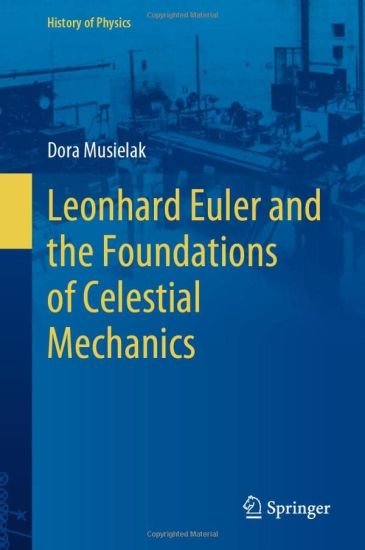
Leonhard Euler and the Foundations of Celestial Mechanics

Leonhard Euler and the Foundations of Celestial Mechanics

Dora Musielak

Springer International Publishing AG
2022
sidottu
The intention of this book is to shine a bright light on the intellectual context of Euler’s contributions to physics and mathematical astronomy. Leonhard Euler is one of the most important figures in the history of science, a blind genius who introduced mathematical concepts and many analytical tools to help us understand and describe the universe. Euler also made a monumental contribution to astronomy and orbital mechanics, developing what he called astronomia mechanica. Orbital mechanics of artificial satellites and spacecraft is based on Euler’s analysis of astromechanics. However, previous books have often neglected many of his discoveries in this field. For example, orbital mechanics texts refer to the five equilibrium points in the Sun-Earth-Moon system as Lagrange points, failing to credit Euler who first derived the differential equations for the general n-body problem and who discovered the three collinear points in the three-body problem of celestial mechanics. These equilibrium points are essential today in space exploration; the James Webb Space Telescope (successor to the Hubble), for example, now orbits the Sun near L2, one of the collinear points of the Sun-Earth-Moon system, while future missions to study the universe will place observatories in orbit around Sun-Earth and Earth-Moon equilibrium points that should be properly called Euler-Lagrange points. In this book, the author uses Euler’s memoirs, correspondence, and other scholarly sources to explore how he established the mathematical groundwork for the rigorous study of motion in our Solar System. The reader will learn how he studied comets and eclipses, derived planetary orbits, and pioneered the study of planetary perturbations, and how, old and blind, Euler put forward the most advanced lunar theory of his time.
Leonhard Euler and the Foundations of Celestial Mechanics

Leonhard Euler and the Foundations of Celestial Mechanics

Dora Musielak

Springer International Publishing AG
2023
nidottu
The intention of this book is to shine a bright light on the intellectual context of Euler’s contributions to physics and mathematical astronomy. Leonhard Euler is one of the most important figures in the history of science, a blind genius who introduced mathematical concepts and many analytical tools to help us understand and describe the universe. Euler also made a monumental contribution to astronomy and orbital mechanics, developing what he called astronomia mechanica. Orbital mechanics of artificial satellites and spacecraft is based on Euler’s analysis of astromechanics. However, previous books have often neglected many of his discoveries in this field. For example, orbital mechanics texts refer to the five equilibrium points in the Sun-Earth-Moon system as Lagrange points, failing to credit Euler who first derived the differential equations for the general n-body problem and who discovered the three collinear points in the three-body problem of celestial mechanics. These equilibrium points are essential today in space exploration; the James Webb Space Telescope (successor to the Hubble), for example, now orbits the Sun near L2, one of the collinear points of the Sun-Earth-Moon system, while future missions to study the universe will place observatories in orbit around Sun-Earth and Earth-Moon equilibrium points that should be properly called Euler-Lagrange points. In this book, the author uses Euler’s memoirs, correspondence, and other scholarly sources to explore how he established the mathematical groundwork for the rigorous study of motion in our Solar System. The reader will learn how he studied comets and eclipses, derived planetary orbits, and pioneered the study of planetary perturbations, and how, old and blind, Euler put forward the most advanced lunar theory of his time.
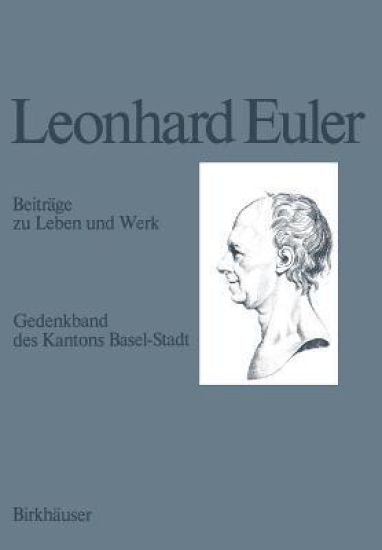
Leonhard Euler 1707–1783
Das vorliegende Buch ist keine Festschrift im gewohnten Sinne, d. h. keine mehr oder weniger willkurliche Sammlung von Fachabhandlungen ohne wechselseitigen inneren Zusammenhang, sondern es unterliegt einer ganz bestimmten Konzeption: Die hier vereinigten Beitdige sollen Leben und Werk Leonhard Eulers etwa im MaBstab seiner breitgefacherten Aktivitaten in synoptischer Sicht abdecken und die nachhaltige Wirkung seines wissenschaft- lichen Schaff ens auf die heutige Zeit aufzeigen. Das Inhaltsverzeichnis lasst leicht folgende Gliederung des Buches erkennen: Der erste Beitrag steht fUr sich al1ein und solI unter BerUcksichtigung der neuen Forschungen einen Uberblick Uber Leben und Wirken Eulers bieten, der einen weiteren Leser- kreis ansprechen mage. Die nachsten neun Aufsatze (Gelfond bis Schoenberg) umspannen die Gebiete Zahlentheorie, Algebra und Analysis, wahrend die nachfolgenden sechs Beitrage (Speiser bis Fellmann) der Physik gewidmet sind. Den drei Arbeiten zur Astronomie (Cross, Yolk, Nevskaja) schliessen sich sechs Uber Eulers Beziehungen zu Akademien und markanten Einzelpersan- lichkeiten an (Kopelevic bis Jaquel), gefolgt von drei Beitragen zur Philoso- phie, Theologie und Biographie Eulers (Breidert, Raith, Bernoulli). Den Abschluss bilden drei Darstellungen zur Editionsgeschichte der Opera omnia und zur Bibliographie (Biermann, Burckhardt). Jeder Beitrag kann unabhan- gig von der getroffenen Reihenfolge gelesen werden. Einheitlich im ganzen Band werden die BezUge auf die Werke Eulers abgekUrzt zitiert, und zwar in der Reihenfolge: Nummer des Enestram- Verzeichnisses, Serie der Opera omnia, Band, evtl. Seitenangabe. Ein Beispiel mage dies verdeutlichen: E. 65/0. I,24, p. 23lf., verweist auf Eulers Methodus inveniendi lineas curvas . . . im Band 24 der Series prima, Seiten 23lf.