Kirjojen hintavertailu. Mukana 11 717 486 kirjaa ja 12 kauppaa.

Kirjahaku

Etsi kirjoja tekijän nimen, kirjan nimen tai ISBN:n perusteella.

1000 tulosta hakusanalla Lester W. Schmerr

Engineering Dynamics 2.0

Engineering Dynamics 2.0

Lester W. Schmerr

Springer International Publishing AG
2019
sidottu
This book presents a new approach to learning the dynamics of particles and rigid bodies at an intermediate to advanced level. There are three distinguishing features of this approach. First, the primary emphasis is to obtain the equations of motion of dynamical systems and to solve them numerically. As a consequence, most of the analytical exercises and homework found in traditional dynamics texts written at this level are replaced by MATLAB®-based simulations. Second, extensive use is made of matrices. Matrices are essential to define the important role that constraints have on the behavior of dynamical systems. Matrices are also key elements in many of the software tools that engineers use to solve more complex and practical dynamics problems, such as in the multi-body codes used for analyzing mechanical, aerospace, and biomechanics systems. The third and feature is the use of a combination of Newton-Euler and Lagrangian (analytical mechanics) treatments for solving dynamics problems. Rather than discussing these two treatments separately, Engineering Dynamics 2.0 uses a geometrical approach that ties these two treatments together, leading to a more transparent description of difficult concepts such as "virtual" displacements.Some important highlights of the book include: Extensive discussion of the role of constraints in formulating and solving dynamics problems.Implementation of a highly unified approach to dynamics in a simple context suitable for a second-level course.Descriptions of non-linear phenomena such as parametric resonances and chaotic behavior.A treatment of both dynamic and static stability.Overviews of the numerical methods (ordinary differential equation solvers, Newton-Raphson method) needed to solve dynamics problems.An introduction to the dynamics of deformable bodies and the use of finite difference and finite elementmethods.Engineering Dynamics 2.0 provides a unique, modern treatment of dynamics problems that is directly useful in advanced engineering applications. It is a valuable resource for undergraduate and graduate students and for practicing engineers.
Ultrasonic Nondestructive Evaluation Systems

Ultrasonic Nondestructive Evaluation Systems

Lester W. Schmerr Jr; Jung-Sin Song

Springer-Verlag New York Inc.
2007
sidottu
This book deals with ultrasonic nondestructive evaluation (NDE) inspections where high frequency waves are used to locate and characterize dangerous flaws (such as cracks) in materials. Ultrasonic NDE flaw inspections involve a very complex combination of electrical, electromechanical, and acoustic/elastic components so that it is important to understand the behavior of those components and their interactions in order to make quantitative flaw measurements. It will be shown that through the use of models and measurements it is now possible to characterize all the elements of an ultrasonic NDE flaw inspection system. Those elements include the pulser/receiver, the cabling, the transducers, and the wave propagation and scattering processes present in an ultrasonic NDE flaw measurement. It will also be demonstrated how to combine models and measurements of those elements to form ultrasonic measurement models which can simulate the flaw signals seen in ultrasonic NDE tests. This comprehensive modeling and measurement capability is described for the first time in this book. There are important engineering applications of this new tech- logy. For example, these ultrasonic models and measurements can be used to design new ultrasonic inspections as well as optimize existing ones. This technology can also help one to extract information on the nature of the flaw present from the measured ultrasonic flaw signals that can then be used to evaluate the safety and reliability of the material being inspected.
Engineering Statics with MATLAB®

Engineering Statics with MATLAB®

Lester W. Schmerr Jr.

TAYLOR FRANCIS LTD
2024
sidottu
This text makes use of symbolic algebra and vector-matrix algebra to demonstrate a new approach to learning statics. Symbolic solutions are obtained, together with the types of solutions covered in other texts, so that students can see the advantages of this new approach.This innovative text is an extension of second-generation vector Statics courses to a new, third-generation matrix-vector Statics course, a course that addresses deformable as well as rigid bodies and employs MATLAB®.MATLAB® is used as a “calculator” whose built-in functions are used to solve statics problems. This text uses vectors and matrices to solve both statically determinate rigid body problems and statically indeterminate problems for deformable bodies.The inclusion of statically indeterminate problems is unique to this text. It is made possible by using symbolic algebra and a new, simplified vector-matrix formulation that combines the equations of equilibrium, the homogeneous solutions to those equations, and a description of the flexibilities found in the deformable elements of a structure to solve directly for the unknown forces/moments.
Advanced Mechanics of Solids

Advanced Mechanics of Solids

Lester W. Schmerr Jr.

Cambridge University Press
2021
sidottu
Build on the foundations of elementary mechanics of materials texts with this modern textbook that covers the analysis of stresses and strains in elastic bodies. Discover how all analyses of stress and strain are based on the four pillars of equilibrium, compatibility, stress-strain relations, and boundary conditions. These four principles are discussed and provide a bridge between elementary analyses and more detailed treatments with the theory of elasticity. Using MATLAB® extensively throughout, the author considers three-dimensional stress, strain and stress-strain relations in detail with matrix-vector relations. Based on classroom-proven material, this valuable resource provides a unified approach useful for advanced undergraduate students and graduate students, practicing engineers, and researchers.
Ultrasonic Nondestructive Evaluation Systems

Ultrasonic Nondestructive Evaluation Systems

Lester W. Schmerr Jr; Jung-Sin Song

Springer-Verlag New York Inc.
2010
nidottu
This book deals with ultrasonic nondestructive evaluation (NDE) inspections where high frequency waves are used to locate and characterize dangerous flaws (such as cracks) in materials. Ultrasonic NDE flaw inspections involve a very complex combination of electrical, electromechanical, and acoustic/elastic components so that it is important to understand the behavior of those components and their interactions in order to make quantitative flaw measurements. It will be shown that through the use of models and measurements it is now possible to characterize all the elements of an ultrasonic NDE flaw inspection system. Those elements include the pulser/receiver, the cabling, the transducers, and the wave propagation and scattering processes present in an ultrasonic NDE flaw measurement. It will also be demonstrated how to combine models and measurements of those elements to form ultrasonic measurement models which can simulate the flaw signals seen in ultrasonic NDE tests. This comprehensive modeling and measurement capability is described for the first time in this book. There are important engineering applications of this new tech- logy. For example, these ultrasonic models and measurements can be used to design new ultrasonic inspections as well as optimize existing ones. This technology can also help one to extract information on the nature of the flaw present from the measured ultrasonic flaw signals that can then be used to evaluate the safety and reliability of the material being inspected.
Fundamentals of Ultrasonic Nondestructive Evaluation

Fundamentals of Ultrasonic Nondestructive Evaluation

Lester W. Schmerr Jr.

Springer-Verlag New York Inc.
2013
nidottu
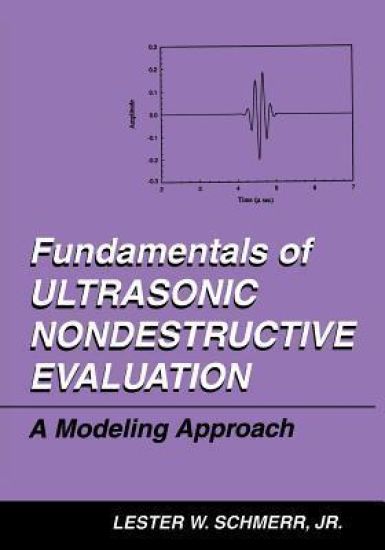
Ultrasound is currently used in a wide spectrum of applications ranging from medical imaging to metal cutting. This book is about using ultrasound in nondestructive evaluation (NDE) inspections. Ultrasonic NDE uses high-frequency acoustic/elastic waves to evaluate components without affecting their integrity or performance. This technique is commonly used in industry (particularly in aerospace and nuclear power) to inspect safety-critical parts for flaws during in-service use. Other important uses of ultrasonic NDE involve process control functions during manufacturing and fundamental materials characterization studies. It is not difficult to set up an ultrasonic NDE measurement system to launch waves into a component and monitor the waves received from defects, such as cracks, even when those defects are deep within the component. It is difficult however to interpret quantitatively the signals received in such an ultrasonic NDE measurement process. For example based on the ultrasonic signal received from a crack, what is the size, shape, and orientation of the crack producing the signal? Answering such questions requires evaluation procedures based on a detailed knowledge of the physics of the entire ultrasonic measurement process. One approach to obtaining such knowledge is to couple quantitative experiments closely with detailed models of the entire ultrasonic measurement system itself. We refer to such models here as ultrasonic NDE measurement models. In other areas of engineering, models have revolutionized how engineering is practiced. A classic example is the impact of the finite-element method on elastic stress analysis.
Algebraic Equations of Linear Elasticity

Algebraic Equations of Linear Elasticity

Lester W. Schmerr Jr.

Springer International Publishing AG
2024
sidottu
This book describes a second-generation force-based method emerging from a general formulation where the partial differential equations of elasticity are replaced by equivalent algebraic equations. These algebraic equations of linear elasticity can be used to solve statically indeterminate problems in reduced forms that define either the new second-generation force-based approach or a new displacement-based approach. The new force-based method can serve as the basis for teaching students at many technical levels how to solve equilibrium problems directly for the forces present. In elasticity courses, the derivation and use of the algebraic equations of linear elasticity can show how the difficulties of dealing with partial differential equations may be avoided by transforming those equations into algebraic equations with work-energy concepts. In a finite element course, a force-based finite element method can be described along with the traditional displacement-based approach to demonstrate how the two methods provide alternative ways for solving complex structural problems. Serving as a resource for including second-generation force-based methods in solid mechanics courses of an engineering curriculum, and as a robust learning resource, the book is ideal for instructors and for students, practicing engineers, and researchers.
Fundamentals of Ultrasonic Phased Arrays

Fundamentals of Ultrasonic Phased Arrays

Lester W. Schmerr Jr.

Springer International Publishing AG
2014
sidottu
This book describes in detail the physical and mathematical foundations of ultrasonic phased array measurements. The book uses linear systems theory to develop a comprehensive model of the signals and images that can be formed with phased arrays. Engineers working in the field of ultrasonic nondestructive evaluation (NDE) will find in this approach a wealth of information on how to design, optimize and interpret ultrasonic inspections with phased arrays. The fundamentals and models described in the book will also be of significant interest to other fields, including the medical ultrasound and seismology communities. A unique feature of this book is that it presents a unified theory of imaging with phased arrays that shows how common imaging methods such as the synthetic aperture focusing technique (SAFT), the total focusing method (TFM), and the physical optics far field inverse scattering (POFFIS) imaging method are all simplified versions of more fundamental and quantitative imaging approaches, called imaging measurement models.To enhance learning, this book first describes the fundamentals of phased array systems using 2-D models, so that the complex 3-D cases normally found in practice can be more easily understood. In addition to giving a detailed discussion of phased array systems, Fundamentals of Ultrasonic Phased Arrays also provides MATLAB® functions and scripts, allowing the reader to conduct simulations of ultrasonic phased array transducers and phased array systems with the latest modeling technology.
Fundamentals of Ultrasonic Nondestructive Evaluation

Fundamentals of Ultrasonic Nondestructive Evaluation

Lester W. Schmerr Jr.

Springer International Publishing AG
2016
sidottu
This extensively revised and updated second edition of a widely read classic presents the use of ultrasound in nondestructive evaluation (NDE) inspections. Retaining the first edition's use of wave propagation /scattering theory and linear system theory, this volume also adds significant new material including:the introduction of MATLAB® functions and scripts that evaluate key results involving beam propagation and scattering, flaw sizing, and the modeling of ultrasonic systems.elements of Gaussian beam theory and a multi-Gaussian ultrasonic beam model for bulk wave transducers.a new chapter on the connection between ultrasonic modeling and probability of detection (POD) and reliability models.new and improved derivations of ultrasonic measurement models.updated coverage of ultrasonic simulators that have been developed around the world.Students, engineers, and researchers workingin the ultrasonic NDE field will find a wealth of information on the modeling of ultrasonic inspections and the fundamental ultrasonic experiments that support those models in this new edition.
Fundamentals of Ultrasonic Phased Arrays

Fundamentals of Ultrasonic Phased Arrays

Lester W. Schmerr Jr.

Springer International Publishing AG
2017
nidottu
This book describes in detail the physical and mathematical foundations of ultrasonic phased array measurements. The book uses linear systems theory to develop a comprehensive model of the signals and images that can be formed with phased arrays. Engineers working in the field of ultrasonic nondestructive evaluation (NDE) will find in this approach a wealth of information on how to design, optimize and interpret ultrasonic inspections with phased arrays. The fundamentals and models described in the book will also be of significant interest to other fields, including the medical ultrasound and seismology communities. A unique feature of this book is that it presents a unified theory of imaging with phased arrays that shows how common imaging methods such as the synthetic aperture focusing technique (SAFT), the total focusing method (TFM), and the physical optics far field inverse scattering (POFFIS) imaging method are all simplified versions of more fundamental and quantitative imaging approaches, called imaging measurement models.To enhance learning, this book first describes the fundamentals of phased array systems using 2-D models, so that the complex 3-D cases normally found in practice can be more easily understood. In addition to giving a detailed discussion of phased array systems, Fundamentals of Ultrasonic Phased Arrays also provides MATLAB® functions and scripts, allowing the reader to conduct simulations of ultrasonic phased array transducers and phased array systems with the latest modeling technology.
Fundamentals of Ultrasonic Nondestructive Evaluation

Fundamentals of Ultrasonic Nondestructive Evaluation

Lester W. Schmerr Jr.

Springer International Publishing AG
2018
nidottu
This extensively revised and updated second edition of a widely read classic presents the use of ultrasound in nondestructive evaluation (NDE) inspections. Retaining the first edition's use of wave propagation /scattering theory and linear system theory, this volume also adds significant new material including:the introduction of MATLAB® functions and scripts that evaluate key results involving beam propagation and scattering, flaw sizing, and the modeling of ultrasonic systems.elements of Gaussian beam theory and a multi-Gaussian ultrasonic beam model for bulk wave transducers.a new chapter on the connection between ultrasonic modeling and probability of detection (POD) and reliability models.new and improved derivations of ultrasonic measurement models.updated coverage of ultrasonic simulators that have been developed around the world.Students, engineers, and researchers workingin the ultrasonic NDE field will find a wealth of information on the modeling of ultrasonic inspections and the fundamental ultrasonic experiments that support those models in this new edition.
Lucky Medicine

Lucky Medicine

Lester W. Thompson

INDIANA UNIVERSITY PRESS
2023
sidottu
A remarkable, personal glimpse of Black student life at Indiana University in the early 1960s. In 1961, a skinny African American boy from Indianapolis arrived at Indiana University Bloomington determined to become a doctor. For the next three years, Lester Thompson kept a detailed, intimate diary of his journey to graduation. In Lucky Medicine, Lester returns to his long-ago journal and, with honesty, humor, and a healthy dose of rueful self-reflection, shares stories from his college years at Indiana University. Fascinating glimpses emerge of Black Greek life at the time, including the building of the Kappa Alpha Psi fraternity house and the successes, struggles, and social lives of its members. Lester's student years were driven by hard work, but also bustled with fun and drama. He recalls his time studying at the university library, falling in and out of love many times, becoming friends with fellow fraternity brother Booker T. Jones, a truly memorable invitation extended to meet with George Wallace, and an epic, no-holds-barred brawl with limestone cutters at the 24-Hour Grill. Lucky Medicine offers a closeup, unforgettable look at IU student life just before the sweeping social changes of the 1960s, when students of color accounted for less than 2 percent of the Indiana University's student body.
Lucky Medicine

Lucky Medicine

Lester W. Thompson

INDIANA UNIVERSITY PRESS
2023
pokkari
A remarkable, personal glimpse of Black student life at Indiana University in the early 1960s. In 1961, a skinny African American boy from Indianapolis arrived at Indiana University Bloomington determined to become a doctor. For the next three years, Lester Thompson kept a detailed, intimate diary of his journey to graduation. In Lucky Medicine, Lester returns to his long-ago journal and, with honesty, humor, and a healthy dose of rueful self-reflection, shares stories from his college years at Indiana University. Fascinating glimpses emerge of Black Greek life at the time, including the building of the Kappa Alpha Psi fraternity house and the successes, struggles, and social lives of its members. Lester's student years were driven by hard work, but also bustled with fun and drama. He recalls his time studying at the university library, falling in and out of love many times, becoming friends with fellow fraternity brother Booker T. Jones, a truly memorable invitation extended to meet with George Wallace, and an epic, no-holds-barred brawl with limestone cutters at the 24-Hour Grill. Lucky Medicine offers a closeup, unforgettable look at IU student life just before the sweeping social changes of the 1960s, when students of color accounted for less than 2 percent of the Indiana University's student body.
Operation Anaconda

Operation Anaconda

Lester W. Grau; Dodge Billingsley

University Press of Kansas
2011
sidottu
Long before it became “Obama’s War,” the long-running conflict in Afghanistan was launched by President George W. Bush in retaliation for the 9/11 attacks on the United States. Only a few months later, Operation Anaconda sent American-led coalition forces into their most intensely brutal confrontation with Al Qaeda and their Taliban hosts in the Shar-i Kot Valley near the Pakistan border. The result was an unexpected set piece of conventional fighting in what has become an era of guerrilla warfare. Drawing upon previously unavailable or neglected sources, Lester Grau and Dodge Billingsley give us the most complete and accurate account of this thirteen-day firefight waged in mountainous terrain nearly two miles above sea level. They describe how allied troops fought a fierce and well-entrenched enemy to a standstill, close to an old Soviet battlefield, and then drove them completely out of Afghanistan. Grau and Billingsley’s account also highlights problems encountered in Anaconda and the lessons we should learn from their in-depth study. The Army and Air Force operated under conflicting views regarding the appropriate application of Close Air Support, and airpower both crippled and aided the overall effort. In addition, severe shortages of transport, attack helicopters, and artillery hampered the effort, while the acquisition and timely sharing of intelligence barely occurred at all and coalition relations frayed under the intense pressures of combat. As an added bonus, the authors also include with the book a documentary on DVD that features interviews with soldiers who fought in Anaconda, provides additional information concerning major phases of the battle, and presents insightful commentary by Grau and by Billingsley, who was on the ground with U.S. forces for the operation. Providing the richest description and critique of all the forces involved—including those that fought on the enemy side—the combined book-and-DVD surpasses all previous accounts of this landmark engagement and is an essential volume in the literature on our war in Afghanistan.
Envisioning a Sustainable Society

Envisioning a Sustainable Society

Lester W. Milbrath

State University of New York Press
1989
pokkari
The evidence is increasingly persuasive. We are changing the way our planet's physical systems work-irrevocably. These changes are global and interconnected and unavoidable. They are upon us already, making it virtually impossible for any modern society to continue its present trajectory of growth.This book provides a penetrating analysis of how we have come to this point, of why science and technology will fail to solve these problems, and of how we as a society must change in order to avoid ecological catastrophe. The scope is broad, the urgency of the message is impossible to ignore.
Political Participation

Political Participation

Lester W. Milbrath; M. L. Goel

University Press of America
1982
nidottu
Originally published in 1965 by Rand McNally College Publishing Company, this volume serves as a compilation of propositions on political participation with supporting discussions, incorporating cross-national research from such countries as Bangladesh, Israel, Malaysia, Nigeria, and Latin America. The authors have also included studies related to the operational definition of political participation, disclosing "modes" of democratic participation: voting, campaign activity, community participation, and particularized contacting.