Kirjojen hintavertailu. Mukana 11 342 296 kirjaa ja 12 kauppaa.

Kirjahaku

Etsi kirjoja tekijän nimen, kirjan nimen tai ISBN:n perusteella.

898 tulosta hakusanalla Levinson Stephen C.

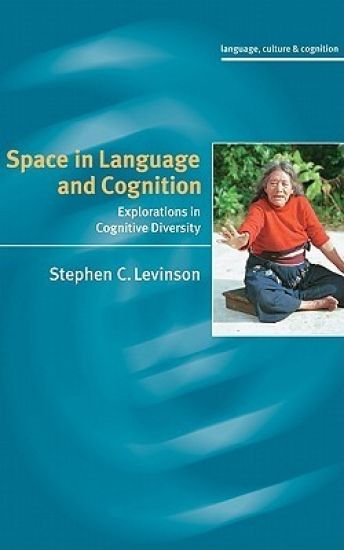
Space in Language and Cognition

Space in Language and Cognition

Levinson Stephen C.

Cambridge University Press
2003
pokkari
Languages differ in how they describe space, and such differences between languages can be used to explore the relation between language and thought. This 2003 book shows that even in a core cognitive domain like spatial thinking, language influences how people think, memorize and reason about spatial relations and directions. After outlining a typology of spatial coordinate systems in language and cognition, it is shown that not all languages use all types, and that non-linguistic cognition mirrors the systems available in the local language. The book reports on collaborative, interdisciplinary research, involving anthropologists, linguists and psychologists, conducted in many languages and cultures around the world, which establishes this robust correlation. The overall results suggest that thinking in the cognitive sciences underestimates the transformative power of language on thinking. The book will be of interest to linguists, psychologists, anthropologists and philosophers, and especially to students of spatial cognition.
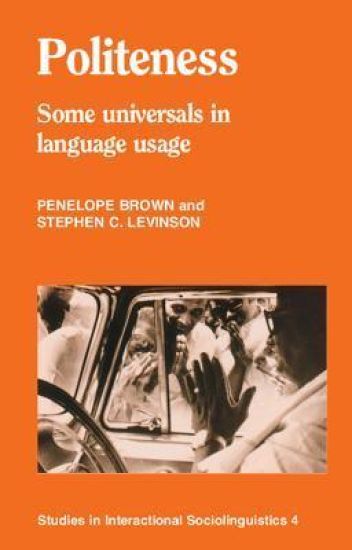
Politeness

Politeness

Brown Penelope; Levinson Stephen C.

Cambridge University Press
1987
pokkari
This study is about the principles for constructing polite speech. The core of it first appeared in Questions and Politeness, edited by Esther N. Goody (now out of print). It is here reissued with a new introduction which surveys the now considerable literature in linguistics, psychology and the social sciences that the original extended essay stimulated, and suggests new directions for research. The authors describe and account for some remarkable parallelisms in the linguistic construction of utterances with which people express themselves in different languages and cultures. A motive for these parallels is isolated - politeness, broadly defined to include both polite friendliness and polite formality - and a universal model is constructed outlining the abstract principles underlying polite usages. This is based on the detailed study of three unrelated languages and cultures: the Tamil of South India, the Tzeltal spoken by Mayan Indians in Chiapas, Mexico, and the English of the USA and England, supplemented by examples from other cultures. Underneath the apparent diversity of polite behaviour in different societies lie some general pan-human principles of social interaction, and the model of politeness provides a tool for analysing the quality of social relations in any society. This volume will be of special interest to students in linguistic pragmatics, sociolinguistics, applied linguistics, anthropology, and the sociology and social psychology of interaction.
Presumptive Meanings

Presumptive Meanings

Stephen C. Levinson

Bradford Books
2000
pokkari
This is the first extended discussion of preferred interpretation in language understanding, integrating much of the best research in linguistic pragmatics from the last two decades.When we speak, we mean more than we say. In this book Stephen C. Levinson explains some general processes that underlie presumptions in communication. This is the first extended discussion of preferred interpretation in language understanding, integrating much of the best research in linguistic pragmatics from the last two decades. Levinson outlines a theory of presumptive meanings, or preferred interpretations, governing the use of language, building on the idea of implicature developed by the philosopher H.P. Grice. Some of the indirect information carried by speech is presumed by default because it is carried by general principles, rather than inferred from specific assumptions about intention and context. Levinson examines this class of general pragmatic inferences in detail, showing how they apply to a wide range of linguistic constructions. This approach has radical consequences for how we think about language and communication.
Pragmatics

Pragmatics

Stephen C. Levinson

Cambridge University Press
1983
pokkari
Dr Levinson provides a lucid and integrative analysis of the central topics in pragmatics - deixis, implicature, presupposition, speech acts, and conversational structure. A central concern of the book is the relation between pragmatics and semantics.
Space in Language and Cognition

Space in Language and Cognition

Stephen C. Levinson

Cambridge University Press
2003
sidottu
Languages differ in how they describe space, and such differences between languages can be used to explore the relation between language and thought. This 2003 book shows that even in a core cognitive domain like spatial thinking, language influences how people think, memorize and reason about spatial relations and directions. After outlining a typology of spatial coordinate systems in language and cognition, it is shown that not all languages use all types, and that non-linguistic cognition mirrors the systems available in the local language. The book reports on collaborative, interdisciplinary research, involving anthropologists, linguists and psychologists, conducted in many languages and cultures around the world, which establishes this robust correlation. The overall results suggest that thinking in the cognitive sciences underestimates the transformative power of language on thinking. The book will be of interest to linguists, psychologists, anthropologists and philosophers, and especially to students of spatial cognition.
The Dark Matter of Pragmatics

The Dark Matter of Pragmatics

Stephen C. Levinson

Cambridge University Press
2024
sidottu
This Element tries to discern the known unknowns in the field of pragmatics, the 'Dark Matter' of the title. We can identify a key bottleneck in human communication, the sheer limitation on the speed of speech encoding: pragmatics occupies the niche nestled between slow speech encoding and fast comprehension. Pragmatic strategies are tricks for evading this tight encoding bottleneck by meaning more than you say. Five such tricks are reviewed, which are all domains where we have made considerable progress. We can then ask for each of these areas, where have we neglected to push the frontier forward? These are the known unknowns of pragmatics, key areas, and topics for future research. The Element thus offers a brief review of some central areas of pragmatics, and a survey of targets for future research. This title is also available as Open Access on Cambridge Core.
The Dark Matter of Pragmatics

The Dark Matter of Pragmatics

Stephen C. Levinson

Cambridge University Press
2024
pokkari
This Element tries to discern the known unknowns in the field of pragmatics, the 'Dark Matter' of the title. We can identify a key bottleneck in human communication, the sheer limitation on the speed of speech encoding: pragmatics occupies the niche nestled between slow speech encoding and fast comprehension. Pragmatic strategies are tricks for evading this tight encoding bottleneck by meaning more than you say. Five such tricks are reviewed, which are all domains where we have made considerable progress. We can then ask for each of these areas, where have we neglected to push the frontier forward? These are the known unknowns of pragmatics, key areas, and topics for future research. The Element thus offers a brief review of some central areas of pragmatics, and a survey of targets for future research. This title is also available as Open Access on Cambridge Core.
The Interaction Engine

The Interaction Engine

Stephen C. Levinson

Cambridge University Press
2025
sidottu
Communicative interaction forms the core of human experience. In this fascinating book Levinson, one of the world's leading scholars in the field, explores how human communicative interaction is structured, the demands it puts on our cognitive processing, and how its system evolved out of continuities with other primate systems. It celebrates the role of the 'interaction engine' which drives our social interaction, not only in human life, but also in the evolution of our species – showing how exchanges such as words, glances, laughter and face-to-face encounters bring us our greatest and most difficult experiences, and have come to define what it means to be human. It draws extensively on the author's fieldwork with speakers across multiple cultures and communities, and was inspired by his own experiences during the Covid lockdown, when humans were starved of the very social interaction that shapes our lives. This title is also available as open access on Cambridge Core.
A Grammar of Yélî Dnye

A Grammar of Yélî Dnye

Stephen C. Levinson

De Gruyter
2022
sidottu
This is a comprehensive description of a language spoken some 450 km offshore from the mainland of Papua New Guinea. The language is remarkable for its phonological, morphological and syntactic complexity. As the sole surviving member of its language family, and with little historical contact with surrounding languages, the language provides evidence of the kind of languages spoken in this part of the world before the Austronesian expansion. The grammar provides detailed information on the phoneme inventory, morphology, syntax and select semantic fields. Remarkable features include a 90 phoneme inventory including unique sounds, a morphology with thousands of non-compositional portmanteau elements, complex rules for negation, and extensive ergative syntax. Unusual patterns are also found in the organization of semantic fields, for example in partonymies of the body, taxonomies of the natural world, verbal semantics and kinship terms. The combination of linguistic ‘rara’ suggest that linguistic evolution under low contact can yield baroque and unusual patterns. The volume should be of special interest to linguists, typologists, sociolinguists, anthropologists and researchers in Oceania and Melanesia. Endorsement: "This long-awaited grammar is a major contribution to Papuan and general linguistics, providing as it does by far the most comprehensive and accurate grammatical description of a language that has already assumed a position as one of the world's most complicated. Hitherto, the most extensive grammatical description of the language has been the survey-like Henderson (1995), and while Levinson explicitly acknowledges his debt to this earlier grammar and to unpublished work by Henderson, his own detailed grammar clearly takes the level of description and analysis of the language to a completely new level. In particular, Levinson's grammar makes clear precisely to what extent and in what ways the language's morphology is complex beyond even what most studies on morphologically complex languages envisage. In addition, it provides a much more detailed account of the language's syntax, based on a judicious combination of corpus attestation and careful elicitation (incl. using the kits developed by Levinson's group at the MPI for Psycholinguistics). The grammar thus not only fills a major lacuna in our knowledge of the non-Austronesian languages of the New Guinea area, but also provides grist for future studies on the implications of the language's complexities."Bernard Comrie, University of California, Santa Barbara
A Grammar of Yélî Dnye

A Grammar of Yélî Dnye

Stephen C. Levinson

De Gruyter
2023
isokokoinen pokkari
This is a comprehensive description of a language spoken some 450 km offshore from the mainland of Papua New Guinea. The language is remarkable for its phonological, morphological and syntactic complexity. As the sole surviving member of its language family, and with little historical contact with surrounding languages, the language provides evidence of the kind of languages spoken in this part of the world before the Austronesian expansion. The grammar provides detailed information on the phoneme inventory, morphology, syntax and select semantic fields. Remarkable features include a 90 phoneme inventory including unique sounds, a morphology with thousands of non-compositional portmanteau elements, complex rules for negation, and extensive ergative syntax. Unusual patterns are also found in the organization of semantic fields, for example in partonymies of the body, taxonomies of the natural world, verbal semantics and kinship terms. The combination of linguistic ‘rara’ suggest that linguistic evolution under low contact can yield baroque and unusual patterns. The volume should be of special interest to linguists, typologists, sociolinguists, anthropologists and researchers in Oceania and Melanesia. Endorsement: "This long-awaited grammar is a major contribution to Papuan and general linguistics, providing as it does by far the most comprehensive and accurate grammatical description of a language that has already assumed a position as one of the world's most complicated. Hitherto, the most extensive grammatical description of the language has been the survey-like Henderson (1995), and while Levinson explicitly acknowledges his debt to this earlier grammar and to unpublished work by Henderson, his own detailed grammar clearly takes the level of description and analysis of the language to a completely new level. In particular, Levinson's grammar makes clear precisely to what extent and in what ways the language's morphology is complex beyond even what most studies on morphologically complex languages envisage. In addition, it provides a much more detailed account of the language's syntax, based on a judicious combination of corpus attestation and careful elicitation (incl. using the kits developed by Levinson's group at the MPI for Psycholinguistics). The grammar thus not only fills a major lacuna in our knowledge of the non-Austronesian languages of the New Guinea area, but also provides grist for future studies on the implications of the language's complexities."Bernard Comrie, University of California, Santa Barbara
Language, Thought, and Reality

Language, Thought, and Reality

Benjamin Lee Whorf; Stephen C. Levinson

MIT Press
2012
pokkari
Writings by a pioneering linguist, including his famous work on the Hopi language, general reflections on language and meaning, and the "Yale Report." The pioneering linguist Benjamin Whorf (1897-1941) grasped the relationship between human language and human thinking: how language can shape our innermost thoughts. His basic thesis is that our perception of the world and our ways of thinking about it are deeply influenced by the structure of the languages we speak. The writings collected in this volume include important papers on the Maya, Hopi, and Shawnee languages, as well as more general reflections on language and meaning. Whorf's ideas about the relation of language and thought have always appealed to a wide audience, but their reception in expert circles has alternated between dismissal and applause. Recently the language sciences have headed in directions that give Whorf's thinking a renewed relevance. Hence this new edition of Whorf's classic work is especially timely. The second edition includes all the writings from the first edition as well as John Carroll's original introduction, a new foreword by Stephen Levinson of the Max Planck Institute for Psycholinguistics that puts Whorf's work in historical and contemporary context, and new indexes. In addition, this edition offers Whorf's "Yale Report," an important work from Whorf's mature oeuvre.
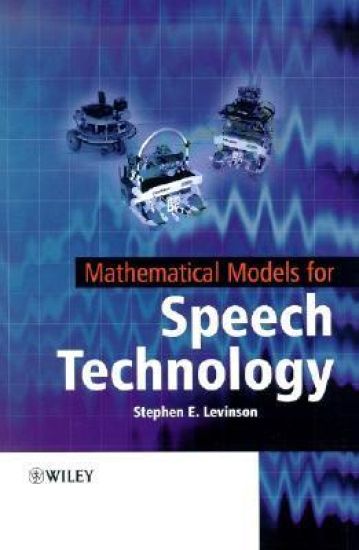
Mathematical Models for Speech Technology

Mathematical Models for Speech Technology

Stephen Levinson

John Wiley Sons Inc
2005
sidottu
Mathematical Modes of Spoken Language presents the motivations for, intuitions behind, and basic mathematical models of natural spoken language communication. A comprehensive overview is given of all aspects of the problem from the physics of speech production through the hierarchy of linguistic structure and ending with some observations on language and mind. The author comprehensively explores the argument that these modern technologies are actually the most extensive compilations of linguistic knowledge available.Throughout the book, the emphasis is on placing all the material in a mathematically coherent and computationally tractable framework that captures linguistic structure. It presents material that appears nowhere else and gives a unification of formalisms and perspectives used by linguists and engineers. Its unique features include a coherent nomenclature that emphasizes the deep connections amongst the diverse mathematical models and explores the methods by means of which they capture linguistic structure. This contrasts with some of the superficial similarities described in the existing literature; the historical background and origins of the theories and models; the connections to related disciplines, e.g. artificial intelligence, automata theory and information theory; an elucidation of the current debates and their intellectual origins; many important little-known results and some original proofs of fundamental results, e.g. a geometric interpretation of parameter estimation techniques for stochastic models and finally the author's own unique perspectives on the future of this discipline. There is a vast literature on Speech Recognition and Synthesis however, this book is unlike any other in the field. Although it appears to be a rapidly advancing field, the fundamentals have not changed in decades. Most of the results are presented in journals from which it is difficult to integrate and evaluate all of these recent ideas. Some of the fundamentals have been collected into textbooks, which give detailed descriptions of the techniques but no motivation or perspective. The linguistic texts are mostly descriptive and pictorial, lacking the mathematical and computational aspects. This book strikes a useful balance by covering a wide range of ideas in a common framework. It provides all the basic algorithms and computational techniques and an analysis and perspective, which allows one to intelligently read the latest literature and understand state-of-the-art techniques as they evolve.
Articulatory Speech Synthesis from the Fluid Dynamics of the Vocal Apparatus

Articulatory Speech Synthesis from the Fluid Dynamics of the Vocal Apparatus

Stephen Levinson; Don Davis; Scott Slimon; Jun Huang

Springer International Publishing AG
2012
nidottu
This book addresses the problem of articulatory speech synthesis based on computed vocal tract geometries and the basic physics of sound production in it. Unlike conventional methods based on analysis/synthesis using the well-known source filter model, which assumes the independence of the excitation and filter, we treat the entire vocal apparatus as one mechanical system that produces sound by means of fluid dynamics. The vocal apparatus is represented as a three-dimensional time-varying mechanism and the sound propagation inside it is due to the non-planar propagation of acoustic waves through a viscous, compressible fluid described by the Navier-Stokes equations. We propose a combined minimum energy and minimum jerk criterion to compute the dynamics of the vocal tract during articulation. Theoretical error bounds and experimental results show that this method obtains a close match to the phonetic target positions while avoiding abrupt changes in the articulatory trajectory. The vocal folds are set into aerodynamic oscillation by the flow of air from the lungs. The modulated air stream then excites the moving vocal tract. This method shows strong evidence for source-filter interaction. Based on our results, we propose that the articulatory speech production model has the potential to synthesize speech and provide a compact parameterization of the speech signal that can be useful in a wide variety of speech signal processing problems. Table of Contents: Introduction / Literature Review / Estimation of Dynamic Articulatory Parameters / Construction of Articulatory Model Based on MRI Data / Vocal Fold Excitation Models / Experimental Results of Articulatory Synthesis / Conclusion
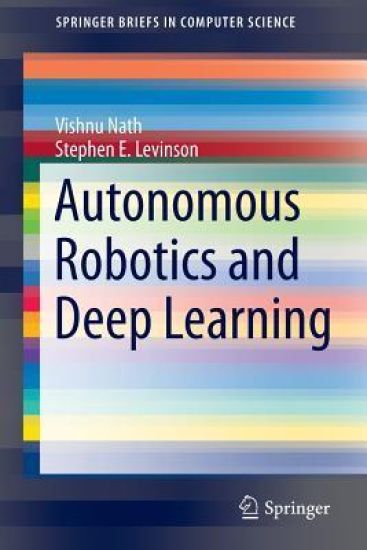
Autonomous Robotics and Deep Learning

Autonomous Robotics and Deep Learning

Vishnu Nath; Stephen E. Levinson

Springer International Publishing AG
2014
nidottu
This Springer Brief examines the combination of computer vision techniques and machine learning algorithms necessary for humanoid robots to develop “true consciousness.” It illustrates the critical first step towards reaching “deep learning,” long considered the holy grail for machine learning scientists worldwide. Using the example of the iCub, a humanoid robot which learns to solve 3D mazes, the book explores the challenges to create a robot that can perceive its own surroundings. Rather than relying solely on human programming, the robot uses physical touch to develop a neural map of its environment and learns to change the environment for its own benefit. These techniques allow the iCub to accurately solve any maze, if a solution exists, within a few iterations. With clear analysis of the iCub experiments and its results, this Springer Brief is ideal for advanced level students, researchers and professionals focused on computer vision, AI and machine learning.
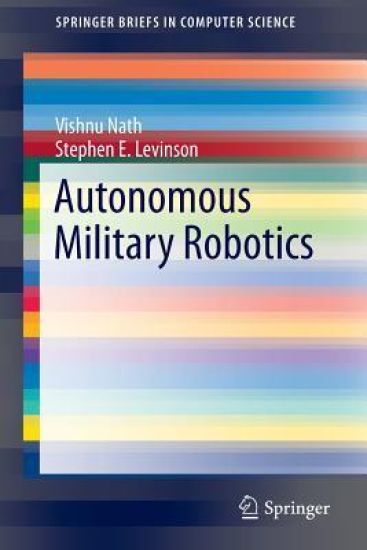
Autonomous Military Robotics

Autonomous Military Robotics

Vishnu Nath; Stephen E. Levinson

Springer International Publishing AG
2014
nidottu
This SpringerBrief reveals the latest techniques in computer vision and machine learning on robots that are designed as accurate and efficient military snipers. Militaries around the world are investigating this technology to simplify the time, cost and safety measures necessary for training human snipers. These robots are developed by combining crucial aspects of computer science research areas including image processing, robotic kinematics and learning algorithms. The authors explain how a new humanoid robot, the iCub, uses high-speed cameras and computer vision algorithms to track the object that has been classified as a target. The robot adjusts its arm and the gun muzzle for maximum accuracy, due to a neural model that includes the parameters of its joint angles, the velocity of the bullet and the approximate distance of the target. A thorough literature review provides helpful context for the experiments. Of practical interest to military forces around the world, this brief is designed for professionals and researchers working in military robotics. It will also be useful for advanced level computer science students focused on computer vision, AI and machine learning issues.
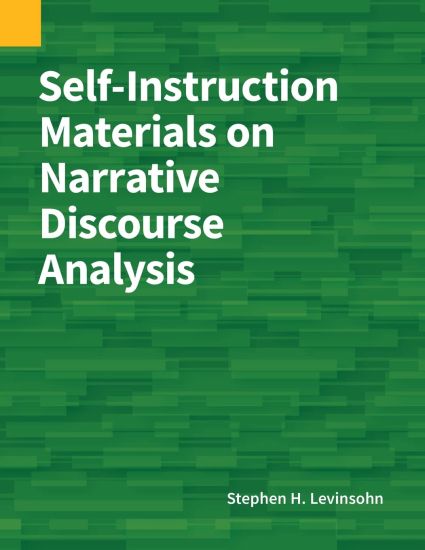
Self-Instruction Materials on Narrative Discourse Analysis

Self-Instruction Materials on Narrative Discourse Analysis

Stephen H Levinsohn

Sil International, Global Publishing
2022
pokkari
Language does not consist solely of isolated words or sentences. Many sentences are connected together into longer stretches of discourse. Anyone engaging in the study of a language needs to consider the factors involved in associating sentences together so that the result is a coherent whole. Narrative* in particular employs both creative and economic features of the language to maximum effect.The approach presented in this volume has been used to analyse narratives in more than 500 languages. Topics includepreparation and charting of texts for analysis factors involved in the ordering of constituents within sentences backgrounding and highlighting devicesconnectivesreporting conversation in narrative participant referenceThis self-instruction course will help those who have completed an initial language learning and analysis phase in a language project, are planning to be involved in a Scripture translation project, or are engaged in the study of a language spoken anywhere in the world. Recommended prerequisites are the completion of a Language Study Skills track of an assignment-related training course, with associated field experience or its equivalent. Students will need an appropriate selection of narrative texts in the language they are studying.*Self-Instruction Materials on Narrative Discourse Analysis is a companion volume to Self-Instruction Materials on Non-Narrative Discourse Analysis, published by SIL International(R) 2023.
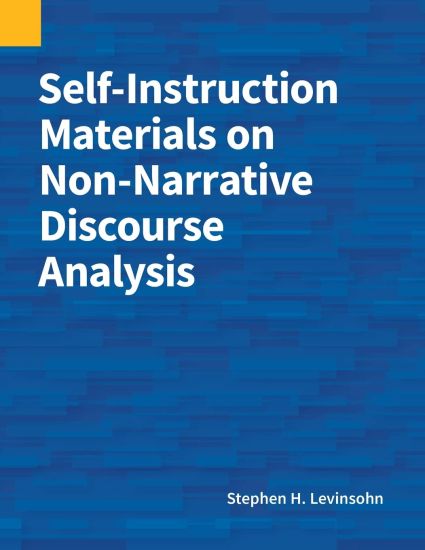
Self-Instruction Materials on Non-Narrative Discourse Analysis

Self-Instruction Materials on Non-Narrative Discourse Analysis

Stephen H Levinsohn

Sil International, Global Publishing
2022
pokkari
Many problems in translation arise because of mismatches between the source and receptor languages. A particularly relevant factor is whether or not the language normally places the verb at the end of the sentence, and whether or not the subject commonly follows the verb. Such potential mismatches are a major discussion in the eight chapters of this course. Topics includedifferences between instruction and persuasionconnectivesvariations in the order of constituents and propositionsprominence-giving, backgrounding and highlighting devicesrelative potency of different forms of exhortationboundary featuresThe course is designed particularly for those who expect to be involved in the translation of non-narrative texts from one language to another, whether as a mother tongue speaker, other tongue speaker or expatriate translator, consultant or advisor. It will also help anyone engaged in the study of non-narrative texts in any language in the world. Recommended prerequisites are the completion of a Narrative Discourse Analysis* course, with associated field experience or its equivalent. Students will need a selection of non-narrative texts in the language they are studying.*Self-Instruction Materials on Narrative Discourse Analysis is a companion volume to Self-Instruction Materials on Non-Narrative Discourse Analysis, published by SIL International(R) 2023.
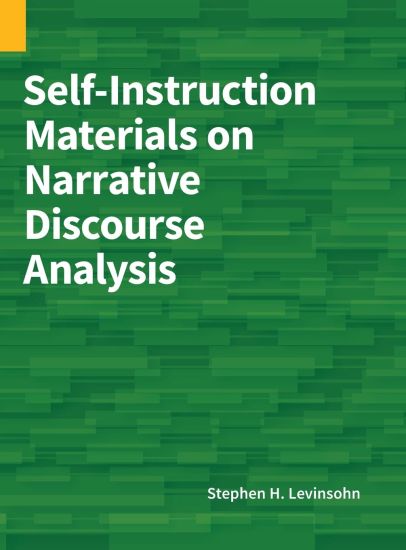
Self-Instruction Materials on Narrative Discourse Analysis

Self-Instruction Materials on Narrative Discourse Analysis

Stephen H Levinsohn

Sil International, Global Publishing
2022
sidottu
Language does not consist solely of isolated words or sentences. Many sentences are connected together into longer stretches of discourse. Anyone engaging in the study of a language needs to consider the factors involved in associating sentences together so that the result is a coherent whole. Narrative* in particular employs both creative and economic features of the language to maximum effect.The approach presented in this volume has been used to analyse narratives in more than 500 languages. Topics includepreparation and charting of texts for analysis factors involved in the ordering of constituents within sentences backgrounding and highlighting devicesconnectivesreporting conversation in narrative participant referenceThis self-instruction course will help those who have completed an initial language learning and analysis phase in a language project, are planning to be involved in a Scripture translation project, or are engaged in the study of a language spoken anywhere in the world. Recommended prerequisites are the completion of a Language Study Skills track of an assignment-related training course, with associated field experience or its equivalent. Students will need an appropriate selection of narrative texts in the language they are studying.*Self-Instruction Materials on Narrative Discourse Analysis is a companion volume to Self-Instruction Materials on Non-Narrative Discourse Analysis, published by SIL International(R) 2023.