

Kirjahaku
Etsi kirjoja tekijän nimen, kirjan nimen tai ISBN:n perusteella.
391 tulosta hakusanalla Lizabeth Rossner

Lizabeth Scott reigned in Hollywood as the queen of film noir. By the time obsessed fan and gay filmmaker Todd Hughes sat down to lunch with her at Musso & Frank in Hollywood, she had largely outlived her fame. The two of them formed a unique bond and an enduring friendship that spanned twenty years. One of the very last vestiges of Hollywood's Golden Age, Lizabeth reveals to Hughes her ebullient personality and zest for life while shedding insight into her fabulously brief career as an international film star, recording artist and mistress to one of Hollywood's biggest producers. They stumble over homosexuality, art and politics but always manage to find a way to navigate the turn of the century.

Lizabeth Scott reigned in Hollywood as the queen of film noir. By the time obsessed fan and gay filmmaker Todd Hughes sat down to lunch with her at Musso & Frank in Hollywood, she had largely outlived her fame. The two of them formed a unique bond and an enduring friendship that spanned twenty years. One of the very last vestiges of Hollywood's Golden Age, Lizabeth reveals to Hughes her ebullient personality and zest for life while shedding insight into her fabulously brief career as an international film star, recording artist and mistress to one of Hollywood's biggest producers. They stumble over homosexuality, art and politics but always manage to find a way to navigate the turn of the century.

With the publication of her novel Annie John in 1985, Jamaica Kincaid entered the ranks of the best novelists of her generation. Her three autobiographical novels, Annie John, Lucy, and Autobiography of My Mother, and collection of short stories, At the Bottom of the River, touch on the universal theme of coming-of-age and the female adolescent's need to sever her ties to her mother. This angst is couched in the social landscape of post-colonial Antigua, a small Caribbean island whose legacy of racism affects Kincaid's protagonists. Her fiction rewrites the history of the Caribbean from a West Indies perspective and this milieu colors the experiences of her characters. Following a biographical chapter, Paravisini-Gebert traces the development of Kincaid's craft as a writer. Each of the novels and the collection of short stories is discussed in a separate chapter that includes sections on plot, character, theme, and an alternate critical approach from which to read the novel, such as feminist. A complete primary and secondary bibliography and lists of selected reviews of Kincaid's work complete the study.

The Caribbean is an exotic but not too distant land, full of rich cultural traditions. The literature of the Caribbean reflects the social, political, and cultural concerns of the region and is a valuable tool for learning about the area and its people. This book includes chapters on roughly a dozen contemporary Caribbean writers. Along with plot summaries, these sections discuss major themes and give close attention to how Caribbean culture figures in the writer's texts. To help students conduct further research, each chapter cites works for further reading.

In this signal work of history, Bancroft Prize winner and Pulitzer Prize finalist Lizabeth Cohen shows how the pursuit of prosperity after World War II fueled our pervasive consumer mentality and transformed American life. Trumpeted as a means to promote the general welfare, mass consumption quickly outgrew its economic objectives and became synonymous with patriotism, social equality, and the American Dream. Material goods came to embody the promise of America, and the power of consumers to purchase everything from vacuum cleaners to convertibles gave rise to the power of citizens to purchase political influence and effect social change. Yet despite undeniable successes and unprecedented affluence, mass consumption also fostered economic inequality and the fracturing of society along gender, class, and racial lines. In charting the complex legacy of our "Consumers' Republic" Lizabeth Cohen has written a bold, encompassing, and profoundly influential book.

Unique in in its focus on eukaryotic molecular biology, this textbook provides a distillation of the essential concepts of molecular biology, supported by current examples, experimental evidence, and boxes that address related diseases, methods, and techniques. End-of-chapter analytical questions are well designed and will enable students to apply the information they learned in the chapter. A supplementary website include self-tests for students, resources for instructors, as well as figures and animations for classroom use.

Making a New Deal: Industrial Workers in Chicago, 1919-1939
Lizabeth Cohen
Cambridge University Press
1990
sidottu

This book examines how it was possible and what it meant for ordinary factory workers to become effective unionists and national political participants by the mid-1930s. We follow Chicago workers as they make choices about whether to attend ethnic benefit society meetings or to go to the movies, whether to shop in local neighborhood stores or patronize the new A&P. As they made daily decisions like these, they declared their loyalty in ways that would ultimately have political significance. When the depression worsened in the 1930s, workers adopted new ideological perspectives and overcame longstanding divisions among themselves to mount new kinds of collective action. Chicago workers' experiences all converged to make them into New Deal Democrats and CIO unionists. First printed in 1990, Making a New Deal has become an established classic in American history. The second edition includes a new preface by Lizabeth Cohen.

This handbook is for everyone who wants to observe and understand plants and the differences between them, but is particularly aimed at botanical artists. It explains the most important diagnostic features that are essential when identifying a plant and painting an accurate picture. With practical advice on how to approach a painting, this book is sure to become an invaluable reference for artists and an insightful aid so all gardeners can enjoy their plants to the full.

Constables and Tobacco Planters in Orange County, Virginia, 1735-1769
Lizabeth Ward Papageorgiou
Clearfield
2011
pokkari

Creole Religions of the Caribbean
Lizabeth Paravisini-Gebert; Margarite Fernández Olmos; Joseph M. Murphy
New York University Press
2011
sidottu
A comprehensive introduction to the syncretic religions developed in the Caribbean region Creolization—the coming together of diverse beliefs and practices to form new beliefs and practices—is one of the most significant phenomena in Caribbean religious history. Brought together in the crucible of the sugar plantation, Caribbean peoples drew on the variants of Christianity brought by European colonizers, as well as on African religious and healing traditions and the remnants of Amerindian practices, to fashion new systems of belief. Creole Religions of the Caribbean offers a comprehensive introduction to the syncretic religions that have developed in the region. From Vodou, Santería, Regla de Palo, the Abakuá Secret Society, and Obeah to Quimbois and Espiritismo, the volume traces the historical–cultural origins of the major Creole religions, as well as the newer traditions such as Pocomania and Rastafarianism. This second edition updates the scholarship on the religions themselves and also expands the regional considerations of the Diaspora to the U. S. Latino community who are influenced by Creole spiritual practices. Fernández Olmos and Paravisini–Gebert also take into account the increased significance of material culture—art, music, literature—and healing practices influenced by Creole religions.
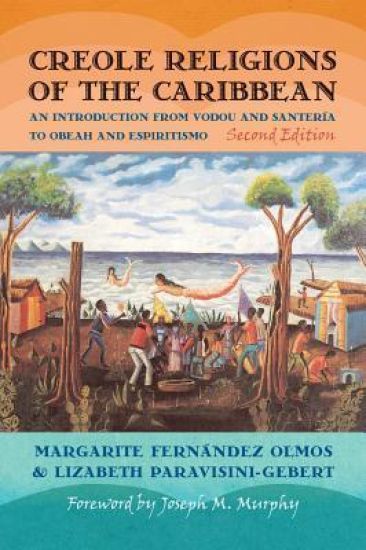
Creole Religions of the Caribbean
Lizabeth Paravisini-Gebert; Margarite Fernández Olmos; Joseph M. Murphy
New York University Press
2011
pokkari
A comprehensive introduction to the syncretic religions developed in the Caribbean region Creolization—the coming together of diverse beliefs and practices to form new beliefs and practices—is one of the most significant phenomena in Caribbean religious history. Brought together in the crucible of the sugar plantation, Caribbean peoples drew on the variants of Christianity brought by European colonizers, as well as on African religious and healing traditions and the remnants of Amerindian practices, to fashion new systems of belief. Creole Religions of the Caribbean offers a comprehensive introduction to the syncretic religions that have developed in the region. From Vodou, Santería, Regla de Palo, the Abakuá Secret Society, and Obeah to Quimbois and Espiritismo, the volume traces the historical–cultural origins of the major Creole religions, as well as the newer traditions such as Pocomania and Rastafarianism. This second edition updates the scholarship on the religions themselves and also expands the regional considerations of the Diaspora to the U. S. Latino community who are influenced by Creole spiritual practices. Fernández Olmos and Paravisini–Gebert also take into account the increased significance of material culture—art, music, literature—and healing practices influenced by Creole religions.

What happens when something unexpected crashes into your business or personal life? You are left high and dry, beached. What you do next and how you move through that challenge defines and determines life success. Beached is a parable that follows six people dealing with work layoff, death of a loved one, natural disaster, medical diagnosis, and other catastrophic events. Through messages received in unexpected ways and the sage advice from a mysterious lighthouse keeper they frame and implement their plans to "get back in the swim." Readers are invited to gain from the experiences, decisions, and resolutions offered here, as they face and master their own life challenges.

Unlike other texts for undergraduate sociological social psychology courses, Individual and Society covers each of the three research traditions in sociological social psychology—symbolic interactionism, social structure and personality, and group processes and structures. With this approach, the authors make clear the link between sociological social psychology, theory, and methodology. Students will gain a better understanding of how and why social psychologists trained in sociology ask particular kinds of questions; the types of research they are involved in; and how their findings have been, or can be, applied to contemporary societal patterns and problems.This new, third edition makes the emphasis on social inequality within sociological social psychology, a key theme in earlier versions of the book, more salient throughout the text by including new or expanded discussions of intersectionality, positionality, the experiences of gender and sexual minorities, racial microaggression, contemporary social movements, and the complexities of allyship. Other additions to the text address the ubiquity of the Internet and social media, where the authors consider how these phenomena have shaped the experiences of Generation Z, the first “digital natives,” and altered individuals’ self-concepts and social relationships. Engaging exercises and group activities are also embedded within each chapter to enhance students’ readiness to reflect and think critically about the social world around them and to improve their understanding of the different dimensions of sociological social psychology and how they relate to everyday life.

Unlike other texts for undergraduate sociological social psychology courses, Individual and Society covers each of the three research traditions in sociological social psychology—symbolic interactionism, social structure and personality, and group processes and structures. With this approach, the authors make clear the link between sociological social psychology, theory, and methodology. Students will gain a better understanding of how and why social psychologists trained in sociology ask particular kinds of questions; the types of research they are involved in; and how their findings have been, or can be, applied to contemporary societal patterns and problems.This new, third edition makes the emphasis on social inequality within sociological social psychology, a key theme in earlier versions of the book, more salient throughout the text by including new or expanded discussions of intersectionality, positionality, the experiences of gender and sexual minorities, racial microaggression, contemporary social movements, and the complexities of allyship. Other additions to the text address the ubiquity of the Internet and social media, where the authors consider how these phenomena have shaped the experiences of Generation Z, the first “digital natives,” and altered individuals’ self-concepts and social relationships. Engaging exercises and group activities are also embedded within each chapter to enhance students’ readiness to reflect and think critically about the social world around them and to improve their understanding of the different dimensions of sociological social psychology and how they relate to everyday life.


This book examines how it was possible and what it meant for ordinary factory workers to become effective unionists and national political participants by the mid-1930s. We follow Chicago workers as they make choices about whether to attend ethnic benefit society meetings or to go to the movies, whether to shop in local neighborhood stores or patronize the new A & P. As they made daily decisions like these, they declared their loyalty in ways that would ultimately have political significance. When the depression worsened in the 1930s, workers adopted new ideological perspectives and overcame longstanding divisions among themselves to mount new kinds of collective action. Chicago workers' experiences all converged to make them into New Deal Democrats and CIO unionists. First printed in 1990, Making a New Deal has become an established classic in American history. The second edition includes a new preface by Lizabeth Cohen.

Fundamental Molecular Biology Discover a focused and up to date exploration of foundational and core concepts in molecular biologyThe newly revised Third Edition of Fundamental Molecular Biology delivers a selective and precise treatment of essential topics in molecular biology perfect for allowing students to develop an accurate understanding of the applications of the field. The book applies the process of discovery-observations, questions, experimental designs, results, and conclusions-with an emphasis on the language of molecular biology. Readers will easily focus on the key ideas they need to succeed in any introductory molecular biology course.Fundamental Molecular Biology provides students with the most up to date techniques and research used by molecular biologists today. Readers of the book will have the support and resources they need to develop a concrete understanding of core and foundational concepts of molecular biology, without being distracted by outdated or peripheral material.Readers will also benefit from the inclusion of:A thorough introduction to and comparison of eukaryotic and prokaryotic organisms illustrating the variation of cellular processes across organismsTool boxes exploring up to date experimental methods and techniques used by molecular biologistsFocus boxes providing detailed treatment of topics that delve further into experimental strategiesDisease boxes placing complex regulatory pathways in their relevant context and illustrating key principles of molecular biologyPerfect for instructors and professors of introductory molecular biology courses, Fundamental Molecular Biology will also earn a place in the libraries of anyone seeking to improve their understanding of molecular biology with an insightful and well-grounded treatment of the core principles of the subject.

Unlike other texts for undergraduate sociological social psychology courses, this text presents the three distinct traditions in sociological social psychology—symbolic interactionism, social structure and personality, and group processes and structures—and emphasizes the different theoretical frameworks within which social psychological analyses are conducted within each research tradition. With this approach, the authors make clear the link between sociological social psychology, theory, and methodology. Students will gain a better understanding of how and why social psychologists trained in sociology ask particular kinds of questions; the types of research they are involved in; and how their findings have been, or can be, applied to contemporary societal patterns and problems.This new, second edition includes the latest research on topics related to current events and changing societal patterns; more detailed discussions on intersectionality, social media, and contemporary social movements; as well as a new concluding chapter that asks students to reflect on what they have learned about sociological social psychology and its applicability to contemporary social issues. Engaging exercises and group activities are also embedded within in each chapter to enhance students’ understanding of key concepts, theories, methods and research findings within the field and how they relate to everyday life.