An indispensable guide to the myth of Oedipus this book is the first to analyze its long and varied history from ancient times to the modern day, and presented with an authoritative survey that considers Oedipus in art and music as well as in literature. Lowell Edmunds accepts this variation as the driving force in its longevity and popularity. Refraining from seeking for an original form of the myth, Edmunds relates the changes in content in the myth to changes in meaning, eschewing the notion that one particular version can be set as standard.
An indispensable guide to the myth of Oedipus this book is the first to analyze its long and varied history from ancient times to the modern day, and presented with an authoritative survey that considers Oedipus in art and music as well as in literature. Lowell Edmunds accepts this variation as the driving force in its longevity and popularity. Refraining from seeking for an original form of the myth, Edmunds relates the changes in content in the myth to changes in meaning, eschewing the notion that one particular version can be set as standard.
It's a familiar story: a beautiful woman is abducted and her husband journeys to recover her. This story's best-known incarnation is also a central Greek myth--the abduction of Helen that led to the Trojan War. Stealing Helen surveys a vast range of folktales and texts exhibiting the story pattern of the abducted beautiful wife and makes a detailed comparison with the Helen of Troy myth. Lowell Edmunds shows that certain Sanskrit, Welsh, and Old Irish texts suggest there was an Indo-European story of the abducted wife before the Helen myth of the Iliad became known. Investigating Helen's status in ancient Greek sources, Edmunds argues that if Helen was just one trope of the abducted wife, the quest for Helen's origin in Spartan cult can be abandoned, as can the quest for an Indo-European goddess who grew into the Helen myth. He explains that Helen was not a divine essence but a narrative figure that could replicate itself as needed, at various times or places in ancient Greece. Edmunds recovers some of these narrative Helens, such as those of the Pythagoreans and of Simon Magus, which then inspired the Helens of the Faust legend and Goethe. Stealing Helen offers a detailed critique of prevailing views behind the "real" Helen and presents an eye-opening exploration of the many sources for this international mythical and literary icon.
It's a familiar story: a beautiful woman is abducted and her husband journeys to recover her. This story’s best-known incarnation is also a central Greek myth—the abduction of Helen that led to the Trojan War. Stealing Helen surveys a vast range of folktales and texts exhibiting the story pattern of the abducted beautiful wife and makes a detailed comparison with the Helen of Troy myth. Lowell Edmunds shows that certain Sanskrit, Welsh, and Old Irish texts suggest there was an Indo-European story of the abducted wife before the Helen myth of the Iliad became known.Investigating Helen’s status in ancient Greek sources, Edmunds argues that if Helen was just one trope of the abducted wife, the quest for Helen’s origin in Spartan cult can be abandoned, as can the quest for an Indo-European goddess who grew into the Helen myth. He explains that Helen was not a divine essence but a narrative figure that could replicate itself as needed, at various times or places in ancient Greece. Edmunds recovers some of these narrative Helens, such as those of the Pythagoreans and of Simon Magus, which then inspired the Helens of the Faust legend and Goethe.Stealing Helen offers a detailed critique of prevailing views behind the "real" Helen and presents an eye-opening exploration of the many sources for this international mythical and literary icon.
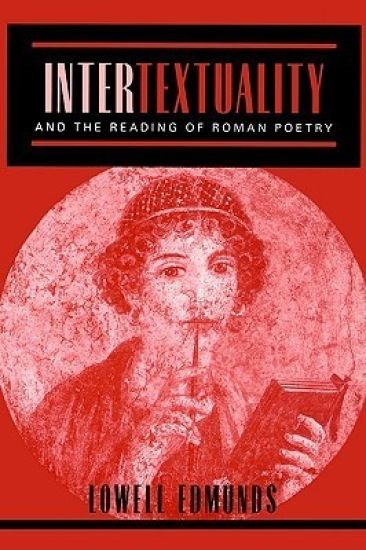
How can we explain the process by which a literary text refers to another text? For the past decade and a half, intertextuality has been a central concern of scholars and readers of Roman poetry. In Intertextuality and the Reading of Roman Poetry, Lowell Edmunds proceeds from such fundamental concepts as "author," "text," and "reader," which he then applies to passages from Vergil, Horace, Ovid, and Catullus. Edmunds combines close readings of poems with analysis of recent theoretical models to argue that allusion has no linguistic or semiotic basis: there is nothing in addition to the alluding words that causes the allusion or the reference to be made. Intertextuality is a matter of reading.
While Greek tragedies are often studied as works of literature, they are less frequently examined as products of the social and political environment in which they were created. Rarely, too, are the visual and spatial aspects of these plays given careful consideration. In this detailed and innovative book, Lowell Edmunds combines two readings of the Oedipus at Colonus to arrive at a new way of looking at Greek tragedy. Edmunds sets forth a semiotic theory of theatrical space, and then applies this theory to the visual and spatial dimensions of the Oedipus at Colonus. In his historical analysis, Edmunds describes the Athenian revolution of 411 B.C.E. and its effect on Colonus. The book includes an appendix on the life of Sophocles and the reception of the Oedipus at Colonus. Edmunds' unique approach to the Oedipus at Colonus. makes this an important book for students and scholars of semiotics, Greek tragedy, and theatrical performance.
Drawing on more than seventy works that dispersed the Oedipus legend from Greece to Asia, Africa, and the Americas, Edmunds provides a foundation for discussion of the lasting appeal of this legend, for claims of its universality, and for its uses as a vehicle for personal and cultural expression.The power of the Oedipus legend is apparent not only in its interpretations but even more so in its variations. As Edmunds writes, "Translations, adaptations, and performances still come forth in a never-ending stream. Again and again, playwrights have tried their hand at new shapings of the Sophoclean Oedipuses and often a country's Oedipus forms a whole chapter in the history of its literature." Drawing on more than seventy works that dispersed the Oedipus legend from Greece to Asia, Africa, and the Americas, Edmunds provides a foundation for discussion of the lasting appeal of this legend, for claims of its universality, and for its uses as a vehicle for personal and cultural expression.
Originally published in 1998. From its contested origins in nineteenth-century California; through its popularity among the smart set of the 1930s, world leaders of the 1940s, and the men in the gray flannel suits of the 1950s; to its resurgence among today's retro-hipsters: Lowell Edmunds traces the history and cultural significance of the cocktail H. L. Mencken called "the only American invention as perfect as a sonnet."
This monograph lays the groundwork for a new approach of the characterization of the Homeric Helen, focusing on how she is addressed and named in the Iliad and the Odyssey and especially on her epithets. Her social identity in Troy and in Sparta emerges in the words used to address and name her. Her epithets, most of them referring to her beauty or her kinship with Zeus and coming mainly from the narrator, make her the counterpart of the heroes.
This volume provides a guide to research in the field of Greek Myth, introducing the main questions, theories and methods related to the study of Greek Myth today. The author points out, with critical reappraisal, the key themes and ideas in recent scholarship and makes suggestions for future lines of study. Aimed at students and scholars in Classics, it will also be of interest to larger audiences in the Humanities.
This monograph lays the groundwork for a new approach of the characterization of the Homeric Helen, focusing on how she is addressed and named in the Iliad and the Odyssey and especially on her epithets. Her social identity in Troy and in Sparta emerges in the words used to address and name her. Her epithets, most of them referring to her beauty or her kinship with Zeus and coming mainly from the narrator, make her the counterpart of the heroes.
This book is a detailed study of a single poem -- Horace, Odes 1.9 -- often called 'The Soracte Ode' after the mountain named in its second line. Although more than seventy articles and parts of books have been devoted to this twenty-four line poem since the beginning of the last century, Lowell Edmunds is the first scholar to apply developments in literary theory from outside the field of classics to a discussion of the ode. Specifically, he uses Hans Robert Jauss's essay on Baudelaire's ""Spleen (II)"" as a model for his study.According to Edmunds, attempts to answer aesthetic questions about ancient lyric poems typically begin with philological or historical facts -- which scholars present as new evidence, heretofore undiscovered or misunderstood -- and proceed to an analysis built on those facts. Edmunds argues that contemporary literary theory provides a different way of reconciling the aestheic and historical claims of a lyric poem, ancient or modern. He then takes a fresh look at Horace's poem, employing Jauss's method of performing three successive readings of the text: the first aesthetic or perceptual, the second interpretive, and the third historicist.In this hermeneutic Jaussian approach, Edmunds shows, the unity of the poem appears in the process of reading rather than, as in a philological approach, in the analysis of it. Moreover, he labels an emphasis on the act of reading itself, distinct from analysis, as the main difference between philological and hermeneutical ways of understanding a poem. Focusing on this contrast, he surveys the history of the ode's reception and scholarly interpretation. In the final chapter, he briefly considers deconstruction as an alternative critical method. Assessing the rival claims of hermeneutics, deconstruction, and philology as interpretive tools, Edmunds concludes by favoring hermeneutics.A UNC Press Enduring Edition -- UNC Press Enduring Editions use the latest in digital technology to make available again books from our distinguished backlist that were previously out of print. These editions are published unaltered from the original, and are presented in affordable paperback formats, bringing readers both historical and cultural value.
The Letters of Thomas Lovell Beddoes is an unchanged, high-quality reprint of the original edition of 1894. Hansebooks is editor of the literature on different topic areas such as research and science, travel and expeditions, cooking and nutrition, medicine, and other genres. As a publisher we focus on the preservation of historical literature. Many works of historical writers and scientists are available today as antiques only. Hansebooks newly publishes these books and contributes to the preservation of literature which has become rare and historical knowledge for the future.
The Letters of Thomas Lovell Beddoes is an unchanged, high-quality reprint of the original edition of 1894. Hansebooks is editor of the literature on different topic areas such as research and science, travel and expeditions, cooking and nutrition, medicine, and other genres. As a publisher we focus on the preservation of historical literature. Many works of historical writers and scientists are available today as antiques only. Hansebooks newly publishes these books and contributes to the preservation of literature which has become rare and historical knowledge for the future.