Kirjojen hintavertailu. Mukana 11 342 296 kirjaa ja 12 kauppaa.

Kirjahaku

Etsi kirjoja tekijän nimen, kirjan nimen tai ISBN:n perusteella.

1000 tulosta hakusanalla Lyle Campbell; Wade Davis

Linguist on the Loose

Linguist on the Loose

Lyle Campbell; Wade Davis

EDINBURGH UNIVERSITY PRESS
2021
sidottu
A vivid memoir of life in the field that highlights the importance of documenting indigenous languages Lyle Campbell's linguistic fieldwork has taken him to numerous countries, sometimes in challenging circumstances. It has led to exciting discoveries including a new language in southeastern Guatemala, a unique speech sound, unknown in any other language, in the Nivacle language of Paraguay and Argentina, and unusual and unique features in several other languages. Along the way, he has experienced dangers and challenges, the joys and excitement of fieldwork, and encountered first-hand the importance of collaborating with indigenous groups to help document and revitalise their languages.Written with humour, heart, and a clear dedication to endangered languages and their speakers, Lyle's vivid memoir is a lesson not only on life in the field but on the importance of language documentation. With so many of the world's languages being lost at an alarming rate, this remains the most compelling and urgent task for linguists now and into the future.
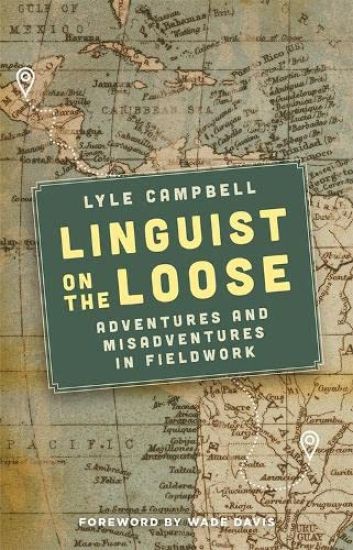
Linguist on the Loose

Linguist on the Loose

Lyle Campbell; Wade Davis

EDINBURGH UNIVERSITY PRESS
2021
nidottu
A vivid memoir of life in the field that highlights the importance of documenting indigenous languages Lyle Campbell's linguistic fieldwork has taken him to numerous countries, sometimes in challenging circumstances. It has led to exciting discoveries including a new language in southeastern Guatemala, a unique speech sound, unknown in any other language, in the Nivacle language of Paraguay and Argentina, and unusual and unique features in several other languages. Along the way, he has experienced dangers and challenges, the joys and excitement of fieldwork, and encountered first-hand the importance of collaborating with indigenous groups to help document and revitalise their languages.Written with humour, heart, and a clear dedication to endangered languages and their speakers, Lyle's vivid memoir is a lesson not only on life in the field but on the importance of language documentation. With so many of the world's languages being lost at an alarming rate, this remains the most compelling and urgent task for linguists now and into the future.
The Indigenous Languages of the Americas

The Indigenous Languages of the Americas

Lyle Campbell

OXFORD UNIVERSITY PRESS INC
2024
sidottu
The Indigenous Languages of the Americas takes stock of what is known about the history and classification of these languages and language families. It identifies the gaps in knowledge and puts them into perspective, and it assesses differences of opinion. It also resolves some issues and makes new contributions of its own. The nine chapters of the book deal incisively with the major themes involving these languages: the classification and history of the Indigenous languages of North American, Middle American (Mexico and Central America), and South American; difficulties involving names of the languages; origins of the languages of the New World; unclassified, phantom, fake, and spurious languages in the Americas; recent hypotheses of remote linguistic relationships; the linguistic areas of the Americas; contact languages, including pidgins, lingua francas, and mixed languages; and loanwords and other new words in the native languages of the Americas.
Historical Linguistics

Historical Linguistics

Lyle Campbell

Edinburgh University Press
2021
sidottu
Lyle Campbell presents an accessible, hands-on introduction to historical linguistics one that does not just talk about the topics, but through practical exercises and examples shows you how to apply the procedures, how to think about the issues and, in general, how to do what historical linguists do. This 4th edition covers a wide range of topics including areal linguistics, linguistic prehistory, distant genetic relationships, language contact, lexical and semantic change, sociolinguistics and language change, quantitative and corpus research methods. Examples are drawn from a wide range of languages including English, French, German, and Spanish as well many non-Indo-European languages. With its lucid and engaging style, expert guidance and comprehensive coverage, this book is ideal for students coming to historical linguistics for the first time.
Historical Linguistics

Historical Linguistics

Lyle Campbell

Edinburgh University Press
2021
nidottu
Lyle Campbell presents an accessible, hands-on introduction to historical linguistics one that does not just talk about the topics, but through practical exercises and examples shows you how to apply the procedures, how to think about the issues and, in general, how to do what historical linguists do. This 4th edition covers a wide range of topics including areal linguistics, linguistic prehistory, distant genetic relationships, language contact, lexical and semantic change, sociolinguistics and language change, quantitative and corpus research methods. Examples are drawn from a wide range of languages including English, French, German, and Spanish as well many non-Indo-European languages. With its lucid and engaging style, expert guidance and comprehensive coverage, this book is ideal for students coming to historical linguistics for the first time.
Historical Linguistics, Fourth Edition: An Introduction
The new edition of a comprehensive, accessible, and hands-on text in historical linguistics, revised and expanded, with new material and a new layout. This accessible, hands-on textbook not only introduces students to the important topics in historical linguistics but also shows them how to apply the methods described and how to think about the issues. Abundant examples from a broad range of languages and exercises allow students to focus on how to do historical linguistics. The book is distinctive for its integration of the standard topics with others now considered important to the field, including syntactic change, grammaticalization, sociolinguistic contributions to linguistic change, distant genetic relationships, areal linguistics, and linguistic prehistory.
The Secret History of Language

The Secret History of Language

Lyle Campbell

Cambridge University Press
2026
sidottu
What are the causes of language change? Where do words come from? Is modern technology and social media corrupting our language? Language change is just as relevant today as it ever was, yet the secrets of how and why it occurs remain tantalisingly out of reach to anyone without a background in linguistics. This book has the answers. Written by one of the leading experts in the field, it provides readers with an accessible account of language change, unraveling the processes and phenomena that have so far remained locked within academia. It explores a range of fascinating topics, such as whether language change is bad, whether change is different in some kinds of languages than others, and if television, AI, and modern technology have any impact on language change. Written in a lively and engaging way, it uncovers the marvels and mysteries of language change for anyone curious about this captivating field.
The Secret History of Language

The Secret History of Language

Lyle Campbell

Cambridge University Press
2026
nidottu
What are the causes of language change? Where do words come from? Is modern technology and social media corrupting our language? Language change is just as relevant today as it ever was, yet the secrets of how and why it occurs remain tantalisingly out of reach to anyone without a background in linguistics. This book has the answers. Written by one of the leading experts in the field, it provides readers with an accessible account of language change, unraveling the processes and phenomena that have so far remained locked within academia. It explores a range of fascinating topics, such as whether language change is bad, whether change is different in some kinds of languages than others, and if television, AI, and modern technology have any impact on language change. Written in a lively and engaging way, it uncovers the marvels and mysteries of language change for anyone curious about this captivating field.
Language Classification

Language Classification

Lyle Campbell; William J. Poser

Cambridge University Press
2008
sidottu
How are relationships established between the world's languages? This is one of the most topical and most controversial questions in contemporary linguistics. The central aims of this book are to answer this question, to cut through the controversies, and to contribute to research in distant genetic relationships. In doing this the authors aim to: (1) show how the methods have been employed; (2) reveal which methods, techniques, and strategies have proven successful and which ones have proven ineffective; (3) determine how particular language families were established; (4) evaluate several of the most prominent and more controversial proposals of distant genetic relationship (such as Amerind, Nostratic, Eurasiatic, Proto-World, and others); and (5) make recommendations for practice in future research. This book will contribute significantly to understanding language classification in general.
A Glossary of Historical Linguistics

A Glossary of Historical Linguistics

Lyle Campbell; Mauricio J. Mixco

Edinburgh University Press
2007
sidottu
Historical Linguistics - the study of language change - is a major field in linguistics. With its long history and numerous subfields of its own, Historical Linguistics provides challenges to both beginning students and scholars not specialized in this field. This Glossary meets these challenges by providing accessible and widely representative definitions, discussion, and examples of key terms and concepts used in the field. It is written by two well-known authorities in this field. The book is extremely valuable to anyone wishing to understand historical linguistic terminology and concepts. Key features: * A handy, easily understandable pocket guide, and a valuable companion for courses in Historical Linguistics, history of individual languages, history of linguistics, and for anyone curious about how and why languages change. * Numerous cross-references to related terms * Covers new as well as traditional terminology * Not only defines, but provides examples and relevant discussion
Nivaclé Grammar

Nivaclé Grammar

Lyle Campbell; Luis Díaz; Fernando Ángel

University of Utah Press,U.S.
2020
sidottu
This book offers an extensive description of Nivacle´, an indigenous language spoken in the Gran Chaco region of Argentina and Paraguay. Nivacle´'s phonology, morphology, and syntax are complex; the language has no tenses marked on verbs, essentially no prepositions, and a sizable number of lexical suffixes whose content is so concrete they would be expected to be independent words in most other languages. Nivacle´ has a unique speech sound, /k? l/, known nowhere else. In some locations where it is spoken, multilingual conversations are the norm. These and other rare traits make Nivacle´ an especially fascinating language for linguists, with many implications for language typology and linguistic theory. The book is based on dozens of audio and video recordings of narratives and on hundreds of hours of elicitation and analysis with native speakers. Four lengthy texts are included here to demonstrate the language in action. Scholars - whether in anthropology, folklore, geography, history, or language - will find value in the narratives included here and in the insights into Nivacle´ life and culture found throughout the book.