Kirjojen hintavertailu. Mukana 11 244 527 kirjaa ja 12 kauppaa.

Kirjahaku

Etsi kirjoja tekijän nimen, kirjan nimen tai ISBN:n perusteella.

1000 tulosta hakusanalla M.H. Salmon

Gila Libre!

Gila Libre!

M.H. Salmon

University of New Mexico Press
2008
nidottu
M. H. Salmon was told, ""a river named 'Gila' offered sporting fish. But this was no river. It was a stream, and standing on the bank I could see that if you picked out a riffle you could cross on foot without wetting your knees. Hardly even your ankles. I knew rivers - the St. Lawrence, the Seneca, the Oswego, the Salmon, the Black, and the Nueces. A real river could float a freighter, or at the least a barge, a yacht, a bass or drift boat. This Gila would ground a canoe."" But he soon learned the river offered more than water and fish.""Gila Libre! New Mexico's Last Wild River"" is the story of a geographic anomaly that includes roughly four million acres of the nation's first designated (1924) wilderness area, New Mexico's largest national forest, and the state's only undammed river. Visitors might spot a beaver and a coatimundi on the same day, an elk and a javelina on the same hillside, or catch a flathead catfish and a wild trout in the same pool. Apaches roamed along the Gila's shores, as did mountain men and outlaws.""Gila Libre!"" tells the river's story to-date, extolling what is still a unique Southwest resource and speculating on its future, which includes the threatening proposal of a major state and federal water project.

Ideas and Contexts in France and England from the Renaissance to the Romantics
These essays examine the thought and works of a series of writers on political thought, religion, historiography and literature, from the 16th century to the 19th. Throughout, the author is concerned to situate individual thinkers in the context of their times and, in many of the essays, to illuminate the links between intellectual currents in France and England. Particular topics include Gallicanism, Neostoicism, the historical novel, and constitutionalism, while the figures dealt with range from Bodin and Hotman in the Renaissance, to Descartes and La Rochefoucauld in the Grand Siècle and Condorcet and Diderot in the Enlightenment. Less familiar figures include the Oxford historian, Degory Wheare, and the French constitutional theorist, Henrion de Pansey. Among the topics treated in the Romantic era are comparisons between the French and English revolutions, and the French obsession with Oliver Cromwell.
Historians and Ideologues

Historians and Ideologues

J.H.M. Salmon

University of Rochester Press
2001
sidottu
The influence of historiography on aspects of political thought in France, Italy and Germany. In recent years the overlap between political thought and historiography has changed the boundaries of intellectual history. Donald Kelley, the longtime editor of The Journal of the History of Ideas has played a leading part in this process. These essays by his friends and former students follow in his footsteps. The collection is divided into three parts: France, England [six essays], and Italy and Germany [four essays]. Anthony Grafton and John Salmon provide an introduction, and the volume concludes with a bibliography of Donald Kelley's many works. Historians and Ideologues is designed for those with an interest in the contribution of historiography to political thought, and will be a timely addition to the growing reaction against the postmodern scepticism in historiographical research in this field. Contributors include Ann Blair, Julian Franklin, Kathleen Parrow, David Harris Sacks, Sarah Hanley, Daniel Woolf, Gordon Schochet, Joseph Levine, John Pocock, Perez Zagorin, William Connell, Donald Phillip Verene, and Michael Carhart. Anthony Grafton is a Professor in the Department of History at Princeton University. John Salmon is the Marjorie Walter Goodheart Emeritus Professor of History at Bryn Mawr College.
Death By Deere: A Country Killing

Death By Deere: A Country Killing

James H. Salmon M. D.

Independently Published
2019
nidottu
An unidentifiable body, mangled by a John Deere combine, is found inside a locked machinery shed. An inept investigator and an ambitious prosecutor decide to take the combine owner to trial. The owner's idea of how the killing came to happen is confirmed by a telephone call after he is arrested. He must make a terrible decision. "Fear is a reaction. Courage is a decision." - Churchill
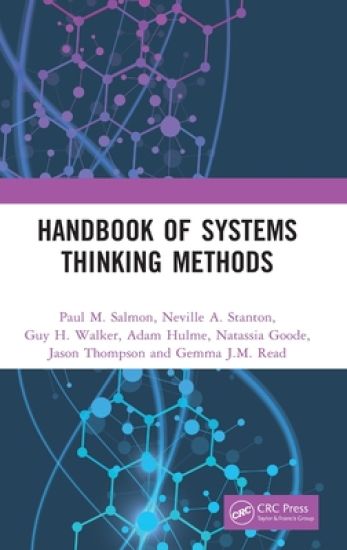
Handbook of Systems Thinking Methods

Handbook of Systems Thinking Methods

Paul M. Salmon; Neville A. Stanton; Guy H. Walker; Adam Hulme; Natassia Goode; Jason Thompson; Gemma J.M. Read

TAYLOR FRANCIS LTD
2022
sidottu
The systems thinking philosophy has become popular in human factors and ergonomics and safety science. These methods are being used to understand and resolve complex societal problems in areas such as transport safety, workplace safety, medication error, disaster management, child abuse, financial crises, terrorism, climate change and public health and wellbeing. This handbook presents practical step-by-step guidance for practitioners and researchers wishing to use these methods to tackle complex problems. Each method includes an example case study which demonstrates how the method can be applied and how the results can be interpreted and translated into practical recommendations.The book presents practical guidance on state-of-the-art systems thinking methods and offers case study applications describing systems thinking methods in novel areas. It explains how to translate the outputs of systems thinking methods in practice and introduces systems thinking with an overview of Human Factors and Ergonomics applications.This book will serve as a great reference for students and engineers in the field of systems engineering, complex systems and the design and development of systems, including ergonomics/human factors and systems engineers, designers, architects, industrial engineers, project management engineers, reliability engineers, risk engineers, software engineers and computer engineers.
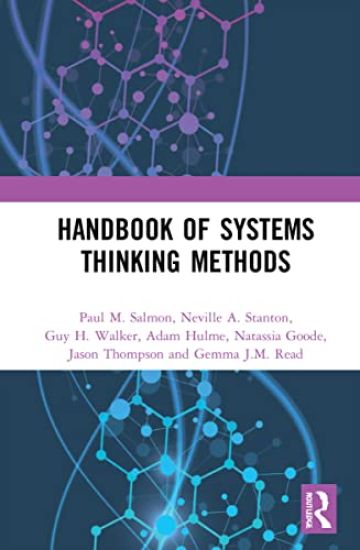
Handbook of Systems Thinking Methods

Handbook of Systems Thinking Methods

Paul M. Salmon; Neville A. Stanton; Guy H. Walker; Adam Hulme; Natassia Goode; Jason Thompson; Gemma J.M. Read

TAYLOR FRANCIS LTD
2025
nidottu
The systems thinking philosophy has become popular in human factors and ergonomics and safety science. These methods are being used to understand and resolve complex societal problems in areas such as transport safety, workplace safety, medication error, disaster management, child abuse, financial crises, terrorism, climate change and public health and wellbeing. This handbook presents practical step-by-step guidance for practitioners and researchers wishing to use these methods to tackle complex problems. Each method includes an example case study which demonstrates how the method can be applied and how the results can be interpreted and translated into practical recommendations.The book presents practical guidance on state-of-the-art systems thinking methods and offers case study applications describing systems thinking methods in novel areas. It explains how to translate the outputs of systems thinking methods in practice and introduces systems thinking with an overview of Human Factors and Ergonomics applications.This book will serve as a great reference for students and engineers in the field of systems engineering, complex systems and the design and development of systems, including ergonomics/human factors and systems engineers, designers, architects, industrial engineers, project management engineers, reliability engineers, risk engineers, software engineers and computer engineers.
Distributed Situation Awareness in Road Transport

Distributed Situation Awareness in Road Transport

Paul M. Salmon; Gemma Jennie Megan Read; Guy H. Walker; Michael G. Lenné; Neville A. Stanton

Ashgate Publishing Limited
2018
sidottu
How can we design transport environments that cater to the situation awareness needs of different end-users? This book answers this question by showcasing how state-of-the-art human factors theory and methods can be used to understand how situation awareness differs across drivers, cyclists, motorcyclists, and pedestrians and creates new designs that cater to these diverse situation awareness needs. Written by experts in the field and based on a major program of work funded by the Australian Research Council, this book outlines the distributed situation awareness model and provides practical guidance on how to study situation awareness naturalistically and how to create designs that support, rather than hinder, situation awareness. The book closes by outlining outline a generic framework to support similar applications in other areas, and discusses future applications in areas such as vehicle automation, artificial intelligence, and cybersecurity.Features Challenges traditional road safety analysis, design processes and conventions Outlines a novel on-road study methodology for analyzing naturalistic interactions among drivers, cyclists, motorcyclists and pedestrians Presents a review of state-of-the-art situation awareness theory and methods Provides practical guidance on a series of human factors methods Describes a framework to support the design of transport environments Evaluates new intersection concepts that encompass features designed to prevent collisions at intersections
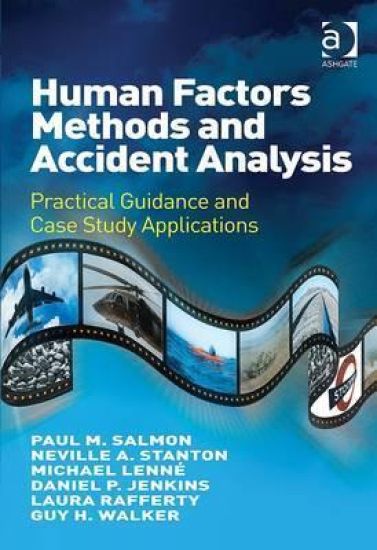
Human Factors Methods and Accident Analysis

Human Factors Methods and Accident Analysis

Paul M. Salmon; Neville A. Stanton; Michael Lenné; Daniel P. Jenkins; Laura Rafferty; Guy H. Walker

Ashgate Publishing Limited
2011
sidottu
This book provides an overview of, and practical guidance on, the range of human factors (HF) methods that can be used for the purposes of accident analysis and investigation in complex sociotechnical systems. Human Factors Methods and Accident Analysis begins with an overview of different accident causation models and an introduction to the concepts of accident analysis and investigation. It then presents a discussion focussing on the importance of, and difficulties associated with, collecting appropriate data for accident analysis purposes. Following this, a range of HF-based accident analysis methods are described, as well as step-by-step guidance on how to apply them. To demonstrate how the different methods are applied, and what the outputs are, the book presents a series of case study applications across a range of safety critical domains. It concludes with a chapter focussing on the data challenges faced when collecting, coding and analysing accident data, along with future directions in the area. Human Factors Methods and Accident Analysis is the first book to offer a practical guide for investigators, practitioners and researchers wishing to apply accident analysis methods. It is also unique in presenting a series of novel applications of accident analysis methods, including HF methods not previously used for these purposes (e.g. EAST, critical path analysis), as well as applications of methods in new domains.
Vehicle Feedback and Driver Situation Awareness

Vehicle Feedback and Driver Situation Awareness

Guy H. Walker; Neville A. Stanton; Paul M. Salmon

CRC Press
2018
sidottu
A potentially troubling aspect of modern vehicle design – some would argue - is a trend for isolating the driver and reducing vehicle feedback, usually in the name of comfort and refinement but increasingly because of automation. There is little doubt cars have become more civilised over the years, yet despite this, the consequences of driver behaviour remain to a large extent anecdotal. Readers will have heard such anecdotes for themselves. They usually take the form of drivers of a certain age recalling their first cars from the 1970s or 80s, in which "doing 70 mph really felt like it". The question is whether such anecdotes actually reflect a bigger, more significant issue that could be better understood. Related questions have been explored in other domains such as aviation, where the change to ‘fly-by-wire’ did indeed bring about some occasionally serious performance issues that were not anticipated. Despite some clear parallels, automotive systems have been left relatively unstudied. The research described in this book aims to explore precisely these issues from a Human Factors perspective. This means connecting the topics of vehicle feel, vehicle dynamics, and automotive engineering with the latest research on driver situation awareness. The problem is explored experimentally from a variety of theoretical viewpoints but the outcomes are consistently practical. Here we have a promising new avenue along which the driver experience can be enhanced in novel and insightful ways. Tools and templates are provided so that engineers and designers can try different ways to boost vehicle safety, efficiency and enjoyment from a human-centered perspective.Association of American Publishers (AAP) Finalist for the 2019 PROSE AwardFeatures Diagnosis of how vehicle feel impacts driver situation awareness, and how this could aid future vehicle designsMulti-theory approach to driver situation awareness, and how different views of this important concept give rise to different insightsComprehensive analysis of situation awareness in driving, the information requirements of drivers, and how these needs can be supportedPractical descriptions of how state-of-science Human Factors methods have been applied in practice
The French Religious Wars in English Political Thought

The French Religious Wars in English Political Thought

J. H. M. (John Hearsey MCMILL Salmon

Hassell Street Press
2021
nidottu
This work has been selected by scholars as being culturally important and is part of the knowledge base of civilization as we know it.This work is in the public domain in the United States of America, and possibly other nations. Within the United States, you may freely copy and distribute this work, as no entity (individual or corporate) has a copyright on the body of the work.Scholars believe, and we concur, that this work is important enough to be preserved, reproduced, and made generally available to the public. To ensure a quality reading experience, this work has been proofread and republished using a format that seamlessly blends the original graphical elements with text in an easy-to-read typeface.We appreciate your support of the preservation process, and thank you for being an important part of keeping this knowledge alive and relevant.
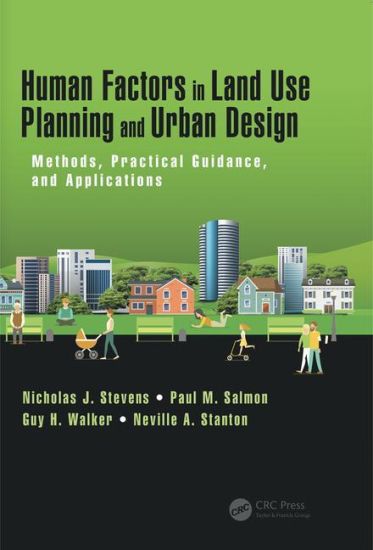
Human Factors in Land Use Planning and Urban Design

Human Factors in Land Use Planning and Urban Design

Nicholas J. Stevens; Paul M. Salmon; Guy H. Walker; Neville A. Stanton

TAYLOR FRANCIS LTD
2023
nidottu
The integration of Human Factors in Land Use Planning and Urban Design (LUP & UD) is an exciting and emerging interdisciplinary field. This book offers practical guidance on a range of Human Factors methods that can be used to rigorously and reliably explore LUP & UD.It provides new ways to interpret urban space and detail context sensitive analysis for the interpretation and design of our surroundings. The methodologies outlined allow for the consideration of the technical aspects of the built environment with the necessary experience and human centered approaches to our urban and regional settings. This book describes 30 Human Factors methods for use in the LUP & UD context. While it explores theory, it also focuses on the question of what Human Factors methods are; their advantages and disadvantages; step-by-step guidance on how to carry them out; and case studies to guide the reader. Describes the practice and processes associated with urban and regional strategic planning Constructed so that students, practitioners, and researchers with an interest in one particular area of Human Factors can read the chapters independently from one another
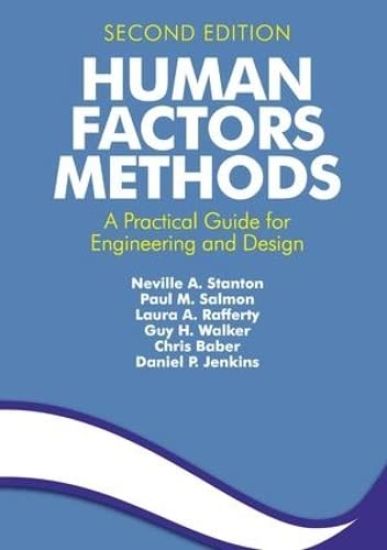
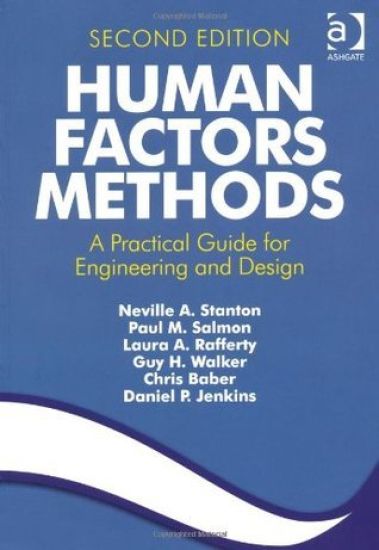
Human Factors Methods

Human Factors Methods

Neville A. Stanton; Paul M. Salmon; Laura A. Rafferty; Guy H. Walker; Chris Baber; Daniel P. Jenkins

Ashgate Publishing Limited
2013
sidottu
This second edition of Human Factors Methods: A Practical Guide for Engineering and Design now presents 107 design and evaluation methods as well as numerous refinements to those that featured in the original. The book has been carefully designed to act as an ergonomics methods manual, aiding both students and practitioners. The eleven sections represent the different categories of ergonomics methods and techniques that can be used in the evaluation and design process. Offering a 'how-to' text on a substantial range of ergonomics methods that can be used in the design and evaluation of products and systems, it is a comprehensive point of reference for all these methods. An overview of the methods is presented in chapter one, with a methods matrix showing which can be used in conjunction. The following chapters detail the methods showing how to apply them in practice. Flowcharts, procedures and examples cover the requirements of a diverse audience and varied applications of the methods. The final chapter, a new addition, illustrates the EAST method, which integrates several well-known methods into a teamwork analysis approach.
Human Factors Methods

Human Factors Methods

Neville A. Stanton; Paul M. Salmon; Laura A. Rafferty; Guy H. Walker; Chris Baber; Daniel P. Jenkins

Ashgate Publishing Limited
2013
nidottu
This second edition of Human Factors Methods: A Practical Guide for Engineering and Design now presents 107 design and evaluation methods as well as numerous refinements to those that featured in the original. The book has been carefully designed to act as an ergonomics methods manual, aiding both students and practitioners. The eleven sections represent the different categories of ergonomics methods and techniques that can be used in the evaluation and design process. Offering a 'how-to' text on a substantial range of ergonomics methods that can be used in the design and evaluation of products and systems, it is a comprehensive point of reference for all these methods. An overview of the methods is presented in chapter one, with a methods matrix showing which can be used in conjunction. The following chapters detail the methods showing how to apply them in practice. Flowcharts, procedures and examples cover the requirements of a diverse audience and varied applications of the methods. The final chapter, a new addition, illustrates the EAST method, which integrates several well-known methods into a teamwork analysis approach.
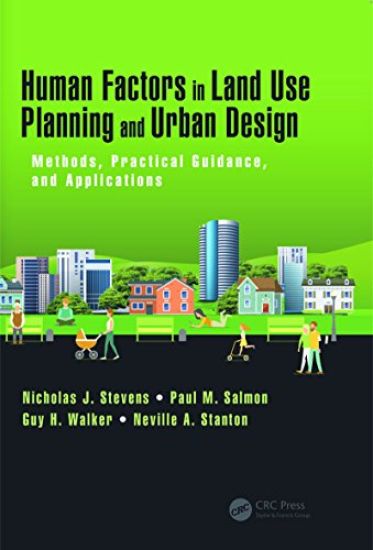
Human Factors in Land Use Planning and Urban Design

Human Factors in Land Use Planning and Urban Design

Nicholas J. Stevens; Paul M. Salmon; Guy H. Walker; Neville A. Stanton

CRC Press
2018
sidottu
The integration of Human Factors in Land Use Planning and Urban Design (LUP & UD) is an exciting and emerging interdisciplinary field. This book offers practical guidance on a range of Human Factors methods that can be used to rigorously and reliably explore LUP & UD.It provides new ways to interpret urban space and detail context sensitive analysis for the interpretation and design of our surroundings. The methodologies outlined allow for the consideration of the technical aspects of the built environment with the necessary experience and human centered approaches to our urban and regional settings. This book describes 30 Human Factors methods for use in the LUP & UD context. While it explores theory, it also focuses on the question of what Human Factors methods are; their advantages and disadvantages; step-by-step guidance on how to carry them out; and case studies to guide the reader. Describes the practice and processes associated with urban and regional strategic planning Constructed so that students, practitioners, and researchers with an interest in one particular area of Human Factors can read the chapters independently from one another
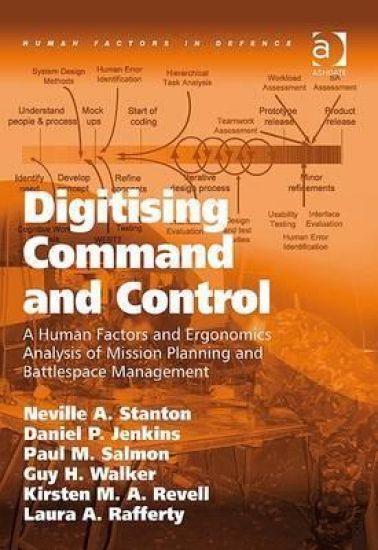
Digitising Command and Control

Digitising Command and Control

Neville A. Stanton; Daniel P. Jenkins; Paul M. Salmon; Guy H. Walker; Kirsten M. A. Revell; Laura A. Rafferty

Ashgate Publishing Limited
2009
sidottu
This book presents a human factors and ergonomics evaluation of a digital Mission Planning and Battle-space Management (MP/BM) system. An emphasis was placed on the activities at the Brigade (Bde) and the Battle Group (BG) headquarters (HQ) levels. The analysts distributed their time evenly between these two locations. The human factors team from Brunel University, as part of the HFI DTC, undertook a multi-faceted approach to the investigation, including: - observation of people using the traditional analogue MP/BM processes in the course of their work - cognitive work analysis of the digital MP/BM system - analysis of the tasks and goal structure required by the digital MP/BM - assessment against a usability questionnaire - analysis of the distributed situation awareness - an environmental survey. The book concludes with a summary of the research project's findings and offers many valuable insights. For example, the recommendations for short-term improvements in the current generation of digital MP/BM system address general design improvements, user-interface design improvements, hardware improvements, infrastructure improvements and support improvements. In looking forward to the next generation digital MP/BM systems, general human factors design principles are presented and human factors issues in digitising mission planning are considered.
Digitising Command and Control

Digitising Command and Control

Neville A. Stanton; Daniel P. Jenkins; Paul M. Salmon; Guy H. Walker; Kirsten M. A. Revell; Laura A. Rafferty

CRC Press
2017
nidottu
This book presents a human factors and ergonomics evaluation of a digital Mission Planning and Battle-space Management (MP/BM) system. An emphasis was placed on the activities at the Brigade (Bde) and the Battle Group (BG) headquarters (HQ) levels. The analysts distributed their time evenly between these two locations. The human factors team from Brunel University, as part of the HFI DTC, undertook a multi-faceted approach to the investigation, including: - observation of people using the traditional analogue MP/BM processes in the course of their work - cognitive work analysis of the digital MP/BM system - analysis of the tasks and goal structure required by the digital MP/BM - assessment against a usability questionnaire - analysis of the distributed situation awareness - an environmental survey. The book concludes with a summary of the research project's findings and offers many valuable insights. For example, the recommendations for short-term improvements in the current generation of digital MP/BM system address general design improvements, user-interface design improvements, hardware improvements, infrastructure improvements and support improvements. In looking forward to the next generation digital MP/BM systems, general human factors design principles are presented and human factors issues in digitising mission planning are considered.