

Kirjahaku
Etsi kirjoja tekijän nimen, kirjan nimen tai ISBN:n perusteella.
947 tulosta hakusanalla Maciej Jasinski

C'est dans la petite cit mini re de Loos-En-Gohelle, aux pieds des terrils jumeaux, que Wiktor a grandi. Aujourd'hui, il vit seul dans la modeste maison familiale de briques rouges. Un ancien coron que le temps puise. Wiktor a perdu sa m re quand il n'avait que dix ans. Au d c s de son p re, c'est sa tante qui vient s'occuper de lui et tenir la maison. La cohabitation est difficile. l'aube de la majorit du jeune Maciej, elle repart Lens. Le gar on se retrouve nouveau seul. Un matin, Wiktor re oit la visite inamicale de ses logeurs qui lui signifient son expulsion. Il est contraint de quitter les lieux sans d lai. Compl tement abasourdi par cette nouvelle, le jeune gar on se sent d sempar . Il se r fugie dans le foyer bienveillant de son patron en attendant de trouver un nouvel appartement. Lors du d m nagement, un objet de famille tombe au sol et se brise. parmi les fragments, Wiktor n'imaginait pas d couvrir un l ment qui allait bouleverser sa vie et le conduire o il r vait d'aller quand il tait enfant.

Themed Issue in Honor of Prof. Maciej J. Nowak, for His Contributions to the Field of Photochemistry of Matrix-Isolated Species
MDPI AG
2024
sidottu
This Special Issue of Photochem is dedicated to Professor Maciej J. Nowak for his contributions to our understanding of the photochemistry of matrix-isolated species. The Special Issue comprises a series of articles that span a broad range of interests and issues, encompassing both experimental and theoretical investigations.

Casimir Britannicus - English Translations, Paraphrases, and Emulations of the Poetry of Maciej Kazimierz Sarbiewski
Modern Humanities Research Association
2010
pokkari
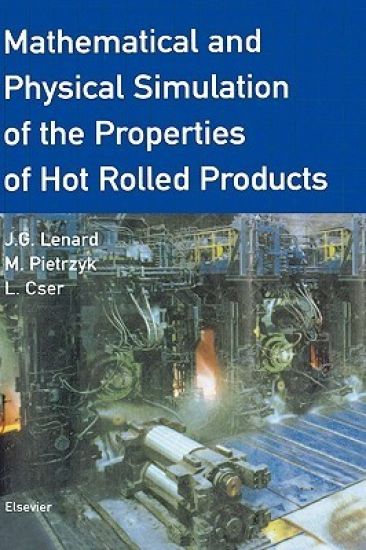
Mathematical and Physical Simulation of the Properties of Hot Rolled Products
Maciej Pietrzyk; L. Cser; J.G. Lenard
Elsevier Science Ltd
1999
sidottu
The objective of this publication is to comprehensively discuss the possibilities of producing steels with pre-determined attributes, demanded by the customer to fit exacting specifications. The information presented in the book has been designed to indicate the reasons for the expenses and to aid in the process of overcoming the difficulties and reducing the costs. In nine detailed chapters, the authors cover topics including: • steel as a major contributor to the economic wealth of a country in terms of its capabilities and production • current concerns of major steel producers • phenomena contributing to the quality of the product • information concerning the boundary conditions of the rolling process and initial conditions, put to use by mathematical models • the solid state incremental approach and flow formulation • parameters and variables - most of which make use of the exponential nature of phenomena that are activated by thermal energy • the application of three dimensional analysis to shape rolling • the evaluation of parameters by a form of inverse analysis to the flat rolling process • knowledge based modeling, using artificial intelligence, expert systems and neural networks They conclude that when either mathematical or physical modeling of the rolling process is considered and the aim is to satisfy the demands for customers, it is possible to produce what the customer wants, exactly.
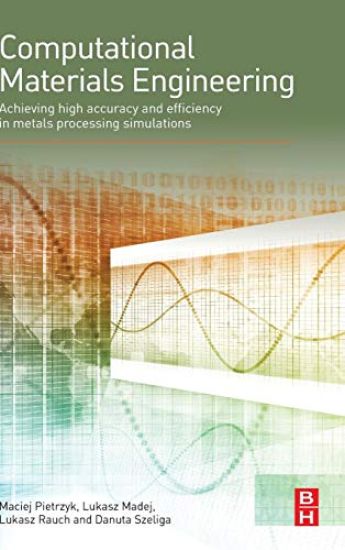
Computational Materials Engineering
Maciej Pietrzyk; Lukasz Madej; Lukasz Rauch; Danuta Szeliga
Butterworth-Heinemann Inc
2015
sidottu
Computational Materials Engineering: Achieving High Accuracy and Efficiency in Metals Processing Simulations describes the most common computer modeling and simulation techniques used in metals processing, from so-called "fast" models to more advanced multiscale models, also evaluating possible methods for improving computational accuracy and efficiency. Beginning with a discussion of conventional fast models like internal variable models for flow stress and microstructure evolution, the book moves on to advanced multiscale models, such as the CAFÉ method, which give insights into the phenomena occurring in materials in lower dimensional scales. The book then delves into the various methods that have been developed to deal with problems, including long computing times, lack of proof of the uniqueness of the solution, difficulties with convergence of numerical procedures, local minima in the objective function, and ill-posed problems. It then concludes with suggestions on how to improve accuracy and efficiency in computational materials modeling, and a best practices guide for selecting the best model for a particular application.

Neuro-Oncology Compendium for the Boards and Clinical Practice
Maciej M. Mrugala; Na Tosha Gatson; Jennifer L. Clarke; Sylvia C. Kurz; Kathryn S. Nevel
OXFORD UNIVERSITY PRESS INC
2023
nidottu
Renowned experts in the neuro-oncological field bring their expertise together for Neuro-Oncology Compendium for the Boards and Clinical Practice. This volume reviews the core topics of neuro-oncology including adult and pediatric neuro-oncology, management, central nervous system tumor complications, genetic considerations, and more. With a focus on updated treatments and terminology, this volume is designed to comprehensively review all major facets of neuro-oncology so that physicians-in-training may prepare for the board review and practicing specialists can stay up to date in their treatment of patients. This essential text includes hundreds of figures and tables, succinct review flashcards, end-of-chapter questions and answers, as well as end-of-volume exams so readers can review and test their own comprehension. Each chapter has been reviewed by the editors to ensure cohesive board-level verbiage, emphasizing practical clinical knowledge. Neuro-Oncology Compendium for the Boards and Clinical Practice is up-to-date and comprehensive, eliminating the need for multiple sources of study. Key features of this volume include: -End of chapter flashcards to summarize key content -End of chapter Questions and Answers for review -Practice exams to simulate board questions -Updated terminology and practices -Complimentary images and tables to support learning
Pluripotential theory is a recently developed non-linear complex counterpart of classical potential theory. Its main area of application is multidimensional complex analysis. The central part of the pluripotential theory is occupied by maximal plurisubharmonic functions and the generalized complex Monge-Ampère operator. The interplay between these two notions provides the focal point of this monograph, which contains an up-to-date account of the developments from the large volume of recent work in this area. The substantial proportion of this monograph devoted to classical properties of subharmonic and plurisubharmonic functions makes the pluripotential theory available for the first time to a wide audience of analysts.
Most nonlinear differential equations arising in natural sciences admit chaotic behaviour and cannot be solved analytically. Integrable systems lie on the other extreme. They possess regular, stable, and well behaved solutions known as solitons and instantons. These solutions play important roles in pure and applied mathematics as well as in theoretical physics where they describe configurations topologically different from vacuum. While integrable equations in lower space-time dimensions can be solved using the inverse scattering transform, the higher-dimensional examples of anti-self-dual Yang-Mills and Einstein equations require twistor theory. Both techniques rely on an ability to represent nonlinear equations as compatibility conditions for overdetermined systems of linear differential equations. The book provides a self-contained and accessible introduction to the subject. It starts with an introduction to integrability of ordinary and partial differential equations. Subsequent chapters explore symmetry analysis, gauge theory, gravitational instantons, twistor transforms, and anti-self-duality equations. The three appendices cover basic differential geometry, complex manifold theory, and the exterior differential system.

Ultracold Atoms in Optical Lattices
Maciej Lewenstein; Anna Sanpera; Verònica Ahufinger
Oxford University Press
2017
nidottu
Quantum computers, though not yet available on the market, will revolutionize the future of information processing. Quantum computers for special purposes like quantum simulators are already within reach. The physics of ultracold atoms, ions and molecules offer unprecedented possibilities of control of quantum many body systems and novel possibilities of applications to quantum information processing and quantum metrology. Particularly fascinating is the possibility of using ultracold atoms in lattices to simulate condensed matter or even high energy physics. This book provides a complete and comprehensive overview of ultracold lattice gases as quantum simulators. It opens up an interdisciplinary field involving atomic, molecular and optical physics, quantum optics, quantum information, condensed matter and high energy physics. The book includes some introductory chapters on basic concepts and methods, and then focuses on the physics of spinor, dipolar, disordered, and frustrated lattice gases. It reviews in detail the physics of artificial lattice gauge fields with ultracold gases. The last part of the book covers simulators of quantum computers. After a brief course in quantum information theory, the implementations of quantum computation with ultracold gases are discussed, as well as our current understanding of condensed matter from a quantum information perspective.

Most nonlinear differential equations arising in natural sciences admit chaotic behaviour and cannot be solved analytically. Integrable systems lie on the other extreme. They possess regular, stable, and well-behaved solutions known as solitons and instantons. These solutions play important roles in pure and applied mathematics as well as in theoretical physics where they describe configurations topologically different from vacuum. While integrable equations in lower space-time dimensions can be solved using the inverse scattering transform, the higher-dimensional examples of anti-self-dual Yang-Mills and Einstein equations require twistor theory. Both techniques rely on an ability to represent nonlinear equations as compatibility conditions for overdetermined systems of linear differential equations. The book provides a self-contained and accessible introduction to the subject. It starts with an introduction to integrability of ordinary and partial differential equations. Subsequent chapters explore symmetry analysis, gauge theory, vortices, gravitational instantons, twistor transforms, and anti-self-duality equations. The three appendices cover basic differential geometry, complex manifold theory, and the exterior differential system.

Most nonlinear differential equations arising in natural sciences admit chaotic behaviour and cannot be solved analytically. Integrable systems lie on the other extreme. They possess regular, stable, and well-behaved solutions known as solitons and instantons. These solutions play important roles in pure and applied mathematics as well as in theoretical physics where they describe configurations topologically different from vacuum. While integrable equations in lower space-time dimensions can be solved using the inverse scattering transform, the higher-dimensional examples of anti-self-dual Yang-Mills and Einstein equations require twistor theory. Both techniques rely on an ability to represent nonlinear equations as compatibility conditions for overdetermined systems of linear differential equations. The book provides a self-contained and accessible introduction to the subject. It starts with an introduction to integrability of ordinary and partial differential equations. Subsequent chapters explore symmetry analysis, gauge theory, vortices, gravitational instantons, twistor transforms, and anti-self-duality equations. The three appendices cover basic differential geometry, complex manifold theory, and the exterior differential system.

Ultracold Atoms in Optical Lattices
Maciej Lewenstein; Anna Sanpera; Verònica Ahufinger
Oxford University Press
2012
sidottu
Quantum computers, though not yet available on the market, will revolutionize the future of information processing. Quantum computers for special purposes like quantum simulators are already within reach. The physics of ultracold atoms, ions and molecules offer unprecedented possibilities of control of quantum many body systems and novel possibilities of applications to quantum information processing and quantum metrology. Particularly fascinating is the possibility of using ultracold atoms in lattices to simulate condensed matter or even high energy physics. This book provides a complete and comprehensive overview of ultracold lattice gases as quantum simulators. It opens up an interdisciplinary field involving atomic, molecular and optical physics, quantum optics, quantum information, condensed matter and high energy physics. The book includes some introductory chapters on basic concepts and methods, and then focuses on the physics of spinor, dipolar, disordered, and frustrated lattice gases. It reviews in detail the physics of artificial lattice gauge fields with ultracold gases. The last part of the book covers simulators of quantum computers. After a brief course in quantum information theory, the implementations of quantum computation with ultracold gases are discussed, as well as our current understanding of condensed matter from a quantum information perspective.
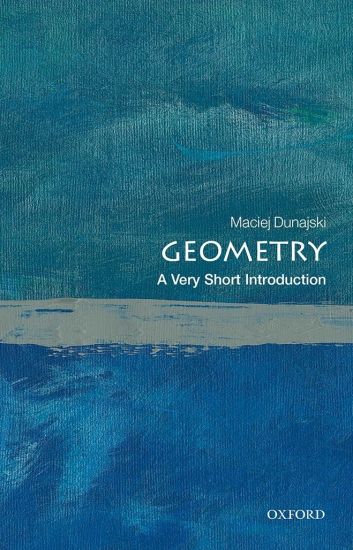
The study of geometry is at least 2500 years old, and it is within this field that the concept of mathematical proof - deductive reasoning from a set of axioms - first arose. To this day geometry remains a very active area of research in mathematics. This Very Short Introduction covers the areas of mathematics falling under geometry, starting with topics such as Euclidean and non-Euclidean geometries, and ranging to curved spaces, projective geometry in Renaissance art, and geometry of space-time inside a black hole. Starting from the basics, Maciej Dunajski proceeds from concrete examples (of mathematical objects like Platonic solids, or theorems like the Pythagorean theorem) to general principles. Throughout, he outlines the role geometry plays in the broader context of science and art. Very Short Introductions: Brilliant, Sharp, Inspiring ABOUT THE SERIES: The Very Short Introductions series from Oxford University Press contains hundreds of titles in almost every subject area. These pocket-sized books are the perfect way to get ahead in a new subject quickly. Our expert authors combine facts, analysis, perspective, new ideas, and enthusiasm to make interesting and challenging topics highly readable.

Hackathons—participatory gatherings in which people with various backgrounds and experiences come together to address a challenge or create something new in a limited period of time—have become an important part of today’s technological, social, and business landscapes. They originated in IT and have since spread into other fields including medicine, law, biology, environment, education, and civic engagement. How and why can hackathons drive innovation? How can they challenge the status quo? What role can they play in an organization’s strategy? Under what conditions are hackathons most effective, and what are their limitations?Maciej Rys—a hackathon leader and scholar with extensive experience in the field—offers a step-by-step guide to organizing successful hackathons and understanding their dynamics. He examines the evolution of hackathons from niche programming marathons to versatile platforms fostering technological advancements, entrepreneurial ventures, and social change. Drawing on extensive research, including observations and interviews from dozens of events worldwide, this book provides data-driven insights into the hackathon ecosystem. Rys shares practical lessons for organizers, participants, and mentors ranging from planning to inclusivity and sustaining momentum afterward, emphasizing both individual and group levels. Readers will learn how to build better hackathons that attract more participants, and they will gain a deeper understanding of the dynamics of innovation. For both hackathon veterans and those new to the field, Sparks for Innovation helps readers develop new skills, discover new possibilities, and achieve new breakthroughs.
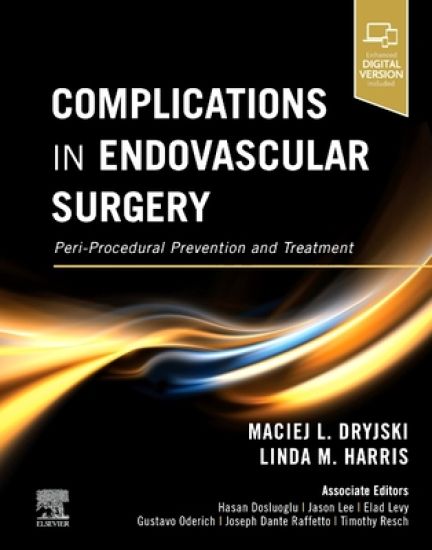
Complications in Endovascular Surgery
Maciej Dryjski; Linda M Harris
Elsevier - Health Sciences Division
2021
sidottu
As devices, technologies, and imaging techniques continue to evolve, today's endovascular surgical techniques have increased in both number and complexity. Complications in Endovascular Surgery provides a unique focus on potential complications encountered in the operating room, preparing you to anticipate the unexpected, identify the risk factors in individual procedures, and take steps to successfully manage complications when they occur. Helps you manage the surgical complications associated with image-guided interventional techniques used when treating patients with vascular disease, with clear descriptions of how to prevent problems and how to prevent catastrophic problems once a simple problem occurs. Provides a practical guide to device-specific tips and tricks from experts in the field, making this unique resource ideal for surgeons at all levels of training and practice. Features highly illustrated, consistent instructions that explain how to avoid and manage both common and uncommon complications. Covers EVAR, TEVAR, FEVAR, and other complex aortic work; as well as CAS, TCAR, complex LE endovascular procedures, and venous intervention-lysis/stenting. Includes tip boxes with key facts and technical recommendations, warning boxes that highlight safety precautions, and a troubleshooting guide for each procedure that helps you get back on track if things don't go exactly as planned. Enhanced eBook version included with purchase, which allows you to access all of the text, figures, and references from the book on a variety of devices

This book provides an analysis of the European policy approach to combined heat and power (CHP), a highly efficient technology used by all EU Member States for the needs of generating electricity and heat. European Law on Combined Heat and Power carries out an assessment of the European legal and policy measures on CHP, evaluating how it has changed over the years through progress and decline in specific member states. Over the course of the book, Sokolowski explores all aspects of CHP, examining the types of measures used to steer the growth of cogeneration in the EU and the policies and regulatory tools that have influenced its development. He also assesses the specific role of CHP in the liberalisation of the internal energy market and EU action on climate and sustainability. Finally, by delivering his notions of "cogenatives", "cogenmunities", or "Micro-Collective-Flexible-Smart-High-Efficiency cogeneration", Sokolowski considers how the new EU energy package – "Clean energy for all Europeans" – will shape future developments. This book will be of great interest to students and scholars of energy law and regulation, combined heat and power and energy efficiency, as well as policy makers and energy experts working in the CHP sector.
Psychology for Coaches offers its readers a chance to ground their interpersonal skills in sound psychological theory and research. It provides a solid synthesis of current concepts and research results, translating them into hands-on recommendations and examples of tools.The book was written in response to questions asked by trainee coaches eager to make sure they are doing their best to provide a safe, professional, and valuable service. It offers clear, practical examples on how to apply presented concepts into coaching practice. It challenges popular strategies that may have unwanted side effects and offers to replace them with specific ideas on how to use coaching conversations to: support goal setting and consistent motivationencourage autonomy and responsibilityassist self-reflection and manage learningincrease awareness of emotions and manage them betteridentify and change beliefs and schemasbuild a healthier perception of oneselfPsychology for Coaches will be essential reading for coaches in all areas, including those in training, who want an accessible, fast introduction to the most relevant areas of psychology and an overview that will guide their further learning. It will also be an inspirational guide for people aiming to use coaching skills in other professional roles.
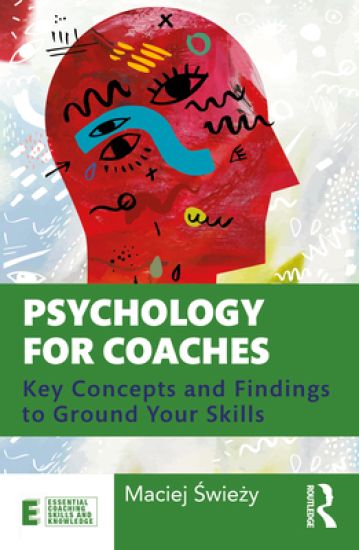
Psychology for Coaches offers its readers a chance to ground their interpersonal skills in sound psychological theory and research. It provides a solid synthesis of current concepts and research results, translating them into hands-on recommendations and examples of tools.The book was written in response to questions asked by trainee coaches eager to make sure they are doing their best to provide a safe, professional, and valuable service. It offers clear, practical examples on how to apply presented concepts into coaching practice. It challenges popular strategies that may have unwanted side effects and offers to replace them with specific ideas on how to use coaching conversations to: support goal setting and consistent motivationencourage autonomy and responsibilityassist self-reflection and manage learningincrease awareness of emotions and manage them betteridentify and change beliefs and schemasbuild a healthier perception of oneselfPsychology for Coaches will be essential reading for coaches in all areas, including those in training, who want an accessible, fast introduction to the most relevant areas of psychology and an overview that will guide their further learning. It will also be an inspirational guide for people aiming to use coaching skills in other professional roles.

Despite the fact that Maple V has become one of the most popular computer algebra systems on the market, surprisingly few users realize its potential in the field of scientific visualization. The purpose of this book is to equip the reader with a variety of graphics tools needed on the voyage of discovery into the complex and often beautiful world of curves and surfaces. A comprehensive treatment of Maple's graphics commands and structures is combined with an introduction to the main aspects of visual perception. Top priority is given to the use of light, color, perspective, and geometric transformations. Numerous examples, accompanied by pictures (many in color), cover all aspects of Maple graphics. The examples can be easily customized to suit the individual needs of the reader. The approach is context independent, and as such will appeal to students, educators, and researchers in a broad spectrum of scientific disciplines. For the general user at any level of experience, this book can serve as a comprehensive reference manual. For the beginner, it offers a user- friendly elementary introduction to the subject, with mathematical requirements kept to a minimum. For those interested in advanced mathematical visualization, it explains how to maximize Maple's graphical capabilities. In particular, this book shows how to turn Maple into an excellent modeling tool capable of generating elaborate surfaces that conventional modelers cannot produce. These surfaces can be exported to an external ray tracer (e.g. POV-ray) for sophisticated photo-realistic rendering. All of the Maple code segments which are presented in the book, as well as high-resolution pictures showing alternative renderings of some of the book's color plates, are included on the accompanying DOS diskette.