Kirjojen hintavertailu. Mukana 11 244 527 kirjaa ja 12 kauppaa.

Kirjahaku

Etsi kirjoja tekijän nimen, kirjan nimen tai ISBN:n perusteella.

224 tulosta hakusanalla Manjit S. Kang

Genetic and Production Innovations in Field Crop Technology
Get cutting-edge information to improve crop breeding and productivity!Crop improvement will become progressively important over the next few decades as the world’s population is expected to top 10 billion people, with more than eight billion in developing countries alone. Genetic and Production Innovations in Field Crop Technology: New Developments in Theory and Practice tackles this enormous challenge by detailing the latest available research and innovations for crop breeders and physiologists for the twenty-first century. Respected multidisciplinary scientists comprehensively discuss cutting-edge advances in field crop technology and genetic production as they keep an eye on the goal of providing nutrition to a hungry world.Genetic and Production Innovations in Field Crop Technology emphasizes an integrated approach to solve global crop production problems and increase crop productivity. Crop research experts review methods of globally improving crop yield, food product efficiency, and providing adequate nutrition in diet. The authors discuss various types of field crops, including corn, soybeans, winter wheat, cassavas, rubber, sunflowers, and barley, as well as review the exciting innovations on the food production horizon. The text is extensively referenced and includes useful graphs and tables to clearly present data.Genetic and Production Innovations in Field Crop Technology presents: visionary articles by authorities in agricultural sciences statistical design axioms and modern plot techniques discussions of integration of crop physiology and plant breeding information on systematic collection and preservation of germplasm explanations of genetic diversity in soybeans corn breeding and production researchincluding the economicsin the United States research on cassava breeding in less favorable environments to alleviate poverty strategies for improving yielding potential of rubber in sub-optimal environments information on fine-tuning wheat genotype-by-environment interaction methodology reviews of QTL identification, mega-environment classification, and effective strategies for marker-based selection via GGE biplot analyses research on statistical properties and practical usefulness of the Scheffe-Calinski and Shukla models relative to genotype-by-environment interaction Genetic and Production Innovations in Field Crop Technology: New Developments in Theory and Practice belongs in every agricultural university library. Crop breeders, geneticists, agronomists and horticulturists, educators, and students will find this an invaluable research source for now and for the future.
Genetic and Production Innovations in Field Crop Technology
Get cutting-edge information to improve crop breeding and productivity!Crop improvement will become progressively important over the next few decades as the world’s population is expected to top 10 billion people, with more than eight billion in developing countries alone. Genetic and Production Innovations in Field Crop Technology: New Developments in Theory and Practice tackles this enormous challenge by detailing the latest available research and innovations for crop breeders and physiologists for the twenty-first century. Respected multidisciplinary scientists comprehensively discuss cutting-edge advances in field crop technology and genetic production as they keep an eye on the goal of providing nutrition to a hungry world.Genetic and Production Innovations in Field Crop Technology emphasizes an integrated approach to solve global crop production problems and increase crop productivity. Crop research experts review methods of globally improving crop yield, food product efficiency, and providing adequate nutrition in diet. The authors discuss various types of field crops, including corn, soybeans, winter wheat, cassavas, rubber, sunflowers, and barley, as well as review the exciting innovations on the food production horizon. The text is extensively referenced and includes useful graphs and tables to clearly present data.Genetic and Production Innovations in Field Crop Technology presents: visionary articles by authorities in agricultural sciences statistical design axioms and modern plot techniques discussions of integration of crop physiology and plant breeding information on systematic collection and preservation of germplasm explanations of genetic diversity in soybeans corn breeding and production researchincluding the economicsin the United States research on cassava breeding in less favorable environments to alleviate poverty strategies for improving yielding potential of rubber in sub-optimal environments information on fine-tuning wheat genotype-by-environment interaction methodology reviews of QTL identification, mega-environment classification, and effective strategies for marker-based selection via GGE biplot analyses research on statistical properties and practical usefulness of the Scheffe-Calinski and Shukla models relative to genotype-by-environment interaction Genetic and Production Innovations in Field Crop Technology: New Developments in Theory and Practice belongs in every agricultural university library. Crop breeders, geneticists, agronomists and horticulturists, educators, and students will find this an invaluable research source for now and for the future.
Agricultural and Environmental Sustainability
Understand sustainable development from economic, ecological, and social perspectivesAs world population continues to increase, the need grows for a safe, sustainable supply of food. Agricultural and Environmental Sustainability: Considerations for the Future provides the latest research results and vital information on the process of producing an enduring food supply that is healthy for consumers and does not harm the environment. Internationally respected experts provide diverse perspectives on the issues and problems in striving for a safe, continuous food supply that is stable for future generations. Researchers and practitioners will gain insight into the current and oncoming challenges in providing food for the hungry around the world. The neglect of environmental factors would inevitably lead to the collapse of both industry and agriculture. Agricultural and Environmental Sustainability: Considerations for the Future focuses on the economic, ecological, and sociological issues that intertwine with efforts for effective agricultural sustainability in the coming years. This crucial look to the future provides a clear view of what needs to be done in long-term land use to ensure sustainability of resources, economic viability, and environmental preservation. This important resource is well-referenced and has several figures, tables, and graphs to clearly illustrate ideas.Topics in Agricultural and Environmental Sustainability: Considerations for the Future include: sustainability of agriculture issues, such as economic returns, environmental preservation, and enhancing quality of life opportunities for alleviating poverty and stopping land degradation through agroforestry management principles to improve and restore soil whole-system modeling approach to work for sustainable agricultural systems global wheat mega-environments and sustainability enhancing the productivity and sustainability of the rice-wheat cropping system overcoming the use of the outmoded plow holistic model systems to help farm families become more food secure the economic impact of bacterial wilt and drought stresses in banana production the sale of environmentally friendly products in developed countries Agricultural and Environmental Sustainability: Considerations for the Future is an essential resource for crop breeders, geneticists, agronomists and horticulturists, educators, and students and belongs in every agricultural university library.
Agricultural and Environmental Sustainability
Understand sustainable development from economic, ecological, and social perspectivesAs world population continues to increase, the need grows for a safe, sustainable supply of food. Agricultural and Environmental Sustainability: Considerations for the Future provides the latest research results and vital information on the process of producing an enduring food supply that is healthy for consumers and does not harm the environment. Internationally respected experts provide diverse perspectives on the issues and problems in striving for a safe, continuous food supply that is stable for future generations. Researchers and practitioners will gain insight into the current and oncoming challenges in providing food for the hungry around the world. The neglect of environmental factors would inevitably lead to the collapse of both industry and agriculture. Agricultural and Environmental Sustainability: Considerations for the Future focuses on the economic, ecological, and sociological issues that intertwine with efforts for effective agricultural sustainability in the coming years. This crucial look to the future provides a clear view of what needs to be done in long-term land use to ensure sustainability of resources, economic viability, and environmental preservation. This important resource is well-referenced and has several figures, tables, and graphs to clearly illustrate ideas.Topics in Agricultural and Environmental Sustainability: Considerations for the Future include: sustainability of agriculture issues, such as economic returns, environmental preservation, and enhancing quality of life opportunities for alleviating poverty and stopping land degradation through agroforestry management principles to improve and restore soil whole-system modeling approach to work for sustainable agricultural systems global wheat mega-environments and sustainability enhancing the productivity and sustainability of the rice-wheat cropping system overcoming the use of the outmoded plow holistic model systems to help farm families become more food secure the economic impact of bacterial wilt and drought stresses in banana production the sale of environmentally friendly products in developed countries Agricultural and Environmental Sustainability: Considerations for the Future is an essential resource for crop breeders, geneticists, agronomists and horticulturists, educators, and students and belongs in every agricultural university library.
Crop Improvement

Crop Improvement

Manjit S. Kang

Food Products Press,U.S.
2002
sidottu
Learn to integrate molecular genetic techniques with traditional plant breeding methods!This comprehensive book provides the latest authoritative scientific information on improvement of both temperate and tropical crops. Crop Improvement: Challenges in the Twenty-First Century brings together expert plant breeders and geneticists to address issues related to crop adaptability and stability across environments for important food and fiber crops. It emphasizes the need to integrate molecular genetic techniques with traditional plant breeding methods to develop hardier, more productive crops. Crop Improvement includes the latest research on physiological and biochemical responses of plants to drought and heat stress, which should help breeders develop effective strategies for improving resistance to abiotic stresses. In addition, this helpful book elucidates the use of mixed models and best linear unbiased prediction. To make the book comprehensive, chapters discuss stability analysis in crop performance trials and genotype-by-environment interactions.Crop Improvement includes detailed information on breeding specific crops, including: rice tropical maize sorghum common bean sugar beet bananas and plantain cottonCrop Improvement offers both practical information and up-to-date research. It also suggests a vision of new directions and partnerships that are expected to evolve in this century. This book is an essential resource for practicing plant breeders and geneticists at universities, government agencies, and industry. It should also be of use to teachers and students engaged in crop breeding.
Crop Improvement

Crop Improvement

Manjit S. Kang

Food Products Press,U.S.
2001
nidottu
Learn to integrate molecular genetic techniques with traditional plant breeding methods!This comprehensive book provides the latest authoritative scientific information on improvement of both temperate and tropical crops. Crop Improvement: Challenges in the Twenty-First Century brings together expert plant breeders and geneticists to address issues related to crop adaptability and stability across environments for important food and fiber crops. It emphasizes the need to integrate molecular genetic techniques with traditional plant breeding methods to develop hardier, more productive crops. Crop Improvement includes the latest research on physiological and biochemical responses of plants to drought and heat stress, which should help breeders develop effective strategies for improving resistance to abiotic stresses. In addition, this helpful book elucidates the use of mixed models and best linear unbiased prediction. To make the book comprehensive, chapters discuss stability analysis in crop performance trials and genotype-by-environment interactions.Crop Improvement includes detailed information on breeding specific crops, including: rice tropical maize sorghum common bean sugar beet bananas and plantain cottonCrop Improvement offers both practical information and up-to-date research. It also suggests a vision of new directions and partnerships that are expected to evolve in this century. This book is an essential resource for practicing plant breeders and geneticists at universities, government agencies, and industry. It should also be of use to teachers and students engaged in crop breeding.
GGE Biplot Analysis

GGE Biplot Analysis

Weikai Yan; Manjit S. Kang

CRC Press
2019
nidottu
Research data is expensive and precious, yet it is seldom fully utilized due to our ability of comprehension. Graphical display is desirable, if not absolutely necessary, for fully understanding large data sets with complex interconnectedness and interactions. The newly developed GGE biplot methodology is a superior approach to the graphical analysis of research data and may revolutionize the way researchers analyze data. GGE Biplot Analysis: A Graphical Tool for Breeders, Geneticists, and Agronomists introduces the theory of the GGE biplot methodology and describes its applications in visual analysis of multi-environment trial (MET) data and other types of research data. The text includes three parts: I) Genotype by environment interaction and stability analysis, II) GGE biplot and multi-environment trial (MET) data analysis, and III) GGE biplot software and applications in analyzing other types of two-way data. Part I presents a comprehensive but succinct treatment of genotype-by-environment (G x E) interaction in order to provide an overall picture of the entire G x E issue and to show how GGE biplot methodology fits in. Part II describes and demonstrates the numerous utilities of a GGE biplot in visualizing MET data. Part III describes the "GGE biplot" software and extends its application to the analysis of genotype by trait data, QTL mapping data, diallel cross data, and host by pathogen data. Altogether, this book demonstrates that the GGE biplot methodology is a superior data-visualization tool and allows the researcher to graphically extract and utilize the information from MET data and other types of two-way data to the fullest extent. GGE Biplot Analysis makes this useful technology accessible on a wider scale to plant and animal breeders, geneticists, agronomists, ecologists, and students in these and other related research areas. The information presented here will greatly enhance researchers' ability to understand their data and will mak
GGE Biplot Analysis

GGE Biplot Analysis

Weikai Yan; Manjit S. Kang

CRC Press Inc
2002
sidottu
Research data is expensive and precious, yet it is seldom fully utilized due to our ability of comprehension. Graphical display is desirable, if not absolutely necessary, for fully understanding large data sets with complex interconnectedness and interactions. The newly developed GGE biplot methodology is a superior approach to the graphical analysis of research data and may revolutionize the way researchers analyze data. GGE Biplot Analysis: A Graphical Tool for Breeders, Geneticists, and Agronomists introduces the theory of the GGE biplot methodology and describes its applications in visual analysis of multi-environment trial (MET) data and other types of research data. The text includes three parts: I) Genotype by environment interaction and stability analysis, II) GGE biplot and multi-environment trial (MET) data analysis, and III) GGE biplot software and applications in analyzing other types of two-way data. Part I presents a comprehensive but succinct treatment of genotype-by-environment (G x E) interaction in order to provide an overall picture of the entire G x E issue and to show how GGE biplot methodology fits in. Part II describes and demonstrates the numerous utilities of a GGE biplot in visualizing MET data. Part III describes the "GGE biplot" software and extends its application to the analysis of genotype by trait data, QTL mapping data, diallel cross data, and host by pathogen data. Altogether, this book demonstrates that the GGE biplot methodology is a superior data-visualization tool and allows the researcher to graphically extract and utilize the information from MET data and other types of two-way data to the fullest extent. GGE Biplot Analysis makes this useful technology accessible on a wider scale to plant and animal breeders, geneticists, agronomists, ecologists, and students in these and other related research areas. The information presented here will greatly enhance researchers' ability to understand their data and will mak
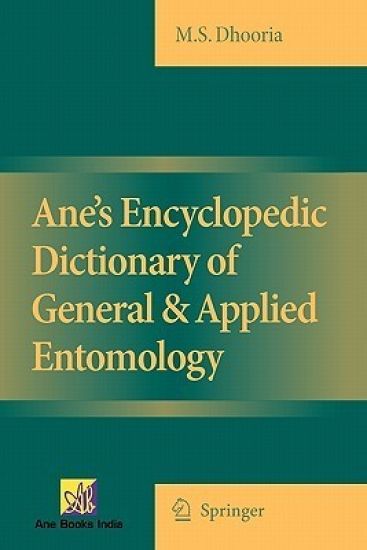
Ane's Encyclopedic Dictionary of General & Applied Entomology

Ane's Encyclopedic Dictionary of General & Applied Entomology

Manjit S Dhooria

Springer-Verlag New York Inc.
2008
sidottu
“Encyclopedic Dictionary of General and Applied Entomology” has been written keeping in view the fact that different terminology employed in teaching and researchers on different aspects of studies on insects and their management is found in scattered sources. Moreover, in the last 3-4 decades, many developments have been made especially in economic entomology. An attempt has been made to present the terminology in entomology and pest management in the most authentic and comprehensive way keeping the requirements of teachers and researchers in mind. Most of the terms have been given in encyclopedic form. Terms relating to the close relatives of insects such as mites and ticks and some other organisms which are pests of crops have also been included. Appendices giving useful information regarding various prefixes and suffixes used in formation of terms; and terms based on colour and shapes etc. have been included at the end for better understanding of the subject. Some useful literature for gaining more information about different terms is also listed.
Ane's Encyclopedic Dictionary of General & Applied Entomology
“Encyclopedic Dictionary of General and Applied Entomology” has been written keeping in view the fact that different terminology employed in teaching and researchers on different aspects of studies on insects and their management is found in scattered sources. Moreover, in the last 3-4 decades, many developments have been made especially in economic entomology. An attempt has been made to present the terminology in entomology and pest management in the most authentic and comprehensive way keeping the requirements of teachers and researchers in mind. Most of the terms have been given in encyclopedic form. Terms relating to the close relatives of insects such as mites and ticks and some other organisms which are pests of crops have also been included. Appendices giving useful information regarding various prefixes and suffixes used in formation of terms; and terms based on colour and shapes etc. have been included at the end for better understanding of the subject. Some useful literature for gaining more information about different terms is also listed.
100 Questions  &  Answers About Esophageal Cancer

100 Questions & Answers About Esophageal Cancer

Pamela K. Ginex; Manjit S. Bains; Jacqueline Hanson; Bart L. Frazzitta

Jones and Bartlett Publishers, Inc
2005
nidottu
Written for those effected by cancer, this book provides both the patient's and doctor's views, giving answers to questions about treatment options, post-treatment quality of life and sources of support, providing a resource for anyone coping with the physical and emotional turmoil of this disease.
100 Questions & Answers About Esophageal Cancer

100 Questions & Answers About Esophageal Cancer

Pamela K. Ginex; Maureen Jingeleski; Bart L. Frazzitta; Manjit S. Bains

Jones and Bartlett Publishers, Inc
2009
nidottu
EMPOWER YOURSELF!Whether you're a newly diagnosed esophageal cancer patient, a survivor, or a friend or relative of either, this book offers help. The only text to provide the doctor's and patient's views, Questions amp Answers About Esophageal Cancer, Second Edition gives you authoritative, practical answers to your questions about treatment options, post-treatment quality of life, sources of support, and much more. Written by two oncology nurses and a gastric surgeon, with extensive commentary from an esophageal cancer survivor, this book is an invaluable resource for anyone coping with the physical and emotional turmoil of this frightening disease.
Africa's Long Road to Rights

Africa's Long Road to Rights

Firoze Manji; Korir Sing'Oei Abraham; Roselynn Musa

Fahamu Books
2009
pokkari
2007 marked the 21st anniversary of the entry into force of the African Charter on Human and Peoples' Rights and the establishment of the African Commission on Human and Peoples' Rights. It was a moment both for celebration and for reflection on the achievements and the limitations of the charter and its implementation. The purpose of this book, which accompanies a special issue of the award-winning electronic newsletter Pambazuka News, is not only to mark the 20th anniversary, but also to popularise understanding of the work of the commission. The essays in this book review the achievements of the commission since its establishment, with contributions from Hakima Abbas, Korir Sing'Oei Abraham, Roselynn Musa , Mireille Affa'a Mindzie, Otto Saki, as well as interviews with Commissioner Bahame Tom Mukirya Nyanduga, Special Rapporteur on Refugees and Displaced Persons in Africa, and Commissioner Faith Pansy Tlakula, Special Rapporteur on Freedom of Expression in Africa. The articles appear in English in the first part of the book with French translations in the second.
The Trouble with Islam Today: A Muslim's Call for Reform in Her Faith
"I have to be honest with you. Islam is on very thin ice with me.... Through our screaming self-pity and our conspicuous silences, we Muslims are conspiring against ourselves. We're in crisis and we're dragging the rest of the world with us. If ever there was a moment for an Islamic reformation, it's now. For the love of God, what are we doing about it?" In this open letter, Irshad Manji unearths the troubling cornerstones of mainstream Islam today: tribal insularity, deep-seated anti-Semitism, and an uncritical acceptance of the Koran as the final, and therefore superior, manifesto of God's will. But her message is ultimately positive. She offers a practical vision of how Islam can undergo a reformation that empowers women, promotes respect for religious minorities, and fosters a competition of ideas. Her vision revives "ijtihad," Islam's lost tradition of independent thinking. In that spirit, Irshad has a refreshing challenge for both Muslims and non-Muslims: Don't silence yourselves. Ask questions---out loud. The Trouble with Islam Today is a clarion call for a fatwa-free future.