Esprit-Joseph-Antoine Blanchard, a contemporary of Jean-Philippe Rameau, is regarded as a representative composer of religious music in eighteenth-century France. This book focuses on the eleven "grands motets" selected by Marc-Francois Beche, a highly esteemed singer of the Chapelle Royale, who had firsthand experience of Blanchard's music performed during the king's mass at Versailles. The author provides a comprehensive examination of Blanchard's finest motets by exploring concepts and ideas that are appropriate in illuminating the composer's musical style. He also discusses in detail various issues pertinent to the liturgical context and performance of this repertoire."
Etudes de geographie medicale, notamment sur la question de l'antagonisme pathologique, par J.-Ch.-M. Boudin, ...Date de l'edition originale: 1846Ce livre est la reproduction fidele d une uvre publiee avant 1920 et fait partie d une collection de livres reimprimes a la demande editee par Hachette Livre, dans le cadre d un partenariat avec la Bibliotheque nationale de France, offrant l opportunite d acceder a des ouvrages anciens et souvent rares issus des fonds patrimoniaux de la BnF.Les uvres faisant partie de cette collection ont ete numerisees par la BnF et sont presentes sur Gallica, sa bibliotheque numerique.En entreprenant de redonner vie a ces ouvrages au travers d une collection de livres reimprimes a la demande, nous leur donnons la possibilite de rencontrer un public elargi et participons a la transmission de connaissances et de savoirs parfois difficilement accessibles.Nous avons cherche a concilier la reproduction fidele d un livre ancien a partir de sa version numerisee avec le souci d un confort de lecture optimal. Nous esperons que les ouvrages de cette nouvelle collection vous apporteront entiere satisfaction.Pour plus d informations, rendez-vous sur www.hachettebnf.fr
The artist Jean Paul Riopelle is best known for his renowned mature abstract style. In this fascinating history, François-Marc Gagnon begins with the artist's first paintings and his early commitment to objectivity to explore Riopelle's involvement with the Automatiste movement and its lasting impact on his work. Gagnon traces Riopelle's early development from the traditional figurative style imparted by his first teacher, Henri Bisson, through a turn toward the subjective on seeing a travelling exhibition of Dutch art that included the works of Vincent van Gogh, to Automatiste experiments in an alley studio in Montreal where he painted with Marcel Barbeau and Jean-Paul Mousseau. As early as 1946, Riopelle was an Automatiste emissary in Paris, organizing the first group show there. In spite of the perception that Riopelle was ideologically disinterested, Gagnon shows that he was in fact instrumental to the publication of Refus global – which includes his art on its cover – and publicly defended the manifesto amid controversy in both artistic and intellectual circles in Quebec. Initially devoted to the Automatiste notion of painting without preconception, by 1949 Riopelle was breaking into a markedly individual style in which the idea of chance was central. Gagnon reads this approach through Riopelle's own work and testimony, placing it in careful conversation with writing by philosophers and theorists on the role of chance in creativity. Gagnon also makes use of formal analysis of Riopelle's style and technique as he abandoned the paintbrush to work exclusively with the spatula. The well-established narrative of Jackson Pollock's influence on Riopelle is tested – and found wanting – in the first extended examination of Riopelle's relationship to American painting and to Pollock in particular. Demonstrating the qualities of scholarship and writing that were the hallmark of Gagnon's long career, his last book is engaging and clear and stands out for its originality, integrity, and profound insight into the work and milieu of the artist that André Breton called "the peerless trapper."
Jean Paul Riopelle est surtout connu pour les célèbres toiles abstraites de sa maturité artistique. Toutefois, François Marc Gagnon amorce cette histoire fascinante avec les premières peintures et l'adhésion précoce à l'objectivité, avant de sonder la participation de l'artiste à l'automatisme et l'incidence durable de ce mouvement sur son œuvre. Gagnon retrace les premières étapes du cheminement de Riopelle depuis le style figuratif traditionnel enseigné par Henri Bisson, son premier professeur, jusqu'au virage subjectif inspiré par une exposition itinérante d'art hollandais et, en particulier, des toiles de Vincent Van Gogh, ainsi qu'aux expériences automatistes dans un atelier d'une ruelle de Montréal où le peintre travaille en compagnie de Marcel Barbeau et de Jean Paul Mousseau. Dès 1946, Riopelle est un émissaire de l'automatisme à Paris, où il organise la première exposition collective consacrée à ce style. L'auteur montre que malgré la perception d'un désintéressement idéologique, Riopelle a joué un rôle déterminant dans la publication du Refus global, manifeste dont il a dessiné la couverture et qu'il défendra publiquement, alors que la controverse agite les cercles artistiques et intellectuels du Québec. En 1949, après avoir embrassé la notion automatiste d'une peinture sans préconception, Riopelle adopte un style très personnel, où le hasard tient une place prépondérante. L'auteur retrouve cette démarche dans l'œuvre et les témoignages du peintre lui-même, qu'il fait dialoguer habilement avec les textes de philosophes et de théoriciens sur le rôle du hasard dans la créativité. Il propose en outre une analyse formelle du style et de la technique privilégiés par son sujet au moment où il abandonne définitivement le pinceau pour la spatule. Dans ce premier examen approfondi du rapport de Riopelle à la peinture américaine et à Jackson Pollock en particulier, il remet en question l'idée, pourtant largement acceptée, d'une influence de Pollock, qu'il juge peu probante. Cet ouvrage d'érudition, stimulant et clair, dernier de la longue carrière de l'auteur, est porté comme toujours par une écriture brillante. Il se distingue par son originalité, son intégrité et une connaissance approfondie de l'œuvre et du milieu de l'artiste, ce « trappeur supérieur » selon le mot d'André Breton.
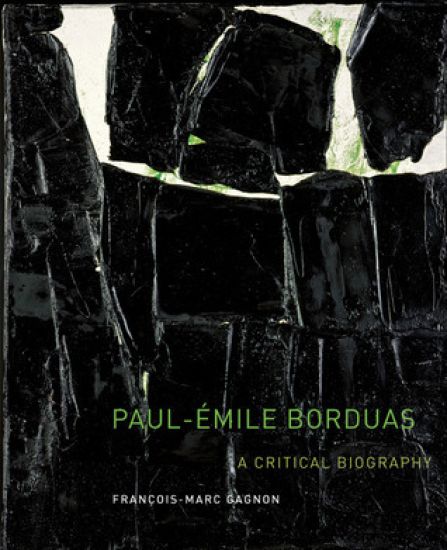
From his beginnings as a rural church decorator, to his role as catalyst of the social and artistic manifesto the Refus global, to a career as Canada's pre-eminent practitioner of radical abstraction abroad, Paul-Emile Borduas's short life encompassed the reversals and contradictions of the modern condition. Drawing on a lifetime of published research, Francois-Marc Gagnon's comprehensive biography is a far-reaching exploration of a Quebec cultural figure renowned for both his art and his thought. Gagnon details each period of Borduas's dynamic career - his apprenticeship with Ozias Leduc, his teaching in Montreal and the role within the Automatiste group, his move to New York at the height of the Abstract Expressionist movement, and then, against the current of the times, to Paris, where he created the iconic images of his "cosmic" period. Borduas's relentless search for an authentic art often put him at odds with his surroundings. As an avant-garde artist in a Montreal art world bound by tradition, his most important work had to be exhibited in makeshift venues; as a surrealist-influenced francophone in New York, he recognized the importance of the major figures of Abstract Expressionism but maintained an independent style and method. A full appreciation of Borduas's radical stance - an artistic and intellectual orientation that was always towards the universal - transforms a Canadian cultural landscape where the narrative of artistic modernism centres on figurative landscape art. An original and rigorously researched work, Paul-Emile Borduas: A Critical Biography provides an English-language readership with a much-needed understanding of a seminal modernist, an exemplary figure in Canadian art, and the origins of modern art in North America.