Kirjojen hintavertailu. Mukana 11 244 527 kirjaa ja 12 kauppaa.

Kirjahaku

Etsi kirjoja tekijän nimen, kirjan nimen tai ISBN:n perusteella.

1000 tulosta hakusanalla Mari Sandoz

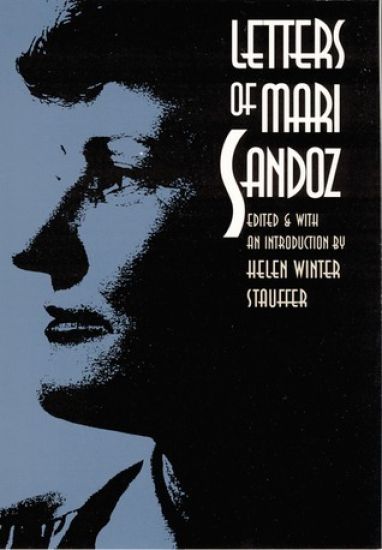
Letters of Mari Sandoz

Letters of Mari Sandoz

Mari Sandoz

University of Nebraska Press
1992
sidottu
Mari Sandoz came out of the Sandhills of Nebraska to write at least three enduring books: Old Jules, Cheyenne Autumn, and Crazy Horse, the Strange Man of the Oglalas. She was a tireless researcher, a true storyteller, an artist passionately dedicated to a place little known and a people largely misunderstood. Blasted by some critics, revered by others for her vivid detail and depth of feeling, Sandoz has achieved a secure place in American literature. Her letters, edited by Helen Winter Stauffer, reveal extraordinary courage and zest for life. Included here are letters written by Sandoz over nearly forty years-from 1928, the year of her father's death and a critical one for her creative development, to 1966, the year of her own death. They allow memorable glimpses of the professional and private person: her struggles to learn her craft in spite of an unsupportive family and hard-won formal education, her experiences in gathering material, her relationships with editors and publishers, her work with fledgling writers, and her commitment to art and to various social concerns.
Mari Sandoz

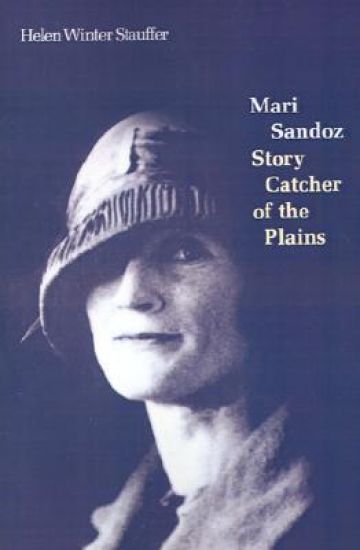
Mari Sandoz

Helen Winter Stauffer

University of Nebraska Press
1982
pokkari
As a historian and as a novelist Mari Sandoz (1896–1966) stands in the front rank of western writers: in the words of John K. Hutchens, "no one in our time wrote better than the late Mari Sandoz did, or with more authority and grace, about as many aspects of the old West." This first full-length biography is particularly concerned to show the relationship between Sandoz's life and experiences and her writing. Drawing heavily on materials in the Mari Sandoz Collection at the University of Nebraska-Lincoln—correspondence to and from Sandoz, her research notes, and manuscripts—and on interviews with dozens of Sandoz's friends and acquaintances, the author not only establishes the facts of Sandoz's life but confirms her standing as a writer and historian.
Mari Sandoz's Native Nebraska: The Plains Indian Country

Mari Sandoz's Native Nebraska: The Plains Indian Country

Clark Laverne Harrell

Arcadia Publishing (SC)
2000
nidottu
When the Mari Sandoz High Plains Center opens in Chadron, Nebraska in 2001, it will be one of three centers at which Nebraska honors its outstanding writers. Through the compilation of over 200 images in this new book, taken from historical collections and her own work, author and photographer LaVerne Harrell Clark contributes to that same purpose. In it, she recreates the frontier life of settlers and the neighboring Sioux and Cheyenne Indians of the sandhills region of northwestern Nebraska. Accompanied by in-depth captions detailing Mari Sandoz's life and works, these images illustrate how she came to hold an outstanding place as an American writer until her death in 1966. Born in 1896, in the free-land region of the Nebraska Panhandle, Sandoz was greatly influenced in her writing by the people who called at her homestead. Her acquaintances included Bad Arm, a Sioux Indian who fought at the Little Bighorn and was present at Wounded Knee, Old Cheyenne Woman, a survivor of both the Oklahoma and Fort Robinson conflicts, and William Buffalo Bill Cody, the legend of the Old West.
Crazy Horse

Crazy Horse

Mari Sandoz

Bison Books
2008
pokkari
“[One] of the great stories of the West, and written . . . in the spirit of the sages, with a scrupulous regard for truth and history.”-Atlantic MonthlyCrazy Horse, the legendary military leader of the Oglala Sioux whose personal power and social nonconformity contributed to his reputation as being “strange,” fought in many famous battles, including the Little Bighorn, and held out tirelessly against the U.S. government’s efforts to confine the Lakotas to reservations. Finally, in the spring of 1877 he surrendered, only to meet a violent death. More than a century later Crazy Horse continues to hold a special place in the hearts and minds of his people. Mari Sandoz offers a powerful evocation of the long-ago world and enduring spirit of Crazy Horse.Chosen as a 2007 One Book, One Nebraska selection, this edition of Crazy Horse includes discussion questions and a comprehensive glossary to enhance the reader's experience with this classic Sandoz text.
The Buffalo Hunters

The Buffalo Hunters

Mari Sandoz

Bison Books
2008
pokkari
In 1867 conservative estimates put the number of buffaloes in the trans-Missouri region at fifteen million. By the end of the 1880s, that figure had dwindled to a few hundred. The destruction of the great herds is the theme of The Buffalo Hunters. Mari Sandoz’s vast canvas is charged with color and excitement-accounts of Indian ambushes, hairbreadth escapes, gambling and gunfights, military expeditions, and famous frontier characters such as Wild Bill Hickok, Lonesome Charlie Reynolds, Buffalo Bill, Sheridan, Custer, and Indian chiefs Whistler, Yellow Wolf, Spotted Tail, and Sitting Bull.
The Beaver Men

The Beaver Men

Mari Sandoz

Bison Books
2010
pokkari
Covering more than two centuries, The Beaver Men recounts the beginning of the beaver trade along the St. Lawrence to the last great rendezvous of traders and trappers on Ham’s Fork, in what is now Wyoming, in 1834. The Beaver Men is the third in Mari Sandoz’s trilogy of books narrating the history of the American West in relation to an animal species.
The Cattlemen

The Cattlemen

Mari Sandoz

Bison Books
2010
pokkari
The Cattlemen is the story of the cattle industry in America and of the men whose ranches reached from the Rio Grande into Montana, from the early Spanish days to Mari Sandoz’s contemporary times. It is the second in Sandoz’s trilogy of books narrating the history of the American West in relation to animal species.
Love Song to the Plains

Love Song to the Plains

Mari Sandoz

University of Nebraska Press
1966
pokkari
Love Song to the Plains is a lyric salute to the earth and sky and people who made the history of the Great Plains by the region's incomparable historian, Mari Sandoz. It is a story of men and women of many hues-courageous, violent, indomitable, foolish-their legends, failures, and achievements: of explorers and fur trappers and missionaries; of soldiers and army posts and Indian fighting; of California-bound emigrants who stopped off to become settlers; of cattlemen and bad men, boomers and land speculators, and their feuds and rivalries. Above all, this is a portrait of the true Plainsman, the man or woman who can stand to have the horizon far off and every day, every year, a gamble.
Son of the Gamblin' Man

Son of the Gamblin' Man

Mari Sandoz

Bison Books
1976
pokkari
The story tells of the gambler and townsite promoter who founded Cozad, Nebraska, and of his family, particularly his younger son, [who] became a world-famous artist and teacher known as 'Robert Henri.' This tale is essentially Robert's story, the story of a sensitive talented boy growing up in the midst of frontier violence. But it is also the story of the ambitious promoter and of frontier people fighting hunger, cold, blizzards, drouths, grasshoppers, prairie fires, and ruthless cattlemen. . . .
Capital City

Capital City

Mari Sandoz

Bison Books
2007
pokkari
First published in the dark days immediately before World War II, Capital City is Mari Sandoz’s angriest and most political novel.Like many important American novels of the 1930s-John Steinbeck’s The Grapes of Wrath, Jack Conroy’s The Disinherited, Robert Cantwell's Land ofPlenty-Capital City depicts the troubles of working people trapped in the Great Depression. A unique portrayal of how the Depression affected the Great Plains, it examines the forces that bitterly contended for wealth and power. Sandoz researched the daily life and behind-the-scenes operations of several state capitals in the thirties before synthesizing them in this novel, which is part allegory, part indictment, part warning.Famous for her passionate writing, Sandoz imbued Capital City with the full measure of her outrage.
Miss Morissa

Miss Morissa

Mari Sandoz

University of Nebraska Press
1980
pokkari
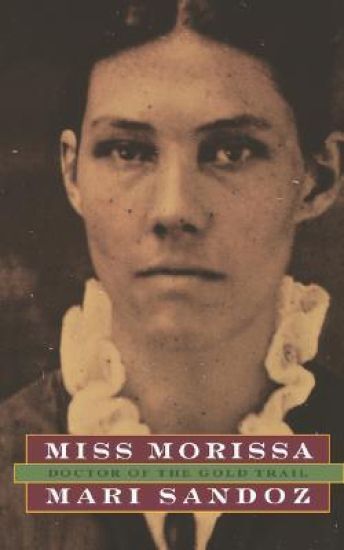
Miss Morissa is a dramatic, moving novel of a young pioneering woman doctor on the brawling Nebraska frontier of the 1870s.Fleeing the East and a heartbreaking past, Morissa Kirk finds the North Platte River Valley rife with rumors of gold strikes. Fortune hunters, desperadoes, horse thieves, murderers make up the frontier society, while Indians roam the plains refusing to surrender their land to the gold-hungry white men. Near lawless Clarke Bridge she sets up her practice, treating white and Indian alike, receiving horses (if anything) in return for her services. Then, even as fame spreads of her skill, and acceptance slowly grows, Morissa becomes embroiled in the life-and-death struggle between the cattlemen and the homesteaders, a struggle as destructive as it was inevitable. In the telling of Morissa's story, Mari Sandoz has caught the whole turmoil of the changing frontier in the days of Custer, Calamity Jane, and Buffalo Bill Cody.
Slogum House

Slogum House

Mari Sandoz

University of Nebraska Press
1981
pokkari
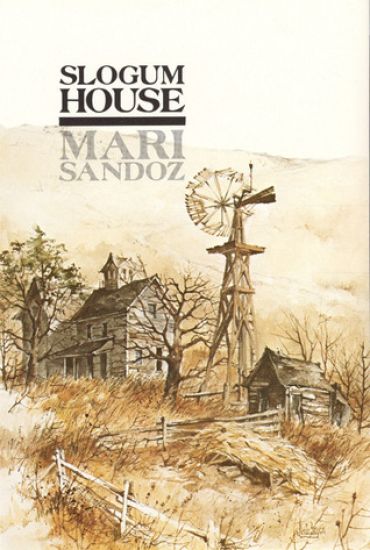
Slogum House "lay on the winter flat of Oxbow like the remains of some great, hulking animal that had foraged the region long ago, leaving its old gray carcass to dry and bleach at the foot of the hogback." Ruled by Gulla Slogum, the house was headquarters for a clan that terrorized what it couldn't seduce or steal. Using her daughter as poisoned bait and her sons as predators, Gulla plotted to put a whole county under her control. She had been insulted too often and worked too hard; now she sought power, land, and revenge.
Old Jules Country

Old Jules Country

Mari Sandoz

University of Nebraska Press
1983
pokkari
By zealous research, keen observation, and wide-ranging and deeply probing commentary, Mari Sandoz has become one of the most famous and well-respected interpreters of the American West. Old Jules Country is made up of the region that Sandoz has written about most frequently—the High Plains of the Dakotas, Montana, Nebraska, and Wyoming—the Black Hills, the Bad Lands, the sandhills, and the great rivers: the Missouri, the Platte, and the Yellowstone. Here are selections from the six volumes of her acclaimed Great Plains Series The Beaver Men, Crazy Horse, Cheyenne Autumn, The Buffalo Hunters, The Cattlemen, and Old Jules and from her study of a great people, These Were the Sioux. Also included are two essays, "The Lost Sitting Bull" and "The Homestead in Perspective." A Cheyenne prayer and two sketches unavailable elsewhere—"Snakes" and "Coyotes and Eagles"—complete the collection.This anthology provides a stimulating sampling for readers not yet acquainted with Sandoz's work. For her extensive following, it offers the opportunity for a satisfying reappraisal of her overall achievement.
The Tom-Walker

The Tom-Walker

Mari Sandoz

University of Nebraska Press
1984
pokkari
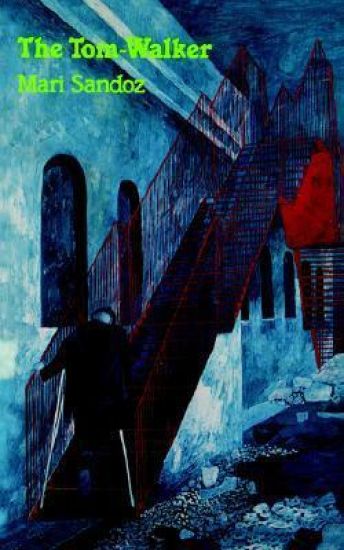
A bold, biting novel by the author of Old Jules and Crazy Horse, The Tom-Walker spans three generations in a Midwestern family. The patriarch, Milt Stone, who lost a leg fighting in Grant's army, is the Tom-Walker, circus slang for man on stilts. After the Civil War he takes his family west to the Missouri country. There he gains a reputation as a raconteur and as a passionate defender of the little man who works hard, fights the wars, and gets squeezed out by powerful interests. He lives to see his son and grandson fight in World War I and World War II, respectively, and return home from those wars, maimed like him, only to have to resume a fight just to stay alive. Crowded with living characters, The Tom-Walker never loses the larger view of American history. From the Gilded Age to the Atomic Age, everybody is "trying to be either a Jay Gould or a Jesse James, out for easy money, everybody [is] wanting to be king of something: mines, railroads, cattle, outlaws, anything." How people like the Stones fare is the story within this story.
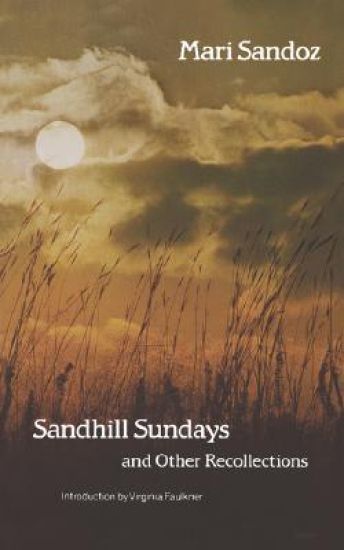
Sandhill Sundays and Other Recollections

Sandhill Sundays and Other Recollections

Mari Sandoz

University of Nebraska Press
1984
pokkari
"No one in our time wrote better than the late Mari Sandoz did, or with more authority and grace, about as many aspects of the Old West," said John K. Hutchens.The proof of that is in her powerful re-creation of pioneer days in the Sandhills of northwestern Nebraska in these autobiographical pieces written between 1929 and 1965. Those who have not read her classic Old Jules (1935) will find Sandhill Sundays and Other Recollections a colorful introduction to Sandoz Country, and those who have will look for the same landmarks and unforgettable people. They include the Sandoz patriarch, the fiery libertarian Old Jules; Marlizzie, the archetypal pioneer woman who was Mari's mother; siblings, chums, neighbors, homesteaders, and Indians, all individualized and defined by a harsh and lonely frontier. Dangers in every form-blizzards, fires, rattlesnakes, murderous men-are described, and, just as vividly, so are the pleasures afforded by country cooking, storytelling, pet animals, and the first phonograph for miles around. Even when she strays, as in the final piece, "Outpost in New York," Mari Sandoz never leaves the Sandhills in spirit. Included are a chronology of her career, a checklist of her writings, and a brief introduction by Virginia Faulkner.
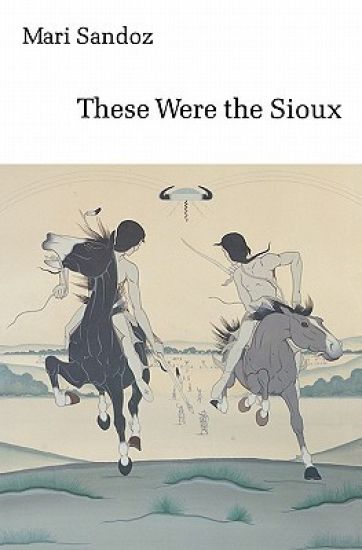
These Were the Sioux

These Were the Sioux

Mari Sandoz

Bison Books
1985
pokkari
"The Sioux Indians came into my life before I had any preconceived notions about them," writes Mari Sandoz about the visitors to her family homestead in the Sandhills of Nebraska when she was a child. These Were the Sioux, written in her last decade, takes the reader far inside a world of rituals surrounding puberty, courtship, and marriage, as well as the hunt and the battle.
Winter Thunder

Winter Thunder

Mari Sandoz

University of Nebraska Press
1986
pokkari
Winter Thunder has been named by the Reader’s Digest as one of the ten best American short novels.In a blinding blizzard a schoolbus overturns and a young teacher, her seven pupils, and the driver-a mere boy-are stranded in the open country, miles and miles from the nearest ranchhouse. Thus Mari Sandoz introduces a situation that will stretch the limits of human endurance.The exposed little group is armed with no more than the lunches they started out with and only the clothing required for a normal winter's day. As a killer storm takes hold and the mercury plunges below zero they become desperate. How each character facesthe terrifying prospect of freezing to death is a story that has become a small classic. And because it is based upon fact-the author's niece experienced much the same ordeal in the paralyzing midwestern blizzard of January 1949-it has the ring of undisputed truth.
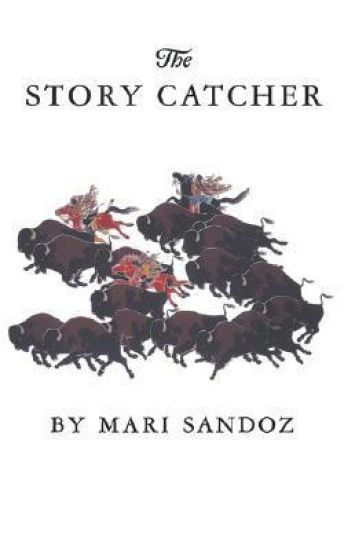
The Story Catcher

The Story Catcher

Mari Sandoz

University of Nebraska Press
1986
pokkari
A young Sioux warrior earns the right to be called historian for his tribe after numerous adventures and trials which test his ability to tell the story of his people with truth and courage.