Im Mittelpunkt der vorliegenden Studie steht Antonio Canovas (1757-1822) Portr tstatue der Paolina Bonaparte Borghese als Venus Victrix, deren Genese und Bedeutung anhand potenzieller Vorbilder aus Antike und Renaissance dokumentiert wird. Da das Werk f r den betont m nnlichen Blick geschaffen worden ist, werden in dieser Publikation die vom K nstler bewusst eingesetzten "verf hrerisch-traditionellen" Bildmittel von verschiedenen Gesichtspunkten (Literatur und Kunst) aus betrachtet. Was wir heute als "Star" bezeichnen, ist mit dieser modernen Venus geboren worden. Paolina Borghese steht mit ihrem eigenen Leben wie mit ihrer von Canova geschaffenen marmornen Existenz am Beginn einer genealogischen Linie von moderner Weiblichkeit.
Die Lebensgeschichte der Maria Anna Schwegelin - Deutschlands letzte Hexe. Kempten, im April 1775. Fürstabt Honorius von Schreckenstein, der ganz im Zeichen der neuen Zeit eine aufgeklärte Kirche zu forcieren versucht, steht vor der schwersten Entscheidung seines Lebens: Das Volk will die Landstreicherin Maria Anna Schwegelin auf dem Scheiterhaufen brennen sehen. Nach ihrem Geständnis, mit dem Teufel Unzucht getrieben zu haben, scheint ein Hexenprozess und damit ihr Todesurteil unabwendbar.
This book includes the family history and genealogy of Johann Ferdinand Th ne and Maria Anna Juliana Antonette Drewes. It shows their descendants through nine generations. Included are the families Klahold, Meiwes and Th ne. Next, their three major ancestral lines are documented, leading back to Karl the Great and beyond. The book also contains the ancestors of the Bartneck and Masuoka family.
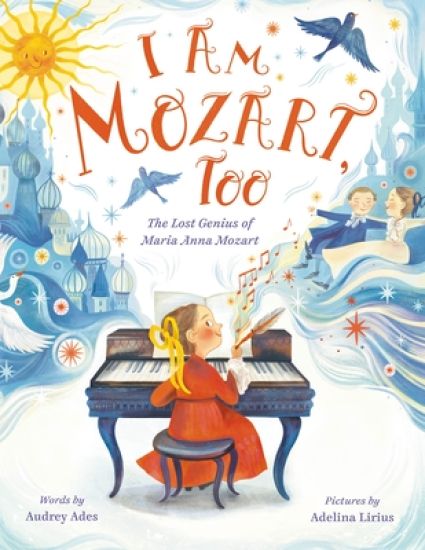
To everyone who has heard of my famous younger brother but has never heard of me. I Am Mozart, Too is a picture book biography about Wolfgang's older sister, Maria Anna Mozart, who was a child prodigy and a secret composer, perfect for Women's History Month. Nannerl and Wolfie love playing the harpsichord together. They are so talented, the Mozart siblings perform all over Europe for packed audiences in beautiful concert halls. Even Empress Maria Theresa requests that they stop in Vienna to play especially for her. But then Nannerl does something naughty: She starts writing music of her own. Papa fumes. Girls are not allowed to compose Girls belong behind the curtain. While Wolfie's solo career takes flight, Nannerl must settle for a life offstage. But it doesn't stop her from pursuing her dreams in secret. With vivid, sweeping art by Adelina Lirius, author Audrey Ades tells the powerful true story of a talented, ambitious girl who has been hidden from history--a girl who was and always will be a genius, too.
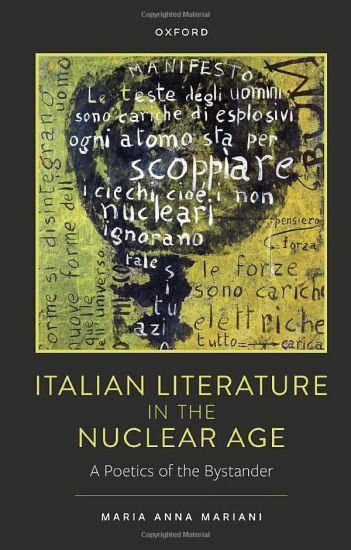
Italian Literature in the Nuclear Age: A Poetics of the Bystander explores the overlooked position of the bystander in the Nuclear Age by focusing on the Italian situation as a paradigmatic case. Host to hundreds of American atomic weapons while lacking a nuclear arsenal of its own, Italy's status was an ambiguous one: that of an unwilling--and in many ways passive--accomplice. Inspired by Seamus Heaney's dictum that "there is no such thing as innocent by-standing," the book frames Italy's fraught mix of implication and powerlessness not only as a geopolitical question, but as a way to rethink the role of the sidelined intellectual in the face of mass extinction. Italian Literature in the Nuclear Age includes discrete chapters on the major Italian intellectuals of the time: Italo Calvino, Alberto Moravia, Elsa Morante, Pier Paolo Pasolini, and Leonardo Sciascia. Conscious of their own political marginalization, these authors address the atomic question through a wide range of experimental forms, approaching the nearly unthinkable theme in allusive and oblique ways. Often dismissed as disengaged, inconsistent, or merely playful, these works demand instead a political reading capable of recognizing their confrontation with the paradoxes of the nuclear age.
This book investigates patterns of fragmentation and coherence in the international regulatory architecture of public procurement. In the context of the major international instruments of procurement regulation, the book studies the achievement of social and labour policies, the most controversial and problematic instrumental uses of public procurement practices.This work offers an innovative comparative approach, discussing the ways in which the different international instruments—namely the EU Procurement Directives, the WTO Agreement on Government Procurement, the UNCITRAL Model Law and the World Bank's Procurement Framework—are able to implement labour and social purposes and, at the same time, ensure a regulatory balance with the principles of efficiency and non-discrimination.Scholarly, rigorous and timely, this will be important reading for international trade lawyers and procurement practitioners.
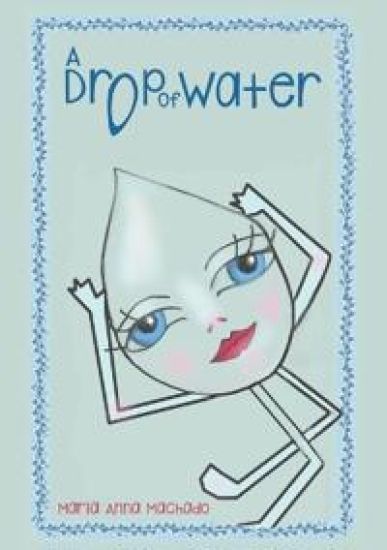
I've always loved plants and yams were one of my favorites. In my home, there were always large yam leaves and in the center of them was always a drop of water. Looking at them, they looked like liquid diamonds and I imagined they were alive and that they would go out in search of adventures. So, I wrote this little story and I hope everyone reads it. Both the drawings and words came out very easy and light. Hope you enjoy it
I've always loved plants and yams were one of my favorites. In my home, there were always large yam leaves and in the center of them was always a drop of water. Looking at them, they looked like liquid diamonds and I imagined they were alive and that they would go out in search of adventures. So, I wrote this little story and I hope everyone reads it. Both the drawings and words came out very easy and light. Hope you enjoy it
This book investigates patterns of fragmentation and coherence in the international regulatory architecture of public procurement. In the context of the major international instruments of procurement regulation, the book studies the achievement of social and labour policies, the most controversial and problematic instrumental uses of public procurement practices.This work offers an innovative comparative approach, discussing the ways in which the different international instruments—namely the EU Procurement Directives, the WTO Agreement on Government Procurement, the UNCITRAL Model Law and the World Bank's Procurement Framework—are able to implement labour and social purposes and, at the same time, ensure a regulatory balance with the principles of efficiency and non-discrimination.Scholarly, rigorous and timely, this will be important reading for international trade lawyers and procurement practitioners.
This book discusses a major issue in the food contact materials industry: non-intentionally added substances (NIAS), and their impact on PET-bottled water. NIAS are chemical compounds that are present in food contact materials but have not been added for technical reasons during the production process, and consumers are usually unaware of their presence. NIAS can include decomposition or degradation products, impurities in the raw materials, unwanted by-products or contaminants from recycling processes, and they pose a challenge for packaging manufacturers.In Europe, the EU Regulations No. 1935/2004 and 10/2011 set out, respectively, the general principles of safety and inertness for all packaging materials, and rules on the composition of plastic food-contact materials. Among the plastics commonly used for bottled water and other non-alcoholic refreshment beverages, polyethylene terephthalate (PET) is the most favoured thanks to its chemical and physicalstability, its transparency, low weight and good recyclability. Further, very few additives are used for its manufacture. Nonetheless, due to the complex formulations of polymers, processes and storage, NIAS can also be found in PET-bottled water, with potential cancerogenic or toxic effects.This book provides an overview of the European regulation of NIAS in plastic packaging materials, offering insights into their chemical composition in PET-bottled water. Lastly, it provides a useful discussion on NIAS and their toxicity.
Wie lassen sich Tier-Mensch-Relationen jenseits der in der Gegenwart problematisch gewordenen Pr missen des Logozentrismus der Moderne neu fassen? Das Buch antwortet darauf, indem es Passungen zwischen dem Wissen der Literaturen und Theorie herausarbeitet, um so Konzeptionen f r ein neues Weltverh ltnis zu erschlie en. Es fordert dazu auf, unsere Relationen zu berdenken - und dies nicht nur f r die Gegenwart, sondern auch f r die Zukunft.
Unver nderter Nachdruck der Originalausgabe von 1856. Der Verlag Anatiposi gibt historische B cher als Nachdruck heraus. Aufgrund ihres Alters k nnen diese B cher fehlende Seiten oder mindere Qualit t aufweisen. Unser Ziel ist es, diese B cher zu erhalten und der ffentlichkeit zug nglich zu machen, damit sie nicht verloren gehen.
Unver nderter Nachdruck der Originalausgabe von 1856. Der Verlag Anatiposi gibt historische B cher als Nachdruck heraus. Aufgrund ihres Alters k nnen diese B cher fehlende Seiten oder mindere Qualit t aufweisen. Unser Ziel ist es, diese B cher zu erhalten und der ffentlichkeit zug nglich zu machen, damit sie nicht verloren gehen.
Im Kolleg St. Thomas der Dominikaner in Fuchtel hat es im Untersuchungszeitraum in den Jahren 1947 bis 1970 Falle von strafrechtlich relevanter physischer und sexueller Gewalt gegen Schuler gegeben, psychische Gewalt ist bis heute in der Regel kein Straftatbestand. Spuren finden sich marginal bis gar nicht in der zeitgenossischen Aktenuberlieferung des Ordens, sondern nahezu ausschliealich in den Erinnerungen ehemaliger Schuler. Es sind in keinem Fall polizeiliche Ermittlungen aufgenommen worden. Somit gab es auch keine Strafverfahren und keine rechtskraftigen Verurteilungen. Ehemalige Schuler blicken mit so unterschiedlichen Gefuhlen wie Trauer und Wut - "Ich blicke zuruck im Zorn" - und ambivalenten Empfindungen - "Schon war die Zeit nicht, aber sie war gut fur mich" - auf ihr Leben im Kolleg zuruck. Insbesondere hinsichtlich der fruhen Nachkriegszeit uberwiegt der Eindruck groaer Dankbarkeit fur die Moglichkeit, nach den Kriegswirren in Fuchtel das Abitur absolvieren zu konnen - "Dankbarkeit, Dankbarkeit, Dankbarkeit seit 59 Jahren " - sowie vor allem im letzten Jahrzehnt des Untersuchungszeitraum der Stolz - "Einmal Thomaner - immer Thomaner". Insgesamt dominieren ambivalente bis positive Erinnerungen an das Leben und Lernen im Kolleg St. Thomas die knapp 200 eingegangenen Berichte - wenngleich diese uber keine statistische Relevanz verfugen konnen und jedes zum Teil bis heute traumatisierende Erlebnis eines ehemaligen Schulers eine negative Erfahrung zu viel war und ist.