Kirjojen hintavertailu. Mukana 11 342 296 kirjaa ja 12 kauppaa.

Kirjahaku

Etsi kirjoja tekijän nimen, kirjan nimen tai ISBN:n perusteella.

544 tulosta hakusanalla Marilee Sprenger

Brain-Based Teaching in the Digital Age

Brain-Based Teaching in the Digital Age

Marilee Sprenger

Association for Supervision Curriculum Development
2010
nidottu
Smartphones, videogames, webcasts, wikis, blogs, texting, emoticons. What does the rapidly changing digital landscape mean for classroom teaching? How has technology affected the brain development of students? How does it relate to what we know about learning styles, memory, and multiple intelligences? How can teachers close the digital divide that separates many of them from their students?In Brain-Based Teaching in the Digital Age, Marilee Sprenger answers these and other questions with research-based information and practical advice gained from her years as a classroom teacher and a consultant on brain-based teaching. As she puts it, ""It's time to meet the 'digital brain.' We need to use the technology tools, learn the digital dialogue, and understand and relate better to our students."" At the same time, she emphasizes the importance of educating the whole child by including exercise, music, and art in the classroom and helping students develop their social-emotional intelligence. Creativity, empathy, and the ability to synthesize material are 21st century skills that can't be ignored in the digital age.Readers will find easy-to-understand information about the digital brain and how it works, ""high-tech"" and ""low-tech"" strategies for everyday teaching and learning, and inspiration for creating classroom environments that will entice and encourage students at all grade levels. With this book as a guide, educators can move confidently across the digital divide to a world of new possibilities—for themselves and their students.
Teaching the Critical Vocabulary of the Common Core

Teaching the Critical Vocabulary of the Common Core

Marilee Sprenger

Association for Supervision Curriculum Development
2013
nidottu
Your students may recognize words like determine, analyze, and distinguish, but do they understand these words well enough to quickly and completely answer a standardized test question? For example, can they respond to a question that says ""determine the point of view of John Adams in his 'Letter on Thomas Jefferson' and analyze how he distinguishes his position from an alternative approach articulated by Thomas Jefferson""?Students from kindergarten to 12th grade can learn to compare and contrast, to describe and explain, if they are taught these words explicitly. Marilee Sprenger has curated a list of the critical words students must know to be successful with the Common Core State Standards and any other standardized assessment they encounter.Fun strategies such as jingles, movements, and graphic organizers will engage students and make learning these critical words enjoyable and effective. Learning the critical vocabulary will help your students with testing and college and career readiness, and will equip them with confidence in reading, writing, and speaking.Marilee Sprenger is also the author of How to Teach So Students Remember, Learning and Memory, and Brain-Based Teaching in the Digital Age.
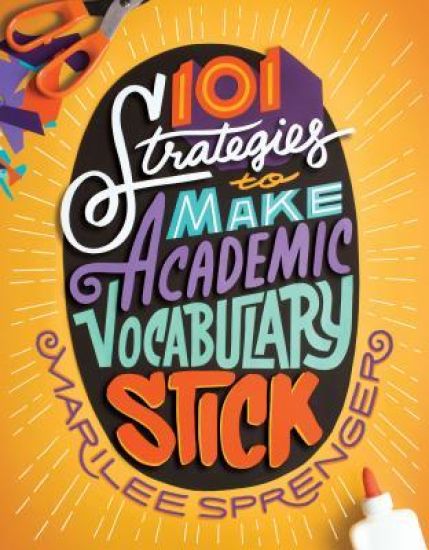
101 Strategies to Make Academic Vocabulary Stick

101 Strategies to Make Academic Vocabulary Stick

Marilee Sprenger

Association for Supervision Curriculum Development
2017
nidottu
Veteran educator Marilee Sprenger explains how to teach the essential, high-frequency words that appear in academic contexts—and reverse the disadvantages of what she calls ""word poverty."" Drawing on research and experience, Sprenger provides a rich array of engaging strategies to help educators across all content areas and grade levels not only teach students a large quantity of words but also ensure that they know these words well. You'll find:An overview of how the brain learns and retains new words, including the three stages of building long-term memories: encoding, storage, and retrieval.Encoding strategies to introduce words in novel ways and jump-start the memory process.Rehearsal strategies to help students put words into long-term storage.Review strategies to help students strengthen their retrieval skills and gain the automaticity needed for reading comprehension.Ways to address planning and assessment as crucial, intersecting supports of a robust vocabulary program.This comprehensive resource has everything you need to help your students profoundly expand their vocabulary, enabling them to speak, read, and write with greater understanding and confidence.
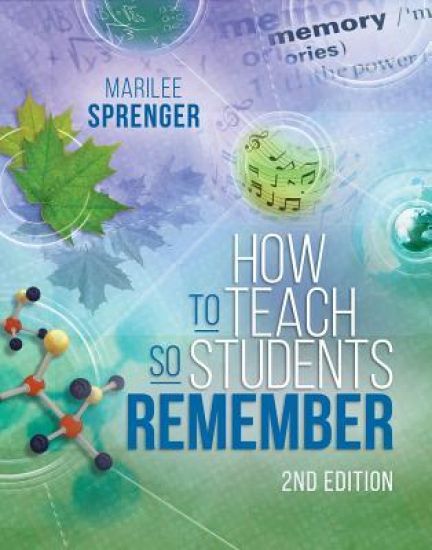
How to Teach So Students Remember

How to Teach So Students Remember

Marilee Sprenger

Association for Supervision Curriculum Development
2018
nidottu
Memory is inextricable from learning; there's little sense in teaching students something new if they can't recall it later. Ensuring that the knowledge teachers impart is appropriately stored in the brain and easily retrieved when necessary is a vital component of instruction. In How to Teach So Students Remember, author Marilee Sprenger provides you with a proven, research-based, easy-to-follow framework for doing just that.This second edition of Sprenger's celebrated book, updated to include recent research and developments in the fields of memory and teaching, offers seven concrete, actionable steps to help students use what they've learned when they need it. Step by step, you will discover how to:Actively engage your students with new learning.Teach students to reflect on new knowledge in a meaningful way.Train students to recode new concepts in their own words to clarify understanding.Use feedback to ensure that relevant information is binding to necessary neural pathways.Incorporate multiple rehearsal strategies to secure new knowledge in both working and long-term memory.Design lesson reviews that help students retain information beyond the test.Align instruction, review, and assessment to help students more easily retrieve information.The practical strategies and suggestions in this book, carefully followed and appropriately differentiated, will revolutionize the way you teach and immeasurably improve student achievement. Remember: By consciously crafting lessons for maximum ""stickiness,"" we can equip all students to remember what's important when it matters.
Social-Emotional Learning and the Brain

Social-Emotional Learning and the Brain

Marilee Sprenger

Association for Supervision Curriculum Development
2020
nidottu
Today's teachers face a daunting challenge: how to ensure a positive school experience for their students, many of whom carry the burden of adverse childhood experiences, such as abuse, poverty, divorce, abandonment, and numerous other serious social issues. Spurred by her personal experience and extensive exploration of brain-based learning, author Marilee Sprenger explains how brain science-what we know about how the brain works-can be applied to social-emotional learning. Specifically, she addresses how to:Build strong, caring relationships with students to give them a sense of belonging.Teach and model empathy, so students feel understood and can better understand others.Awaken students' self-awareness, including the ability to name their own emotions, have accurate self-perceptions, and display self-confidence and self-efficacy.Help students manage their behavior through impulse control, stress management, and other positive skills.Improve students' social awareness and interaction with others.Teach students how to handle relationships, including with people whose backgrounds differ from their own.Guide students in making responsible decisions.Offering clear, easy-to-understand explanations of brain activity and dozens of specific strategies for all grade levels, Social-Emotional Learning and the Brain is an essential guide to creating supportive classroom environments and improving outcomes for all our students.nd dozens of specific strategies for all grade levels, Social-Emotional Learning and the Brain is an essential guide to creating supportive classroom environments and improving outcomes for all our students.
The Essential 25

The Essential 25

Marilee Sprenger

Association for Supervision Curriculum Development
2021
nidottu
"Determine the main idea of a text and explain how it is supported by key details; summarize the text." Your students may recognize the words determine, explain, and summarize in this standard, but would they understand and be able to apply these concepts?Students encounter these and other academic vocabulary words throughout their school years, but too often, they don't have a firm grasp of these words' meanings or what skills they require.Enter vocabulary expert Marilee Sprenger, who has curated a list of 25 essential high-frequency words that students must know to be academically successful, especially on standardized tests, and be ready for college and career. In this indispensable guide for all educators, she provides* Pre- and post-assessments to help you evaluate your students' understanding of the essential 25. * A detailed entry for each word, including activities and strategies that will help students internalize the word's meaning and application. * Retrieval games to help students practice the words in fun, engaging ways and reinforce the networks for those words in their brains. * Downloadable blank templates for many of the strategies used throughout the book.Every student needs to know and understand these words to perform at their best. If educators get behind this effort and make the essential 25 part of the fabric of their schools, students will be equipped to thrive in school and beyond.
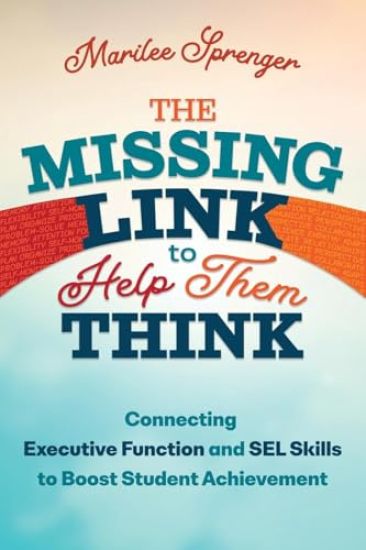
The Missing Link to Help Them Think: Connecting Executive Function and Sel Skills to Boost Student Achievement
What if you could help your students who are struggling academically simply by teaching them executive function skills?If you're a teacher, chances are you're familiar with the student who never finishes homework, the one who always interrupts, the one who can't seem to pay attention during lessons. Too often, we assume these characteristics are innate or chalk them up to lack of discipline, when in fact they are executive function issues that teachers can easily address-- and even help to reverse-- with a little guidance.In The Missing Link to Help Them Think, veteran educator and bestselling author Marilee Sprenger imparts that guidance with a wealth of practical, research-based classroom strategies teachers can use to develop six core areas of executive function skills (EFS): impulse inhibition; working memory; attention and focus; cognitive flexibility; self-monitoring; and planning, organization, prioritization, and time management. In addition, Sprenger- Explains how executive function skills bridge the gap between social-emotional learning and academics and how to develop both skill sets at the same time.- Discusses the research on and neurological origins of different executive functions.- Provides practical, easily implemented self-assessment tools that teachers and students can use to evaluate their strengths and needs related to executive functioning.All students can improve their executive function skills and succeed in the classroom. With strategies and examples across grade levels and relevant to all subject areas, this thought-provoking book gives you the resources necessary to support them in this journey.
Memory 101 for Educators

Memory 101 for Educators

Sprenger Marilee B.

SAGE Publications Inc
2006
sidottu
This is the book for every teacher who has ever forgotten what someone just told him or whose students have ever forgotten to take their books and assignments home with them. Memory expert Marilee Sprenger uses the latest research on learning, memory, and the brain to weave a storyteller's spell for us with two parallel parables: one a tale of adult educators in a Memory 101 workshop, and the other a story for children with magical talking elephants, lions, and jungle creatures. Along the way, we acquire tips, strategies,mnemonics, graphic organizers, and checklists that help us to strengthen our memories train our brains, and help us help our students to do the same. Relax and enjoy this book: the experience will be memorable!
Memory 101 for Educators

Memory 101 for Educators

Sprenger Marilee B.

SAGE Publications Inc
2006
nidottu
This is the book for every teacher who has ever forgotten what someone just told him or whose students have ever forgotten to take their books and assignments home with them. Memory expert Marilee Sprenger uses the latest research on learning, memory, and the brain to weave a storyteller's spell for us with two parallel parables: one a tale of adult educators in a Memory 101 workshop, and the other a story for children with magical talking elephants, lions, and jungle creatures. Along the way, we acquire tips, strategies,mnemonics, graphic organizers, and checklists that help us to strengthen our memories train our brains, and help us help our students to do the same. Relax and enjoy this book: the experience will be memorable!
Differentiation Through Learning Styles and Memory

Differentiation Through Learning Styles and Memory

Sprenger Marilee B.

SAGE Publications Inc
2008
sidottu
Help students lead with their strengths and gain a deeper understanding of concepts! This updated edition of the bestseller demonstrates how to optimize learning by using strategies that address students' social/emotional, cognitive, and physical learning needs. The second edition offers current research on memory, graphic organizers, and new charts to help implement differentiated strategies, and also covers: How the brain processes, stores, and retains information Pre-assessment strategies for each learning style "Reflect and Connect" questions to help teachers evaluate their current classroom practice Text boxes that highlight contents of each chapter Learning and memory tips for students
Differentiation Through Learning Styles and Memory

Differentiation Through Learning Styles and Memory

Sprenger Marilee B.

SAGE Publications Inc
2008
nidottu
Help students lead with their strengths and gain a deeper understanding of concepts! This updated edition of the bestseller demonstrates how to optimize learning by using strategies that address students' social/emotional, cognitive, and physical learning needs. The second edition offers current research on memory, graphic organizers, and new charts to help implement differentiated strategies, and also covers: How the brain processes, stores, and retains information Pre-assessment strategies for each learning style "Reflect and Connect" questions to help teachers evaluate their current classroom practice Text boxes that highlight contents of each chapter Learning and memory tips for students
Wiring the Brain for Reading

Wiring the Brain for Reading

Marilee B. Sprenger

John Wiley Sons Inc
2013
nidottu
Using the latest neuroscience research to enhance literacy instruction Wiring the Brain for Reading introduces teachers to aspects of the brain's functions that are essential to language and reading development. Marilee Sprenger, a specialist in learning and the brain, provides practical, brain friendly, strategies for teaching essential skills like phonemic awareness, phonics, fluency, vocabulary, and comprehension. The author's innovative approach aligns well with the Common Core State Standards for English Language Arts and is designed to enhance students' motivation and excitement in reading. Offers a clear explanation of brain functioning in order to enhance language and reading instructionIncorporates proven literacy strategies, games, and activities as well as classroom examplesAligns with Common Core State Standards for learning to read, developing fluency, and interpreting complex texts Wiring the Brain for Reading offers practical strategies for applying the latest research in neuroscience and learning to the classroom.
Saving Marilee

Saving Marilee

Annette K Larsen

Createspace Independent Publishing Platform
2015
pokkari
A sweet, clean romance. For all those who have suffered in silence, no matter the hardship. Everyone deserves a voice. Marriage wasn't bliss-not for Marilee. Instead of finding contentment with the handsome son of a sovereign duke, she found betrayal, manipulation, and neglect. And fear. A fear that finally lifts when her husband dies, freeing her from his domineering hand. But freedom alone can't give her peace, and she must battle to regain her love for life, rebuild her happiness, and reclaim the ability to trust. When her charming neighbor intrudes on her quiet life, she must determine whether his interest is genuine, and whether he deserves the fragile bit of trust she has managed to scrape together. However, trusting is a risk, and she has vowed never to put herself at the mercy of someone else's whims. Can Marilee take that chance, knowing how terribly she's chosen before? She doesn't know if she can survive being wrong again. Her recovery is messy, but it's real. It's raw but full of hope. While this story might be a little much for a tween audience, teens, young adults, and new adults can all find a lot of value in it. It's a story about a woman who tells the truth about her situation and refuses to keep quiet about it. A woman who takes back her power and then somehow learns to trust again. It's about women banding together, believing one another, and becoming stronger. And of course it's a love story. It's a sweet, clean romance that takes an honest look at emotional trauma and treats it with the care it deserves. Saving Marilee is part of the Dalthia series, but each book has a different main character and can be read as a stand alone. Not quite historical, but not quite fantasy, this inspirational fairy-tale-without-the-fairies series gives a nod to the medieval, a wink to the renaissance and blows a kiss to teens, tweens, young adults and women who love stories set in kingdoms and castles. Annette K. Larsen is one of the top sweet romance authors of recent years. Writing for teen and tween girls, young adults, and women alike, her books can be shared from mother to daughter to grandmother. Any book of hers would be a great gift idea for the book-loving women in your life. Whether she's writing a historical fantasy series about princesses, or a romantic suspense thriller full of action and adventure, all of her novels have a guaranteed happy ending and plenty of swoon-worthy kisses.
A Bright Red Scream: Self-Mutilation and the Language of Pain
"I highly recommend A Bright Red Scream], because it's beautifully written and . . . so candid." --Amy Adams, star of HBO's Sharp Objects in Entertainment Weekly Self-mutilation is a behavior so shocking that it is almost never discussed. Yet estimates are that upwards of eight million Americans are chronic self-injurers. They are people who use knives, razor blades, or broken glass to cut themselves. Their numbers include the actor Johnny Depp, Girl Interrupted author Susanna Kaysen, and the late Princess Diana. Mistakenly viewed as suicide attempts or senseless masochism--even by many health professionals--"cutting" is actually a complex means of coping with emotional pain. Marilee Strong explores this hidden epidemic through case studies, startling new research from psychologists, trauma experts, and neuroscientists, and the heartbreaking insights of cutters themselves--who range from troubled teenagers to middle-age professionals to grandparents. Strong explains what factors lead to self-mutilation, why cutting helps people manage overwhelming fear and anxiety, and how cutters can heal both their internal and external wounds and break the self-destructive cycle. A Bright Red Scream is a groundbreaking, essential resource for victims of self-mutilation, their families, teachers, doctors, and therapists.
Willa Cather

Willa Cather

Marilee Lindemann

Columbia University Press
1999
pokkari
Although it has been proven posthumously by scholars that Willa Cather had lesbian relationships, she did not openly celebrate lesbian desire, and even today is sometimes described as homophobic and misogynistic. What, then, can a reassessment of this contentious first lady of American letters add to an understanding of the gay identities that have emerged in America over the past century? As Marilee Lindemann shows in this study of the novelist's life and work, Cather's sexual coming-of-age occurred at a time when a cultural transition was recasting love between women as sexual deviance rather than romantic friendship. At the same time, the very identity of "America" was characterized by great instability as the United States emerged as a modern industrial nation and imperial power. Indeed, both terms, "queer" and "America," achieved fresh ideological potency at the turn of the century. Willa Cather: Queering America is an enlightening unpacking of Cather's writings, from her controversial love letters of the 1890s--in which "queer" is employed to denote sexual deviance--to her epic novels, short stories, and critical writings. Lindemann points to the "queer" qualities of Cather's fiction--rebellion against traditional fictional form, with sometimes unlikable characters, lack of emphasis on heroic action, and lack of engagement in the drama of heterosexual desire.
Change Your Questions, Change Your Life

Change Your Questions, Change Your Life

Marilee Adams

ReadHowYouWant
2016
pokkari
Great Results Begin with Great Questions. In this new expanded edition of her classic international bestseller, Marilee Adams shows how the kinds of questions we ask shape our thinking and can be the root cause of many personal and organizational problems. She uses a highly instructive and entertaining story to show how to quickly recognize any undermining questions that pop into your mind - or out of your mouth - and reframe them to achieve amazingly positive and practical results. The third edition includes a new introduction and epilogue and two powerful new tools that show how Question Thinking can dramatically improve coaching and leadership. Based on Adams's decades of research and experience, this book can make a life - transforming difference - as it already has for many thousands of people around the world.
The Art of the Question

The Art of the Question

Marilee C. Goldberg

John Wiley Sons Inc
1997
sidottu
"The important thing is not to stop questioning." –Albert Einstein The Art of the Question extends the range of cognitive-behavioral therapy by elaborating on the ways that internal questions program thought, emotion, and behavior. Describing a groundbreaking, question-centered approach to therapy, the concepts and practices in this book are essential for facilitating successful counseling and therapy. The Art of the Question contains everything therapists need to add question-centered methods to their therapeutic toolkits. The question-driven nature of choice is one of the pillars of question-centered therapy. The Art of the Question offers practical psycho-educational tools to help clients create better choices, be more effective in the ways they make choices, and take responsibility for their decisions. Clients learn to ask questions leading to solutions and positive possibilities, rather than those focusing on problems, negativity, and limitations. They discover that healing, growth, creativity, and change are often catalyzed through the simple act of changing their questions. The Art of the Question includes: *Question strategies for win-win marriages *Many compelling clinical cases and vignettes *Detailed methods for helping clients discover and transform the silent, implicit questions that program their lives *A framework for asking questions of clients at each stage of the therapeutic process *Illustrated psycho-educational materials for clients The Art of the Question contains everything therapists need to incorporate question-centered methods into their therapeutic tool kits, making it an essential resource and reference guide for all mental health professionals.