
Kirjahaku
Etsi kirjoja tekijän nimen, kirjan nimen tai ISBN:n perusteella.
1000 tulosta hakusanalla Mark Knight; Mark Novak
Pastoral failure, volunteer fatigue, exhausted staff members, church wounds, and increasing membership decline have left us wondering, how do we lead from God-with-us rather than the world's hustle culture? Non-Anxious Churches examines communities' need for churches that are authentic, real, and non-anxious. Unfortunately, churches are not immune to anxiousness and can even perpetuate it by juggling tasks, getting caught up in activities, and focusing on the wrong goals. Pastor Mark Knight guides church leaders instead to dwell in and lead from the abiding presence of Jesus. Over the years, the social sciences have added a lot to this discussion about churches and anxious systems. Non-Anxious Churches seeks to further the conversation using answers found in Scripture and in the discipline of spiritual formation.
Nineteenth-Century Religion and Literature
Mark Knight; Emma Mason
Oxford University Press
2006
sidottu
Recent scholarship in nineteenth-century literary studies consistently recognizes the profound importance of religion, even as it marginalizes the topic. There are few, if any, challenging yet manageable introductions to religion and literature in the long-nineteenth century, a factor that serves to fuel scholars' neglect of theological issues. This book aims to show how religion, specifically Christianity, is integral to the literature and culture of this period. It provides close readings of popular texts and integrates these with accessible explanations of complex religious ideas. Written by two scholars who have published widely on religion and literature, the book offers a detailed grounding in the main religious movements of the period 1750-1914. The dominant traditions of High Anglicanism, Tractarianism, Evangelicalism, and Roman Catholicism are contextualized by preceding chapters addressing dissenting culture (primarily Presbyterianism, Methodism, Unitarianism andQuakerism), and the question of secularization is considered in the light of the diversity and capacity for renewal within the Christian faith. Throughout the book the authors untangle theological and church debates in a manner that highlights the privileged relationship between religion and literature in the period. The book also gives readers a language to approach and articulate their own "religious" readings of texts, texts that are often concerned with slippery subjects, such as the divine, the non-material and the nature of religious experience. Refusing to shut down religious debate by offering only narrow or fixed definitions of Christian traditions, the book also questions the demarcation of sacred material from secular, as well as connecting the vitality of religion in the period to a broader literary culture.
Nineteenth-Century Religion and Literature
Mark Knight; Emma Mason
Oxford University Press
2006
nidottu
Recent scholarship in nineteenth-century literary studies consistently recognizes the profound importance of religion, even as it marginalizes the topic. There are few, if any, challenging yet manageable introductions to religion and literature in the long-nineteenth century, a factor that serves to fuel scholars' neglect of theological issues. This book aims to show how religion, specifically Christianity, is integral to the literature and culture of this period. It provides close readings of popular texts and integrates these with accessible explanations of complex religious ideas. Written by two scholars who have published widely on religion and literature, the book offers a detailed grounding in the main religious movements of the period 1750-1914. The dominant traditions of High Anglicanism, Tractarianism, Evangelicalism and Roman Catholicism are contextualized by preceding chapters addressing dissenting culture (primarily Presbyterianism, Methodism, Unitarianism and Quakerism), and the question of secularization is considered in the light of the diversity and capacity for renewal within the Christian faith. Throughout the book the authors untangle theological and church debates in a manner that highlights the privileged relationship between religion and literature in the period. The book also gives readers a language to approach and articulate their own 'religious' readings of texts, texts that are often concerned with slippery subjects such as the divine, the non-material and the nature of religious experience. Refusing to shut down religious debate by offering only narrow or fixed definitions of Christian traditions, the book also questions the demarcation of sacred material from secular, as well as connecting the vitality of religion in the period to a broader literary culture.
This new study explores how evangelicalism played a vital role in the development of the Victorian novel. In contrast to those who see the evangelical movement as trivial to our histories of the novel and part of the losing side in religion's battle with secularity, Good Words: Evangelicalism and the Victorian Novel examines fiction by major writers of the nineteenth century-Thackeray, Dickens, Wood, MacDonald, Collins, and Butler-and reveals the extent to which the novel was shaped by evangelical thought and practice. Rather than getting lost in historical and theological rabbit holes, Good Words invites readers to think about why evangelicalism still matters for the stories we tell about fiction in the Victorian period. The result has major implications for our understanding of the Victorian novel, our conception of the relationship between nineteenth-century literature and religion, the way in which we think about evangelical culture in the modern world, and our ideas about the practices and protocols of scholarly reading.
This new study explores how evangelicalism played a vital role in the development of the Victorian novel. In contrast to those who see the evangelical movement as trivial to our histories of the novel and part of the losing side in religion's battle with secularity, Good Words: Evangelicalism and the Victorian Novel examines fiction by major writers of the nineteenth century--Thackeray, Dickens, Wood, MacDonald, Collins, and Butler--and reveals the extent to which the novel was shaped by evangelical thought and practice. Rather than getting lost in historical and theological rabbit holes, Good Words invites readers to think about why evangelicalism still matters for the stories we tell about fiction in the Victorian period. The result has major implications for our understanding of the Victorian novel, our conception of the relationship between nineteenth-century literature and religion, the way in which we think about evangelical culture in the modern world, and our ideas about the practices and protocols of scholarly reading.
In the engaging Chesterton and Evil, Mark Knight offers a compelling analysis of the increasingly marginalized, but undoubtedly influential Gilbert Keith Chesterton and his late 19th and early 20th century fiction. In his Autobiography Chesterton observed: "Perhaps, when I eventually emerged as a sort of theorist, and was described as an Optimist, it was because I was one of the few people in that world of diabolism who really believed in devils." Arguing that a serious analysis of the nature of evil is at the center of his fiction, Chesterton and Evil offers an exciting, new interdisciplinary reading of Chesterton's work, and provides a means of locating it among important theological and cultural concerns of his age.
An Introduction to Religion and Literature
Mark Knight
Continuum International Publishing Group Ltd.
2009
sidottu
Organised around important theological ideas this is a lucid, accessible and thoughtful introduction to the study of literature and religion. Religion has always been an integral part of the literary tradition: many canonical and non-canonical texts engage extensively with religious ideas and the development of English Literature as a professional discipline began with an explicit consideration of the relationship between religion and literature. Both the recent theological turn of literary theory and the renewed political significance of religious debate in contemporary western culture have generated further interest in this interdisciplinary area.This book offers a lucid, accessible and thoughtful introduction to the study of religion and literature. The focus is on Christian theology and post-1800 British literature, although substantial reference is made to earlier writers, texts from North America and mainland Europe, and other faith positions."An Introduction to Religion and Literature" is organised around important theological ideas, each of which is explored through close readings of well-known and influential literary texts. Throughout the book the reader is encouraged to think about the ways in which religion and literature combine to trace and disclose other worlds that might be seen as sacred.
An Introduction to Religion and Literature
Mark Knight
Continuum International Publishing Group Ltd.
2009
nidottu
Organised around important theological ideas, this is a lucid, accessible and thoughtful introduction to the study of literature and religion. Religion has always been an integral part of the literary tradition: many canonical and non-canonical texts engage extensively with religious ideas and the development of English Literature as a professional discipline began with an explicit consideration of the relationship between religion and literature. Both the recent theological turn of literary theory and the renewed political significance of religious debate in contemporary western culture have generated further interest in this interdisciplinary area.This book offers a lucid, accessible and thoughtful introduction to the study of religion and literature. The focus is on Christian theology and post-1800 British literature, although substantial reference is made to earlier writers, texts from North America and mainland Europe, and other faith positions."An Introduction to Religion and Literature" is organised around important theological ideas, each of which is explored through close readings of well-known and influential literary texts. Throughout the book the reader is encouraged to think about the ways in which religion and literature combine to trace and disclose other worlds that might be seen as sacred.
A few short months have passed since Agent Barton and Arthur Mason (Ahmad), fled Turkey and the failed attempt at preventing an Al Qaeda plot to assassinate a prominent religious leader. Arthur has taken up residence in Oxnard, California, courtesy of the U.S. government in hopes of leaving his past behind and assimilating into American culture. Arthur's new job with a local delivery company seems innocent enough, until he meets an unsavory character that blinds his common sense with the promise of quick cash. Arthur's motivation to marry his fianc e, buy a home and live the American dream drives his decision, but there is no turning back. While the whole world is focused on the horrific events in Turkey, the CIA is thrust into investigating and averting an impending terrorist attack of epic proportion. The terrorist chatter indicates an attack on one of the 104 commercial nuclear facilities in the US. Newly promoted CIA Director of Domestic Terrorism, Marks, tasks former Delta Force operator, Special Agent Barton as his lead man to head the investigation. Time is of the essence as the agency realizes the magnitude and destruction of a nuclear meltdown. Can he identify the target and the players in time to avert the menacing plot?

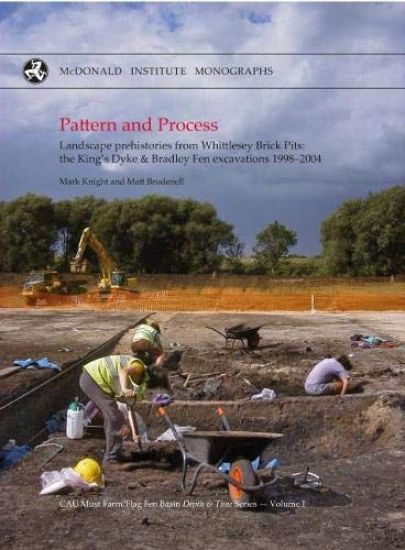
Pattern and Process
Mark Knight; Matt Brudenell
McDonald Institute for Archaeological Research
2020
sidottu
The King’s Dyke and Bradley Fen excavations occurred within the brick pits of the Fenland town of Whittlesey, Cambridgeshire. The investigations straddled the south-eastern contours of the Flag Fen Basin, a small peat-filled embayment located between Peterborough and the western limits of Whittlesey ‘island’. Renowned principally for its Bronze Age discoveries at sites such as Fengate and Flag Fen, the Flag Fen Basin also marked the point where the prehistoric River Nene debouched into the greater Fenland Basin. A henge, two round barrows, an early fieldsystem, metalwork deposition and patterns of sustained settlement along with metalworking evidence helped produce a plan similar in its configuration to that revealed at Fengate. In addition, unambiguous evidence of earlier second millennium BC settlement was identified together with large watering holes and the first burnt stone mounds to be found along Fenland’s western edge. Genuine settlement structures included three of Early Bronze Age date, one Late Bronze Age, ten Early Iron Age and three Middle Iron Age. Later Bronze Age metalwork, including single spears and a weapon hoard, was deposited in indirect association with the earlier land divisions and consistently within ground that was becoming increasingly wet. The large-scale exposure of the base of the Flag Fen Basin at Bradley Fen revealed a beneath-the-peat or pre-basin landscape related to the buried floodplain of an early River Nene. Above all, the revelation of sub-fen occupation means we can now situate the Flag Fen Basin in time as well as space.
Varieties of Women's Sensation Fiction, 1855-1890 Vol 1
Andrew Maunder; Sally Mitchell; Tamar Heller; Mark Knight; Graham Law
Routledge
2004
sidottu
Five 'sensation' novels are here presented complete and fully reset, along with scholarly annotation, a bibliography of 'sensation' fiction and articles contributing to contemporary debate.

Varieties of Women's Sensation Fiction, 1855-1890 Vol 2
Andrew Maunder; Sally Mitchell; Tamar Heller; Mark Knight; Graham Law
Routledge
2004
sidottu
Five 'sensation' novels are here presented complete and fully reset, along with scholarly annotation, a bibliography of 'sensation' fiction and articles contributing to contemporary debate.
Varieties of Women's Sensation Fiction, 1855-1890 Vol 3
Andrew Maunder; Sally Mitchell; Tamar Heller; Mark Knight; Graham Law
Routledge
2004
sidottu
Five 'sensation' novels are here presented complete and fully reset, along with scholarly annotation, a bibliography of 'sensation' fiction and articles contributing to contemporary debate.

Varieties of Women's Sensation Fiction, 1855-1890 Vol 4
Andrew Maunder; Sally Mitchell; Tamar Heller; Mark Knight; Graham Law
Routledge
2004
sidottu
Five 'sensation' novels are here presented complete and fully reset, along with scholarly annotation, a bibliography of 'sensation' fiction and articles contributing to contemporary debate.

Varieties of Women's Sensation Fiction, 1855-1890 Vol 5
Andrew Maunder; Sally Mitchell; Tamar Heller; Mark Knight; Graham Law
Routledge
2004
sidottu
Five 'sensation' novels are here presented complete and fully reset, along with scholarly annotation, a bibliography of 'sensation' fiction and articles contributing to contemporary debate.
Varieties of Women's Sensation Fiction, 1855-1890 Vol 6
Andrew Maunder; Sally Mitchell; Tamar Heller; Mark Knight; Graham Law
Routledge
2004
sidottu
Five 'sensation' novels are here presented complete and fully reset, along with scholarly annotation, a bibliography of 'sensation' fiction and articles contributing to contemporary debate.