This book studies the made-to-order genre of socialist-realist fiction that was produced at the direction of the Main Political Directorate of the Soviet Army and Navy (MPD) as a part of the war for men's minds waged by the Soviet State. The first chapter is a history of the genre, tracing it from its roots in the Revolution to the dissolution of the MDP in 1991. Topics examined in the book include the attitude toward Germans following World War II; the retirement of the World War II generation; military wives; Dear John letters; life at remote posts; the military as a socializing institution; the use of lethal force by sentries; attitudes toward field training exercises, heroism, and initiative; legitimacy of command; and the reception of Afghan vets.
Holland was once a superpower upon whose empire the sun never set. Today it is on the leading edge of social change. This history of Holland, from its earliest beginnings to the present day, provides the most up-to-date survey of modern Dutch history, including the current Dutch approach to a number of social issues, such as the welfare state, the environment, socialized medicine, and the role of the military in the post-Cold War world. Containing a wealth of current information and statistics, this work will help the reader to understand the Dutch both within the historical context in which Holland exists and as world leaders in social change as we approach the twenty-first century.This engagingly written history provides a contemporary overview of Holland's geography, economy, political system, and society. Chapters arranged chronologically trace the history and culture of the nation from the Ice Age to the new post-Cold War world. Chapters on recent Dutch history show how Holland has claimed a leading role in social change: the Dutch have authorized euthanasia, socialized medicine, and legalized soft drugs. A selection of brief biographical sketches will introduce the reader to many of the important Dutch personalities throughout Holland's history, and a bibliographical essay will help the researcher to locate recommended books and other materials for further reading.
The approach used in this course is predicated on the perception that non-native students normally begin their studies of the language with Codified Standard Russian (CSR) i.e. the way that Russians write, not the way they talk]. Therefore, Colloquial Russian (CR) is presented as a modification of CSR with which the student is already familiar. The course shows how CSR constructions are changed into colloquial constructions by the "omission" of elements from the CSR constructions. To a native speaker the omitted elements are implied by the remaining portion of the construction, but to a non-native student of the language these "missing" elements are a great source of confusion. The course presents a series of models to help the non-native student "reconstruct" more familiar CSR constructions from condensed colloquial variants. Student critiques from the courses where this book has been used have been very positive about the material. * "A course of this type was very much needed, and I hope it remains on the curriculum." * "I found it highly interesting, informative and useful." * "Well structured. Plenty of examples." * "This is the first course I've taken that really addresses colloquial Russian." * "I liked learning about condensates in general. Now I keep finding them in English." * "I liked learning about the ways things are carried in dictionaries and the way they change with time."
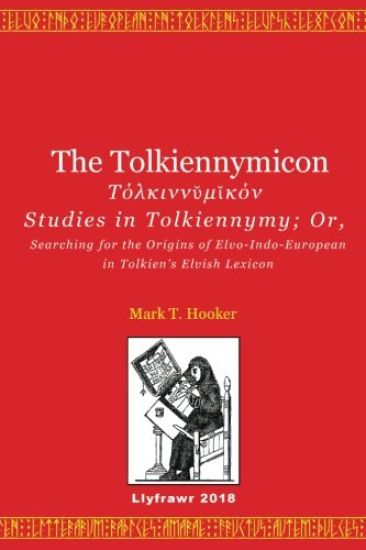
The impulse to write Iter Tolkienensis came from a book by Steve Ponty: Middle-earth in Magic Mirror Maps of Wales ... of the Wilderness in Wales ... of the Shire in England (Matador, 2014). The insight of Ponty's book is that the maps in The Hobbit are the mirror images of the maps of Wales. Ponty's insight prompted me to return to a question that I had raised in my article "The Linguistic Landscape of Tolkien's Shire" in A Tolkienian Mathomium (2006), where I equated the real-world Bredon with Bree Hill of Middle-earth due to both a correlation of meaning and of location. "The suggestion is intriguing," I noted, "and certainly begs to be followed up on, but that is another story." Iter Tolkienensis is the story that I should have told, but didn't after my article. It starts in Buckland (near Evesham), proceeds west (Middle-earth east) to Bredon Hill, and then follows the road into Wales that is known in its latest incarnation as the M50 and the A40. The name Iter Tolkienensis is an echo of the book title Iter Britanniarum, an extract of the Roman Roads of Britain from the Antonine Itinerary, a famous itinerarium, or list of the Roman stations and the distances between them along the various roads of the Roman Empire. Though the selection of the route is admittedly arbitrary, it nevertheless offers a good assortment of real-world place names that can profitably be viewed through a Tolkienian lens, which is a linguistic perspective that begins with a name or a word, and then looks for its story in the real world with which Tolkien was familiar. Iter Tolkienensis will, therefore, look at the meanings and stories of the place names that the route passes along the way, place names that might be translations or corruptions of those on a map of Middle-earth. Iter Tolkienensis passes places that could be Minhiriath, and the family estates of the Gamgee-s and Boffin-s; the Black Country, a rope-walk, and a lookout post; Rivendell, Esgaroth, and Eryn Vorn; before reaching The Carrock, Dol Guldur, and the Ivy Bush; to name but a few. Also from this author: Tolkien Through Russian Eyes (Walking Tree Publishers, 2003), published simultaneously in Russian "Frodo's Batman," Tolkien Studies, No. 1 (2004) The Hobbitonian Anthology (Llyfrawr, 2009) "Reading John Buchan in Search of Tolkien," Tolkien and the Study of His Sources, Jason Fisher (ed.). (McFarland, 2011) Tolkien and Welsh (Llyfrawr, 2012) The Tolkienaeum (Llyfrawr, 2014) Iter Tolkienensis (Llyfrawr, 2016) Tolkien and Sanskrit (Llyfrawr, 2016) An American Forger in Wales (Llyfrawr, 2017) The Tolkiennymicon (Llyfrawr, 2018)
This study is based on the observation that Tolkien calqued the names of the Sapta Sindhavah (Seven Rivers) from the Rig Veda as the Seven Rivers of Ossiriand. In other words, Tolkien created seven Elvish river names that mean the same thing as the river names of the Sapta Sindhavah.Much has been said of Tolkien's use of Welsh, Old English, Gothic, Icelandic, Russian, Greek, and Latin. Little, however, has been said about Tolkien's use of Sanskrit (Refined Speech), the great-great-...grandfather of all the languages above. Sanskrit was spoken in the second millennium B.C. in the valley of the River Indus, the river that put the "Indo" in the name Proto-Indo-European, a linguistic term for the *reconstructed common ancestor of the European languages.All indications to the contrary (C&G ii, 461), there is little doubt about Tolkien's knowledge of Sanskrit from the point of view of a linguist. It is de rigueur for any serious philologist interested in etymologies like Tolkien. Tolkien was on the Language side of the English School at Oxford, where he took Comparative Philology as a special subject for Honour Moderations. (G&G ii, 758)In a certain sense, Tolkien's The Silmarillion can be considered a veiled member of the genre of Raj Literature. The names of The Silmarillion say that in the same way that the names in Tolkien's poem "The Mewlips" are masks that hide the fact that it is a poem about World War I. As the present study shows, the names of The Silmarillion say that the locus of Tolkien's "Mythology for England" (C&G ii, 244-248) is the India of the British Raj.A literary analysis of Tolkien's place in Raj Literature is, however, much more speculative than the linguistic analysis that makes up the core of this study, which stands on solid philological ground. The literary analysis will, therefore, be left to another time and place.While the basis of Tolkien's calque of the names of the Seven Rivers as Ossiriand is Vedic in concept, the superstructure that Tolkien builds upon this foundation is non-Vedic. Some elements of the superstructure are more readily attributable to historical sources, like the history of the India Campaign of Alexander the Great, and the history of the British Raj in India, both of which were a part of the school curriculum when Tolkien was growing up.While the analysis of some of the words names in this study would not be believable in stand-alone articles, in the context of the coherent structure of words and names presented here, they are worthy of serious consideration.The discovery presented here has the potential to more clearly define the linguistic and philosophical cradle of Tolkien's 'Mythology for England, ' which was always The Silmarillion, and never The Lord of the Rings. It is Proto-Indo-European in the same way that the English language stems from Proto-Indo-European. That does not, however, mean that there is no gap between Proto-Indo-European language and culture, and the language and culture of The Shire.The analysis that follows is not a rehash of the discredited ideas of The Shores of Middle-earth (1981). It is instead, a completely new, linguistic approach to Tolkien's Silmarillion nomenclature.Correction: On page 156, the name of the King of Anga is given as Kama. It should read: Karna, which is the correct spelling of the name of this King, who is one of the main protagonists of the Hindu epic Mahabharata.Your attention is invited to: The Tolkienotheca (Llyfrawr, 2019), Part I of which is an "Addendum to Tolkien and Sanskrit."
INSTANT NEW YORK TIMES BESTSELLERFormer Secretary of Defense Mark T. Esper reveals the shocking details of his tumultuous tenure while serving in the Trump administration.From June of 2019 until his firing by President Trump after the November 2020 election, Secretary Mark T. Esper led the Department of Defense through an unprecedented time in history—a period marked by growing threats and conflict abroad, a global pandemic unseen in a century, the greatest domestic unrest in two generations, and a White House seemingly bent on breaking accepted norms and conventions for political advantage. A Sacred Oath is Secretary Esper’s unvarnished and candid memoir of those extraordinary and dangerous times, and includes events and moments never before told.
INSTANT NEW YORK TIMES BESTSELLERFormer Secretary of Defense Mark T. Esper reveals the shocking details of his tumultuous tenure while serving in the Trump administration.A graduate of West Point, Mark Esper has always lived by the principles of Duty, Honor, and Country. For eighteen months while he served as secretary of defense under President Donald Trump, those ideals were put to the test.From June of 2019 until his firing by President Trump after the November 2020 election, Secretary Mark T. Esper led the Department of Defense through an unprecedented time in history. Esper takes readers behind the scenes during dramatic moments in the Trump administration involving several foreign nations and as he worked to shore up the United States’ shaky relationships with its allies—all while facing a global pandemic that threatened America’s military readiness, a nationwide unrest that followed the murder of George Floyd, and a White House determined to politicize the armed forces.Unvarnished and extraordinary in its candor, A Sacred Oath is a memoir critical to understanding the Trump administration during this tumultuous period in American history.
INSTANT NEW YORK TIMES BESTSELLERFormer Secretary of Defense Mark T. Esper reveals the shocking details of his tumultuous tenure while serving in the Trump administration.From June of 2019 until his firing by President Trump after the November 2020 election, Secretary Mark T. Esper led the Department of Defense through an unprecedented time in history--a period marked by growing threats and conflict abroad, a global pandemic unseen in a century, the greatest domestic unrest in two generations, and a White House seemingly bent on breaking accepted norms and conventions for political advantage. A Sacred Oath is Secretary Esper's unvarnished and candid memoir of those extraordinary and dangerous times, and includes events and moments never before told.
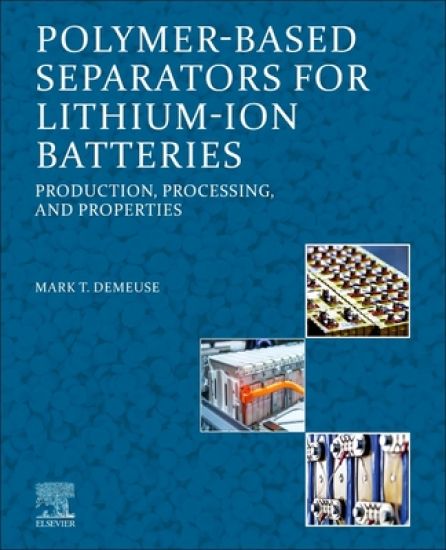
Polymer-Based Separators for Lithium-Ion Batteries: Production, Processing, and Properties takes a detailed, systematic approach to the development of polymer separators for lithium-ion batteries, supporting the reader in selecting materials and processes for high-performance polymer separators with enhanced properties. The book begins by introducing the polymeric materials that may be used for separators, as well as characterization techniques, before presenting the available technologies used to produce separators for use in lithium-ion batteries. Each technology is discussed in terms of the advantages and disadvantages of the chosen approach, with the properties of the separators made via each technology also summarized and compared in detail. In addition, areas for further development are addressed, and the limitations of current materials and separators in achieving those goals are highlighted. This is a valuable resource for scientists and engineers in the industry who work on polymer-based battery separators, polymers for electronic/energy applications, and new materials and processes for lithium-ion batteries. In academia, this book will be of interest to researchers and advanced students across the fields of polymer science, materials science, electronics, energy, and chemical engineering.
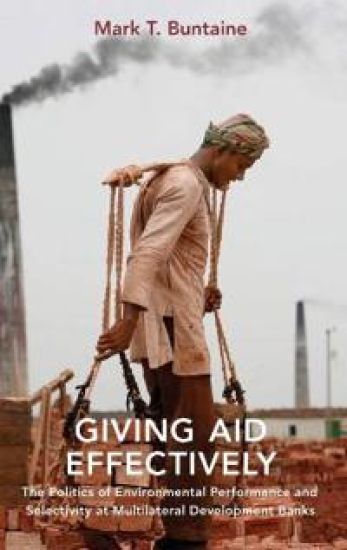
International organizations do not always live up to the expectations and mandates of their member countries. One of the best examples of this gap is the environmental performance of multilateral development banks, which are tasked with allocating and managing approximately half of all development assistance worldwide. In the 1980s and 1990s, the multilateral development banks came under severe criticism for financing projects that caused extensive deforestation, polluted large urban areas, displaced millions of people, and destroyed valuable natural resources. In response to significant and public failures, member countries established or strengthened administrative procedures, citizen complaint mechanisms, project evaluation, and strategic planning processes. All of these reforms intended to close the gap between the mandates and performance of the multilateral development banks by shaping the way projects are approved. Giving Aid Effectively provides a systematic examination of whether these efforts have succeeded in aligning allocation decisions with performance. Mark T. Buntaine argues that the most important way to give aid effectively is selectivity - moving towards projects with a record of success and away from projects with a record of failure for individual recipient countries. This book shows that under certain circumstances, the control mechanisms established to close the gap between mandate and performance have achieved selectivity. Member countries prompt the multilateral development banks to give aid more effectively when they generate information about the outcomes of past operations and use that information to make less successful projects harder to approve or more successful projects easier to approve. This argument is substantiated with the most extensive analysis of evaluations across four multilateral development banks ever completed, together with in-depth case studies and dozens of interviews. More generally, Giving Aid Effectively demonstrates that member countries have a number of mechanisms that allow them to manage international organizations for results.
International organizations do not always live up to the expectations and mandates of their member countries. One of the best examples of this gap is the environmental performance of multilateral development banks, which are tasked with allocating and managing approximately half of all development assistance worldwide. In the 1980s and 1990s, the multilateral development banks came under severe criticism for financing projects that caused extensive deforestation, polluted large urban areas, displaced millions of people, and destroyed valuable natural resources. In response to significant and public failures, member countries established or strengthened administrative procedures, citizen complaint mechanisms, project evaluation, and strategic planning processes. All of these reforms intended to close the gap between the mandates and performance of the multilateral development banks by shaping the way projects are approved. Giving Aid Effectively provides a systematic examination of whether these efforts have succeeded in aligning allocation decisions with performance. Mark T. Buntaine argues that the most important way to give aid effectively is selectivity--moving towards projects with a record of success and away from projects with a record of failure for individual recipient countries. This book shows that under certain circumstances, the control mechanisms established to close the gap between mandate and performance have achieved selectivity. Member countries prompt the multilateral development banks to give aid more effectively when they generate information about the outcomes of past operations and use that information to make less successful projects harder to approve or more successful projects easier to approve. This argument is substantiated with the most extensive analysis of evaluations across four multilateral development banks ever completed, together with in-depth case studies and dozens of interviews. More generally, Giving Aid Effectively demonstrates that member countries have a number of mechanisms that allow them to manage international organizations for results.
The chemistry of solid inorganic materials has become a central theme in research and in the teaching of chemistry. This area is, however, ignored by the main inorganic text books which concentrate almost solely on molecular inorganic chemistry. The primer fills this gap by producing a text which can be bought alongside the major texts, by a student on a budget, with coverage of the most salient points in an undergraduate course on solid materials. Topics include transition metal oxides, non-stoichiometry, zeolites, layer compounds chemistry, high temperature superconductors and fullerides. In addition the synthesis of these compound types is presented. As well as introducing and describing important solid state materials, the primer addresses the major experimental technique used to study and characterise the powder x-ray diffraction. The basis of this method and associated relevant crystallography is discussed; experimental data from this technique is used to illustrate topics throughout the primer. This tying together of an experimental method and the chemistry is a much needed approach, reflecting the true need of the chemist and the method by which chemistry is taught.
Characterisation Methods in Inorganic Chemistry provides a fresh alternative to the existing theoretical and descriptive inorganic chemistry texts by adopting a techniques-based approach and providing problem-solving opportunities to show how analytical methods are used to help us characterise inorganic compounds. The text covers the full range of analytical techniques employed by inorganic chemists, emphasizing those in most frequent use: NMR, diffraction, UV-Vis spectroscopy, and IR. The additional coverage on other techniques allows readers to study these less widely used methods when relevant to their specific course material. Each chapter follows a clear, structured format, which begins with a brief introduction to the technique and basic theory behind it before moving on to data collection and analysis, typical data and interpretation, with numerous worked examples, self- tests and problems. Online Resources For registered adopters of the book: - Figures and tables of data from the book, ready to download - Additional problems and exercises For students: - Answers to self-test questions - Additional problems and data sets
In The Limits of Liberalism, Mark T. Mitchell argues that a rejection of tradition is both philosophically incoherent and politically harmful. The Limits of Liberalism identifies why most modern thinkers have denied the essential role of tradition and explains how tradition can be restored to its proper place. Mitchell demonstrates that the rejection of tradition as an epistemic necessity has produced a false conception of the human person—the liberal self—which in turn has produced a false conception of freedom. Together, these false conceptions have facilitated both liberal cosmopolitanism and identity politics. Mitchell uses the philosophies of Michael Oakeshott, Alasdair MacIntyre, and Michael Polanyi to construct a compelling argument for a reconstructed view of tradition and, as a result, a reconstructed view of freedom. The Limits of Liberalism reveals that only by finding an alternative to the liberal self can we escape the incoherencies and pathologies inherent therein.
In The Limits of Liberalism, Mark T. Mitchell argues that a rejection of tradition is both philosophically incoherent and politically harmful. The Limits of Liberalism identifies why most modern thinkers have denied the essential role of tradition and explains how tradition can be restored to its proper place. Mitchell demonstrates that the rejection of tradition as an epistemic necessity has produced a false conception of the human person—the liberal self—which in turn has produced a false conception of freedom. Together, these false conceptions have facilitated both liberal cosmopolitanism and identity politics. Mitchell uses the philosophies of Michael Oakeshott, Alasdair MacIntyre, and Michael Polanyi to construct a compelling argument for a reconstructed view of tradition and, as a result, a reconstructed view of freedom. The Limits of Liberalism reveals that only by finding an alternative to the liberal self can we escape the incoherencies and pathologies inherent therein.
Designing Successful Products with Plastics: Fundamentals of Plastic Part Design provides expert insight into design considerations required to bring a concept product or part through design and ready-for-production. The book shows how integrating four key choices—materials, processes, tooling and design—in every design decision allows the designer to fully vet and optimize the design. Rather than focusing on design rules and engineering equations used during product development, the emphasis of the book is on what the designer needs to consider during the early conceptual visualization stages, and in the detailed stages of the design process. This approach will bridge the gap between the industrial designer, tasked with the ‘big picture’ product design and use, and the part designer, tasked with the detailed plastic part design for manufacture. Useful to both experienced and novice designers, this book brings valuable design process information through specific examples, enabling designers and engineers in the plastics industry to effectively use the available technical information to successfully design and manufacture new products.