Kirjojen hintavertailu. Mukana 11 699 587 kirjaa ja 12 kauppaa.

Kirjahaku

Etsi kirjoja tekijän nimen, kirjan nimen tai ISBN:n perusteella.

1000 tulosta hakusanalla Marsha Keith Schuchard

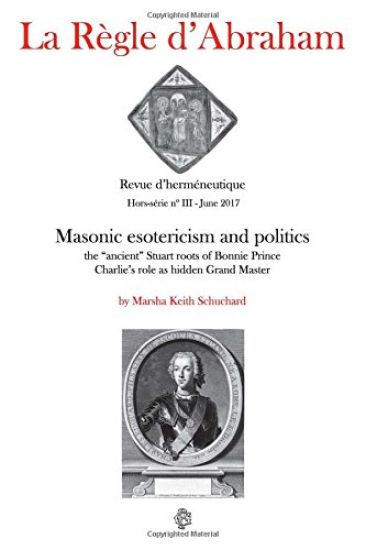
La Règle d'Abraham Hors-série #3: Masonic esotericism and politics: the "ancient" Stuart roots of Bonnie Prince Charlie's role as hidden Grand Master
Mainly focused on the study of esoteric traditions within the three monotheist Revelations, La R gle d'Abraham is a periodical founded and directed by Patrick Geay since April 1996. This special edition in English, with 20 rare Masonic illustrations in color, is dedicated to an important article by Marsha Keith Schuchard on Masonic esotericism and politics: the "ancient" Stuart roots of Bonnie Prince Charlie's role as hidden Grand Master Research into Charles Edward Stuart's alleged affiliation with Jacobite or Ecossais Freemasonry has long been hampered by the misleading assumption, which became academic "conventional wisdom," that Freemasonry virtually began in England when the Grand Lodge of London was formed in 1717. Moreover, it was generally characterized as non-political and rationalistic, devoted to the Protestant succession, the Hanoverian government, Newtonian science, and latitudinarian religion. However, the recent international expansion of Masonic and Jacobite studies makes possible a more credible and documented study of the Stuart prince's political and Masonic activities, within a context of anti-Hanoverian, politically-active, diplomatically-diverse, and spiritually-oriented Masonry that draws upon the early Scots-Irish traditions maintained by the Stuart kings in Greater Britain and by the exiles in the Jacobite diaspora. Ranging from the 1590s in Scotland to the 1780s in Italy, the Stuart-Masonic themes of Jewish mysticism, Lullist illuminated knighthood, Solomonic architecture, and religious toleration sustained the military and political campaigns of James II, James III, and "Bonnie Prince Charlie" in their struggle to reclaim the thrones of their ancestors. Table of contents Introduction Swift, Lull, and the masonic Art of Memory Stuart freemasonry and solomonic architecture Jacobite versus Hanoverian rivalries Mar, Ramsay, and the restoration of Stuart freemasonry "Bonnie Prince Charlie" emerges on the masonic stage The Royal Order of Heredom and Kilwinning The ancient chivalry of the Temple of Jerusalem The fates of the Jacobite Grand Masters The hidden Grand Master and the cossais network Old world royalists and new world revolutionaries Restoring the Temple in the North Conclusion Fond e en 1996 La R gle d'Abraham est une revue annuelle fran aise d'herm neutique principalement consacr e l' tude des traditions sot riques issues des trois r v lations monoth istes: juda sme, christianisme, islam. Pour autant, elle est aussi vou e la connaissance approfondie de toutes les religions du monde. Son but est de favoriser une meilleure compr hension de celles-ci, mais galement d' tablir l'existence d'un v ritable fond commun universel partir de leur dimension int rieure, m taphysique, cosmologique et symbolique. Notre revue vise en ce sens le r tablissement d'une interpr tation spirituelle du sacr en g n ral, en opposition toutes les formes de r ductionnisme qu'elle critique. Elle fait appel des sp cialistes, universitaires le plus souvent ou ind pendants. Nous publions des recherches originales in dites ainsi que des traductions de textes anciens et contemporains. Certains articles parus dans La R gle d'Abraham ont eux-m mes t traduits et publi s en Espagne, en Italie et aux Etats-Unis.
A Concatenation of Conspiracies

A Concatenation of Conspiracies

Marsha Keith Schuchard

Plumbstone Academic
2021
pokkari
Sometimes conspiracies are real or even "benevolent," as the Irish nationalist William Drennan wrote in 1791. His work to utilize "illuminist" Freemasonry to gain Irish independence placed the movement in the international context of conservative versus liberal debates on the alleged role of radical Masonry in revolutionary plots. Drennan wrote that "such schemes are not to be laughed at as romantic, for without enthusiasm nothing great was done." While the reactionary Abb Barruel warned about "the concatenation of conspiracies," his English translator Robert Clifford targeted the United Irishmen as the most dangerous seditionists. But the visionary artist William Blake-an advocate of enthusiasm-sympathized with the Irish rebels and infused support for their cause into the imagery of his greatest works. He also knew that the Irish angel harp-the nationalists' main symbol-was "no gentle harp." When he revealed that "they give the oath of blood in Lambeth," he possibly wrote from personal experience in an oath-bound secret society.
A Concatenation of Conspiracies: "Irish" William Blake and Illuminist Freemasonry in 1798
Sometimes conspiracies are real or even "benevolent," as the Irish nationalist William Drennan wrote in 1791. His work to utilize "illuminist" Freemasonry to gain Irish independence placed the movement in the international context of conservative versus liberal debates on the alleged role of radical Masonry in revolutionary plots. Drennan wrote that "such schemes are not to be laughed at as romantic, for without enthusiasm nothing great was done." While the reactionary Abb Barruel warned about "the concatenation of conspiracies," his English translator Robert Clifford targeted the United Irishmen as the most dangerous seditionists. But the visionary artist William Blake-an advocate of enthusiasm-sympathized with the Irish rebels and infused support for their cause into the imagery of his greatest works. He also knew that the Irish angel harp-the nationalists' main symbol-was "no gentle harp." When he revealed that "they give the oath of blood in Lambeth," he possibly wrote from personal experience in an oath-bound secret society.
Masonic Rivalries and Literary Politics: From Jonathan Swift to Henry Fielding

Masonic Rivalries and Literary Politics: From Jonathan Swift to Henry Fielding

Marsha Keith Schuchard

Createspace Independent Publishing Platform
2018
nidottu
Freemasonry had a major influence on politics and literature in eighteenth-century Britain, but many historical accounts have been limited by an overly Anglo-centric focus, which omitted the importance of Scotland, Ireland, Wales, and Europe in its development. The persistent "conventional wisdom" that the fraternity was non-political ignored the intense Jacobite-Hanoverian and Tory-Whig rivalries that continued from the 1690s. The assumption that Freemasonry generally espoused a rationalistic Enlightenment agenda omits the Hermetic, Cabalistic, and chivalric themes that infused the cossais (Scottish-French) higher degrees which expanded rapidly in Europe and eventually in Britain itself. These rivalries and polarizations were reflected in the Tory-Jacobite writings of Jonathan Swift, Alexander Pope, Moses Mendes, Eliza Haywood, Chevalier Ramsay, and many others, while Whig-Hanoverian authors such as Daniel Defoe, Jean-Theophilus Desaguliers, "Orator" Henley, and Henry Fielding supported the loyalist agenda of the Grand Lodge of England. By providing a detailed, chronological account of these developments, this book fills many gaps in eighteenth-century Masonic history. Marsha Keith Schuchard, Ph. D has written extensively on eighteenth-century Cabalistic and "illuminist" Freemasonry and its influence on Swift, Ramsay, Swedenborg, and Blake. She lives in Atlanta, Georgia. Table of contentIntroductionChapter 1 - The Ruined Temple and the Flight of Knights (1685-1691)Chapter 2 - Freemasons, Rosicrucians, and Radical Clubs (1691-1703)Chapter 3 - Jacobites, Williamites, and Disputed Architectural Traditions (1695-1703)Chapter 4 - Judaized Scots, Jacobite Jews, and the Problem of "False Brothers" (1702-1712)Chapter 5 - Building Castles in the Air, at Home and Abroad (1710-1716)Chapter 6 - The Swedish-Jacobite Plot and the Grand Lodge of London (1716-1719)Chapter 7 - Scottish-Swedish Masonic Traditions and English Innovations (1719-1722)Chapter 8 - Atterbury, Wharton, and "Combinations of Workmen" (1722-1723)Chapter 9 - Chinese and Cabalistic Threats to the Grand Lodge (1723-1724)Chapter 10 - Masonic Rivalries and International Ramifications (1725-1726)Chapter 11 - A New King, Yet Old Corruption (1727-1730)Chapter 12 - International Expansion of Chivalric Masonry (1730-1732)Chapter 13 - Masonic Politics and "A Babel of Religions" (1732-1733)Chapter 14 - Outbreaks of "Hyp" at Home and Abroad (1734)Chapter 15 - Riots in Britain, Wars in Europe, Charges of Masonic Conspiracy (1735-1736)Chapter 16 - Rival Claimants to the "Higher Order" and "Ancient Footing" (1737)Chapter 17 - Two Young Pretenders to the British Throne (1738-1739)Chapter 18 - Masonic Cabalists and the Opposition Cabal (1740-1742)Chapter 19 - Mock Masons, Royal Arch Rebels, and Invasion Fears (1743-1744)Chapter 20 - Rebuilding the Temple in the North (1745)Chapter 21 - Early Jacobite Victories, Apparent Hanoverian Triumph (1745-1746)Chapter 22 - Rival Grand Masters, Beheadings, and Boastings (1746-1748)Chapter 23 - Disappearance of One Young Pretender, Emergence of the Other (1748-1750)Epilogue - Schisms: Antients versus Moderns, Royalists versus Republicans, Nationalists versusImperialists (1751-1788)AbbreviationsBibliographyIndex
La Règle d'Abraham Hors-série #3 (B&W): Masonic esotericism and politics: the "ancient" Stuart roots of Bonnie Prince Charlie's role as hidden Grand M
Mainly focused on the study of esoteric traditions within the three monotheist Revelations, La R gle d'Abraham is a periodical founded and directed by Patrick Geay since April 1996. This special edition in English, with 20 rare Masonic illustrations, is dedicated to an important article by Marsha Keith Schuchard on Masonic esotericism and politics: the "ancient" Stuart roots of Bonnie Prince Charlie's role as hidden Grand Master Research into Charles Edward Stuart's alleged affiliation with Jacobite or Ecossais Freemasonry has long been hampered by the misleading assumption, which became academic "conventional wisdom," that Freemasonry virtually began in England when the Grand Lodge of London was formed in 1717. Moreover, it was generally characterized as non-political and rationalistic, devoted to the Protestant succession, the Hanoverian government, Newtonian science, and latitudinarian religion. However, the recent international expansion of Masonic and Jacobite studies makes possible a more credible and documented study of the Stuart prince's political and Masonic activities, within a context of anti-Hanoverian, politically-active, diplomatically-diverse, and spiritually-oriented Masonry that draws upon the early Scots-Irish traditions maintained by the Stuart kings in Greater Britain and by the exiles in the Jacobite diaspora. Ranging from the 1590s in Scotland to the 1780s in Italy, the Stuart-Masonic themes of Jewish mysticism, Lullist illuminated knighthood, Solomonic architecture, and religious toleration sustained the military and political campaigns of James II, James III, and "Bonnie Prince Charlie" in their struggle to reclaim the thrones of their ancestors. Table of contents Introduction Swift, Lull, and the masonic Art of Memory Stuart freemasonry and solomonic architecture Jacobite versus Hanoverian rivalries Mar, Ramsay, and the restoration of Stuart freemasonry "Bonnie Prince Charlie" emerges on the masonic stage The Royal Order of Heredom and Kilwinning The ancient chivalry of the Temple of Jerusalem The fates of the Jacobite Grand Masters The hidden Grand Master and the cossais network Old world royalists and new world revolutionaries Restoring the Temple in the North Conclusion Fond e en 1996 La R gle d'Abraham est une revue annuelle fran aise d'herm neutique principalement consacr e l' tude des traditions sot riques issues des trois r v lations monoth istes: juda sme, christianisme, islam. Pour autant, elle est aussi vou e la connaissance approfondie de toutes les religions du monde. Son but est de favoriser une meilleure compr hension de celles-ci, mais galement d' tablir l'existence d'un v ritable fond commun universel partir de leur dimension int rieure, m taphysique, cosmologique et symbolique. Notre revue vise en ce sens le r tablissement d'une interpr tation spirituelle du sacr en g n ral, en opposition toutes les formes de r ductionnisme qu'elle critique. Elle fait appel des sp cialistes, universitaires le plus souvent ou ind pendants. Nous publions des recherches originales in dites ainsi que des traductions de textes anciens et contemporains. Certains articles parus dans La R gle d'Abraham ont eux-m mes t traduits et publi s en Espagne, en Italie et aux Etats-Unis.
La Règle d'Abraham #39

La Règle d'Abraham #39

Jean-Luc Perillie; Emma Abate; Marsha Keith Schuchard

Createspace Independent Publishing Platform
2017
nidottu
Fond e en 1996 La R gle d'Abraham est une revue annuelle fran aise d'herm neutique principalement consacr e l' tude des traditions sot riques issues des trois r v lations monoth istes: juda sme, christianisme, islam. Pour autant, elle est aussi vou e la connaissance approfondie de toutes les religions du monde. Son but est de favoriser une meilleure compr hension de celles-ci, mais galement d' tablir l'existence d'un v ritable fond commun universel partir de leur dimension int rieure, m taphysique, cosmologique et symbolique. Notre revue vise en ce sens le r tablissement d'une interpr tation spirituelle du sacr en g n ral, en opposition toutes les formes de r ductionnisme qu'elle critique. Elle fait appel des sp cialistes, universitaires le plus souvent ou ind pendants. Nous publions des recherches originales in dites ainsi que des traductions de textes anciens et contemporains. Certains articles parus dans La R gle d'Abraham ont eux-m mes t traduits et publi s en Espagne, en Italie et aux Etats-Unis. Au sommaire du num ro 39: Jean-Luc P rilli - La question de l' sot risme platonicien. L'apport du fragment papyrologique PHerc. 1021; Emma Abate Nouvelles lumi res sur la tradition du Sefer Raziel; Marsha Keith Schuchard - Politique et sot risme ma onnique. Les racines stuartistes du titre de Grand Ma tre cach de Bonnie Prince Charlie (II); Andr Kervella - Le secret du Grand Orient de Bouillon; Philippe Lefebvre - Lire sans la chair; Christine Sourgins - De la subversion des sanctuaires chr tiens, en France...; Comptes rendus
The Haunting of Gothia/Rebecca

The Haunting of Gothia/Rebecca

Marsha Hubbard Norton Keith

Twin Sisters Publishing
2011
nidottu
Rebecca was a writer but she used the name Gothia as she wrote paranormal romances. She finds her dream house but soon it turns out to be a nightmare as she finds three ghost. Ghost who were tied to her by blood and spirit. The evil spirit controlled a young woman and wanted to control Gothia but with the help of two of the ghost an old murder is solved and two kind spirits are put to rest while Gothia/Rebecca finds love