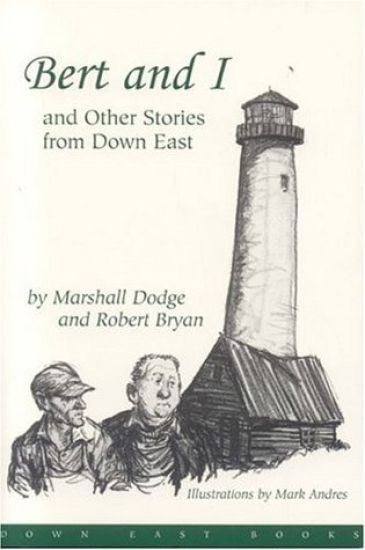
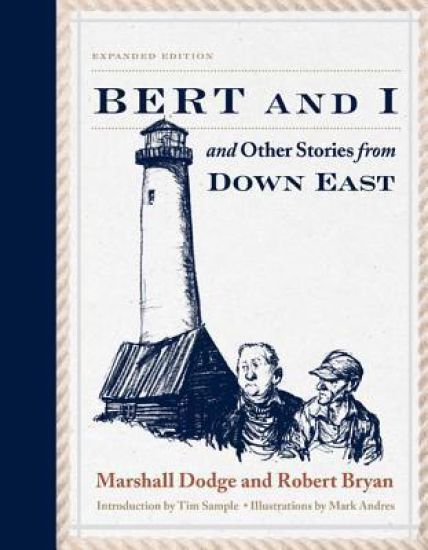
These stories about plain people sympathetically caricatured are universally enjoyed, although they just wouldn't work as well set anywhere else than in Maine. The unmistakable Down East Maine accent enhances the stories on the companion CDs and audiocassettes, while the book contains Mark Andres's wonderful pencil sketches.
Marshall Dodge and Bob Bryan began swapping funny Down East stories when they were students at Yale in the 1950s. Their fascination and appreciation for Maine and its people triggered the production of several “Bert and I” records, from which 14 stories were selected for the first edition of this book. Now, eleven more have been added for this expanded second edition. Dodge and Bryan were groundbreaking in their appreciation of the oral tradition and paved the way for contemporary storytelling icons like Garrison Keillor, Tim Sample, and Tom Bodett.
Collects many of the classic Down East stories told by Bert and I, as performed by Marshall Dodge and Robert Bryan, in print. Dodge recorded five humor albums as Bert and I or as himself and starred in a regional television show that aired on public television in the early 1970s.
Combining the polish of a turn-of-the-twentieth-century parlor recitation with the rough-and-ready quality of a folk tale, Frost, You Say? is a timeless story told as an old Maine farmer's rambling response to a simple question. Proving that sometimes getting there is a more pleasant experience than arriving, this is wry Maine humor at its very finest.
This wonderful CD captures the magic of a Marshall Dodge performance. It was originally recorded at the University of Maine in the fall of 1977. All tracks on this CD were digitally remastered in 2008 for improved audio quality. The stories include "Set 'er Again" and "One Heckuva Draft".
The iconic "Bert and I" stories were first created by Yale University students Marshall Dodge and Robert Bryan in the late 1950s and performed around campus. The two amateur storytellers soon recorded a short 10-inch album of 11 stories for friends and family, but ultimately pressed just a few hundred. However, growing popularity prompted them in 1958 to record and release the seminal commercial album of New England humor and storytelling - Bert and I . . . And Other Stories from Down East. Featuring 13 stories, the album depicts Maine fishermen and woodsmen with dry, classic humor and set the tone of direction of the genre for decades. The 13 rib-tickling tracks include "Gagnon" and "Harry Startles Wiscasset." Track List for The Return of Bert and I: The Return of Bert and I Directions Gagnon The Return of Virgil Bliss Harry Sleeps at L.L. Bean By a Fluke The Silent Chain Saw M'am Hacket's Compost Heap At the Graveyard The Stove with the Powerful Draft The Captain and the Lady The Chicken Truck Harry Startles Wiscasset
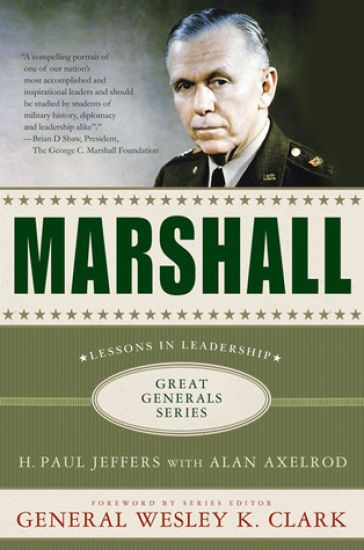
General George C. Marshall was a skillful and compassionate leader with a unique legacy. He never fired a shot during WWII and led no troops into battle - his brilliance was purely strategic and diplomatic, and incredibly effective. He was responsible for the building, supplying, and, in part, the deployment of over eight million soldiers. In 1947, as Secretary of State, he created the Marshall Plan, a sweeping economic recovery effort that pulled the war-shattered European nations out of ruin, and gave impetus to NATO and the European Common Market. It was for the Marshall Plan that he won the Nobel Peace Prize - the only time in history a military commander has ever been awarded this honor. Marshall's skilled combination of military strategy and politics, emphasis on planning as well as execution, and his expertise in nation-building holds lessons for military and civilian leaders today.
Of all the honored military commanders in American history, George C. Marshall is the only one who never led a large force in the field. Yet he came close to receiving the most coveted post of all - Supreme Commander of the Allied force that invaded France on the most famous of all D-Days, June 6, 1944. Marshall, who was then Chief of Staff of the army, clearly wanted the job. But the long-retired Pershing, who still wielded much influence, had other ideas; precisely because of his great admiration for Marshall, he told Roosevelt that it would be a "very grave error" to send the Chief of Staff away from Washington. Roosevelt, after offering the general a pro forma chance to request the appointment, gave the Supreme Command to General Eisenhower. One of the great contributions Marshall brought to the table as Chief of Staff was his study of the possibilities of coalitions and his advocacy of turning alliances into genuine unified partnerships. Marshall, who became Chief of Staff in 1939, felt the burden of turning a tiny army, not much more than a constabulary force, into a mighty machine capable of fighting on battlefields thousands of miles apart. In the realm of strategy, his focus became known as "Germany first": regardless of other considerations, take the fight to the most dangerous enemy, wage war as efficiently as possible, and then turn on other foes. It was only much later, after his brief retirement, that President Truman offered Marshall the position of Secretary of State, which resulted in the Marshall Plan, the achievement for which he is now best known and that holds many lessons for leaders today.
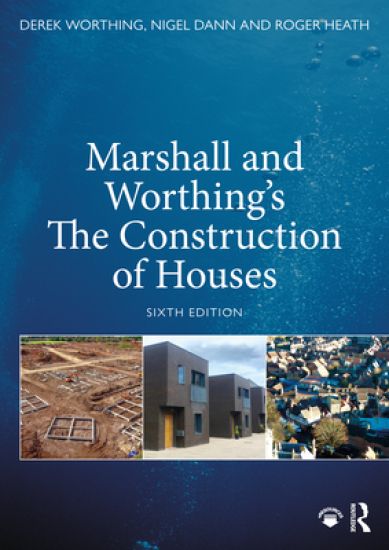
The sixth edition of The Construction of Houses builds on the success of the previous five editions. The book provides a comprehensive introduction to the principles and processes of the construction of houses and their services. As such it is aimed at providing a broad understanding of domestic building construction for students as part of their academic studies and as a useful information source for practitioners. The existing chapters have all been updated and most of them expanded to take account of changes to dwelling house construction since the last edition and there are new chapters on ‘Modern Methods of Construction’ and ‘Regulatory controls and building standards’. Additionally, many new and/or updated photographs and diagrams have been added.As with the previous editions, the authors have concentrated on presenting current mainstream approaches to the construction of houses. The detailed, yet accessible, text that is supported by hundreds of coloured photographs and diagrams provides clear explanations of the many complex processes that go into the building of a house. A deeper insight into modern construction is also given by the book’s consideration of historical building techniques from the 18th century onwards in order to illustrate how and why we build houses in the way we do now.
The sixth edition of The Construction of Houses builds on the success of the previous five editions. The book provides a comprehensive introduction to the principles and processes of the construction of houses and their services. As such it is aimed at providing a broad understanding of domestic building construction for students as part of their academic studies and as a useful information source for practitioners. The existing chapters have all been updated and most of them expanded to take account of changes to dwelling house construction since the last edition and there are new chapters on ‘Modern Methods of Construction’ and ‘Regulatory controls and building standards’. Additionally, many new and/or updated photographs and diagrams have been added.As with the previous editions, the authors have concentrated on presenting current mainstream approaches to the construction of houses. The detailed, yet accessible, text that is supported by hundreds of coloured photographs and diagrams provides clear explanations of the many complex processes that go into the building of a house. A deeper insight into modern construction is also given by the book’s consideration of historical building techniques from the 18th century onwards in order to illustrate how and why we build houses in the way we do now.
Alfred Marshall was one of the most important economists ever to have lived. This excellent new book, from a Marshall expert respected the world over, attempts to show that Marshall anticipated some of the views that are now associated with the cognitive sciences. Examining Marshall's philosophy of the human mind, his overall approach to economics, his concern for socio-economic issues, and the fertility of his framework, this book breathes fresh life into the fascinating world of Marshallian economics.
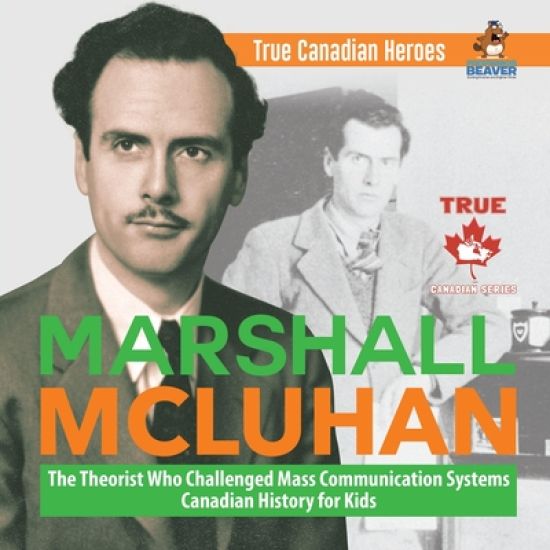
This collection contains key critical essays and assessments of the writings of Canadian communications thinker Marshall McLuhan selected from the voluminous output of the past forty years. McLuhan's famous aphorisms and uncanny ability to sense megatrends are once again in circulation across and beyond the disciplines. Since his untimely death in 1980, McLuhan's ideas have been rediscovered and redeployed with urgency in the age of information and cybernation.Together the three volumes organise and present some forty years of indispensable critical works for readers and researchers of the McLuhan legacy. The set includes critical introductions to each section by the editor.Forthcoming titles in this series include Walter Benjamin (0-415-32533-1) December 2004, 3 vols, Theodor Adorno (0-415-30464-4) April 2005, 4 vols and Jean-Francois Lyotard (0-415-33819-0) 2005, 3 vols.
Alfred Marshall was one of the most important economists ever to have lived. This excellent new book, from a Marshall expert respected the world over, attempts to show that Marshall anticipated some of the views that are now associated with the cognitive sciences. Examining Marshall's philosophy of the human mind, his overall approach to economics, his concern for socio-economic issues, and the fertility of his framework, this book breathes fresh life into the fascinating world of Marshallian economics.