Kirjojen hintavertailu. Mukana 11 244 527 kirjaa ja 12 kauppaa.

Kirjahaku

Etsi kirjoja tekijän nimen, kirjan nimen tai ISBN:n perusteella.

1000 tulosta hakusanalla Marshall Ganz

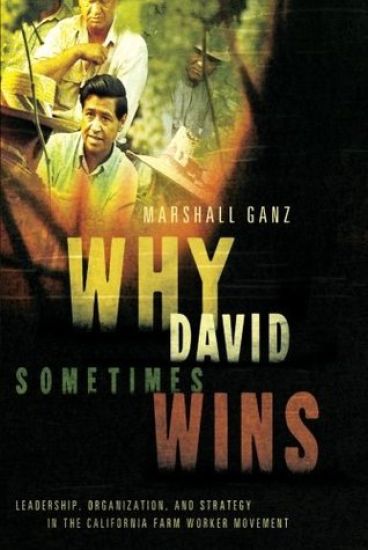
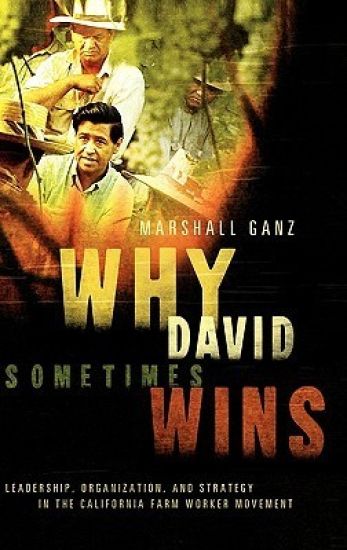
Why David Sometimes Wins

Why David Sometimes Wins

Marshall Ganz

Oxford University Press Inc
2009
sidottu
On April 10, 1966, a crowd of 10,000 farm workers and supporters gathered at the California state capitol to celebrate victory in one of the most significant strikes in American history--one that made Cesar Chavez famous as leader of the National Farm Workers Association, which later became the United Farm Workers (UFW). In Why David Sometimes Wins, Marshall Ganz tells the story of the UFW's ground-breaking victory, drawing out larger lessons from this dramatic tale. A longtime leader in the movement and current lecturer in public policy at Harvard, he offers unique insight. Since the 1900s, large-scale agricultural enterprises had relied on migrant labor--a cheap, unorganized, and powerless workforce. In 1965, after successive waves of attempts at organizing this large and growing population, the AFL-CIO, the Teamsters, and the three-year-old NFWA all found themselves on the ground, recruiting members. That year, some 800 Filipino grape workers began a strike, under the aegis of the AFL-CIO. The UFW soon joined the action with some 2,000 Mexican workers. The UFW's leaders turned the strike into a kind of civil rights struggle; they engaged in civil disobedience, mobilized support from churches and students, boycotted growers, and transformed itself into La Causa, a farm workers' movement that eventually triumphed over the grape industry's Goliath. Why did they succeed? How can the powerless challenge the powerful successfully? Ganz points to three elements: the greater motivation of its leaders, their ties to the community and access to grass-roots knowledge, and their open and deliberative decision-making process. In total, the ability to devise good strategy and turn short-term advantages into long-term gains. As both an insider and scholar, Ganz provides insight unavailable anywhere else. Authoritative in scholarship and magisterial in scope, this book constitutes a seminal contribution to the movement's struggles and ultimate success.
People, Power, Change

People, Power, Change

Marshall Ganz

OXFORD UNIVERSITY PRESS INC
2024
sidottu
At a moment when our democratic abilities seem to have eroded, and political, economic, and technological forces have weakened the capacity for collective action, People, Power, Change is a once-in-a-generation book for anyone who wants to create real and lasting change. Marshall Ganz is one of the world's leading authorities on democratic organizing, and this book is the culmination of his decades of teaching, research, and work. In People, Power, Change, Ganz distills for students, practitioners, and activists the principles he has gleaned over the last half-century of creating collective action. Ganz explores the forces, craft, and learned skill of organizing and provides an actionable framework for how to actually do it. He focuses the book on the creation and substance of relationships, the fuel of values and narrative, the resources and power of strategy, the necessity of structure, and the accountability of action. Across these five organizing ideas, Ganz weaves in his personal experiences from a lifetime of organizing in iconic social movements and campaigns to illustrate how collective action actually works and to build the practices and skills that must be developed to do it with intention and with success.
Why David Sometimes Wins

Why David Sometimes Wins

Marshall Ganz

Oxford University Press Inc
2010
nidottu
Why David Sometimes Wins tells the story of Cesar Chavez and the United Farm Workers' groundbreaking victory, drawing important lessons from this dramatic tale. Since the 1900s, large-scale agricultural enterprises relied on migrant labor--a cheap, unorganized, and powerless workforce. In 1965, when some 800 Filipino grape workers began to strike under the aegis of the AFL-CIO, the UFW soon joined the action with 2,000 Mexican workers and turned the strike into a civil rights struggle. They engaged in civil disobedience, mobilized support from churches and students, boycotted growers, and transformed their struggle into La Causa, a farm workers' movement that eventually triumphed over the grape industry's Goliath. Why did they succeed? How can the powerless challenge the powerful successfully? Offering insight from a longtime movement organizer and scholar, Ganz illustrates how they had the ability and resourcefulness to devise good strategy and turn short-term advantages into long-term gains. Authoritative in scholarship and magisterial in scope, this book constitutes a seminal contribution to learning from the movement's struggles, set-backs, and successes. "A brilliant new book. "-Peter Dreier, The Nation "Why David Sometimes Wins is an exceptional book that will be of widespread interest to scholars and activists alike. "-Howard Kimeldorf, American Journal of Sociology "This book is a must read for organizers. The analysis of how a small and poor, but motivated, group of workers triggered a social movement provides invaluable lessons on what to do and not do as we struggle with the challenges of the 21st century. "-Andy Stern, President, Service Employees International Union "How does David defeat Goliath and, equally important, avoid becoming Goliath? The answer is to develop strategic capacity, an ongoing interactive process of experimentation, learning, and adapting. This fascinating book shows how Cesar Chavez and the UFW created and then lost its strategic capacity-an important lesson on leadership and organization. "-Joseph S. Nye, Jr., Harvard University "Through unforgettable and compelling stories, Marshall Ganz convincingly shows how we need not wait for the right time in history, but how we can all participate in making history together and how the resources to do so can be found in one another. Why David Sometimes Wins will enter the canon of readings on social change. Get this book. Read it. Use it! "-Gerald Torres, co-author of The Miner's Canary
What a Mighty Power We Can Be

What a Mighty Power We Can Be

Theda Skocpol; Ariane Liazos; Marshall Ganz

Princeton University Press
2008
pokkari
From the nineteenth through the mid-twentieth centuries, millions of American men and women participated in fraternal associations--self-selecting brotherhoods and sisterhoods that provided aid to members, enacted group rituals, and engaged in community service. Even more than whites did, African Americans embraced this type of association; indeed, fraternal lodges rivaled churches as centers of black community life in cities, towns, and rural areas alike. Using an unprecedented variety of secondary and primary sources--including old documents, pictures, and ribbon-badges found in eBay auctions--this book tells the story of the most visible African American fraternal associations. The authors demonstrate how African American fraternal groups played key roles in the struggle for civil rights and racial integration. Between the 1890s and the 1930s, white legislatures passed laws to outlaw the use of important fraternal names and symbols by blacks. But blacks successfully fought back. Employing lawyers who in some cases went on to work for the NAACP, black fraternalists took their cases all the way to the Supreme Court, which eventually ruled in their favor. At the height of the modern Civil Rights movement in the 1950s and 1960s, they marched on Washington and supported the lawsuits through lobbying and demonstrations that finally led to legal equality. This unique book reveals a little-known chapter in the story of civic democracy and racial equality in America.
Wrong Turn at Lungfish

Wrong Turn at Lungfish

Garry Marshall; Lowell Ganz

SAMUEL FRENCH LTD
2017
pokkari
Audiences in Chicago, Los Angeles, and New York, where George C. Scott starred, applauded the comedy and the drama of Wrong Turn at Lungfish, the story of a blind and bitter college professor and his encounter with a saucy, streetwise young woman who volunteers to read to him in the hospital. The clash of intellect and wit takes the two from animosity and fear to friendship and understanding. Both come to their relationship with questions, hers dealing with her station in life a
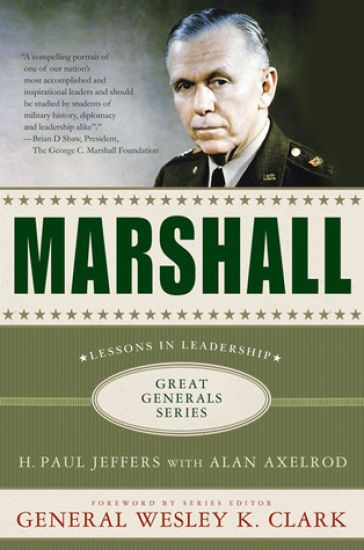
Marshall

Marshall

H. Paul Jeffers; Alan Axelrod; Wesley K. Clark

Palgrave Macmillan
2011
nidottu
General George C. Marshall was a skillful and compassionate leader with a unique legacy. He never fired a shot during WWII and led no troops into battle - his brilliance was purely strategic and diplomatic, and incredibly effective. He was responsible for the building, supplying, and, in part, the deployment of over eight million soldiers. In 1947, as Secretary of State, he created the Marshall Plan, a sweeping economic recovery effort that pulled the war-shattered European nations out of ruin, and gave impetus to NATO and the European Common Market. It was for the Marshall Plan that he won the Nobel Peace Prize - the only time in history a military commander has ever been awarded this honor. Marshall's skilled combination of military strategy and politics, emphasis on planning as well as execution, and his expertise in nation-building holds lessons for military and civilian leaders today.
Marshall

Marshall

H. Paul Jeffers; Wesley K. Clark

Palgrave Macmillan
2010
sidottu
Of all the honored military commanders in American history, George C. Marshall is the only one who never led a large force in the field. Yet he came close to receiving the most coveted post of all - Supreme Commander of the Allied force that invaded France on the most famous of all D-Days, June 6, 1944. Marshall, who was then Chief of Staff of the army, clearly wanted the job. But the long-retired Pershing, who still wielded much influence, had other ideas; precisely because of his great admiration for Marshall, he told Roosevelt that it would be a "very grave error" to send the Chief of Staff away from Washington. Roosevelt, after offering the general a pro forma chance to request the appointment, gave the Supreme Command to General Eisenhower. One of the great contributions Marshall brought to the table as Chief of Staff was his study of the possibilities of coalitions and his advocacy of turning alliances into genuine unified partnerships. Marshall, who became Chief of Staff in 1939, felt the burden of turning a tiny army, not much more than a constabulary force, into a mighty machine capable of fighting on battlefields thousands of miles apart. In the realm of strategy, his focus became known as "Germany first": regardless of other considerations, take the fight to the most dangerous enemy, wage war as efficiently as possible, and then turn on other foes. It was only much later, after his brief retirement, that President Truman offered Marshall the position of Secretary of State, which resulted in the Marshall Plan, the achievement for which he is now best known and that holds many lessons for leaders today.
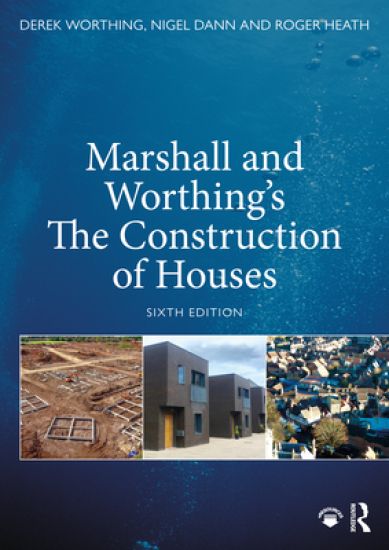
Marshall and Worthing's The Construction of Houses

Marshall and Worthing's The Construction of Houses

Derek Worthing; Nigel Dann; Roger Heath; Duncan Marshall

Routledge
2021
sidottu
The sixth edition of The Construction of Houses builds on the success of the previous five editions. The book provides a comprehensive introduction to the principles and processes of the construction of houses and their services. As such it is aimed at providing a broad understanding of domestic building construction for students as part of their academic studies and as a useful information source for practitioners. The existing chapters have all been updated and most of them expanded to take account of changes to dwelling house construction since the last edition and there are new chapters on ‘Modern Methods of Construction’ and ‘Regulatory controls and building standards’. Additionally, many new and/or updated photographs and diagrams have been added.As with the previous editions, the authors have concentrated on presenting current mainstream approaches to the construction of houses. The detailed, yet accessible, text that is supported by hundreds of coloured photographs and diagrams provides clear explanations of the many complex processes that go into the building of a house. A deeper insight into modern construction is also given by the book’s consideration of historical building techniques from the 18th century onwards in order to illustrate how and why we build houses in the way we do now.
Marshall and Worthing's The Construction of Houses

Marshall and Worthing's The Construction of Houses

Derek Worthing; Nigel Dann; Roger Heath; Duncan Marshall

Routledge
2021
nidottu
The sixth edition of The Construction of Houses builds on the success of the previous five editions. The book provides a comprehensive introduction to the principles and processes of the construction of houses and their services. As such it is aimed at providing a broad understanding of domestic building construction for students as part of their academic studies and as a useful information source for practitioners. The existing chapters have all been updated and most of them expanded to take account of changes to dwelling house construction since the last edition and there are new chapters on ‘Modern Methods of Construction’ and ‘Regulatory controls and building standards’. Additionally, many new and/or updated photographs and diagrams have been added.As with the previous editions, the authors have concentrated on presenting current mainstream approaches to the construction of houses. The detailed, yet accessible, text that is supported by hundreds of coloured photographs and diagrams provides clear explanations of the many complex processes that go into the building of a house. A deeper insight into modern construction is also given by the book’s consideration of historical building techniques from the 18th century onwards in order to illustrate how and why we build houses in the way we do now.
Marshall's Evolutionary Economics

Marshall's Evolutionary Economics

Tiziano Raffaelli

Routledge
2002
sidottu
Alfred Marshall was one of the most important economists ever to have lived. This excellent new book, from a Marshall expert respected the world over, attempts to show that Marshall anticipated some of the views that are now associated with the cognitive sciences. Examining Marshall's philosophy of the human mind, his overall approach to economics, his concern for socio-economic issues, and the fertility of his framework, this book breathes fresh life into the fascinating world of Marshallian economics.
Marshall McLuhan
This collection contains key critical essays and assessments of the writings of Canadian communications thinker Marshall McLuhan selected from the voluminous output of the past forty years. McLuhan's famous aphorisms and uncanny ability to sense megatrends are once again in circulation across and beyond the disciplines. Since his untimely death in 1980, McLuhan's ideas have been rediscovered and redeployed with urgency in the age of information and cybernation.Together the three volumes organise and present some forty years of indispensable critical works for readers and researchers of the McLuhan legacy. The set includes critical introductions to each section by the editor.Forthcoming titles in this series include Walter Benjamin (0-415-32533-1) December 2004, 3 vols, Theodor Adorno (0-415-30464-4) April 2005, 4 vols and Jean-Francois Lyotard (0-415-33819-0) 2005, 3 vols.
Marshall's Evolutionary Economics

Marshall's Evolutionary Economics

Tiziano Raffaelli

Routledge
2006
nidottu
Alfred Marshall was one of the most important economists ever to have lived. This excellent new book, from a Marshall expert respected the world over, attempts to show that Marshall anticipated some of the views that are now associated with the cognitive sciences. Examining Marshall's philosophy of the human mind, his overall approach to economics, his concern for socio-economic issues, and the fertility of his framework, this book breathes fresh life into the fascinating world of Marshallian economics.
Marshall, Marshallians and Industrial Economics
The four sections of the book deal in succession with Marshall’s key ideas on the subject, the wider context of his thought in which they are to be read, their later development by some of his pupils, and their revival in contemporary economics. The first and last sections work together to illustrate the evolutionary focus of Marshall’s research program and to identify its affinity with modern industrial economics; the second explicates the social assumptions within which the Marshallian paradigm was embedded, in particular those relating to the various relationships that exist between individuals and wider groups; while the third traces the development of Marshall’s views by some of his pupils.