Kirjojen hintavertailu. Mukana 11 417 157 kirjaa ja 12 kauppaa.

Kirjahaku

Etsi kirjoja tekijän nimen, kirjan nimen tai ISBN:n perusteella.

1000 tulosta hakusanalla Marshall Soules

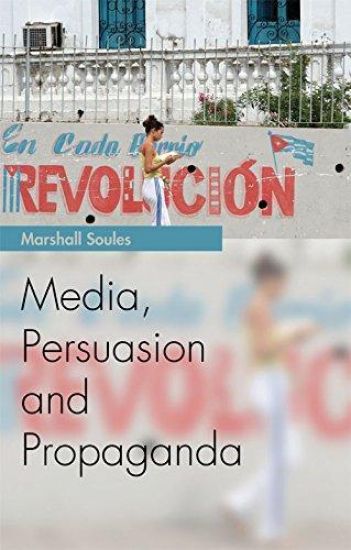
Media, Persuasion and Propaganda

Media, Persuasion and Propaganda

Marshall Soules

Edinburgh University Press
2015
nidottu
This is an eclectic, interdisciplinary overview of persuasive strategies and propaganda techniques. Living in a saturated media environment, we are crowded from all sides by persuasive messages and information. Advice, promotion and propaganda form a spectrum of persuasion - and everywhere we see it performed in its full theatricality, complete with actors, scripts, props and costumes. Media, Persuasion and Propaganda guides the reader through the many varieties of persuasion and its performance, exploring the protocols of rhetoric unique to the medium, from orality and print to film and digital images. Using case studies and exercises, this innovative study poses challenging questions: How do individuals and organisations exert influence to build communities and networks? What role do media play in communicating persuasive messages? How do we use recent discoveries in cognitive science to promote a cause, advocate social change or market ideas and products? How do we defend ourselves against manipulation and undue influence and when does persuasion turn into propaganda? It uses global examples and case studies to define the spectrum of persuasion, from promotion to propaganda. It examines the performance of propaganda, from orality to new media. It includes exercises in each chapter to reinforce the key themes and promote discussion. 1. Orientalism: it explores western scholarly and media portrayals of the Orient the Middle East, North Africa, and Islam for ideological purposes; 2. Abu Ghraib Exposed; it examines the disturbing images which emerged in the US media in 2004 exposing the torture of Iraqi prisoners by the American military and CIA operatives in Abu Ghraib prison, Baghdad; 3. PR and Climate Change: it delves into Cuba's Revolutionary Landscape to look at the presentation of climate issues; 4. The Power of Nightmares; British filmmaker Adam Curtis argues that the global 'War on Terror' is based on a myth providing politicians with their power to govern; and; 5. Rupert Murdoch and his News Corporation Scanda. It also includes: 6. The Israel Lobby: In March 2009, British MP George Galloway was denied entry into Canada because he supported Hamas, an elected political party in Gaza identified as a terrorist organisation by the Canadian government. Soules examines the pro Israel lobby as a significant source of flak challenging media reports on Israeli Palestinian relations; 7. Fox News: raises issues about journalistic ethics and management interference, especially when that interference is sustained, partisan, and inflammatory; and 8. Ai Wei Wei: Never Sorry. In his notorious 1995 performance piece, dissident Chinese artist Ai Wei Wei photographed himself dropping an ancient Han Dynasty urn which smashed at his feet. This case study explores the aftermath and how Ai Wei Wei became a hero of dissent for critics of China's human rights policies.
Media, Persuasion and Propaganda

Media, Persuasion and Propaganda

Marshall Soules

Edinburgh University Press
2015
sidottu
Living in a saturated media environment, we are crowded from all sides by persuasive messages and information. Advice, promotion and propaganda form a spectrum of persuasion, and everywhere we see it performed in its full theatricality, complete with actors, scripts, props and costumes.Based on enduring rhetorical principles, these persuasive techniques and the psychology behind them have become increasingly sophisticated during the 'age of persuasion', a century of applied research in advertising, advocacy, public relations, mass entertainment and social control. Media, Persuasion and Propaganda guides the reader through the many varieties of persuasion and its performance, exploring the protocols of rhetoric unique to the medium, from orality and print to film and digital images. Using case studies and exercises, this innovative study poses challenging questions, such as: How do individuals and organisations exert influence to build communities and networks? What role do media play in communicating persuasive messages? How do we use recent discoveries in cognitive science to promote a cause, advocate social change or market ideas and products? How do we defend ourselves against manipulation and undue influence, and when does persuasion turn into propaganda?
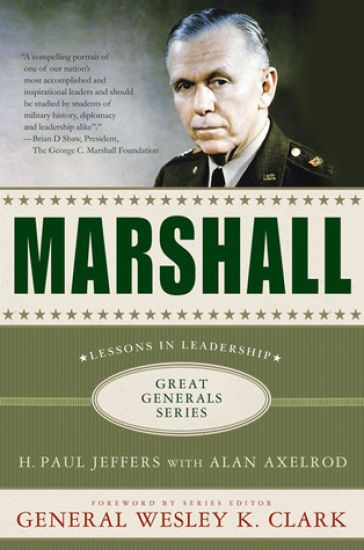
Marshall

Marshall

H. Paul Jeffers; Alan Axelrod; Wesley K. Clark

Palgrave Macmillan
2011
nidottu
General George C. Marshall was a skillful and compassionate leader with a unique legacy. He never fired a shot during WWII and led no troops into battle - his brilliance was purely strategic and diplomatic, and incredibly effective. He was responsible for the building, supplying, and, in part, the deployment of over eight million soldiers. In 1947, as Secretary of State, he created the Marshall Plan, a sweeping economic recovery effort that pulled the war-shattered European nations out of ruin, and gave impetus to NATO and the European Common Market. It was for the Marshall Plan that he won the Nobel Peace Prize - the only time in history a military commander has ever been awarded this honor. Marshall's skilled combination of military strategy and politics, emphasis on planning as well as execution, and his expertise in nation-building holds lessons for military and civilian leaders today.
Marshall

Marshall

H. Paul Jeffers; Wesley K. Clark

Palgrave Macmillan
2010
sidottu
Of all the honored military commanders in American history, George C. Marshall is the only one who never led a large force in the field. Yet he came close to receiving the most coveted post of all - Supreme Commander of the Allied force that invaded France on the most famous of all D-Days, June 6, 1944. Marshall, who was then Chief of Staff of the army, clearly wanted the job. But the long-retired Pershing, who still wielded much influence, had other ideas; precisely because of his great admiration for Marshall, he told Roosevelt that it would be a "very grave error" to send the Chief of Staff away from Washington. Roosevelt, after offering the general a pro forma chance to request the appointment, gave the Supreme Command to General Eisenhower. One of the great contributions Marshall brought to the table as Chief of Staff was his study of the possibilities of coalitions and his advocacy of turning alliances into genuine unified partnerships. Marshall, who became Chief of Staff in 1939, felt the burden of turning a tiny army, not much more than a constabulary force, into a mighty machine capable of fighting on battlefields thousands of miles apart. In the realm of strategy, his focus became known as "Germany first": regardless of other considerations, take the fight to the most dangerous enemy, wage war as efficiently as possible, and then turn on other foes. It was only much later, after his brief retirement, that President Truman offered Marshall the position of Secretary of State, which resulted in the Marshall Plan, the achievement for which he is now best known and that holds many lessons for leaders today.
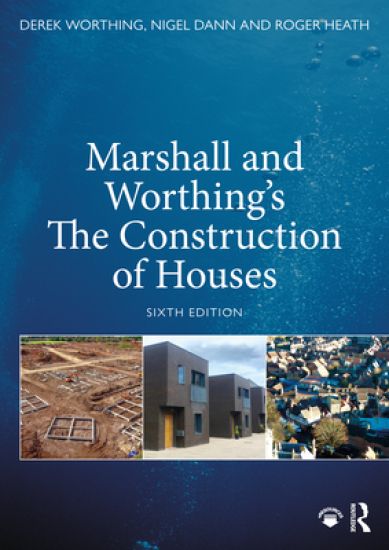
Marshall and Worthing's The Construction of Houses

Marshall and Worthing's The Construction of Houses

Derek Worthing; Nigel Dann; Roger Heath; Duncan Marshall

Routledge
2021
sidottu
The sixth edition of The Construction of Houses builds on the success of the previous five editions. The book provides a comprehensive introduction to the principles and processes of the construction of houses and their services. As such it is aimed at providing a broad understanding of domestic building construction for students as part of their academic studies and as a useful information source for practitioners. The existing chapters have all been updated and most of them expanded to take account of changes to dwelling house construction since the last edition and there are new chapters on ‘Modern Methods of Construction’ and ‘Regulatory controls and building standards’. Additionally, many new and/or updated photographs and diagrams have been added.As with the previous editions, the authors have concentrated on presenting current mainstream approaches to the construction of houses. The detailed, yet accessible, text that is supported by hundreds of coloured photographs and diagrams provides clear explanations of the many complex processes that go into the building of a house. A deeper insight into modern construction is also given by the book’s consideration of historical building techniques from the 18th century onwards in order to illustrate how and why we build houses in the way we do now.
Marshall and Worthing's The Construction of Houses

Marshall and Worthing's The Construction of Houses

Derek Worthing; Nigel Dann; Roger Heath; Duncan Marshall

Routledge
2021
nidottu
The sixth edition of The Construction of Houses builds on the success of the previous five editions. The book provides a comprehensive introduction to the principles and processes of the construction of houses and their services. As such it is aimed at providing a broad understanding of domestic building construction for students as part of their academic studies and as a useful information source for practitioners. The existing chapters have all been updated and most of them expanded to take account of changes to dwelling house construction since the last edition and there are new chapters on ‘Modern Methods of Construction’ and ‘Regulatory controls and building standards’. Additionally, many new and/or updated photographs and diagrams have been added.As with the previous editions, the authors have concentrated on presenting current mainstream approaches to the construction of houses. The detailed, yet accessible, text that is supported by hundreds of coloured photographs and diagrams provides clear explanations of the many complex processes that go into the building of a house. A deeper insight into modern construction is also given by the book’s consideration of historical building techniques from the 18th century onwards in order to illustrate how and why we build houses in the way we do now.
Marshall's Evolutionary Economics

Marshall's Evolutionary Economics

Tiziano Raffaelli

Routledge
2002
sidottu
Alfred Marshall was one of the most important economists ever to have lived. This excellent new book, from a Marshall expert respected the world over, attempts to show that Marshall anticipated some of the views that are now associated with the cognitive sciences. Examining Marshall's philosophy of the human mind, his overall approach to economics, his concern for socio-economic issues, and the fertility of his framework, this book breathes fresh life into the fascinating world of Marshallian economics.