Kirjojen hintavertailu. Mukana 11 213 693 kirjaa ja 12 kauppaa.

Kirjahaku

Etsi kirjoja tekijän nimen, kirjan nimen tai ISBN:n perusteella.

1000 tulosta hakusanalla Martin Roland Pixner

School Was Our Life

School Was Our Life

Jane Roland Martin

Indiana University Press
2018
sidottu
The late 1930s and early 1940s were the peak of progressive education in the United States, and Elisabeth Irwin's Little Red School House in New York City was iconic in that movement. For the first time, stories and recollections from students who attended Little Red during this era have been collected by author Jane Roland Martin. Now in their late eighties, these classmates can still sing the songs they learned in elementary school and credit the progressive education they loved with shaping their outlooks and life trajectories. Martin frames these stories from the former students "tell it like it was" point of view with philosophical commentary, bringing to light the underpinnings of the kind of progressive education employed at Little Red and commenting critically on the endeavor. In a time when the role of the arts in education and public schooling itself are under attack in the United States, Martin makes a case for a different style of education designed for the defense of democracy and expresses hope that an education like hers can become an opportunity for all.
School Was Our Life

School Was Our Life

Jane Roland Martin

Indiana University Press
2018
pokkari
The late 1930s and early 1940s were the peak of progressive education in the United States, and Elisabeth Irwin's Little Red School House in New York City was iconic in that movement. For the first time, stories and recollections from students who attended Little Red during this era have been collected by author Jane Roland Martin. Now in their late eighties, these classmates can still sing the songs they learned in elementary school and credit the progressive education they loved with shaping their outlooks and life trajectories. Martin frames these stories from the former students "tell it like it was" point of view with philosophical commentary, bringing to light the underpinnings of the kind of progressive education employed at Little Red and commenting critically on the endeavor. In a time when the role of the arts in education and public schooling itself are under attack in the United States, Martin makes a case for a different style of education designed for the defense of democracy and expresses hope that an education like hers can become an opportunity for all.
Reclaiming a Conversation

Reclaiming a Conversation

Jane Roland Martin

Yale University Press
1987
pokkari
In this book Jane Roland Martin joins in conversation with five philosophers—Plato, Rousseau, Mary Wollstonecraft, Catharine Beecher, and Charlotte Perkins Gilman—about how women should be educated in an ideal society, and she draws out implications for the education of both sexes today.“A timely and important contribution both to feminist theory and to the philosophy of education.”—Carol Gilligan, Harvard University“Fascinating. . . . The juxtaposition of views, together with Martin’s critical comparisons, illuminates each account.”—Martha Nussbaum, New York Review of Books“Martin’s careful work shows [that]. . . a serious effort to design ideal education for women makes it necessary also to rethink men’s schooling. This is an important book.”—Library Journal“Martin has provided a uniquely valuable service to educators.”—Sandra Harding, Journal of Education“This is a decidedly intelligent and well-written book.”—Margaret Canovan, Times Higher Education Supplement“The book ends with questions rather than answers: how best can each of us reflect all things human in our own lives, and how can education prepare us to do so effectively? The great strength of Martin’s work is the historical resonance that it gives both to these questions and the understanding of their fundamental importance for men and women alike.”—Margaret Rouse Bates, SignsSelected as an American Educational Studies Association’s “Critics Choice” book for 1986
Education Reconfigured

Education Reconfigured

Jane Roland Martin

Routledge
2011
sidottu
As philosophers throughout the ages have asked: What is justice? What is truth? What is art? What is law? In Education Reconfigured, the internationally acclaimed philosopher of education, Jane Roland Martin, now asks: What is education? In answer, she puts forward a unified theory that casts education in a brand new light. Martin’s "theory of education as encounter" places culture alongside the individual at the heart of the educational process, thus responding to the call John Dewey made over a century ago for an enlarged outlook on education. Look through her theory’s lens and you can see that education takes place not only in school but at home, on the street, in the mall—everywhere and all the time. Look through that lens and you can see that education does not always spell improvement; rather, it can be for the better or the worse. Indeed, you can see that education is inevitably a maker and shaper of both individuals and cultures. Above all, Martin’s new educational paradigm reveals that education is too important to be left solely to the professionals; that it is one of the great forces in human society and, as such, deserves the attention and demands the vigilance of every thoughtful person.
Education Reconfigured

Education Reconfigured

Jane Roland Martin

Routledge
2011
nidottu
As philosophers throughout the ages have asked: What is justice? What is truth? What is art? What is law? In Education Reconfigured, the internationally acclaimed philosopher of education, Jane Roland Martin, now asks: What is education? In answer, she puts forward a unified theory that casts education in a brand new light. Martin’s "theory of education as encounter" places culture alongside the individual at the heart of the educational process, thus responding to the call John Dewey made over a century ago for an enlarged outlook on education. Look through her theory’s lens and you can see that education takes place not only in school but at home, on the street, in the mall—everywhere and all the time. Look through that lens and you can see that education does not always spell improvement; rather, it can be for the better or the worse. Indeed, you can see that education is inevitably a maker and shaper of both individuals and cultures. Above all, Martin’s new educational paradigm reveals that education is too important to be left solely to the professionals; that it is one of the great forces in human society and, as such, deserves the attention and demands the vigilance of every thoughtful person.
Changing the Educational Landscape

Changing the Educational Landscape

Jane Roland Martin

Routledge
1993
nidottu
Changing the Educational Landscape is a collection of the best-known and best-loved essays by the renowned feminist philosopher of education, Jane Roland Martin. Trained as an analytic philosopher at a time before women or feminist ideas were welcome in the field, Martin brought a philosopher's detachment to her earliest efforts at revolutionizing the curriculum. Her later essays on women and gender further showcase the tremendous intellectual energy she brought to the field of feminist educational theory. Martin explores the challenges and contradictions posed by the very concept of women's education, and also recognizes how the presence of women necessitates the rearticulation of not only the curriculum but also the standard ideologies in education.
Coming of Age in Academe

Coming of Age in Academe

Jane Roland Martin

Routledge
1999
sidottu
First Published in 2000. At what price entry? Philosopher of education Jane Roland Martin contends that feminist scholars have traded in their idealism for a place in the academy. In Coming of Age in Academe, she looks at the ways that academic feminists have become estranged from women. Determining that this is the membership fee the academy exacts on all its members, she calls for the academy's transformation. Part one explores the chilly research climate for feminist scholars, the academic traps of essentialism and aerial distance, and the education gap in the feminist text. In part two, Martin likens the behavior of present-day feminist scholars to nineteenth-century immigrants to the United States and examines their assimilation into the world of work, politics and the professions. She finds that when you look at higher education, you see what a brutal filter of women it is. Part three highlights the academy's brain drain and its containment of women and then proposes actions both great and small that aim at fundamental change. In this rousing call to action, Martin concludes that the dissociation from women that the academy demands--its entrance fee--can only be stopped by radically reforming the gendered system on which the academy is based.
Coming of Age in Academe

Coming of Age in Academe

Jane Roland Martin

Routledge
1999
nidottu
First Published in 2000. At what price entry? Philosopher of education Jane Roland Martin contends that feminist scholars have traded in their idealism for a place in the academy. In Coming of Age in Academe, she looks at the ways that academic feminists have become estranged from women. Determining that this is the membership fee the academy exacts on all its members, she calls for the academy's transformation. Part one explores the chilly research climate for feminist scholars, the academic traps of essentialism and aerial distance, and the education gap in the feminist text. In part two, Martin likens the behavior of present-day feminist scholars to nineteenth-century immigrants to the United States and examines their assimilation into the world of work, politics and the professions. She finds that when you look at higher education, you see what a brutal filter of women it is. Part three highlights the academy's brain drain and its containment of women and then proposes actions both great and small that aim at fundamental change. In this rousing call to action, Martin concludes that the dissociation from women that the academy demands--its entrance fee--can only be stopped by radically reforming the gendered system on which the academy is based.
The Schoolhome

The Schoolhome

Jane Roland Martin

Harvard University Press
1995
nidottu
Drawing selectively from reform movements of the past and relating them to the unique needs of today’s parents and children, Jane Martin presents a philosophy of education that is responsive to America’s changed and changing realities. As more and more parents enter the workforce, the historic role of the domestic sphere in the education and development of children is drastically reduced. Consequently, Martin advocates removing the barriers between the school and the home.
Educational Metamorphoses

Educational Metamorphoses

Jane Roland Martin

Rowman Littlefield Publishers
2006
sidottu
A preeminent philosopher of education in the United States, Jane Roland Martin challenges conventional wisdom that education consists of small, incremental changes within a student's life. Using case studies of personal transformations, or metamorphoses, Martin examines Malcolm X, George Bernard Shaw's Eliza Doolittle, Victor - the Wild Boy of Aveyron, Minik the Inuit Child, and several others to demonstrate how substantial personal change can be and how vital education is as a fundamental determinant of the human condition. Martin's study results in three important claims: that each of us undergoes personal metamorphoses as a result of education; that these changes can result in a radically altered identity and can therefore be either good or bad; and that each change constitutes a culture crossing which can be accompanied by feelings of guilt, accusations of betrayal, alienation, and a sense of loss.
Educational Metamorphoses

Educational Metamorphoses

Jane Roland Martin

Rowman Littlefield Publishers
2006
nidottu
A preeminent philosopher of education in the United States, Jane Roland Martin challenges conventional wisdom that education consists of small, incremental changes within a student's life. Using case studies of personal transformations, or metamorphoses, Martin examines Malcolm X, George Bernard Shaw's Eliza Doolittle, Victor - the Wild Boy of Aveyron, Minik the Inuit Child, and several others to demonstrate how substantial personal change can be and how vital education is as a fundamental determinant of the human condition. Martin's study results in three important claims: that each of us undergoes personal metamorphoses as a result of education; that these changes can result in a radically altered identity and can therefore be either good or bad; and that each change constitutes a culture crossing which can be accompanied by feelings of guilt, accusations of betrayal, alienation, and a sense of loss.
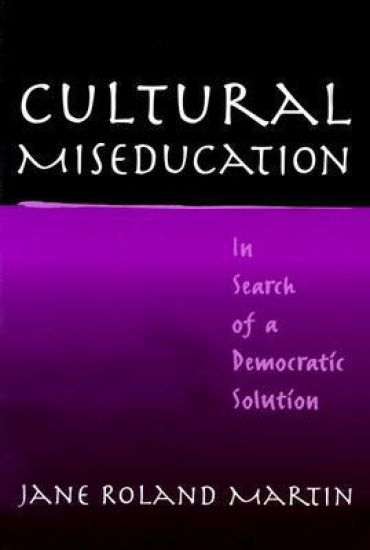
Cultural Miseducation

Cultural Miseducation

Jane Roland Martin

Teachers' College Press
2002
nidottu
In this engaging and accessible volume, Jane Roland Martin develops a brilliantly innovative approach to education that illuminates one of the most pressing issues of our day - the passing down of ""cultural liabilities,"" such as violence in the home, school, and world at large and hatred of other races, religions, genders, ethnicities, or sexual orientations. By encouraging readers to look at education from the standpoint of culture, new questions emerge: How is a culture's wealth to be defined? Who is qualified to contribute to it? How can we preserve a culture's assets for the next generation? Cultural Miseducation: Constructs a new framework for viewing education, school, and curriculum. Develops more inclusive, democratic definitions of culture and citizenship. Expands the concept of educational agency to include all groups and institutions in our society. Covers such important issues as a national curriculum, violence in the media, hate speech, censorship, and standardized testing.
Preserving Planet Earth

Preserving Planet Earth

Jane Roland Martin

TAYLOR FRANCIS LTD
2024
nidottu
This book encourages readers to acknowledge humanity’s contribution to the environmental crisis, proposing a way forward by exploring the power of ordinary people to bring about large-scale cultural change.Is it possible for humankind to change its ways and shed the belief that the planet is ours to do with as we like? Internationally acclaimed philosopher of education Jane Roland Martin argues that "humancentrism" is a learned affair, and what is learned can be unlearned. Turning to the past to see how large-scale cultural change has occurred, she discovers a pattern in the achievements of such historical luminaries as Martin Luther, Mahatma Gandhi, Rosa Parks and Greta Thunberg that we too can follow. Drawing on history, philosophy, and literature as well as the natural and social sciences and hoping to mobilize readers to effective action, Martin employs an accessible and powerful rhetoric, with each chapter beginning with a scene from history written in dialogue form.This book calls on young and old to avert a looming tragedy of Aristotelian proportions--the demise of the “Mother Nature” that made it possible for our species to flourish. Thoroughly interdisciplinary in its approach, it will appeal to students and teachers as well as general readers interested in environmental studies, philosophy, and education.
Preserving Planet Earth

Preserving Planet Earth

Jane Roland Martin

TAYLOR FRANCIS LTD
2024
sidottu
This book encourages readers to acknowledge humanity’s contribution to the environmental crisis, proposing a way forward by exploring the power of ordinary people to bring about large-scale cultural change.Is it possible for humankind to change its ways and shed the belief that the planet is ours to do with as we like? Internationally acclaimed philosopher of education Jane Roland Martin argues that "humancentrism" is a learned affair, and what is learned can be unlearned. Turning to the past to see how large-scale cultural change has occurred, she discovers a pattern in the achievements of such historical luminaries as Martin Luther, Mahatma Gandhi, Rosa Parks and Greta Thunberg that we too can follow. Drawing on history, philosophy, and literature as well as the natural and social sciences and hoping to mobilize readers to effective action, Martin employs an accessible and powerful rhetoric, with each chapter beginning with a scene from history written in dialogue form.This book calls on young and old to avert a looming tragedy of Aristotelian proportions--the demise of the “Mother Nature” that made it possible for our species to flourish. Thoroughly interdisciplinary in its approach, it will appeal to students and teachers as well as general readers interested in environmental studies, philosophy, and education.
White Fear

White Fear

Roland Martin; Leah Lakins

Benbella Books
2022
sidottu
White fear is not new. It enabled the rise of Donald Trump. It’s behind the recent flood of restrictive voting laws disproportionately impacting people of colour. It’s why reactions to movements like Black Lives Matter and a football player taking a knee have been so negative and so strong. For two centuries, the deep-seated fear that many white people feel - of losing power, of losing economic standing, of losing a particular “way of life” - has been the driving force behind American politics and culture. And as we approach a future where white people will become a racial the minority in the US, something estimated to occur as early as 2043, that fear is only intensifying, festering, and becoming more visible. Are we destined for a violent clash? What can we do to step into our country’s inevitable future, without tearing ourselves apart in the process? Nationally renowned journalist and award-winning author Roland Martin has been sounding this alarm for more than a decade. In White Fear, he provides a primer on how white fear has shaped, and continues to shape, our democracy and our culture. He connects the separate puzzle pieces, from the Tea Party Movement and QAnon to the decline of white American optimism to the diminishing blue-collar workforce, to illuminate the larger picture of what will unfold in America over the next decade-plus, and offers a better way forward. If we want to create the kind of country that we’re all welcome in and proud to live in, we can no longer ignore white fear. To neutralise it - in our country and, for white readers, ourselves - we must first understand it. Only then can we recognise and dismantle it. And as the last few years have shown, we don’t have any time to lose.
Presque

Presque

Roland Martin

Roland Martin
2017
nidottu
Trop fauch pour partir d couvrir les tats-Unis, un hurluberlu s'invente un p riple am ricain travers la France. Un voyage foutraque en trains de marchandises, un r ve am ricain low-cost mais riche en rebondissements, cont par un compagnon de route lui aussi bien trange. Et cette question qui revient comme un refrain: apr s quoi courent-ils au juste, nos deux dr les de z bres ?
Bazar Moderne

Bazar Moderne

Roland Martin

978-2-9559983
2022
pokkari
Accus d'un meurtre qu'il n'a pas tout fait commis, Philistin Bonde, plombier-pisciniste de son tat, assiste depuis son box un proc s qui le d passe.Il sait pr cis ment ce qu'il lui reste faire: croiser les doigts.
Roland Barthes

Roland Barthes

Martin McQuillan

Red Globe Press
2011
sidottu
Roland Barthes was one of the most influential thinkers of the twentieth century, but why should the reader of today, or tomorrow, be concerned with him? Martin McQuillan provides a fresh perspective on Barthes, addressing his political and institutional inheritance and considering his work as the origins of a critical cultural studies.This stimulating study:- Provides a biographical consideration of Barthes' writing- Offers an extended reading of his 1957 text Mythologies as a text for our own time, drawing Barthes' work into a historical relation to the present- Examines his connection to what we call cultural studies- Features an annotated bibliography of Barthes' published workThought-provoking and insightful, Roland Barthes is essential reading for anyone who is interested in the writings of this key theorist and his continuing relevance in our post-9/11 world.