Kirjojen hintavertailu. Mukana 11 342 296 kirjaa ja 12 kauppaa.

Kirjahaku

Etsi kirjoja tekijän nimen, kirjan nimen tai ISBN:n perusteella.

1000 tulosta hakusanalla Mary Ann Beavis

Christian Goddess Spirituality

Christian Goddess Spirituality

Mary Ann Beavis

Routledge
2020
nidottu
This monograph focuses on "Christian Goddess Spirituality" (CGS), the phenomenon of (mostly) women who combine Christianity and Goddess Spirituality, including Wicca/Witchcraft. Mary Ann Beavis’s study provides ethnographic data and analysis on the lived religious experience of CGS practitioners, drawing on interviews of over 100 women who self-identify as combining Christianity and Goddess spirituality. Although CGS also has implications for Goddess Spirituality and related traditions (e.g., Neopaganism, Wicca), here, CGS is considered primarily as a phenomenon within Christianity. However, the study also shows that the fusion of Christian and Goddess spiritualties has had an impact on non-Christian feminist spirituality, since Goddess-worshippers have often constructed Christianity as the diametrical opposite and enemy of the Goddess, to the point that some refuse to admit the possibility that CGS is a valid spiritual path, or that it is even possible. In addition, biblical, Jewish and Christian images of the divine such as Sophia, Shekhinah, the Virgin Mary, and even Mary Magdalene, have found their way into the "Pagan" Goddess pantheon.The main themes of the study include: overlaps and differences between Christian feminist theology and CGS; the routes to CGS for individual practitioners, and their beliefs, practices and experiences; proto-denominational classifications ("spiritual paths") within CGS; CGS thealogy (Christian discourse about the female divine); and the future of CGS in social scientific and ecclesiological context. Christian Goddess Spirituality will be of interest to scholars of religion, especially those with interests in women and religion, feminist spiritualities, feminist theology/thealogy, alternative spiritualities, New Religious Movements, and emergent Christianities.
Christian Goddess Spirituality

Christian Goddess Spirituality

Mary Ann Beavis

Routledge
2015
sidottu
This monograph focuses on "Christian Goddess Spirituality" (CGS), the phenomenon of (mostly) women who combine Christianity and Goddess Spirituality, including Wicca/Witchcraft. Mary Ann Beavis’s study provides ethnographic data and analysis on the lived religious experience of CGS practitioners, drawing on interviews of over 100 women who self-identify as combining Christianity and Goddess spirituality. Although CGS also has implications for Goddess Spirituality and related traditions (e.g., Neopaganism, Wicca), here, CGS is considered primarily as a phenomenon within Christianity. However, the study also shows that the fusion of Christian and Goddess spiritualties has had an impact on non-Christian feminist spirituality, since Goddess-worshippers have often constructed Christianity as the diametrical opposite and enemy of the Goddess, to the point that some refuse to admit the possibility that CGS is a valid spiritual path, or that it is even possible. In addition, biblical, Jewish and Christian images of the divine such as Sophia, Shekhinah, the Virgin Mary, and even Mary Magdalene, have found their way into the "Pagan" Goddess pantheon.The main themes of the study include: overlaps and differences between Christian feminist theology and CGS; the routes to CGS for individual practitioners, and their beliefs, practices and experiences; proto-denominational classifications ("spiritual paths") within CGS; CGS thealogy (Christian discourse about the female divine); and the future of CGS in social scientific and ecclesiological context. Christian Goddess Spirituality will be of interest to scholars of religion, especially those with interests in women and religion, feminist spiritualities, feminist theology/thealogy, alternative spiritualities, New Religious Movements, and emergent Christianities.
Mark's Audience

Mark's Audience

Mary Ann Beavis

Bloomsbury Academic
2015
sidottu
Mark 4.11-12, the 'parable theory' passage, has probably been commented upon more often than any other section of Mark's Gospel. The saying has usually been interpreted as an authentic utterance of Jesus, which was subsequently misunderstood and misinterpreted by early Christians - including the evangelist Mark. The precise meaning of the mystery logion in the ministry of Jesus is notoriously elusive, since we have no information about the context in which it was spoken, or about the audience to which it was addressed. Much more, however, can be known about the interpretative context of the logion in Mark, since it is surrounded by passages that seem to echo the mystery saying. This study examines the complex web of literary relationships between Mark 4.11-12 and the Gospel as a whole. Dr Beavis's fresh interpretation is unusual in that she undertakes to interpret the Gospel of Mark, as far as possible, from the point of view of its 'historical' readers/audience. Chapters 1 and 2 of the book attempt to describe the 'community' for which the Gospel was written, and in the rest of the book, this socio-cultural setting is used to investigate the meaning of the mystery saying for the original readers/hearers of Mark.
Mark

Mark

Mary Ann Beavis; Mikeal Parsons; Charles Talbert

Baker Academic, Div of Baker Publishing Group
2011
nidottu
In this addition to the well-received Paideia series, Mary Ann Beavis examines cultural context and theological meaning in Mark. Paideia commentaries explore how New Testament texts form Christian readers by• attending to the ancient narrative and rhetorical strategies the text employs• showing how the text shapes theological convictions and moral habits• commenting on the final, canonical form of each New Testament book• focusing on the cultural, literary, and theological settings of the text• making judicious use of maps, photos, and sidebars in a reader-friendly formatStudents, pastors, and other readers will appreciate the insights that Beavis derives from interrogating the text through multiple perspectives.
Hebrews

Hebrews

Mary Ann Beavis; HyeRan Kim-Cragg

Liturgical Press
2015
sidottu
Hebrews seems like unpromising material for feminist interpretation, although it is the only New Testament writing for which female authorship has been seriously posited. Mary Ann Beavis and HyeRan Kim-Cragg highlight the similarities between Hebrews and the book of Wisdom/Sophia, which share cosmological, ethical, historical, and sapiential themes, revealing that Hebrews is in fact a submerged tradition of Sophia-Wisdom. They also tackle the sacrificial Christology of Hebrews, concluding that in its ancient context, far from symbolizing suffering and abjection, sacrifice was understood as celebratory and relational. Contributions from Filipina (Maricel and Marilou Ibita), Jewish (Justin Jaron Lewis), historical (Nancy Calvert-Koyzis), and First Nations (Marie Annharte Baker) perspectives bring additional scholarly, cultural, religious, and experiential wisdom to the commentary. From the Wisdom Commentary seriesFeminist biblical interpretation has reached a level of maturity that now makes possible a commentary series on every book of the Bible. It is our hope that Wisdom Commentary, by making the best of current feminist biblical scholarship available in an accessible format to ministers, preachers, teachers, scholars, and students, will aid all readers in their advancement toward God’s vision of dignity, equality, and justice for all.The aim of this commentary is to provide feminist interpretation of Scripture in serious, scholarly engagement with the whole text, not only those texts that explicitly mention women. A central concern is the world in front of the text, that is, how the text is heard and appropriated by women. At the same time, this commentary aims to be faithful to the ancient text, to explicate the world behind the text, where appropriate, and not impose contemporary questions onto the ancient texts. The commentary addresses not only issues of gender (which are primary in this project) but also those of power, authority, ethnicity, racism, and classism, which all intersect.Each volume incorporates diverse voices and differing interpretations from different parts of the world, showing the importance of social location in the process of interpretation and that there is no single definitive feminist interpretation of a text.
The First Christian Slave

The First Christian Slave

Mary Ann Beavis; Susan Elliott

Cascade Books
2021
sidottu
The slave Onesimus is the central figure in the letter to Philemon, but he remains silent throughout the discourse. Studies of the letter focus on whether or not Onesimus was a fugitive slave, and on the question of Paul's intentions for him: did he want Philemon to accept him back as a brother in faith; did he expect Philemon to return Onesimus to him for his own use; or was Paul hinting that Philemon should manumit Onesimus? This study centers on Onesimus as an intentional convert; the first Christian slave whose name we know. Using research about early Christian slavery, slavery in the Roman world, and comparative evidence from African-American slave narratives, this study starts from the assumption that Onesimus had his own motives and aspirations in pursuing his association with Paul, and reconstructs his voice using hints within and outside the text that suggest his agency and subjectivity.
Journal of Gospels and Acts Research

Journal of Gospels and Acts Research

Mary Ann Beavis; Francis Moloney

Sydney College of Divinity
2018
pokkari
Articles: 3 Editorial: Gospels Across Worlds 7 Mary Ann Beavis The Parable of the Talents (Matthew 25:14-30): Imagining a Slave's Perspective 22 Louise Gosbell The woman with the 'flow of blood' (Mark 5:25-34) and disability in the ancient world 44 Francis J. Moloney A Study of Mark 16:6-8 Hope in the Midst of Failure 55 James R. Harrison The Historical Jesus as 'Social Critic' An Investigation of Luke 6:27-36 77 Chris Spark Digging, Going Deep, Laying a Foundation: Luke 6:48, Ancient Building and Cultural Communication 86 Peter G. Bolt What Actually Happened on Resurrection Morning? A Clear and Simple Account 101 David Evans A Jerusalemite Source for the List of Nations in Acts 2?Reviews: 115 Wim J.C. Weren, Studies in Matthew's Gospel: Literary Design, Intertextuality and Social Setting 117 Jonathan T. Pennington. The Sermon on the Mount and Human Flourishing: A Theological Commentary 119 Bradley T. Johnson. The Form and Function of Mark 1:1-15: A Multi Disciplinary Approach to the Markan Prologue 121 Armin D. Baum, Detlef H usser, Emmanuel L. Rehfeld (eds.), Der j dische. Messias Jesus und sein j discher Apostel Paulus 124 Rhonda Burnette-Bletsch (ed.). The Bible in Motion: A Handbook of the Bible and Its Reception in Film Part I + II 128 Samuel Byrskog, Tom Holm n, Matti Kankaanniemi (eds.), The Identity of Jesus: Nordic Voices 131 Stephen S. Liggins, Many Convincing Proofs: Persuasive Phenomena Associated with Gospel Proclamation in Acts. 135 Brian J. Wright, Communal Reading in the Time of Jesus: A Window into Early Christian Reading Practices
1–2 Thessalonians

1–2 Thessalonians

Florence Morgan Gillman; Mary Ann Beavis; HyeRan Kim-Cragg

Liturgical Press
2016
sidottu
When Paul wrote First Thessalonians shortly after the recipients had accepted the Gospel, many significant issues had already arisen among them. Of great concern was the social complexity, and even persecution, they encountered because they had “turned to God from idols” (1:9). The countercultural stance of those earliest believers, and especially the impact that may have had for women, is addressed throughout this commentary. While Paul directs no remarks only to women in this letter, the ramifications of his preaching on their daily lives emerge vibrantly from the application of a feminist hermeneutics of suspicion to the text. While Second Thessalonians is a shorter letter, it has been disproportionately influential on Christian thought, especially apocalyptic doctrine and the “Protestant work ethic.” From a feminist perspective, it is androcentric, rhetorically manipulative, and even violent. In this commentary, Mary Ann Beavis and HyeRan Kim-Cragg explore this text from many angles to expose both constructive and destructive implications in the text. Notably, they suggest a perspective on the “afflictions” endured by the Thessalonian church that neither glorifies suffering nor wishes for revenge but rather sees the divine presence in women’s acts of compassion and care in circumstances of extreme duress and inhumanity.From the Wisdom Commentary series Feminist biblical interpretation has reached a level of maturity that now makes possible a commentary series on every book of the Bible. It is our hope that Wisdom Commentary, by making the best of current feminist biblical scholarship available in an accessible format to ministers, preachers, teachers, scholars, and students, will aid all readers in their advancement toward God’s vision of dignity, equality, and justice for all.The aim of this commentary is to provide feminist interpretation of Scripture in serious, scholarly engagement with the whole text, not only those texts that explicitly mention women. A central concern is the world in front of the text, that is, how the text is heard and appropriated by women. At the same time, this commentary aims to be faithful to the ancient text, to explicate the world behind the text, where appropriate, and not impose contemporary questions onto the ancient texts. The commentary addresses not only issues of gender (which are primary in this project) but also those of power, authority, ethnicity, racism, and classism, which all intersect.Each volume incorporates diverse voices and differing interpretations from different parts of the world, showing the importance of social location in the process of interpretation and that there is no single definitive feminist interpretation of a text.
Mary Ann in Autumn

Mary Ann in Autumn

Armistead Maupin

HARPER PERENNIAL
2011
nidottu
Inspiration for the Netflix Limited Series, Tales of the CityThe eighth novel in the beloved Tales of the City series, Armistead Maupin's best-selling San Francisco saga.Following the success of his New York Times bestseller Michael Tolliver Lives, Armistead Maupin's Mary Ann in Autumn is a touching portrait of friendship, family, and fresh starts, as the City by the Bay welcomes back Mary Ann Singleton, the beloved Tales of the City heroine who started it all. A new chapter begins in the lives of both Mary Ann and Michael "Mouse" Tolliver when she returns to San Francisco to rejoin her oldest friend after years in New York City... the reunion that fans of Maupin's beloved Tales of the City series have been awaiting for years.
Mary Ann in Autumn: A Tales of the City Novel

Mary Ann in Autumn: A Tales of the City Novel

Armistead Maupin

Harper Large Print
2010
nidottu
Inspiration for the Netflix Limited Series, Tales of the CityThe eighth novel in the beloved Tales of the City series, Armistead Maupin's best-selling San Francisco saga.Following the success of his New York Times bestseller Michael Tolliver Lives, Armistead Maupin's Mary Ann in Autumn is a touching portrait of friendship, family, and fresh starts, as the City by the Bay welcomes back Mary Ann Singleton, the beloved Tales of the City heroine who started it all. A new chapter begins in the lives of both Mary Ann and Michael "Mouse" Tolliver when she returns to San Francisco to rejoin her oldest friend after years in New York City... the reunion that fans of Maupin's beloved Tales of the City series have been awaiting for years.
Mary Ann Shadd Cary

Mary Ann Shadd Cary

OXFORD UNIVERSITY PRESS INC
2023
sidottu
This volume compiles writings by and about Mary Ann Shadd Cary, a nineteenth-century Black radical feminist, an abolitionist, suffragist, and one of the first Black woman newspaper editors in North America. Mary Ann Shadd Cary includes letters, newspaper articles, organizational records, and never-before-published handwritten notes and essay drafts that illustrate how Shadd Cary participated in major Africana philosophical debates during the nineteenth century. Racial uplift, women's rights, and emigration first emerged as central themes in Shadd Cary's intellectual thought during the 1850s as she grappled with slavery's effects on African Americans. She was frequently mired in controversy during this era, both for her ideas and for outspokenness as a woman. Shadd Cary's support for emigration dissipated in the 1860s. During and after Reconstruction, she advocated for citizenship and economic self-determination for Black people in general and Black women in particular. By the 1880s, Shadd Cary's writings and activism prioritized Black women's needs. Shadd Cary shaped Black radical theory and praxis throughout her lifetime. She is one of many nineteenth-century Black women theorists whose intellectual contributions are often overlooked. By interrogating Shadd Cary's Black radical ethic of care, this book reveals the philosophies that have shaped Black women's centuries-long struggle for rights and freedom.
Mary Ann Shadd Cary

Mary Ann Shadd Cary

OXFORD UNIVERSITY PRESS INC
2023
nidottu
This volume compiles writings by and about Mary Ann Shadd Cary, a nineteenth-century Black radical feminist, an abolitionist, suffragist, and one of the first Black woman newspaper editors in North America. Mary Ann Shadd Cary includes letters, newspaper articles, organizational records, and never-before-published handwritten notes and essay drafts that illustrate how Shadd Cary participated in major Africana philosophical debates during the nineteenth century. Racial uplift, women's rights, and emigration first emerged as central themes in Shadd Cary's intellectual thought during the 1850s as she grappled with slavery's effects on African Americans. She was frequently mired in controversy during this era, both for her ideas and for outspokenness as a woman. Shadd Cary's support for emigration dissipated in the 1860s. During and after Reconstruction, she advocated for citizenship and economic self-determination for Black people in general and Black women in particular. By the 1880s, Shadd Cary's writings and activism prioritized Black women's needs. Shadd Cary shaped Black radical theory and praxis throughout her lifetime. She is one of many nineteenth-century Black women theorists whose intellectual contributions are often overlooked. By interrogating Shadd Cary's Black radical ethic of care, this book reveals the philosophies that have shaped Black women's centuries-long struggle for rights and freedom.
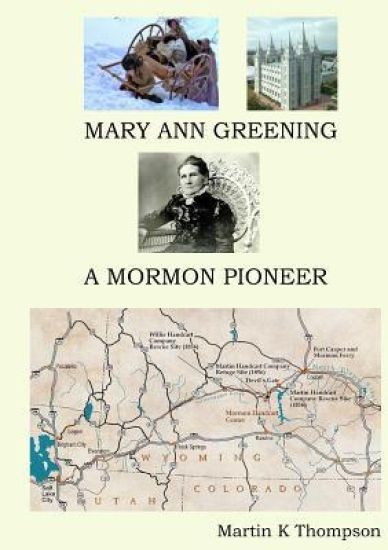
Mary Ann Greening - A Mormon Pioneer

Mary Ann Greening - A Mormon Pioneer

Martin K Thompson

Lulu.com
2017
pokkari
This biography brings together biographical sketches, extracts from journals, reminiscences and the author's own research to paint a vivid picture of the life and times of Mary Ann Greening (1829- 1914). Study of original parish registers revealed a number of errors in previously published work and these are discussed. Mary Ann Greening's upbringing within a large middle class family in Georgian and Victorian England, her conversion to Mormonism, travel to the United States, the incredibly arduous 1,000 mile trek to Salt Lake City with the ill-fated Martin Handcart Company, followed by a long life in Utah are all covered in some detail to make an enthralling story.
Mary Ann Shadd Cary

Mary Ann Shadd Cary

Jane Rhodes

INDIANA UNIVERSITY PRESS
2023
pokkari
Mary Ann Shadd Cary was a courageous and outspoken nineteenth-century African American who used the press and public speaking to fight slavery and oppression in the United States and Canada. Part of the small free black elite who used their education and limited freedoms to fight for the end of slavery and racial oppression, Shadd Cary is best known as the first African American woman to publish and edit a newspaper in North America. But her importance does not stop there. She was an active participant in many of the social and political movements that influenced nineteenth century abolition, black emigration and nationalism, women's rights, and temperance. Mary Ann Shadd Cary: The Black Press and Protest in the Nineteenth Century explores her remarkable life and offers a window on the free black experience, emergent black nationalisms, African American gender ideologies, and the formation of a black public sphere. This new edition contains a new epilogue and new photographs.
Mary Ann Omnibus (2)

Mary Ann Omnibus (2)

Catherine Cookson

TRANSWORLD PUBLISHERS LTD
2000
pokkari
Volume 2 opens with a seventeen-year-old Mary Ann struggling with the painful business of growing up as her first love, Corny Boyle, leaves for America. It follows her through her eventual marriage to Corny, and the joys and trials of being a wife, and a mother to six-year-old twins, Rose Mary and David.
Mary Ann in Autumn

Mary Ann in Autumn

Armistead Maupin

Transworld Publishers Ltd
2011
pokkari
Twenty years have passed since Mary Ann Singleton left her husband and child in San Francisco to pursue her dream of a television career in New York. Now, a pair of personal calamities has driven her back to the city of her youth and into the arms of her oldest friend, Michael "Mouse" Tolliver, a gay gardener.