Kirjahaku
Etsi kirjoja tekijän nimen, kirjan nimen tai ISBN:n perusteella.
1000 tulosta hakusanalla Mary Ann O'Farrell
This collection breaks new ground in the area of gender studies both because it creates a name for gender fantasy--virtual gender--that introduces a new understanding of the concept, and in expanding the idea of virtuality to include people and events in history. The essays in Virtual Gender help identify and name the persistent cultural desire for an imaginative space in which to "put on" alternative gender identities, while examining as well the equally persistent and consequent critique of that desire.The sweep of the volume's coverage is impressive, ranging across historical periods and academic disciplines, as contributors consider the place of the body in gender fantasy and the consequences of gender fantasy for real people and real bodies. The essays investigate figures and topics including Amelia Earhart, soap-opera chat groups, Elizabeth I, mesmerism, lesbianism in the early modern period, cybergames, women in the federalist period, the transgendered body, and performance art. Also examined are the status of embodiment, the origins of gender, gender politics, the pains of subjectivity, the uses of utopian fantasy, technological advances and information technology, the experience of gendered communities, and the role of gender in global politics.Contributors include Harriette Andreadis, Seyla Benhabib, Charlotte Canning, Bernice Hausman, Janel Mueller, Mary Ann O'Farrell, Kay Schaffer, Sidonie Smith, Carroll Smith-Rosenberg, Helen F. Thompson, Lynne Vallone, and Robyn Warhol. The book will appeal to an interdisciplinary audience of scholars, critics, and students with interests in gender, identity, and cyberculture.Mary Ann O'Farrell is Associate Professor of English, Texas A & M University. Lynne Vallone is Associate Professor of English, Texas A & M University.
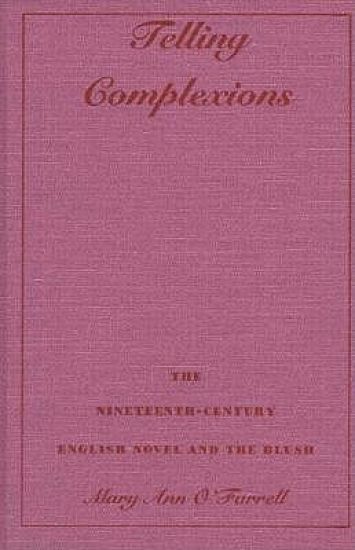
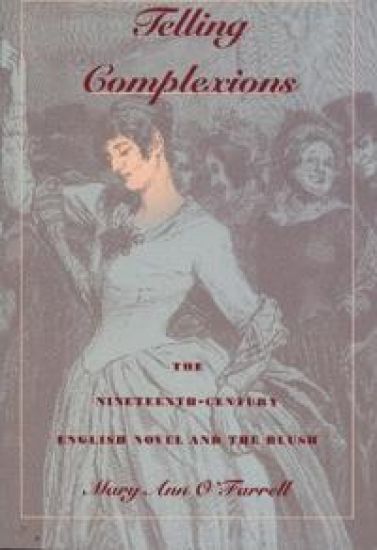
In Telling Complexions Mary Ann O’Farrell explores the frequent use of "the blush" in Victorian novels as a sign of characters’ inner emotions and desires. Through lively and textured readings of works by such writers as Jane Austen, Elizabeth Gaskell, Charles Dickens, and Henry James, O’Farrell illuminates literature’s relation to the body and the body’s place in culture. In the process, she plots a trajectory for the nineteenth-century novel’s shift from the practices of manners to the mode of self-consciousness. Although the blush was used to tell the truth of character and body, O’Farrell shows how it is actually undermined as a stable indicator of character in novels such as Pride and Prejudice, Persuasion, North and South, and David Copperfield. She reveals how these writers then moved on in search of other bodily indicators of mortification and desire, among them the swoon, the scar, and the blunder. Providing unique and creative insights into the constructedness of the body and its semiotic play in literature and in culture, Telling Complexions includes parallel examples of the blush in contemporary culture and describes ways that textualized bodies are sometimes imagined to resist the constraints imposed by such construction.
This annotated bibliography constitutes a thoroughly revised and more easily readable study of Behn's publications, of those edited or translated by her, of publications that included her works, and of writings ascribed to her, along with an annotated bibliography of over 1600 works about her from 1671 to 2001, with an unannotated update covering 2002. The augmented primary bibliography describes all known editions and issues of her works to 1702, and adds a catalogue of editions to 2002, including on-line sources. The secondary bibliography adds close to 1000 items published since 1984 to the original 600 of the first edition along with about 175 more from 1671 to 1984, with attention to materials not in English. New appendices include a list of dedicatees, actors, recent productions (with reviews), and provenances. This volume will be invaluable for book dealers, collectors and librarians, as well as students and scholars of Aphra Behn and of Restoration literature.
This work has been selected by scholars as being culturally important, and is part of the knowledge base of civilization as we know it. This work was reproduced from the original artifact, and remains as true to the original work as possible. Therefore, you will see the original copyright references, library stamps (as most of these works have been housed in our most important libraries around the world), and other notations in the work.This work is in the public domain in the United States of America, and possibly other nations. Within the United States, you may freely copy and distribute this work, as no entity (individual or corporate) has a copyright on the body of the work.As a reproduction of a historical artifact, this work may contain missing or blurred pages, poor pictures, errant marks, etc. Scholars believe, and we concur, that this work is important enough to be preserved, reproduced, and made generally available to the public. We appreciate your support of the preservation process, and thank you for being an important part of keeping this knowledge alive and relevant.
This is the tale of a young girl from Brooklyn who dared to live her dreams. Overcoming her fears and insecurities, she persevered. Her determination, strong faith and demanding work propelled her toward manifesting those dreams. A child of the 50s, teen of the 60s and a wife and working mother of the 70s, Mary Ann was a product of her time. She juggled her career and raised her small children while she and her husband Andy Beu participated in Broadway's biggest musical theatre sensation, A CHORUS LINE. In this memoir, Mary Ann takes us on a journey through the ups and downs of her early career... in show business -- sharing the process and glamour of being part of the iconic theatrical experience. Exposing her insecurities with honesty and humor she ushers the reader behind the scenes, through the nerve wracking auditions, the multi-company rehearsals at City Center and the excitement of opening nights and star-studded Hollywood parties. The drama builds as her health and integrity are challenged. Standing her ground as the pressure mounts, she and her husband Andy make a decision no one foresees.
This definitive collection brings together all papal encyclicals, bulls, and official pronouncements condemning Freemasonry from the eighteenth century to the modern era. An indispensable resource for scholars, clergy, and lay readers alike, it reveals the Church's unwavering stance across centuries against secret societies that threaten faith and order.
Developing Community-Empowered Schools
Burke Mary Ann; Picus Lawrence O.
Corwin Press Inc
2001
sidottu
As a result of over 20 years of experience in working with schools to increase parent and community involvement (and witnessing the outcomes), the authors of this book strongly believe that by empowering stakeholders at each school site, better decisions about educational programmes will result, thereby improving learning for all students. The eight chapters of this book develop an effective approach to the implementation of successful school, family, and community partnership activities. In the first chapters, the authors examine the components of a community-empowered school, identify the stakeholders in a school, and define the roles of each stakeholder, describing specifically what each group can do to help the school reach its academic and resource goals. Policies and procedures that support school and community relationships (including programme monitoring, supervision, and volunteer support) are put forth in Chapter Three. Chapter Four provides overheads, training worksheets, and sample memos from teachers to students' families - enough to support a one-day teacher-training workshop on the utilization of parents and community tutors or mentors in the classroom. Later chapters demonstrate how one should seek funding to sustain a school-based community programme, and explain how using the community as a school resource can provide a cost-effective solution to school finance. Finally, the authors illustrate how the community benefits - socially and economically - from a school-community partnership.
Developing Community-Empowered Schools
Burke Mary Ann; Picus Lawrence O.
Corwin Press Inc
2001
nidottu
As a result of over 20 years of experience in working with schools to increase parent and community involvement (and witnessing the outcomes), the authors of this book strongly believe that by empowering stakeholders at each school site, better decisions about educational programmes will result, thereby improving learning for all students. The eight chapters of this book develop an effective approach to the implementation of successful school, family, and community partnership activities. In the first chapters, the authors examine the components of a community-empowered school, identify the stakeholders in a school, and define the roles of each stakeholder, describing specifically what each group can do to help the school reach its academic and resource goals. Policies and procedures that support school and community relationships (including programme monitoring, supervision, and volunteer support) are put forth in Chapter Three. Chapter Four provides overheads, training worksheets, and sample memos from teachers to students' families - enough to support a one-day teacher-training workshop on the utilization of parents and community tutors or mentors in the classroom. Later chapters demonstrate how one should seek funding to sustain a school-based community programme, and explain how using the community as a school resource can provide a cost-effective solution to school finance. Finally, the authors illustrate how the community benefits - socially and economically - from a school-community partnership.
Leveraging Resources for Student Success
Burke Mary Ann; Baca Reynaldo; Picus Lawrence O.; Jones Cathy E.
Corwin Press Inc
2002
nidottu
Here is a book that challenges educators to put aside outmoded images of what is unlikely to push education far or fast enough to make a difference. Underlying each chapter is the belief and the 'how to' that allows for the development of a community culture that matches the changing condition of a changing society and student success' -Lee Mahon, Professor/Mentor, Doctoral Studies The Fielding Institute, Santa Barbara, CA Written in a user-friendly format, Leveraging Resources for Student Success highlights effective leadership strategies for decision-makers and educators at all levels. It offers visionary, yet realistic techniques for building a school culture, as well as policies and procedures that cater to and empower diverse students-resulting in enhanced student, teacher, and schoolwide performance. Special features of this definitive book include: - Invaluable work sheets and sample plans for easy self-evaluation and implementation - Specific "Survival Strategies" that have been successfully utilized in urban schools - Tips for cultivating and maximizing community relationships to obtain resources - Straightforward assessment methods to authentically measure change - Real-life examples of principal and teacher practices that have worked.
Federal Contracting Answer Book
Terrence M. O'Connor; Mary Ann P. Wangemann
Management Concepts, Inc
2009
sidottu
Thousands of contracting professionals have relied on the Federal Contracting Answer Book as their trusted guide to the highly regulated world of government procurement. In each edition the book has offered timely and accurate answers to the questions that arise daily in this complex field. Now in its third edition, this answer book is even more comprehensive. Written by experts who have extensive experience working in and teaching government contracting, the book includes all the latest changes and requirements. The question-and-answer format enables quick look-up and a concise presentation of the information. In this edition, new questions and answers have been added on avoiding proposal errors, debriefings, procurement vocabulary, regulatory changes, and best practices. In addition to these updates and revisions, the third edition includes new chapters on earned value management, GSA schedules, and contractor qualifications.
Loose Leaf for Principles of Environmental Science
William P. Cunningham; Mary Ann Cunningham; Catherine O'Reilly
McGraw-Hill Companies
2022
irtolehti
Principles of Environmental Science: Inquiry and Applications is perfect for the one-semester, non-majors environmental science course. True to its title, the goal of this concise text is to provide an up-to-date, introductory view of essential themes in environmental science along with offering students numerous opportunities to practice scientific thinking and active learning.
Organizational Learning Capability
Arthur K. Yeung; David O. Ulrich; Stephen W. Nason; Mary Ann Von Glinow
Oxford University Press Inc
1999
sidottu
Organizational learning matters now more than ever. In today's hypercompetitive business environment, successful executives must be able to discover opportunities, face problems, and pursue innovative ideas, then turn those ideas into action throughout an organization. Based on both empirical research and practice experience, this book gives managers the tools to do just that. Organizational learning capability is the capacity to generate and generalize ideas with impact. Managers generate new ideas in four basic ways: experimentation, in which organizations learn by trying many new products and processes; continuous improvement, in which they learn by constantly improving what they have done before and mastering each step in a process before moving on to other processes; knowledge acquisition, in which they learn by encouraging individuals and teams to acquire new knowledge continuously; and benchmarking, in which they learn by studying how other groups do things and trying to adapt their techniques. Each learning types leads to different performance consequences. Managers must also be able to generalize information through technology, movement of people, incentives, and learning processes. By both generating and generalizing ideas with impact, managers have a blueprint for making learning happen. Learning may not be sustained, however, unless it is congruent with the larger business context--the organization's strategy and culture and the industry's characteristics. Unfortunately, just as organizations develop learning capabilities, they also suffer from certain learning disabilities. This book outlines common disabilities and the means to overcome them. The authors assist practicing managers by providing several examples of successful and unsuccessful organizations and describing the ways in which they have helped organizations improve learning capability in their consulting practices. Based on detailed case studies, a review of past literature, and data gleaned from a worldwide survey of companies,Organizational Learning Capability is an accessible and useful guide for managers competing in the information economy. This book turns abstract ideas into practice, offers tools that managers can use, and presents a simple yet profound road map for making learning a reality.
Education in the Arts
Christine Sinclair; Neryl Jeanneret; John O'Toole; Mary Ann Hunter
OUP Australia and New Zealand
2017
nidottu
Grounded in theory and research, with links to teaching practice, Education in the Arts helps students apply what they are learning to new contexts, and encourages them to become reflective and mindful practitioners. Students can continue to use this book as they become practising teachers, drawing on how to implement the various arts practices in a school setting. Lecturer Resources: Additional case studies to use with your students.
Your Devotion, O Lord God, consists of many Spiritual Sayings between Almighty God, Jehovah, Christ Jesus, the Heaven sent King, and Barbara Ann Mary Mack, Almighty God's sent messenger and Prophetess. This book is written in the form of Poetry, which makes it easy for the reader to grasp its purpose. The Words of the Lord God Today.
Mother Elizabeth Ann Seton
Mary Coyle O'Neil; Helene Roederer Bailly De Barberey; John Mark Gannon
Literary Licensing, LLC
2012
nidottu