Kirjojen hintavertailu. Mukana 11 699 587 kirjaa ja 12 kauppaa.

Kirjahaku

Etsi kirjoja tekijän nimen, kirjan nimen tai ISBN:n perusteella.

1000 tulosta hakusanalla Mary L. Shannon

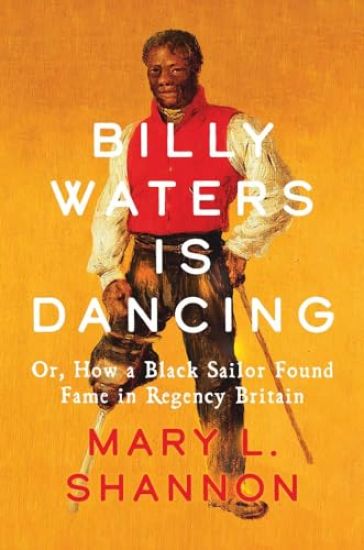
Billy Waters is Dancing

Billy Waters is Dancing

Mary L. Shannon

YALE UNIVERSITY PRESS
2024
sidottu
The story of William Waters, Black street performer in Regency London, and how his huge celebrity took on a life of its own Every child in Regency London knew Billy Waters, the celebrated “King of the Beggars.” Likely born into enslavement in 1770s New York, he became a Royal Navy sailor. After losing his leg in a fall from the rigging, the talented and irrepressible Waters became London’s most famous street performer. His extravagantly costumed image blazed across the stage and in print to an unprecedented degree. For all his contemporary renown, Waters died destitute in 1823—but his legend would live on for decades. Mary L. Shannon’s biography draws together surviving traces of Waters’ life to bring us closer to the historical figure underlying them. Considering Waters’ influence on the London stage and his echoing resonances in visual art, and writing by Douglass, Dickens, and Thackeray, Shannon asks us to reconsider Black presences in nineteenth-century popular culture. This is a vital attempt to recover a life from historical obscurity—and a fascinating account of what it meant to find fame in the Regency metropolis.
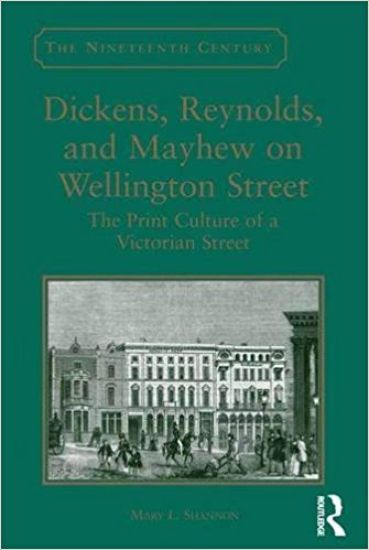
Dickens, Reynolds, and Mayhew on Wellington Street
A glance over the back pages of mid-nineteenth-century newspapers and periodicals published in London reveals that Wellington Street stands out among imprint addresses. Between 1843 and 1853, Household Words, Reynolds’s Weekly Newspaper, the Examiner, Punch, the Athenaeum, the Spectator, the Morning Post, and the serial edition of London Labour and the London Poor, to name a few, were all published from this short street off the Strand. Mary L. Shannon identifies, for the first time, the close proximity of the offices of Charles Dickens, G.W.M. Reynolds, and Henry Mayhew, examining the ramifications for the individual authors and for nineteenth-century publishing. What are the implications of Charles Dickens, his arch-competitor the radical publisher G.W.M. Reynolds, and Henry Mayhew being such close neighbours? Given that London was capital of more than Britain alone, what connections does Wellington Street reveal between London print networks and the print culture and networks of the wider empire? How might the editors’ experiences make us rethink the ways in which they and others addressed their anonymous readers as ’friends’, as if they were part of their immediate social network? As Shannon shows, readers in the London of the 1840s and '50s, despite advances in literacy, print technology, and communications, were not simply an ’imagined community’ of individuals who read in silent privacy, but active members of an imagined network that punctured the anonymity of the teeming city and even the empire.
Dickens, Reynolds, and Mayhew on Wellington Street
A glance over the back pages of mid-nineteenth-century newspapers and periodicals published in London reveals that Wellington Street stands out among imprint addresses. Between 1843 and 1853, Household Words, Reynolds’s Weekly Newspaper, the Examiner, Punch, the Athenaeum, the Spectator, the Morning Post, and the serial edition of London Labour and the London Poor, to name a few, were all published from this short street off the Strand. Mary L. Shannon identifies, for the first time, the close proximity of the offices of Charles Dickens, G.W.M. Reynolds, and Henry Mayhew, examining the ramifications for the individual authors and for nineteenth-century publishing. What are the implications of Charles Dickens, his arch-competitor the radical publisher G.W.M. Reynolds, and Henry Mayhew being such close neighbours? Given that London was capital of more than Britain alone, what connections does Wellington Street reveal between London print networks and the print culture and networks of the wider empire? How might the editors’ experiences make us rethink the ways in which they and others addressed their anonymous readers as ’friends’, as if they were part of their immediate social network? As Shannon shows, readers in the London of the 1840s and '50s, despite advances in literacy, print technology, and communications, were not simply an ’imagined community’ of individuals who read in silent privacy, but active members of an imagined network that punctured the anonymity of the teeming city and even the empire.