Kirjojen hintavertailu. Mukana 11 717 486 kirjaa ja 12 kauppaa.

Kirjahaku

Etsi kirjoja tekijän nimen, kirjan nimen tai ISBN:n perusteella.

1000 tulosta hakusanalla Mats Lundahl

Growth or Stagnation?

Growth or Stagnation?

Mats Lundahl

Routledge
2019
sidottu
First published in 1999, the essays collected in the present volume derive from an interest in South Africa and its economy which goes back to the early 1970s and were written between 1994 and 1999. The intention is to follow how the debate on the South African economy has evolved since the fall of the apartheid regime. Issues discussed include the South African economy after apartheid and whether the new South African economy is ultimately experienced growth or stagnation.
Growth or Stagnation?

Growth or Stagnation?

Mats Lundahl

Routledge
2020
nidottu
First published in 1999, the essays collected in the present volume derive from an interest in South Africa and its economy which goes back to the early 1970s and were written between 1994 and 1999. The intention is to follow how the debate on the South African economy has evolved since the fall of the apartheid regime. Issues discussed include the South African economy after apartheid and whether the new South African economy is ultimately experienced growth or stagnation.
Knut Wicksell on the Causes of Poverty and its Remedy
Knut Wicksell is arguably the greatest Swedish social scientist of all time, and poverty was a theme that occupied him all his life. Indeed, it was probably Wicksell's interest in poverty that was the critical factor in drawing him away from his purely mathematical background towards a greater understanding of the social sciences as a whole.In this outstanding volume, Mats Lundahl, one of the world's leading development economists, examines Wicksell's thinking in the area of poverty, and shows the importance of his contributions to this field.
Knut Wicksell on the Causes of Poverty and its Remedy
Knut Wicksell is arguably the greatest Swedish social scientist of all time, and poverty was a theme that occupied him all his life. Indeed, it was probably Wicksell's interest in poverty that was the critical factor in drawing him away from his purely mathematical background towards a greater understanding of the social sciences as a whole.In this outstanding volume, Mats Lundahl, one of the world's leading development economists, examines Wicksell's thinking in the area of poverty, and shows the importance of his contributions to this field.
The Political Economy of Disaster
Haiti, one of the least developed and most vulnerable nations in the Western Hemisphere, made the international headlines in January 2010 when an earthquake destroyed the capital, Port-au-Prince. More than a year later, little reconstruction has taken place, in spite of a strong international funding commitment. Mats Lundahl has written several seminal works on Haiti, and this volume brings together the best of his past work on Haiti’s economic and political history, along with a comprehensive introduction and two new chapters which bring the story right up to the present day. Together, the volume provides both historical background and explanation as to why Haiti was so badly affected by the earthquake, and to why reconstruction efforts have been ineffective this far. Lundahl argues that the two main causes can found in the interaction between the growth of the population and the destruction of the arable soil on the one hand, and in the creation of a predatory state during the nineteenth century, which still exists to this day. This book provides a comprehensive analysis, which charts these themes from the time of the arrival of Columbus in the island in 1492, to the present day. The book also deals with contemporary market and policy failures, as well as the crucial recent elections, and considers the path ahead for this impoverished nation.This book will be of huge relevance and interest not only to students and researchers in economic history, but also for all those working on development economics, development studies and American and Caribbean Studies more generally.
Themes in International Economics
First published in 1998, this collection of essays deals with four different areas of international economics: the theory of international trade, trade and development, protectionism and factor movements (notably migration and foreign aid). These themes explore the determinants of trade patterns, the relation between these patterns and those of underdevelopment and development, the failure of protectionism to increase welfare and, finally, the impact of emigration on the source country and that of foreign aid on the recipient country.
Themes in International Economics
First published in 1998, this collection of essays deals with four different areas of international economics: the theory of international trade, trade and development, protectionism and factor movements (notably migration and foreign aid). These themes explore the determinants of trade patterns, the relation between these patterns and those of underdevelopment and development, the failure of protectionism to increase welfare and, finally, the impact of emigration on the source country and that of foreign aid on the recipient country.
Peasants and Poverty (Routledge Revivals)
Haiti is a country which, until the earthquake of 2010, remained largely outside the focus of world interest and outside the important international historical currents during its existence as a free nation. The nineteenth century was the decisive period in Haitian history, serving to shape the class structure, the political tradition and the economic system. During most of this period, Haiti had little contact with both its immediate neighbours and the industrialised nations of the world, which led to the development of Haiti as a peasant nation. This title, first published in 1979, examines the factors responsible for the poverty of the Haitian peasant, by using both traditional economic models as well as a multidisciplinary approach incorporating economics and other branches of social science. The analysis deals primarily with the Haitian peasant economy from the early 1950s to the early 1970s, examining in depth the explanations for the secular tendency of rural per capita incomes to decline during this period.
Peasants and Poverty (Routledge Revivals)
Haiti is a country which, until the earthquake of 2010, remained largely outside the focus of world interest and outside the important international historical currents during its existence as a free nation. The nineteenth century was the decisive period in Haitian history, serving to shape the class structure, the political tradition and the economic system. During most of this period, Haiti had little contact with both its immediate neighbours and the industrialised nations of the world, which led to the development of Haiti as a peasant nation. This title, first published in 1979, examines the factors responsible for the poverty of the Haitian peasant, by using both traditional economic models as well as a multidisciplinary approach incorporating economics and other branches of social science. The analysis deals primarily with the Haitian peasant economy from the early 1950s to the early 1970s, examining in depth the explanations for the secular tendency of rural per capita incomes to decline during this period.
The Haitian Economy (Routledge Revivals)
Haiti is a very poor country with a stagnant economy. This title, first published in 1983, considers the Haitian economy, placing it in its historical context, and explores the reasons why it has performed so badly. Mats Lundahl examines agriculture, which has failed to provide an adequate standard of living, analyses the structure of agricultural production, and explains why the land is so unproductive. Lundahl analyses why technology in agriculture is so underdeveloped and argues that no government since 1820 has been seriously interested in fostering economic development, since vested interest consistently intervenes to discourage new projects.
The Haitian Economy (Routledge Revivals)
Haiti is a very poor country with a stagnant economy. This title, first published in 1983, considers the Haitian economy, placing it in its historical context, and explores the reasons why it has performed so badly. Mats Lundahl examines agriculture, which has failed to provide an adequate standard of living, analyses the structure of agricultural production, and explains why the land is so unproductive. Lundahl analyses why technology in agriculture is so underdeveloped and argues that no government since 1820 has been seriously interested in fostering economic development, since vested interest consistently intervenes to discourage new projects.
Incentives and Agriculture in East Africa (Routledge Revivals)
Agriculture is at the centre of the economies of many developing countries, and its stagnation and poor performance across large parts of Africa is a major cause for concern. First published in 1990, this book focuses on the nature and role of incentives in agricultural organization and production in East Africa, looking in particular at the political and ideological determinants of that role. Mats Lundahl analyses ways of improving agricultural performance, and considers the ‘African socialism’ of Julius Nyerere in contrast with the market-led approaches, which he favours. A detailed title, this volume will of interest to all those concerned with the issues of rural development, including students of development studies, economics, and African studies.
Incentives and Agriculture in East Africa (Routledge Revivals)
Agriculture is at the centre of the economies of many developing countries, and its stagnation and poor performance across large parts of Africa is a major cause for concern. First published in 1990, this book focuses on the nature and role of incentives in agricultural organization and production in East Africa, looking in particular at the political and ideological determinants of that role. Mats Lundahl analyses ways of improving agricultural performance, and considers the ‘African socialism’ of Julius Nyererein contrast with this with market-led approaches, which he favours. A detailed title, this volume will of interest to all those concerned with the issues of rural development, including students of development studies, economics, and African studies.
The Political Economy of Disaster
Haiti, one of the least developed and most vulnerable nations in the Western Hemisphere, made the international headlines in January 2010 when an earthquake destroyed the capital, Port-au-Prince. More than a year later, little reconstruction has taken place, in spite of a strong international funding commitment. Mats Lundahl has written several seminal works on Haiti, and this volume brings together the best of his past work on Haiti’s economic and political history, along with a comprehensive introduction and two new chapters which bring the story right up to the present day. Together, the volume provides both historical background and explanation as to why Haiti was so badly affected by the earthquake, and to why reconstruction efforts have been ineffective this far. Lundahl argues that the two main causes can found in the interaction between the growth of the population and the destruction of the arable soil on the one hand, and in the creation of a predatory state during the nineteenth century, which still exists to this day. This book provides a comprehensive analysis, which charts these themes from the time of the arrival of Columbus in the island in 1492, to the present day. The book also deals with contemporary market and policy failures, as well as the crucial recent elections, and considers the path ahead for this impoverished nation.This book will be of huge relevance and interest not only to students and researchers in economic history, but also for all those working on development economics, development studies and American and Caribbean Studies more generally.
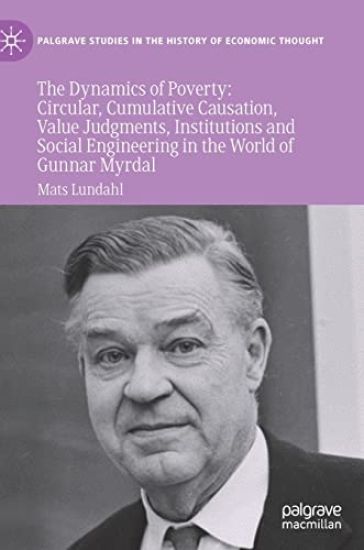
The Dynamics of Poverty

The Dynamics of Poverty

Mats Lundahl

Springer Nature Switzerland AG
2021
sidottu
This book examines Gunnar Myrdal’s analysis of poverty in relation to Sweden, the United States, South Asia, and the international economy. The chapters investigate Mrydal’s methodological development and his focus on the principle of circular and cummulative causation, dynamic economic analysis, institutional frameworks, value premises, and social engineering. The challenge of world poverty, the international dimension of poverty, and the legacy of The American Dilemma and Asian Drama are also discussed. This book aims to explore the development of Myrdal’s analysis of poverty during his life. It will be relevant to students and academics interested in the history of economic thought, development economics, the political economy, and labor economics.
The Dynamics of Poverty

The Dynamics of Poverty

Mats Lundahl

Springer Nature Switzerland AG
2022
nidottu
This book examines Gunnar Myrdal’s analysis of poverty in relation to Sweden, the United States, South Asia, and the international economy. The chapters investigate Mrydal’s methodological development and his focus on the principle of circular and cummulative causation, dynamic economic analysis, institutional frameworks, value premises, and social engineering. The challenge of world poverty, the international dimension of poverty, and the legacy of The American Dilemma and Asian Drama are also discussed. This book aims to explore the development of Myrdal’s analysis of poverty during his life. It will be relevant to students and academics interested in the history of economic thought, development economics, the political economy, and labor economics.
Twelve Figures in Swedish Economics

Twelve Figures in Swedish Economics

Mats Lundahl

Springer Nature Switzerland AG
2022
sidottu
This book explores the development of economic thought in Sweden through some of the people who shaped it. The book highlights both some of the well-known contributions and some overlooked areas of research. It begins with the origins of the pioneer neoclassical Heckscher-Ohlin theorem and Gunnar Myrdal ’s circular, cumulative approach to economic development. Secondly, it focuses on a number of economists related to the Industrial Institute of Economic and Social Research: Ingvar Svennilson, Axel Iveroth, Jan Wallander, Erik Höök, Villy Bergström and Rolf Henriksson. Finally, it offers portraits of three economists from Lund University: Bo Södersten, Ingemar Ståhl and Göte Hansson. The work of all of them is placed within the context of the contemporary academic and public economic debate. This book aims at providing a perspective on the legacy of the Swedish tradition in economics and will be relevant to students and academics interested in the history of economic thought.
Twelve Figures in Swedish Economics

Twelve Figures in Swedish Economics

Mats Lundahl

Springer Nature Switzerland AG
2023
nidottu
This book explores the development of economic thought in Sweden through some of the people who shaped it. The book highlights both some of the well-known contributions and some overlooked areas of research. It begins with the origins of the pioneer neoclassical Heckscher-Ohlin theorem and Gunnar Myrdal ’s circular, cumulative approach to economic development. Secondly, it focuses on a number of economists related to the Industrial Institute of Economic and Social Research: Ingvar Svennilson, Axel Iveroth, Jan Wallander, Erik Höök, Villy Bergström and Rolf Henriksson. Finally, it offers portraits of three economists from Lund University: Bo Södersten, Ingemar Ståhl and Göte Hansson. The work of all of them is placed within the context of the contemporary academic and public economic debate. This book aims at providing a perspective on the legacy of the Swedish tradition in economics and will be relevant to students and academics interested in the history of economic thought.
Bo Södersten from Left to Right

Bo Södersten from Left to Right

Mats Lundahl

Springer International Publishing AG
2022
sidottu
This book explores the economic work and legacy of Bo Södersten. While best known internationally for his textbook International Economics, Södersten’s influence stretches well beyond this. Through his academic work and newspaper articles, he covered a wide spectrum of topics that often challenged conventional wisdom. By examining his work on housing, the labor-managed economy, development economics, nuclear power, childcare, and higher education, a full view of his diverse work is presented. This book aims to provide insight into the motivations and impact of Bo Södersten during each phase of his life: his academic career, his political life, and his time as a debater-provocateur. It will be relevant to students and researchers interested in Swedish economics, the history of economic thought, and international economics.
Peasants and Religion

Peasants and Religion

Mats Lundahl; Jan Lundius

Routledge
1999
sidottu
This book examines the relationship between economics, politics and religion through the case of Olivorio Mateo and the religious movement he inspired from 1908 in the Dominican Republic. The authors explore how and why the new religion was formed, and why it was so successful. Comparing this case with other peasant movements, they show ways in which folk religion serves as a response to particular problems which arise in peasant societies during times of stress.